Highly SearchedFresh ConceptRising StarNext-GenFuturisticContinuous-fibre composite printing
FFiberSeek
FiberSeek
Compact row for standout or technology-specific features only.
# FibreSeeker 3
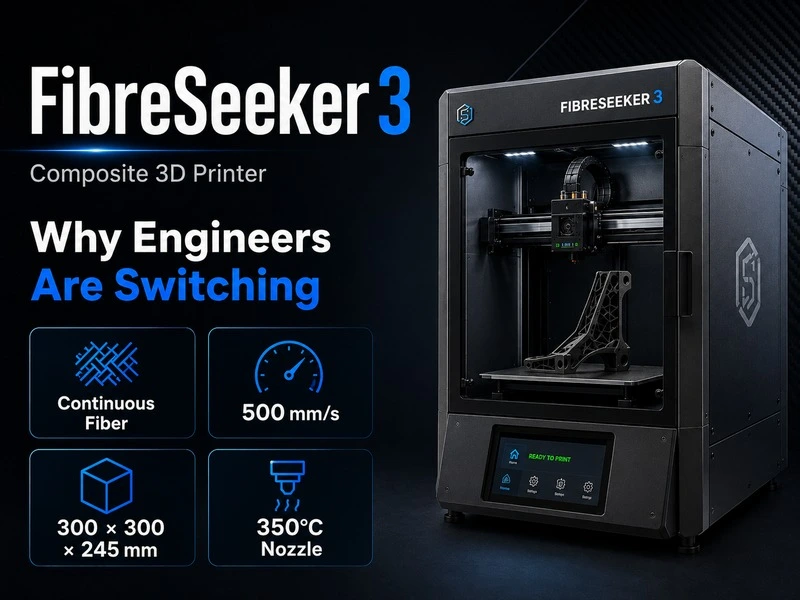
The FibreSeeker 3 is an enclosed desktop composite 3D printer that combines fused filament fabrication (FFF) with Composite Fibre Co-extrusion (CFC). Its two process paths support conventional thermoplastic printing and continuous-fibre reinforcement within the same part, allowing reinforcement to be placed where the print strategy requires it.
The printer provides a 300 × 300 × 245 mm build volume, fully automatic bed levelling, an actively heated chamber, a flexible high-temperature build plate, a built-in fibre cutter and sensors for both polymer and fibre material paths. FibreSeek's Rocket Slicer supports FFF and CFC print preparation, local file export and composite toolpath preview.
Important: The manufacturer states tensile strength of up to 900 MPa for specific continuous-fibre material systems and print configurations. This is not a universal part-strength value or an independent certification for every geometry, material combination or application.
| Specification | Value |
|---|---|
| Printing technology | Composite Fibre Co-extrusion and FFF |
| Build volume | 300 × 300 × 245 mm |
| Device dimensions | 615 × 595 × 540 mm |
| Device weight | 32 kg |
| Printing accuracy | ±0.2 mm |
| Minimum layer thickness | 50 microns |
| Hotend | All-metal |
| Nozzle material | Hardened steel |
| FFF nozzle diameter | 0.4 mm |
| CFC nozzle diameter | 0.7 mm |
| Maximum FFF nozzle temperature | 350°C |
| Maximum CFC nozzle temperature | 350°C |
| Maximum build-plate temperature | 120°C |
| Maximum chamber temperature | 65°C, actively heated |
| Maximum FFF speed | 500 mm/s |
| Maximum CFC throughput | 20 cc/h |
| Bed levelling | Fully automatic |
| Fibre cutter | Built in |
| Polymer filament diameter | 1.75 mm |
| Build-plate type | Flexible high-temperature base |
| Display | 5-inch touchscreen |
| Internal storage | 32 GB eMMC |
| Camera | Integrated 1920 × 1080 live-view camera |
| Slicer | Rocket Slicer |
| Supported operating systems | Windows 10 or later; macOS 10.15 or later |
| Supported model formats | STL, STP and 3MF |
| Electrical input | 90–132 V or 176–264 V AC, 50/60 Hz |
| Documented maximum power | 1,650 W at 110 V; 2,200 W at 220 V |
Note: The manufacturer expresses maximum CFC performance as volumetric throughput in cc/h rather than conventional linear print speed in mm/s.
Recommended use: Hygroscopic materials such as PETG, polycarbonate and PACF should be dried before printing and kept in sealed, dry storage during use.
Important: FibreSeek recommends official filaments for printing stability and quality. Third-party materials may require separately validated parameters and should not be assumed to work with every CFC material combination.
The FibreSeeker 3 uses Rocket Slicer for conventional FFF and continuous-fibre print preparation. The documented workflow supports STL, STP and 3MF models, composite toolpath preparation, print-file export and previewing print information before a job begins.
The printer provides a touchscreen interface, 32 GB of local storage, USB file access, Wi-Fi configuration, PC application control, remote monitoring and an integrated camera. Windows 10 or later and macOS 10.15 or later are documented host platforms.
The printer includes calibration and monitoring functions intended to support its FFF and CFC process paths.
| Feature | FFF Process Path | CFC Process Path | Combined Reinforcement Workflow |
|---|---|---|---|
| Primary function | Thermoplastic printing | Continuous-fibre co-extrusion | Polymer part with selected continuous-fibre reinforcement |
| Nozzle diameter | 0.4 mm | 0.7 mm | Uses both process paths as required |
| Maximum nozzle temperature | 350°C | 350°C | Up to 350°C for each nozzle |
| Published performance metric | Up to 500 mm/s | Up to 20 cc/h | Depends on material, geometry and reinforcement toolpath |
| Material feed | 1.75 mm FFF filament | CFC matrix material plus X-CCF or X-CGF | Polymer plus continuous fibre |
Note: The FFF and CFC performance figures use different measurement units and should not be treated as directly comparable speeds.
Recommended use: Select the FibreSeeker 3 for projects that require desktop FFF printing with strategically placed continuous carbon- or glass-fibre reinforcement. Validate the material combination, fibre path and final part performance for the intended load case before production use.
The FibreSeeker 3 combines Fused Filament Fabrication (FFF) with Composite Fibre Co-extrusion (CFC). This allows the printer to produce thermoplastic parts and place continuous-fibre reinforcement within selected areas of the same component.
The FibreSeeker 3 has a documented build volume of 300 × 300 × 245 mm, providing capacity for medium-sized composite parts, functional prototypes, tooling, jigs and fixtures.
The FibreSeeker 3 supports FibreSeek X-CCF continuous carbon fibre and X-CGF continuous glass fibre. Continuous-fibre printing should use approved fibre and matrix combinations or processing settings validated by FibreSeek.
The FibreSeeker 3 has a documented minimum layer thickness of 50 microns, equivalent to 0.05 mm. The appropriate layer setting will depend on the material, part geometry and selected printing process.
Yes. The FibreSeeker 3 has an actively heated build chamber with a documented maximum temperature of 65°C, along with a heated build plate rated up to 120°C.
The FibreSeeker 3 supports nozzle temperatures up to 350°C for both printing paths. It uses a 0.4 mm nozzle for FFF printing and a 0.7 mm nozzle for Composite Fibre Co-extrusion.