Intelligent DesignRising StarNext-GenFuturisticDual-nozzle multi-material printing
BBambu Lab
Bambu Lab
Compact row for standout or technology-specific features only.
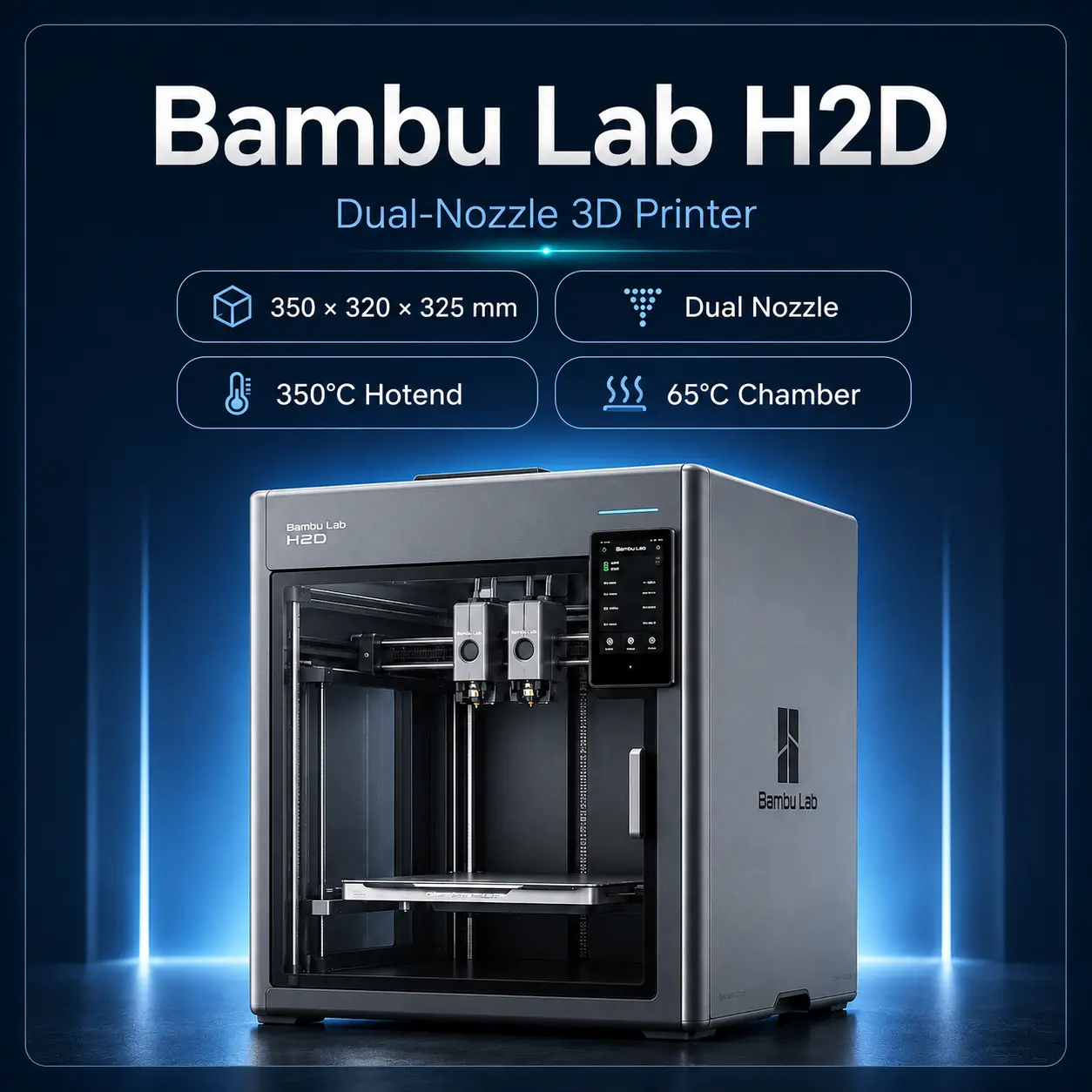
# Bambu Lab H2D
The Bambu Lab H2D is a high-performance enclosed dual-nozzle FDM 3D printer designed for professional prototyping, engineering materials, multi-material printing and demanding functional applications. It expands on Bambu Lab's desktop platform with a larger build area, independent dual-nozzle capability, higher-temperature material support and advanced monitoring and calibration systems.
The H2D provides up to 350 × 320 × 325 mm of total accessible printing space across both nozzles. A single nozzle provides a 325 × 320 × 325 mm printable volume, while the shared dual-nozzle printable area is 300 × 320 × 325 mm. Its 350°C hotends, 120°C heated bed and actively heated 65°C chamber support a broad range of standard and engineering-grade materials.
| Specification | Value |
|---|---|
| Printing technology | FDM / FFF |
| Extrusion system | Dual nozzle |
| Maximum total accessible print space | 350 × 320 × 325 mm |
| Single-nozzle build volume | 325 × 320 × 325 mm |
| Shared dual-nozzle build volume | 300 × 320 × 325 mm |
| Maximum toolhead speed | 1,000 mm/s |
| Maximum nozzle temperature | 350°C |
| Maximum bed temperature | 120°C |
| Chamber heating | Active, up to 65°C |
| Standard nozzle | 0.4 mm hardened steel |
| Filament diameter | 1.75 mm |
| Software | Bambu Studio |
| Connectivity | Wi-Fi and USB storage |
| Printer dimensions | 492 × 514 × 626 mm |
| Net weight | 31 kg |
Note: The 350 × 320 × 325 mm figure represents the total accessible printing space across both nozzles. Bambu Lab states that using the full 350 mm total width requires identical filaments in both nozzles and printing with both nozzles. Single-nozzle printable volume is 325 × 320 × 325 mm, while the shared dual-nozzle printable volume is 300 × 320 × 325 mm.
Recommended use: The actively heated chamber and 350°C hotends make the H2D suitable for engineering-grade and reinforced thermoplastics when appropriate material profiles, nozzle configurations and drying practices are used.
The H2D uses two independently controlled hotends to support multi-material printing, dedicated support materials and more efficient multi-color workflows. It can also integrate with Bambu Lab's AMS 2 Pro and AMS HT material-management systems for automated filament handling, storage and drying.
Important: AMS compatibility depends on the specific filament. Highly flexible or abrasive materials may require the appropriate AMS configuration or bypass feeding path.
The Bambu Lab H2D is the most advanced option among the Bambu Lab A1, Bambu Lab P2S, and H2D. It adds a larger build area, dual-nozzle printing, higher temperatures and an actively heated chamber, making it better suited to demanding engineering and multi-material workflows.
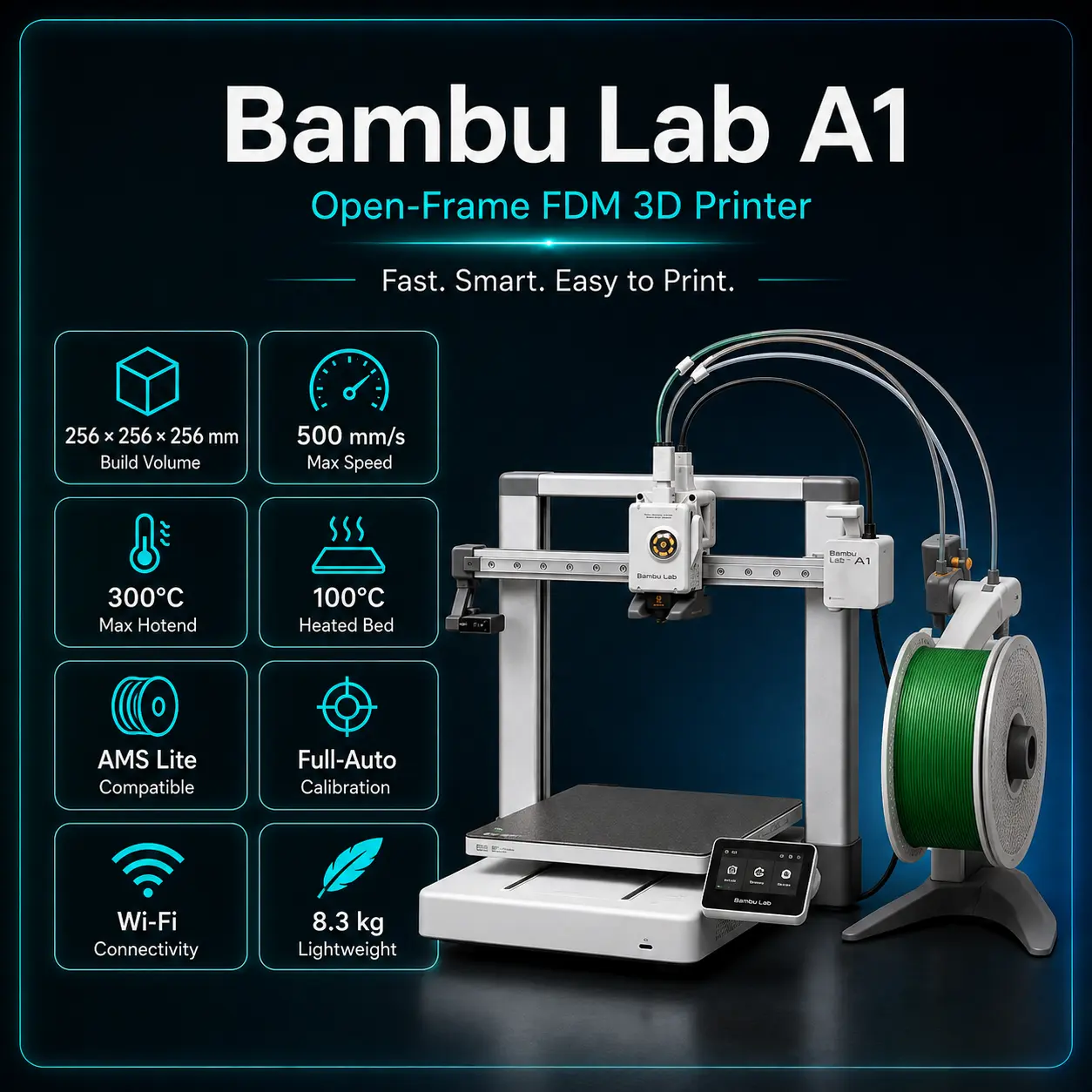
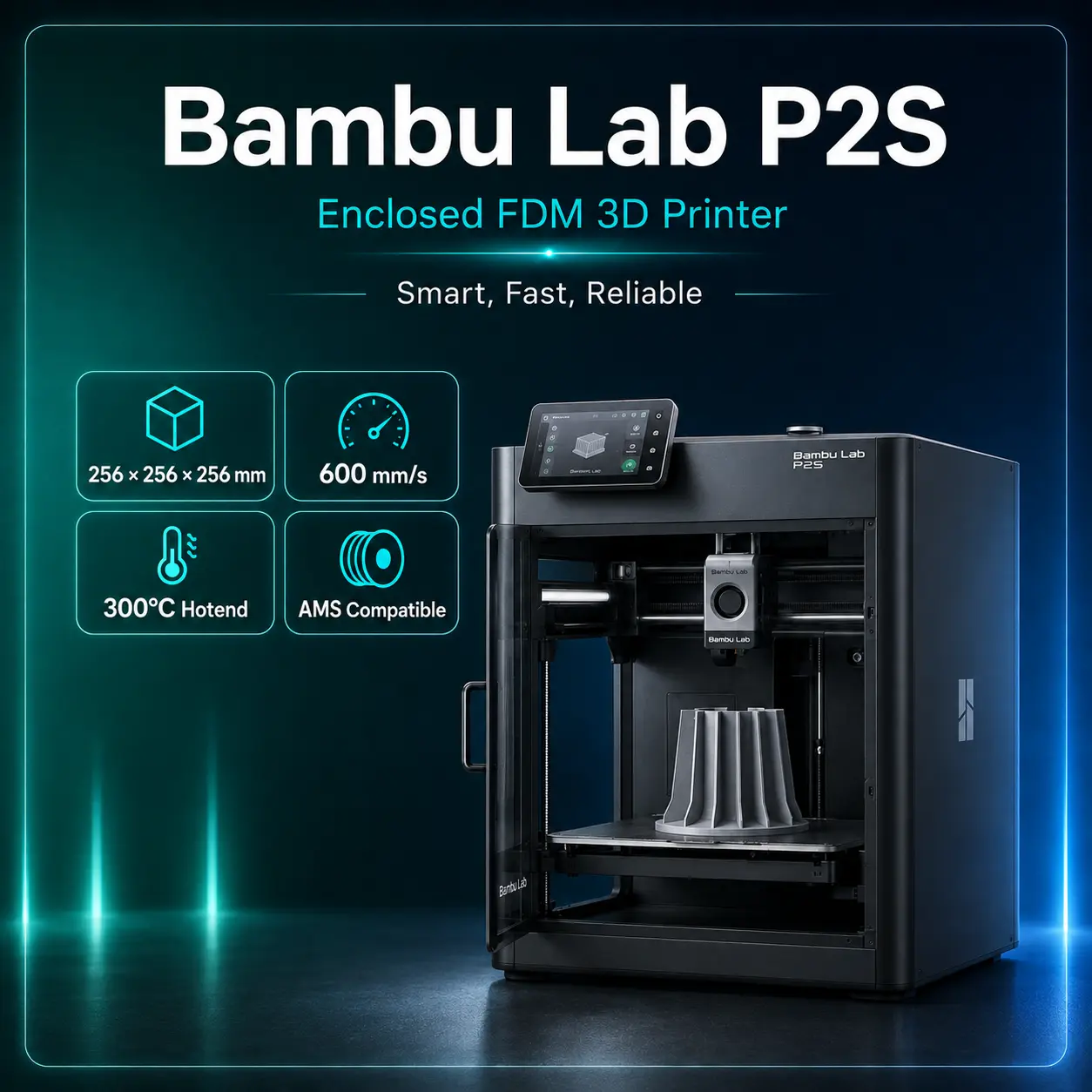
| Feature | Bambu Lab A1 | Bambu Lab P2S | Bambu Lab H2D |
|---|---|---|---|
| Printer design | Open frame | Enclosed | Enclosed |
| Build volume | 256 × 256 × 256 mm | 256 × 256 × 256 mm | Up to 350 × 320 × 325 mm total accessible space |
| Extrusion system | Single nozzle | Single nozzle | Dual nozzle |
| Maximum toolhead speed | 500 mm/s | 600 mm/s | 1,000 mm/s |
| Maximum nozzle temperature | 300°C | 300°C | 350°C |
| Maximum bed temperature | 100°C | 110°C | 120°C |
| Active chamber heating | No | No | Yes, up to 65°C |
| Multi-material system | AMS lite | AMS ecosystem | Dual-nozzle plus AMS ecosystem |
| Engineering-material capability | Limited by open-frame design | Broader engineering-material support | Advanced engineering-material support |
| Reinforced-material support | Not generally recommended | Supported for compatible material families | Broad support for compatible reinforced materials |
| Automatic calibration | Yes | Yes | Yes |
| Best suited for | Hobby, education and multi-color printing | Functional parts and enclosed desktop engineering | Professional prototyping, advanced multi-material and engineering workflows |
Recommended use: Choose the Bambu Lab A1 for accessible everyday and multi-color printing. Choose the Bambu Lab P2S for enclosed desktop printing with broader engineering-material capability. Choose the Bambu Lab H2D when you need dual nozzles, a larger build area, higher processing temperatures and active chamber heating.
Recommended use: The H2D is best suited to users who need advanced dual-material capability, engineering-material support and a larger enclosed build platform without moving to a traditional industrial 3D printer.
Single-nozzle printing provides 325 × 320 × 325 mm, the shared dual-nozzle printable area is 300 × 320 × 325 mm, and the total accessible volume across both nozzles is up to 350 × 320 × 325 mm.
Yes. The Bambu Lab H2D uses a dual-nozzle system designed for multi-material, multi-color and dedicated support-material printing.
The Bambu Lab H2D supports nozzle temperatures up to 350°C.
Yes. The Bambu Lab H2D has an actively heated chamber with a maximum specified temperature of 65°C.
The Bambu Lab H2D supports common materials such as PLA and PETG as well as engineering polymers and a range of carbon- and glass-fibre-reinforced material families.
Bambu Lab specifies a maximum toolhead speed of 1,000 mm/s. This is a toolhead-speed specification rather than a guaranteed printing speed, and actual print speed depends on the material, geometry, flow rate and print settings.
No. Laser functionality belongs to the H2D Laser configurations or can be added using a compatible H2D Laser Upgrade Kit.
Bambu Studio is the primary slicer for the Bambu Lab H2D. The printer also integrates with the Bambu Handy ecosystem.