User ChoiceIntelligent DesignRising StarAutomated enclosed printing
BBambu Lab
Bambu Lab
Compact row for standout or technology-specific features only.
# Bambu Lab P2S
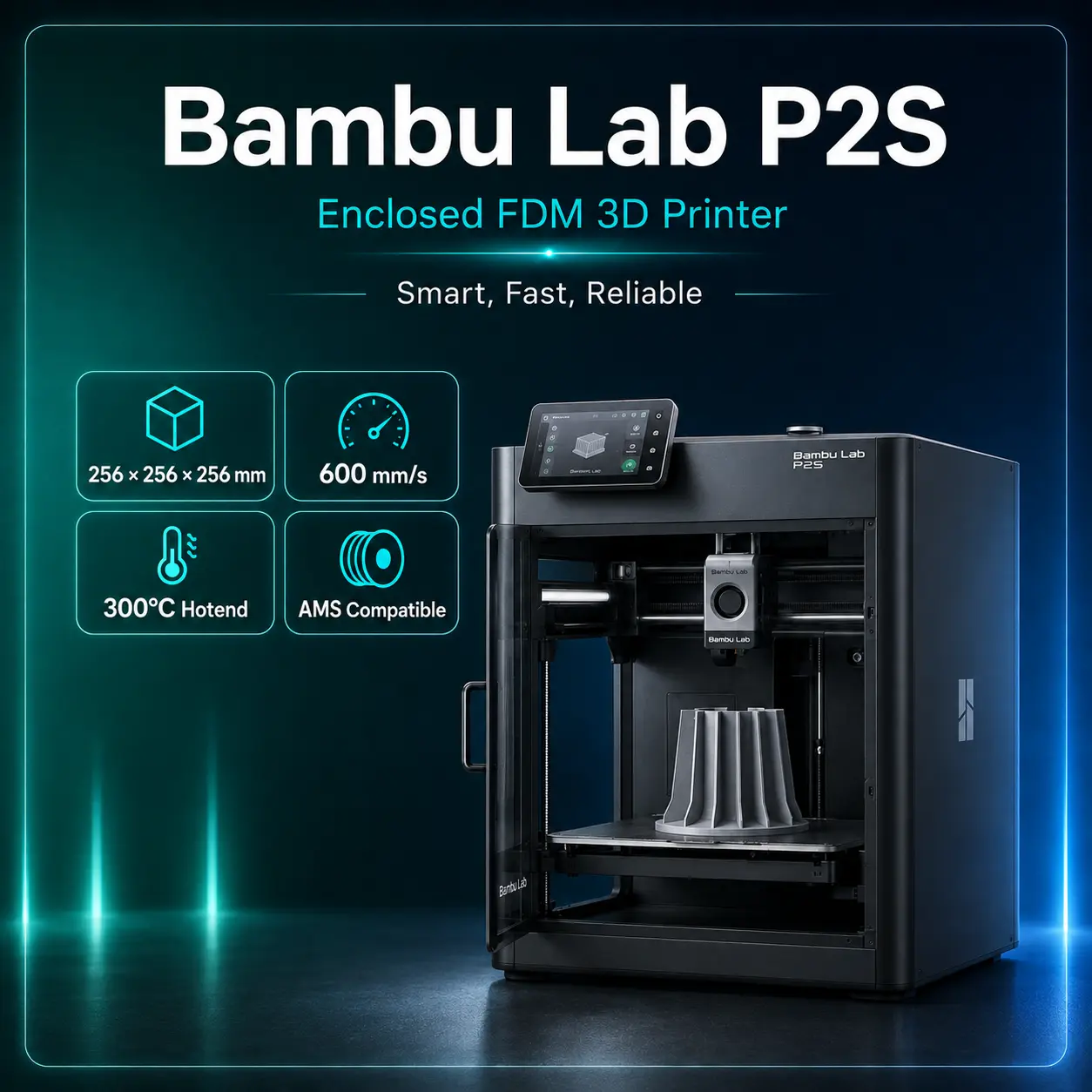
The Bambu Lab P2S is an enclosed desktop FDM 3D printer designed for fast, automated and reliable everyday printing. It builds on the P-Series platform with upgraded extrusion control, improved monitoring, easier nozzle changes and a modern touchscreen interface.
With a 256 × 256 × 256 mm build volume, 300°C hotend and enclosed chamber, the P2S supports common materials as well as a range of engineering and fiber-reinforced filaments. It can also integrate with Bambu Lab's AMS systems for automated multi-color and multi-material workflows.
| Specification | Value |
|---|---|
| Printing technology | FDM / FFF |
| Build volume | 256 × 256 × 256 mm |
| Extrusion | Single nozzle |
| Standard nozzle | 0.4 mm |
| Maximum print speed | 600 mm/s |
| Maximum nozzle temperature | 300°C |
| Maximum bed temperature | 110°C |
| Chamber | Fully enclosed |
| Active chamber heating | No |
| Display | 5-inch touchscreen |
| Camera | 1080p monitoring camera |
| Software | Bambu Studio |
| Multi-material support | AMS compatible |
Note: Maximum advertised motion speed does not represent the speed used for every part or material. Actual print speed varies with geometry, filament, flow limits and quality settings.
Recommended use: Engineering and reinforced materials should be properly dried and printed using suitable nozzle, plate and material profiles.
Important: The P2S is enclosed but does not include active chamber heating, so very demanding high-temperature polymers may be better suited to a printer with controlled chamber heating.
The P2S combines automatic calibration with active extrusion monitoring to simplify setup and improve consistency. Its PMSM servo extruder monitors extrusion behavior, while automatic flow-dynamics calibration adjusts material flow for improved print quality.
The P2S is compatible with Bambu Lab's AMS ecosystem for automated filament switching, multi-color printing and multi-material workflows. The P2S Combo includes the AMS 2 Pro, which also provides filament drying and storage functionality.
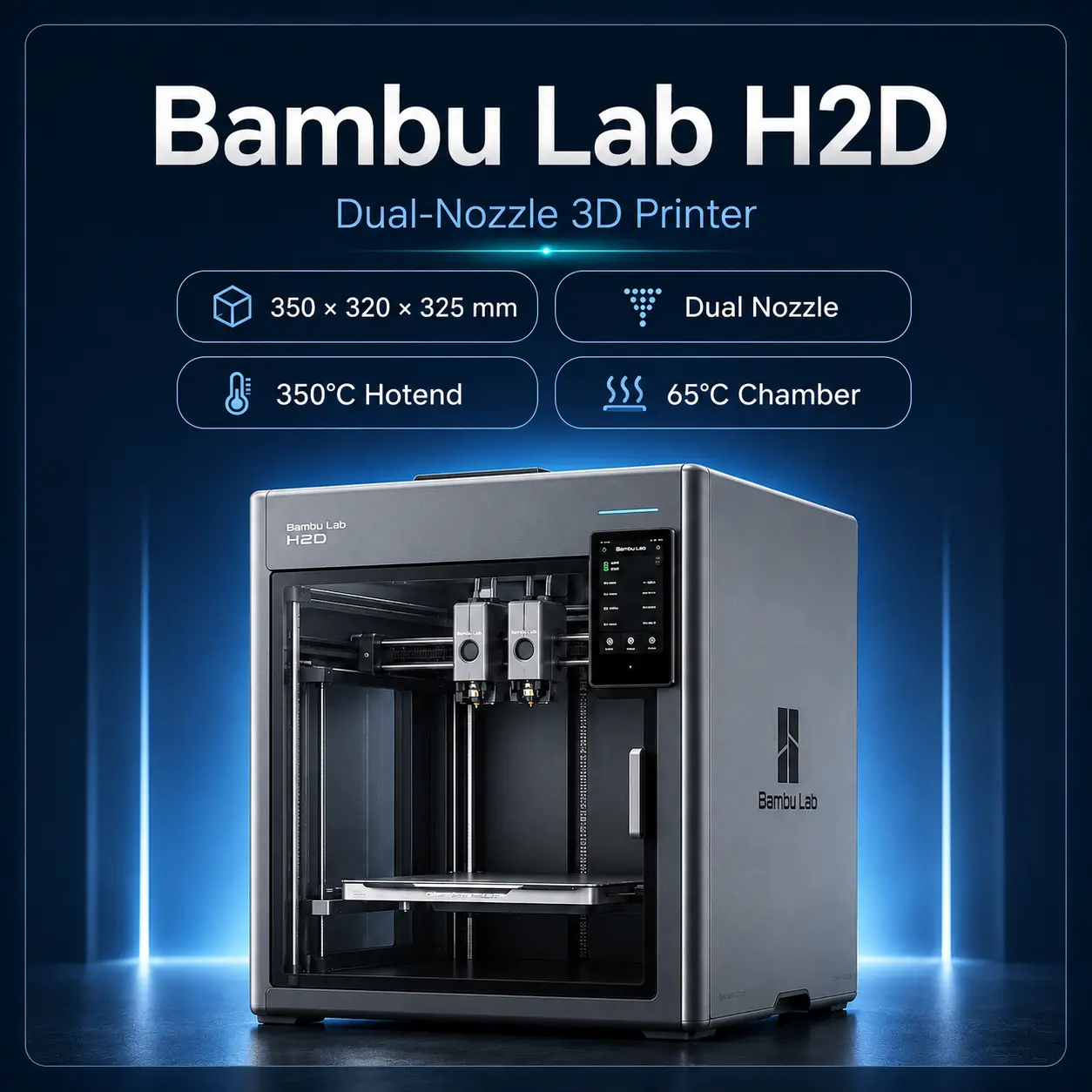
The Bambu Lab P2S sits between the more accessible Bambu Lab A1 and the larger, more advanced Bambu Lab H2D. The P2S keeps the compact 256 × 256 × 256 mm build volume of the A1 but adds an enclosed chamber and broader engineering-material capability, while the H2D moves further toward professional use with dual nozzles, a larger build area and an actively heated chamber.
| Feature | Bambu Lab A1 | Bambu Lab P2S | Bambu Lab H2D |
|---|---|---|---|
| Printer design | Open frame | Enclosed | Enclosed |
| Build volume | 256 × 256 × 256 mm | 256 × 256 × 256 mm | Up to 350 × 320 × 325 mm total accessible space |
| Extrusion system | Single nozzle | Single nozzle | Dual nozzle |
| Maximum toolhead speed | 500 mm/s | 600 mm/s | 1,000 mm/s |
| Maximum nozzle temperature | 300°C | 300°C | 350°C |
| Maximum bed temperature | 100°C | 110°C | 120°C |
| Active chamber heating | No | No | Yes, up to 65°C |
| Multi-material system | AMS lite | AMS ecosystem | Dual-nozzle plus AMS ecosystem |
| Engineering-material capability | Limited by open-frame design | Broader engineering-material support | Advanced engineering and reinforced-material support |
| Reinforced-material support | Not generally recommended | Supported for compatible material families | Broad support for compatible reinforced materials |
| Automatic calibration | Yes | Yes | Yes |
| Best suited for | Hobby, education and multi-color printing | Functional parts, engineering and enclosed desktop printing | Advanced engineering, multi-material and professional workflows |
Recommended use: Choose the Bambu Lab A1 for affordable automated printing and AMS lite multi-color workflows. Choose the Bambu Lab P2S when an enclosed chamber and broader engineering-material support are important. Consider the Bambu Lab H2D when you need dual-nozzle printing, a larger build area, higher temperatures and active chamber heating.
Recommended use: The P2S is well suited to users who want a compact enclosed printer with strong automation, fast printing and flexible material support without moving into a larger professional or industrial platform.
The P2S has a 256 × 256 × 256 mm build volume.
The P2S supports nozzle temperatures up to 300°C.
No. It has a fully enclosed chamber but does not use active chamber heating.
It supports common materials such as PLA, PETG and TPU, as well as ABS, ASA and several engineering and fiber-reinforced polymers.
Yes. Multi-color and multi-material printing is available when the printer is connected to a compatible Bambu Lab AMS system.
Bambu Studio is the primary slicing and printer-management software.
Yes. It includes automatic calibration functions for bed setup, motion and extrusion flow.
Yes. Its enclosure, hardened extrusion components and broad material compatibility make it suitable for prototypes, functional components and many engineering applications.