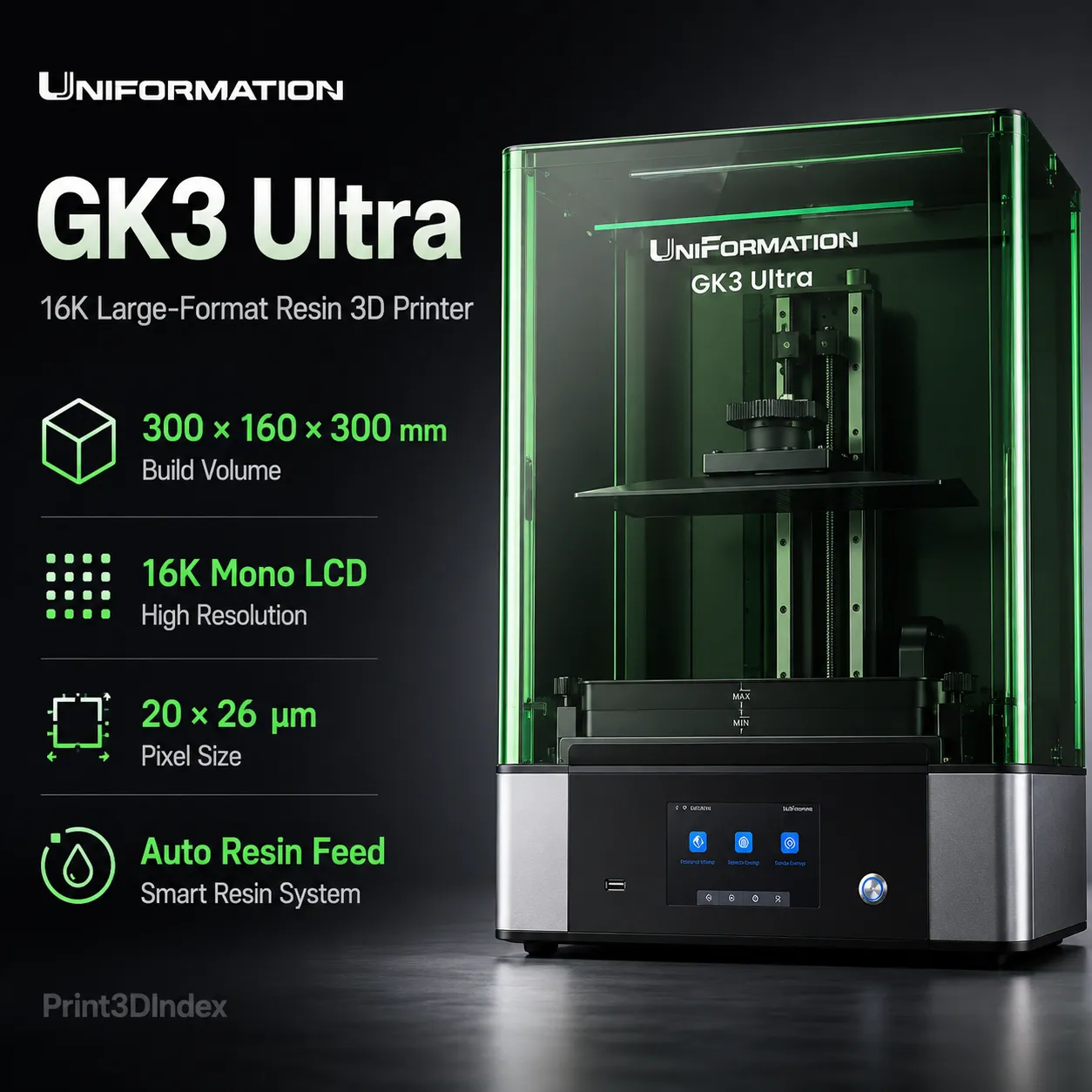
Large-Format 16K Printing20 × 26 μm Pixel DetailAutomatic Resin FeedingSmart Resin HeatingIndustrial KK60 Z-AxisIntegrated Air Purification
UUniFormation
UniFormation
# UniFormation GK3 Ultra
The UniFormation GK3 Ultra is a large-format 16K MSLA resin 3D printer aimed at studios, model makers, prototyping teams, and production users who need substantially more build capacity than a typical desktop resin machine without giving up fine XY sampling.
Its 300 × 160 × 300 mm build volume is paired with a 13.5-inch 16K monochrome LCD at 15120 × 6230 pixels, producing a rectangular 20 × 26 µm XY pixel pitch. That combination makes the GK3 Ultra especially useful for large statues, props, display models, engineering prototypes, and dense batches of smaller parts.
UniFormation also focuses heavily on workflow. The GK3 Ultra includes automatic resin feeding, selectable 25°C / 30°C resin heating, a factory-calibrated quick-release build platform, an industrial-grade KK60 Z-axis motion module, built-in lighting, a resin drip hanger, USB/Wi-Fi/Ethernet transfer, and an integrated activated-carbon air-purification system.
The current official store lists the GK3 Ultra at US$1,309.99, reduced from US$1,399.99, with the printer available to add to cart. UniFormation currently advertises local-stock delivery in about 5–7 business days for several supported regions.
For current specifications and pricing, see the official UniFormation GK3 Ultra page. For broader buying guidance, see Best Large-Format Resin 3D Printers in 2026 and Best Resin 3D Printers for Miniatures in 2026.
| Specification | Value |
|---|---|
| Printing technology | MSLA / LCD resin |
| Light wavelength | 405 nm |
| Build volume | 300 × 160 × 300 mm |
| Screen | 13.5-inch 16K monochrome LCD |
| Screen dimensions | 302.4 × 161.98 mm |
| LCD resolution | 15120 × 6230 |
| XY pixel pitch | 20 × 26 µm |
| Layer thickness | 0.03–0.05 mm |
| Exposure time | Approx. 2–3 s/layer at 0.05 mm |
| Z-axis | Industrial-grade KK60 motion module |
| Resin vat capacity | 1000 ml |
| External resin container | 1.2 kg |
| Automatic resin feed | Yes |
| Resin-level detection | Yes |
| Overflow protection | Yes |
| Resin heating | 25°C / 30°C selectable |
| Build platform | Quick-release, factory calibrated |
| Air filtration | Integrated activated-carbon purification system |
| Built-in lighting | Yes |
| Touchscreen | 5-inch capacitive |
| Connectivity | USB / Wi-Fi / Ethernet |
| Slicing software | UniFormation Slicer / CHITUBOX / Lychee |
| Input formats | STL / OBJ in current UniFormation family comparison |
| Product dimensions | 455 × 400 × 575 mm |
| Gross weight | 35 kg |
| Input voltage | 100–240 V |
| Published power | Up to 200 W |
| Warranty | 1 year |
Resolution note: The 20 × 26 µm figure is the XY pixel pitch of the exposure panel. It is not a guaranteed ±20 or ±26 µm dimensional tolerance for finished parts.
The GK3 Ultra combines the same 15120 × 6230 headline pixel count seen on smaller 16K printers with a much larger physical panel.
That means the individual pixels are larger than on a compact 16K machine. The GK3 Ultra's 20 × 26 µm XY pitch is still very fine for a 300 mm-class resin platform, but buyers should compare physical pixel size rather than the "16K" label alone.
The large area suits statues, prototypes, molds, and miniature batches. For studios, the advantage is often not one enormous model but more successful parts per build cycle.
GK3 Ultra uses rectangular pixels, so its XY values are different on the two axes.
Pixel pitch describes the imaging system, while finished dimensions also depend on resin chemistry, exposure, orientation, supports, release behavior, temperature, shrinkage, washing, and post-curing. Smaller nominal pixels do not automatically mean better real-world dimensional accuracy.
Large builds can consume substantial resin, so the GK3 Ultra includes an automatic feed system connected to a 1.2 kg external resin container.
UniFormation lists:
This reduces the need to manually top up the vat during long builds.
The system automatically feeds resin but does not provide two-way resin recycling.
The GK3 Ultra provides two selectable resin-temperature targets:
Heating can improve resin flow and release consistency in cooler environments, particularly with more viscous formulations.
The heater controls the resin process rather than the entire printer enclosure. The correct target still depends on the material, so users should follow the resin manufacturer's recommendations rather than assuming 30°C is ideal for every formulation.
UniFormation describes the GK3 Ultra as using an industrial-grade KK60 motion module for the Z axis.
The goal is to maintain rigidity and repeatable vertical movement across a much larger build platform than the company's smaller GK3 models.
Large resin plates can carry significant peel loads, especially with broad cross-sections. Z-axis stiffness, support strategy, part orientation, and release-film condition therefore matter more as model size increases.
The build platform is factory calibrated.
UniFormation's current FAQ still recommends checking leveling after:
The printer should therefore be described as factory calibrated, not as a self-leveling or permanently leveling-free system.
The GK3 Ultra includes internal recirculating air purification with an activated-carbon filter and dedicated fan to help reduce resin odor.
An activated-carbon filter is not a substitute for appropriate room ventilation, gloves, eye protection, safe resin handling, and the resin manufacturer's safety data sheet.
UniFormation lists these main resin families for GK3 Ultra:
The current official page also lists multiple colors within its Standard and ABS resin ranges.
Third-party 405 nm materials may work, but exposure should be calibrated for the exact resin, color, layer height, and release settings.
The fine XY pitch and large plate can be useful for jewelry models, masters, dental models, and batch production.
However, castable jewelry work requires a resin formulated for burnout, while intraoral or biocompatible dental applications require a validated material and compliant process. Printer resolution alone does not establish medical or casting suitability.
A larger resin printer also creates a larger post-processing workflow.
Typical steps include:
UniFormation's built-in drip hanger helps with the first part of that process, but users still need washing and curing equipment large enough for 300 mm-class prints.
Large failures can consume substantial resin, so hollowing, drainage, supports, and exposure calibration matter financially as well as technically.
| Printer | Build Volume | XY Pixel / Process Value | Layer Range | Resin Heating | Resin Automation | Main Positioning |
|---|---|---|---|---|---|---|
| UniFormation GK3 Ultra | 300 × 160 × 300 mm | 20 × 26 µm | 0.03–0.05 mm | 25 / 30°C | Auto feed | 16K studio / batch platform |
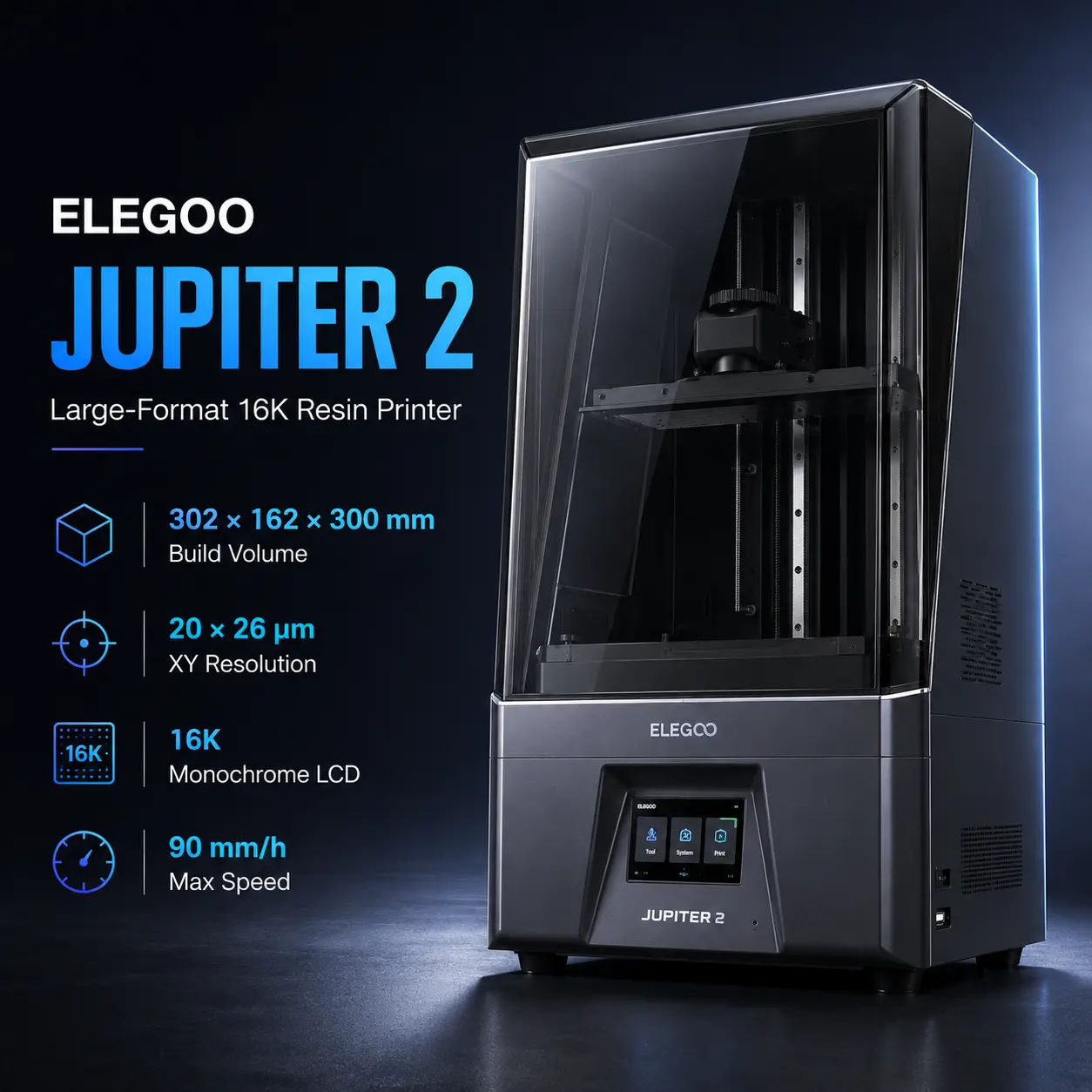
| ELEGOO Jupiter 2 | 302 × 162 × 300 mm | 20 × 26 µm | 0.01–0.20 mm | 30°C target | Auto feed + recycling | Closest direct large-format rival |
| Formlabs Form 4L | 353 × 196 × 350 mm | 46 µm pixel | 0.025–0.20 mm | Material-specific | Dual-cartridge auto dispensing | Professional production ecosystem |
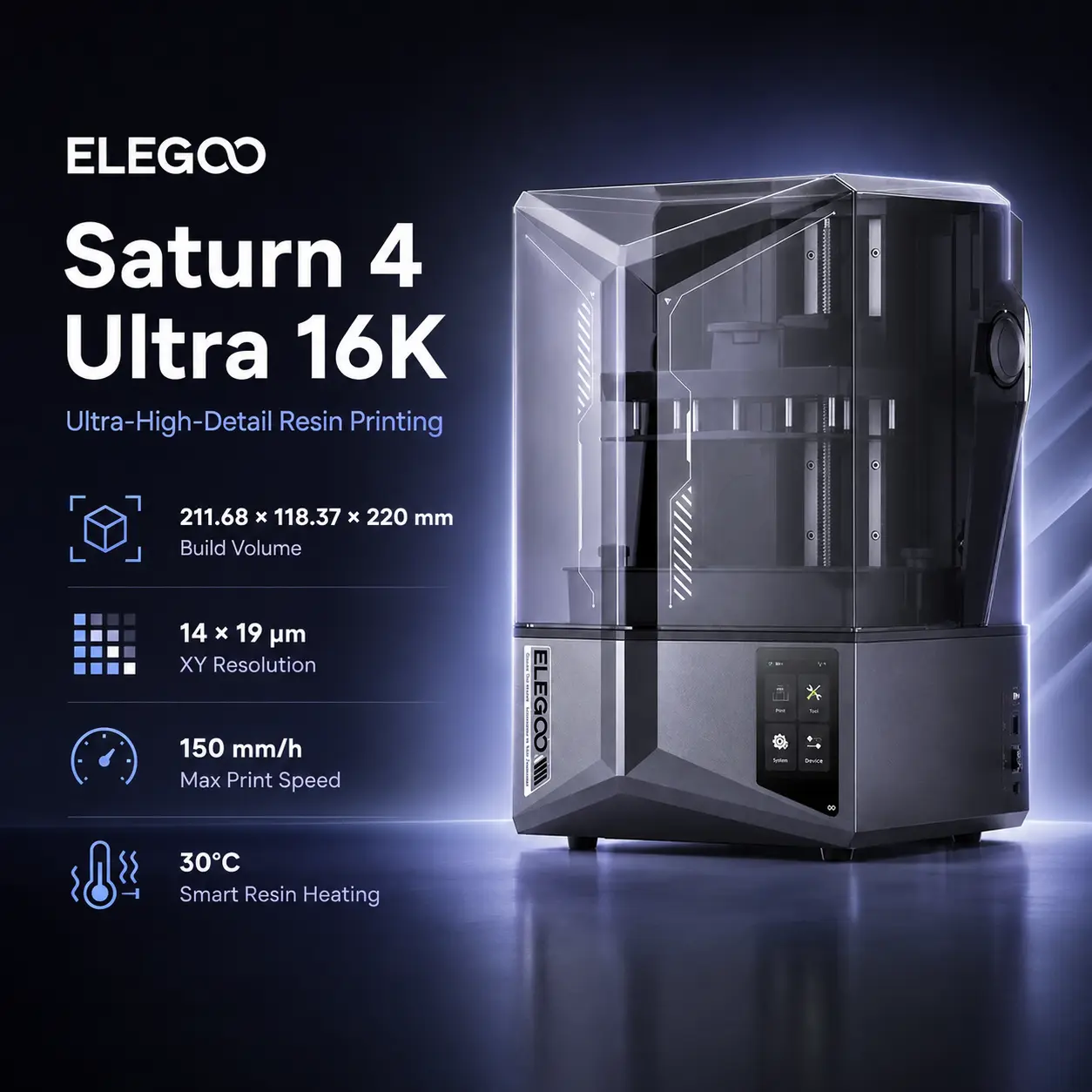
| ELEGOO Saturn 4 Ultra 16K | 211.68 × 118.37 × 220 mm | 14 × 19 µm | 0.01–0.20 mm | 30°C target | Level/residue sensing | Smaller, faster high-detail option |
| UniFormation GK3 Pro | 211 × 118 × 240 mm | 14 × 19 µm | 0.03 / 0.05 / 0.10 mm family spec | 25 / 30°C | Auto feed | Smaller 385 nm precision model |
The closest specification match is Jupiter 2: both use 16K panels at roughly 20 × 26 µm across a 300 mm-class build volume. Form 4L targets a much more expensive professional workflow, while Saturn 4 Ultra 16K and GK3 Pro trade build capacity for finer nominal pixel dimensions.
The UniFormation GK3 Ultra vs ELEGOO Jupiter 2 comparison is the most direct large-format 16K matchup.
The indexed ELEGOO Jupiter 2 provides a 302 × 162 × 300 mm build volume, 15120 × 6230 16K screen, and the same nominal 20 × 26 µm XY pixel pitch.
Jupiter 2 adds:
GK3 Ultra counters with its studio-oriented KK60 Z-axis, factory-calibrated quick-release platform, integrated activated-carbon purification, resin drip hanger, and UniFormation's familiar open slicer support.
Current US pricing also favors Jupiter 2 at roughly US$1,011 versus US$1,309.99 for GK3 Ultra.
Choose Jupiter 2 for automatic leveling, camera monitoring, resin recycling, and lower current price. Choose GK3 Ultra for its KK60 motion platform, integrated purifier, and UniFormation workflow.
See the official ELEGOO Jupiter 2 page for current manufacturer specifications.
The GK3 Ultra vs GK3 Pro comparison is primarily large build capacity versus finer small-format XY sampling.
The official UniFormation GK3 Pro provides a 211 × 118 × 240 mm build volume, the same 15120 × 6230 pixel count, but a finer 14 × 19 µm XY pixel pitch because the display is physically smaller.
GK3 Pro also uses a 385 nm light source and ball-screw Z-axis positioning, giving it a stronger focus on transparent, fine-feature, and specialty-resin workflows.
GK3 Ultra uses 405 nm, offers dramatically more plate area and Z height, and is better suited to large figures and production batches.
Choose GK3 Pro when smaller parts, transparent-resin work, and finer nominal pixel pitch matter most.
Consider GK3 Ultra when one large platform must handle statues, large prototypes, or many parts per batch.
The GK3 Ultra vs Formlabs Form 4L comparison is large-format prosumer value versus a professional production ecosystem.
The indexed Formlabs Form 4L provides a significantly larger 353 × 196 × 350 mm build volume, 46 µm pixel size, 25–200 µm layers, up to 80 mm/h vertical speed, automatic resin dispensing from two cartridge bays, material-specific resin heating, a 5 MP camera, force sensing, and the PreForm/Dashboard workflow.
Form 4L's Basic Package starts around US$7,125. GK3 Ultra is far less expensive and uses smaller nominal pixels; Form 4L emphasizes validated materials, documented dimensional performance, fleet tools, and professional support.
Choose GK3 Ultra for large artistic models, batch production, and high nominal image detail at a lower entry cost.
Check Form 4L for engineering production where validated materials, process documentation, fleet management, and repeatability justify the premium.
See the official Formlabs Form 4L page for manufacturer information.
The GK3 Ultra vs Saturn 4 Ultra 16K comparison is size versus speed and compact precision.
The indexed ELEGOO Saturn 4 Ultra 16K uses a smaller 211.68 × 118.37 × 220 mm build volume but finer 14 × 19 µm XY pixels.
Saturn 4 Ultra 16K also provides:
GK3 Ultra offers much more build volume and automatic resin feeding, making it better suited to large models and dense batches.
Choose Saturn 4 Ultra 16K for miniatures, smaller detailed parts, faster rated printing, and lower hardware cost.
Consider GK3 Ultra when batch capacity or 300 mm-class models are the real bottleneck.
For a wider shortlist, see Best Large-Format Resin 3D Printers in 2026.
The UniFormation GK3 Ultra is currently available from US$1,310, approximately €1,122 in Europe, £962 in the UK, C$1,806 in Canada, A$1,843 in Australia, ₹125,426 in India, and AED 4,811 in the UAE.
Actual pricing may vary by region depending on VAT or local taxes, import duties, shipping costs, exchange rates, stock availability, selected bundles, accessories, and promotional offers. The final checkout price may therefore differ from the figures shown above..
300 × 160 × 300 mm.
A 13.5-inch 16K monochrome LCD with 15120 × 6230 pixels.
20 × 26 µm.
UniFormation lists 0.03–0.05 mm.
UniFormation currently lists approximately 2–3 seconds per layer at 0.05 mm on the direct GK3 Ultra page.
Yes. It provides selectable 25°C and 30°C resin-heating settings.
Yes. It monitors resin level, feeds resin continuously when needed, and includes shortage and overflow protection.
The current GK3 Ultra system is described as automatic feeding rather than a two-way automatic recycling system.
UniFormation describes the build platform as factory calibrated. The company still recommends checking leveling after delivery, relocation, maintenance, or first-layer problems.
UniFormation lists UniFormation Slicer, CHITUBOX, and Lychee Slicer.
USB, Wi-Fi file sharing, and Ethernet.
UniFormation lists Standard, ABS-Like, Flexible, and Water-Washable resins, plus other compatible 405 nm photopolymers.
Yes. It includes internal air circulation through an activated-carbon filter.
Yes, especially when printing large batches, monsters, busts, terrain-style resin pieces, or larger tabletop models. Smaller 14 × 19 µm printers may be preferable when maximum nominal XY pixel density matters more than plate capacity.
They have nearly identical build sizes and the same 20 × 26 µm nominal XY pixel pitch. Jupiter 2 adds automatic leveling, a camera, resin recycling, and a