Large-Format LFD46 µm Pixel PrecisionAutomated Resin HandlingDual-Cartridge Resin SystemProfessional Batch Resin PrintingOpen Material Mode
FFormlabs
Formlabs
# Formlabs Form 4L
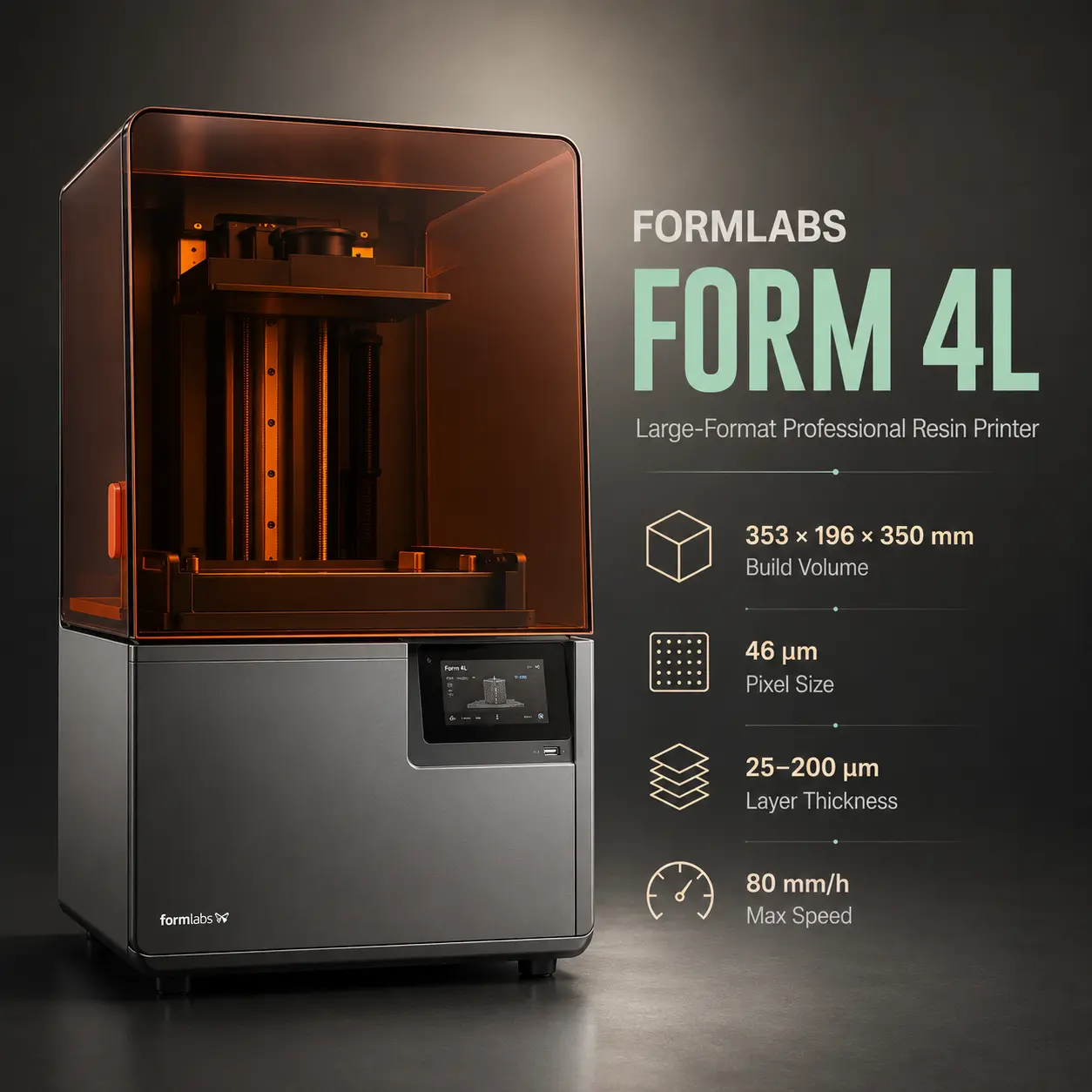
The Formlabs Form 4L is a professional large-format masked stereolithography (MSLA) printer built around Formlabs' Low Force Display (LFD) print engine. Its 353 × 196 × 350 mm build volume provides 24.2 liters of capacity, making it suitable for full-size prototypes, tooling, manufacturing aids, large models, and high-density production batches.
The LFD system combines a 145-LED backlight, custom Light Processing Unit, flexible resin tank, release texture, force sensing, and automated process control. A 46 µm pixel size with pre-tuned anti-aliasing is used across the 692 cm² build area.
Formlabs specifies 25–200 µm layer thicknesses and a maximum vertical print speed of 80 mm/h. That headline speed is achieved with Fast Model Resin at 200 µm; Formlabs' own technical data shows that speed varies substantially by resin, layer height, geometry, and print settings.
The Form 4L also automates resin handling through two cartridge bays, material-specific resin heating, ultrasonic level sensing, a mixer, integrated 5 MP camera, PreForm preparation software, and Dashboard remote management.
For current specifications and package pricing, see the official Form 4L page and Form 4L Basic Package.
| Specification | Value |
|---|---|
| Printing technology | Masked Stereolithography (MSLA) |
| Print engine | Low Force Display (LFD) |
| Build volume | 353 × 196 × 350 mm |
| Build capacity | 24.2 L |
| Build area | 692 cm² |
| Pixel size | 46 µm |
| XY dimensional tolerance | ±0.15% manufacturer claim |
| Layer thickness | 25–200 µm |
| Maximum vertical print speed | 80 mm/h |
| Maximum-speed condition | Fast Model Resin at 200 µm |
| Light wavelength | 405 nm |
| Backlight | 145 LEDs |
| Optical intensity | 16 mW/cm² |
| Resin cartridge bays | 2 |
| Resin heating | Material-specific, approximately 25–45°C |
| Camera | 2592 × 1944, 5 MP |
| Camera functions | Remote monitoring, print history, timelapse |
| Display | 7-inch touchscreen |
| Connectivity | Dual-band Wi-Fi, Gigabit Ethernet, USB-C |
| Software | PreForm, Dashboard |
| Printer dimensions | 664 × 528 × 794 mm |
| Printer weight | 58.5 kg |
| Power | 100–240 V AC, 9 A, 50/60 Hz, 900 W |
The Form 4L provides 4.6 times the build volume of Form 4, according to Formlabs.
The 353 × 196 × 350 mm envelope can be used for:
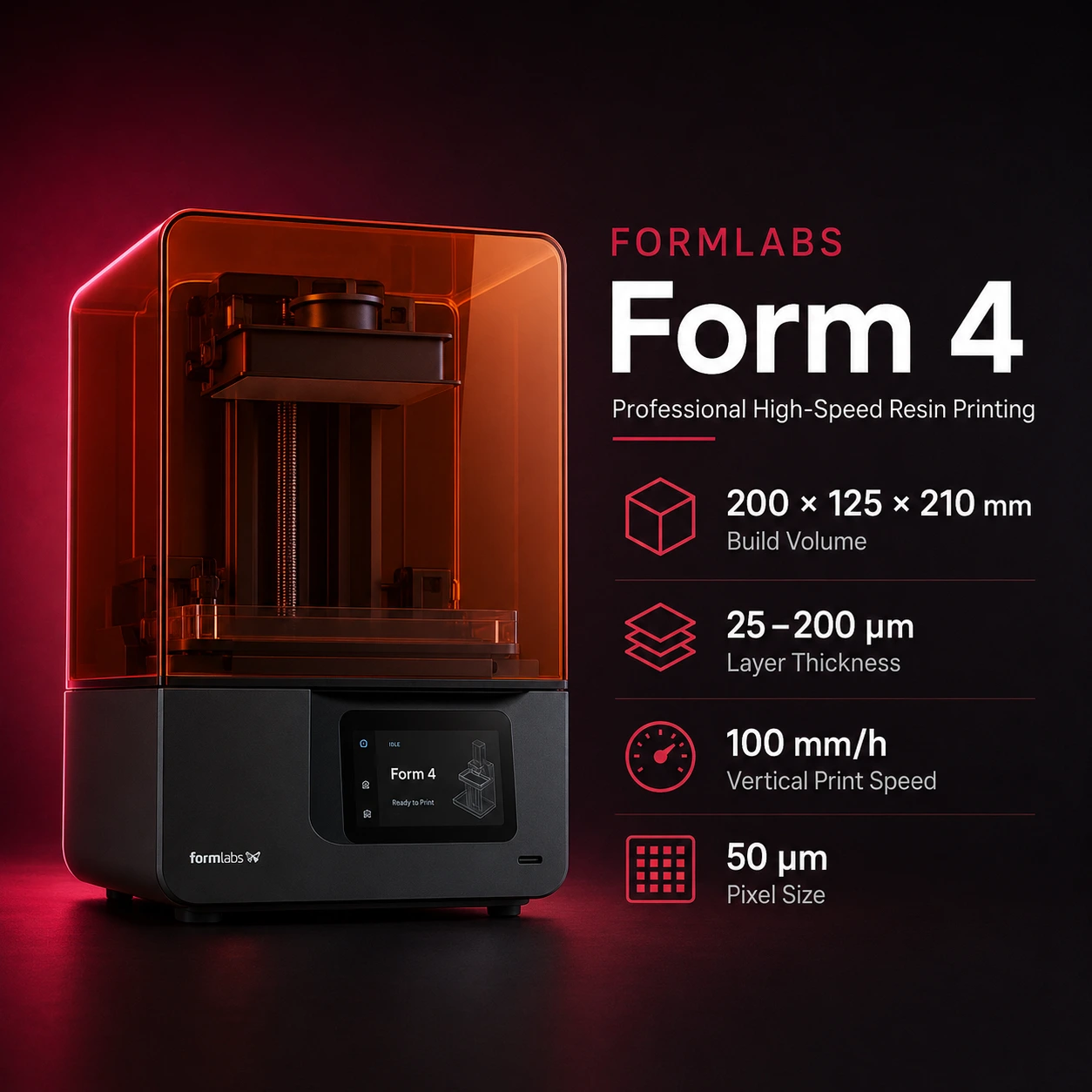
For smaller professional resin work, the indexed Formlabs Form 4 uses the same LFD generation in a more compact 200 × 125 × 210 mm build volume.
Form 4L is an MSLA printer, not a laser-scanning SLA machine.
The LFD print engine uses a 145-LED Backlight Unit, collimating optics, a custom Light Processing Unit and LCD, a flexible resin tank, release texture, and force-controlled peel and squish motions.
Formlabs specifies an optical intensity of 16 mW/cm².
The printer's Z-axis force sensor measures peel and compression forces and adjusts motion behavior to maintain low release loads and reliable separation.
Formlabs specifies a 46 µm pixel size with pre-tuned anti-aliasing and publishes ±0.15% XY dimensional tolerances for the Form 4L platform.
These values should be interpreted correctly. Pixel size describes the imaging system, while finished-part dimensions can still be affected by resin, geometry, orientation, supports, post-curing, and environmental conditions.
Pixel size alone should not be used to rank practical accuracy against consumer MSLA printers with smaller nominal pixels.
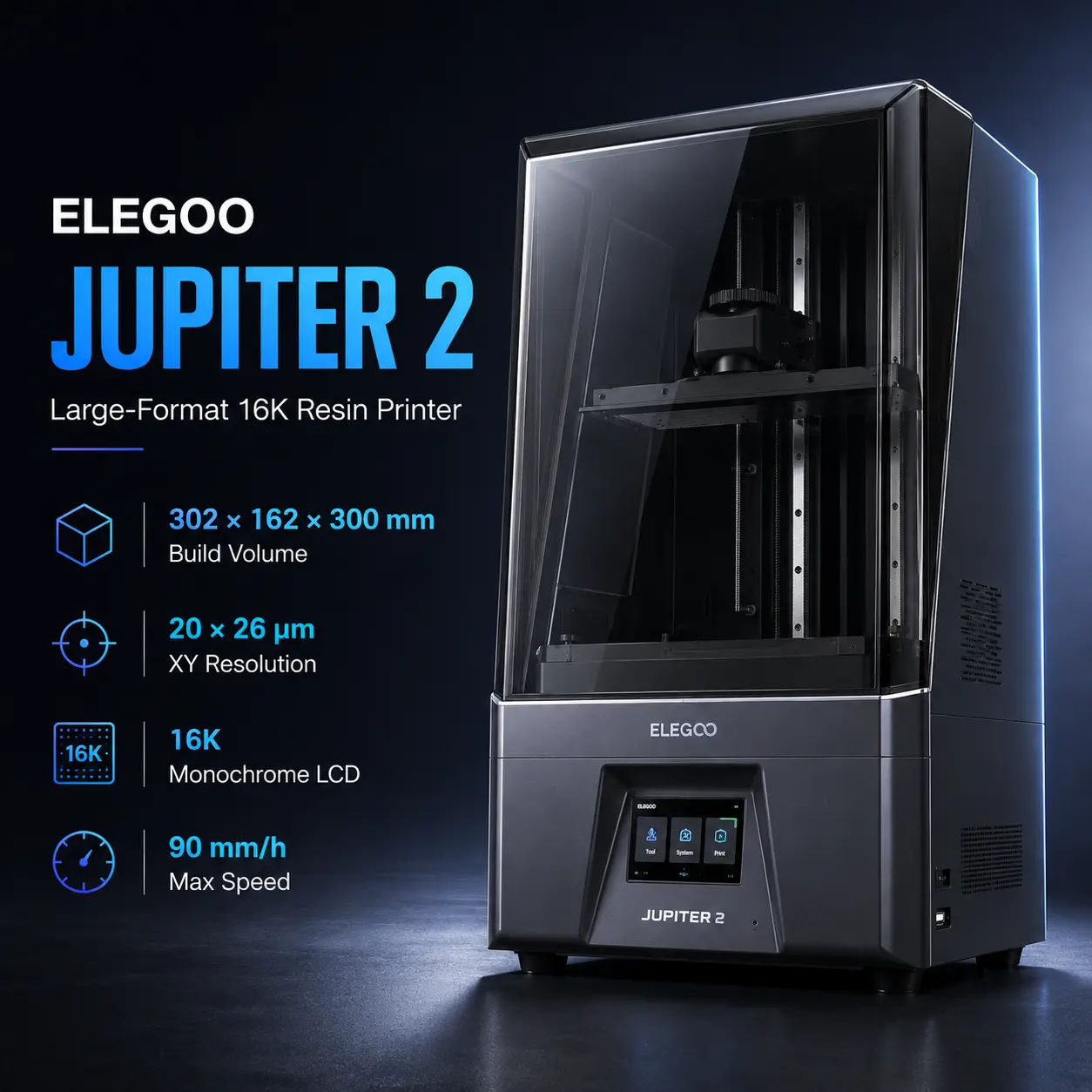
For example, the ELEGOO Jupiter 2 uses smaller 20 × 26 µm pixels but targets a different workflow, material ecosystem, and price segment.
Formlabs specifies a maximum Form 4L speed of 80 mm/h.
The company's technology documentation ties that result to Fast Model Resin at 200 µm layers. The same Formlabs data shows a broader 10–80 mm/h range depending on material, with an approximately 30 mm/h average at 100 µm across the tested material set.
Print speed also depends on resin curing behavior, layer thickness, peel and squish motion, part cross-section, cup geometry, and the number of parts on the platform.
Large hollow cups can slow the peel process unless the geometry includes suitable drainage.
Form 4L generation printers use two resin cartridges at once because of the large resin tank and build volume.
The printer uses:
This reduces manual tank monitoring during large or long prints.
The Form 4L uses high-speed conduction heating and infrared temperature sensing to bring resin to the correct material-specific processing temperature.
Depending on the resin, the target is approximately 25–45°C.
This is resin-process heating, not a heated build chamber. Accordingly, `hasHeatedChamber` remains `false`.
Controlled resin temperature is important because viscosity and cure behavior change with temperature, particularly for higher-viscosity engineering formulations.
The Form 4L supports a broad Formlabs resin library for general prototyping and industrial applications.
Representative categories include:
Formlabs' current pages are inconsistent about the exact number of compatible Form 4L materials, so this listing avoids presenting a fixed material-count claim.
The standard Form 4L is intended for general industrial use.
Formlabs explicitly directs applications requiring certified biocompatible or dental materials to the Form 4BL platform.
A resin appearing elsewhere in the wider Formlabs portfolio should therefore not be interpreted as automatically validated for regulated medical use on a standard Form 4L.
Open Material Mode allows expert users to print compatible third-party 405 nm photopolymer resins on Form 4L.
Open Material Mode is not a standard unrestricted feature included with every printer. Formlabs sells it as an optional, one-time per-printer purchase for lifetime access; accredited educational institutions may qualify for it at no charge with printer purchase.
Third-party resin use may require tuning exposure, layer height, heating, XY correction, support strategy, washing, and curing. Formlabs also notes that printer or consumable performance can vary with third-party materials.
Form 4L includes a 2592 × 1944, 5 MP camera.
It supports:
The camera can be disabled, covered, or removed for environments with stricter privacy requirements.
Dashboard provides remote job status and fleet-management functions.
PreForm is Formlabs' print-preparation application.
Typical functions include:
Dashboard handles remote monitoring, print history, printer status, and fleet management.
The combination is a major part of the Formlabs workflow: validated material profiles, hardware, print preparation, monitoring, washing, and curing are designed as one process.
Resin parts require washing and curing after printing.
The Form 4L Basic Package includes the printer, Resin Tank, Mixer, Build Platform, and Form 4L Finish Kit with manual cleaning tools and rinse bucket.
For automated post-processing, Formlabs offers:
These systems are sold separately or bundled in higher-tier packages.
Post-processing settings should follow the selected resin's current Formlabs guidance.
The Formlabs Form 4 is the smaller printer in the same LFD generation.
Choose Form 4L when part size and batch capacity are more important than Form 4's smaller footprint and higher maximum vertical speed.
The ELEGOO Jupiter 2 is a substantially lower-cost large-format MSLA alternative.
Jupiter 2 offers a 302 × 162 × 300 mm build volume, 20 × 26 µm XY pixels, 30°C heated resin tank, automatic resin feed/recycling, and a broad 405 nm resin workflow.
Form 4L offers a larger 353 × 196 × 350 mm build volume, validated Formlabs material profiles, PreForm and Dashboard, professional post-processing integration, force-controlled LFD printing, and optional Open Material Mode.
Jupiter 2 is attractive when hardware cost and nominal pixel size dominate the decision. Form 4L is stronger when workflow validation, material documentation, support, and production consistency are more important.
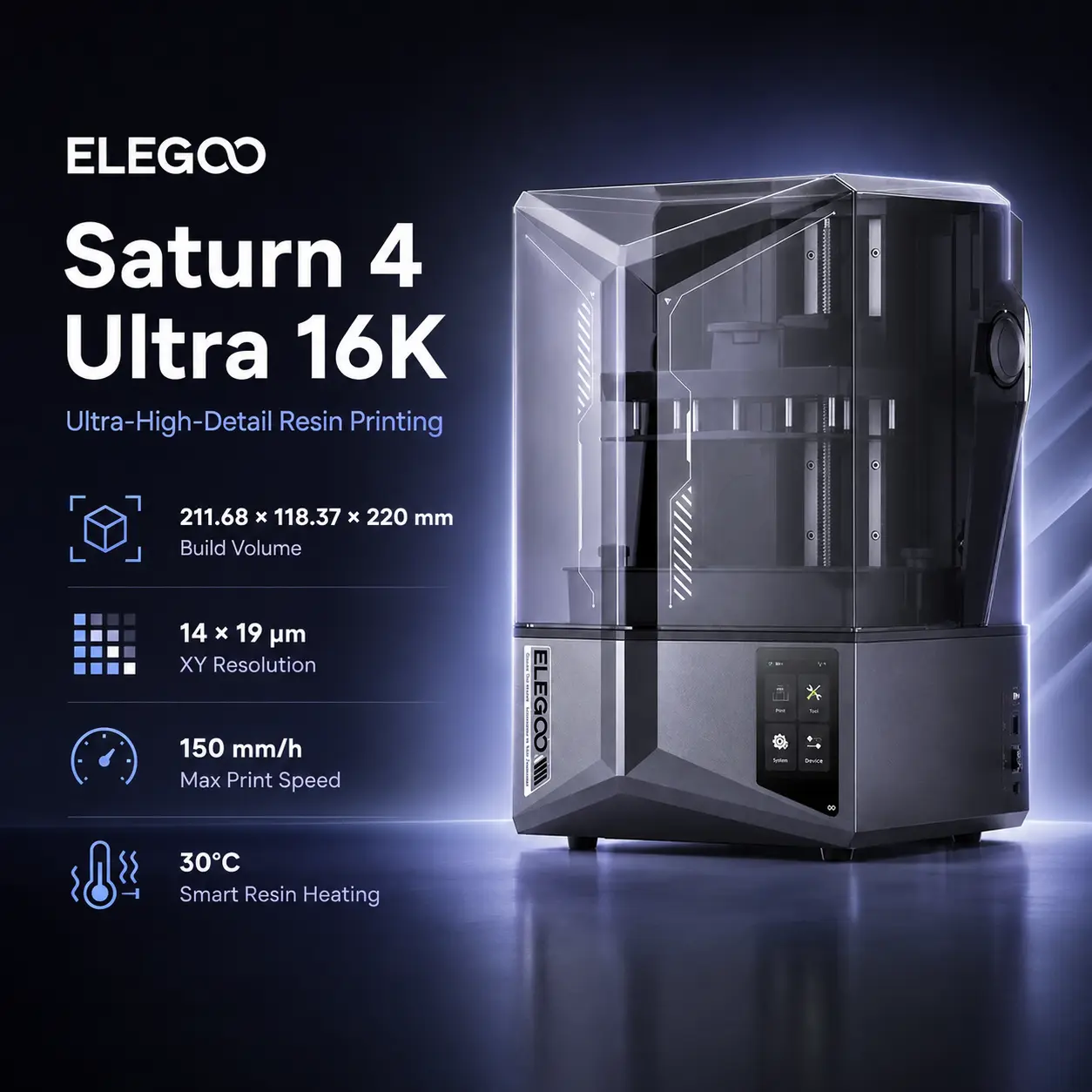
The ELEGOO Saturn 4 Ultra 16K is a compact high-detail consumer/prosumer alternative.
Form 4L is the more appropriate choice for large jigs, tooling, full-size prototypes, validated engineering materials, and production workflows where process repeatability matters more than the smallest nominal XY pixel pitch.
The Form 4L is positioned above desktop resin systems in build capacity and workflow integration. Compared with the standard Form 4, it trades some maximum vertical speed for substantially more build volume. Consumer-oriented large-format MSLA printers can offer finer nominal pixel dimensions, while the Form 4L emphasizes validated materials, dimensional consistency, automated resin handling, and professional production workflows.
| Printer | Technology | Build Volume | Resolution / Process Value | Layer Thickness | Max Speed | Best Fit |
|---|---|---|---|---|---|---|
| Formlabs Form 4L | MSLA / LFD | 353 × 196 × 350 mm | 46 µm pixel | 25–200 µm | 80 mm/h | Professional large-format production |
| Formlabs Form 4 | MSLA / LFD | 200 × 125 × 210 mm | 50 µm pixel | 25–200 µm | 100 mm/h | Professional desktop resin production |
| ELEGOO Jupiter 2 | MSLA | 302 × 162 × 300 mm | 20 × 26 µm XY | 10–200 µm | 90 mm/h | Large-format high-detail printing |
| ELEGOO Saturn 4 Ultra 16K | MSLA | 211.68 × 118.37 × 220 mm | 14 × 19 µm XY | 10–200 µm | 150 mm/h | High-detail prosumer resin printing |
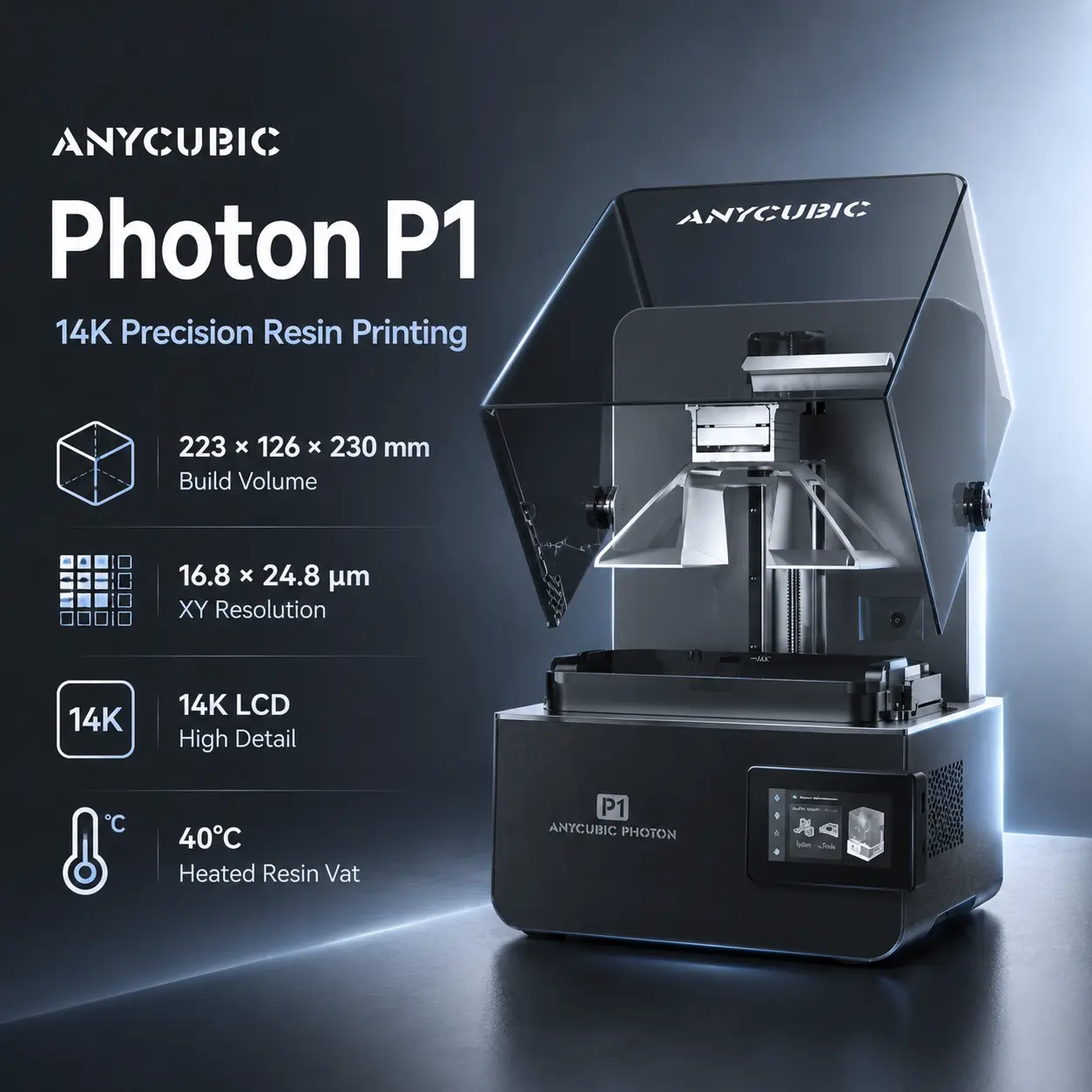
| Anycubic Photon P1 | MSLA | 223 × 126 × 230 mm | 16.8 × 24.8 µm XY | 20–150 µm | 25–35 mm/h* | Heated high-detail resin workflow |
*Photon P1 speed figure applies to the specified standard-resin workflow at 0.05 mm layers.
Formlabs currently lists the Form 4L Basic Package at US$7,125. The estimated equivalent starting prices are approximately €6,160 in the Eurozone, £5,265 in the UK, C$9,887 in Canada, A$10,088 in Australia, AED 26,167 in the UAE, and ₹680,085 in India.
The Basic Package is the entry configuration for the Form 4L platform. Higher-tier packages with additional workflow and post-processing equipment are priced separately
Recommended use: Choose Formlabs Form 4L when large resin parts, validated engineering materials, integrated software, automated resin handling, and repeatable professional workflows matter more than minimizing hardware cost. It is particularly well suited to product development, tooling, manufacturing aids, aerospace and automotive prototyping, and production batches that outgrow desktop resin platforms.
353 × 196 × 350 mm, or 24.2 liters.
Masked stereolithography using Formlabs' Low Force Display print engine.
46 µm with pre-tuned anti-aliasing.
25–200 µm.
Up to 80 mm/h, with Formlabs specifying that maximum using Fast Model Resin at 200 µm.
Yes. Resin is heated to a material-specific operating temperature of approximately 25–45°C.
No. The system heats the resin process rather than actively heating the build chamber.
Two.
Yes, through optional Open Material Mode for compatible 405 nm photopolymer resins.
No. Formlabs sells it as an optional one-time per-printer capability, with separate eligibility for accredited educational institutions.
Formlabs directs biocompatible and regulated medical or dental large-format workflows to Form 4BL.
PreForm for print preparation and Dashboard for remote monitoring and printer management.
Yes. It includes a 5 MP camera for monitoring, history, and timelapse.
The printer, resin tank, mixer, build platform, and Form 4L Finish Kit.
The Form 4L Basic Package is currently listed at US$7,125.