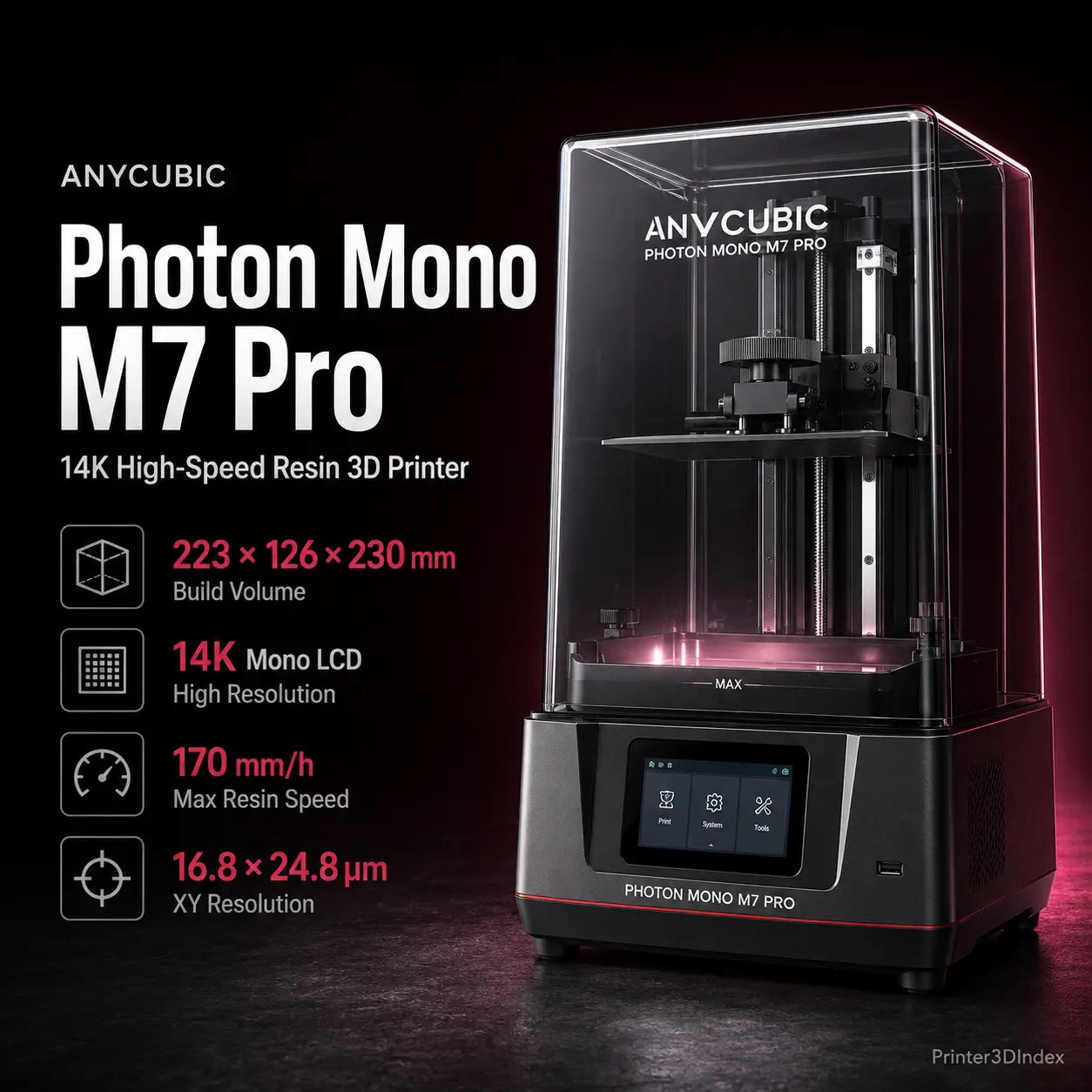
14K Ultra-Detail Printing170 mm/h High-Speed ResinAutomatic Resin Refill20–40°C Heated Resin VatLeveling-Free Resin WorkflowIntelligent Failure Detection
AAnycubic
Anycubic
# Anycubic Photon Mono M7 Pro
The Anycubic Photon Mono M7 Pro is a high-speed desktop MSLA resin 3D printer built around a 10.1-inch 14K monochrome LCD and Anycubic's LighTurbo 3.0 optical system. It combines a 223 × 126 × 230 mm build volume with automated resin handling, adjustable vat heating, failure detection, and network connectivity.
Anycubic rates the M7 Pro at up to 170 mm/h with High-Speed Resin at 0.1 mm layers and up to 130 mm/h with Standard Resin at 0.1 mm layers. Its 13312 × 5120 exposure panel produces a rectangular 16.8 × 24.8 µm XY pixel pitch, while the documented layer-height range is 0.01–0.15 mm.
The Pro model's biggest advantages over the standard Photon Mono M7 are the 20–40°C dynamic resin-vat temperature control, automatic resin refill/withdrawal system, stronger light output, and higher standard-resin printing speed. It is particularly attractive for users who want fast miniature, model, prototype, and small-batch resin printing without moving to a professional ecosystem such as Formlabs.
For current specifications and pricing, see the official Anycubic Photon Mono M7 Pro page. For buying guidance focused on tabletop models, see Best Resin 3D Printers for Miniatures in 2026.
| Specification | Value |
|---|---|
| Printing technology | MSLA / LCD resin |
| Build volume | 223 × 126 × 230 mm |
| LCD | 10.1-inch monochrome |
| LCD resolution | 13312 × 5120 |
| XY pixel pitch | 16.8 × 24.8 µm |
| Z-axis accuracy | 0.01 mm manufacturer specification |
| Layer height | 0.01–0.15 mm |
| High-Speed Resin speed | Up to 170 mm/h at 0.1 mm |
| Standard Resin speed | Up to 130 mm/h at 0.1 mm |
| Light source | COB + Fresnel lens + light-uniformity algorithm |
| Published light intensity | 5500 ±10% µW/cm² |
| Published screen uniformity | ≥90% |
| Build platform | Laser-engraved |
| Z-axis | Dual linear rails |
| Release film | Improved ACF |
| Resin vat capacity | ≤1 L |
| Resin heating | Dynamic vat temperature control |
| Adjustable resin temperature | 20–40°C |
| Leveling | Leveling-free |
| Automatic resin refill | Supported |
| Automatic resin withdrawal | Supported |
| Resin-level detection | Supported |
| Residue detection | Supported |
| Failed-print detection | Supported |
| Power-loss resume | Not supported |
| Touchscreen | 4.3-inch |
| Connectivity | USB / Wi-Fi / LAN |
| Slicer | Anycubic Photon Workshop |
| Other slicers | CHITUBOX; Lychee support listed by Anycubic |
| Anycubic App | Supported |
| Power supply | 240 W |
| Machine weight | 12.8 kg |
Resolution note: The 16.8 × 24.8 µm figure is the XY pixel pitch of the exposure system. It should not be interpreted as guaranteed ±16.8 or ±24.8 µm finished-part dimensional accuracy.
The M7 Pro uses a 13312 × 5120 monochrome LCD.
Its pixels are rectangular, which is why Anycubic publishes 16.8 × 24.8 µm rather than one square XY figure.
Pixel pitch matters for the projected image, but final model detail and dimensional accuracy also depend on:
LighTurbo 3.0 combines a COB light source, Fresnel lens, and Anycubic's light-uniformity control.
Anycubic publishes:
The optical system is intended to maintain more consistent exposure across the full 10.1-inch panel.
Anycubic also uses a light-off compensation algorithm to adjust delay time between layers as resin flows back under the model.
Anycubic publishes two important speed figures:
These are vertical build-rate figures, not XY movement speeds.
Actual print time depends on resin, exposure, layer height, model cross-section, lift/release settings, support structure, and temperature. Fine 0.02–0.05 mm layers will not complete at the same vertical rate as a 0.1 mm speed benchmark.
The M7 Pro includes a heated resin vat with adjustable temperature from 20°C to 40°C. Anycubic lists 25°C as the default setting.
Resin viscosity rises in colder conditions, which can slow refill between layers and increase release stress. Controlled heating can make printing more consistent when ambient temperature is below the resin's preferred range.
The correct temperature still depends on the specific resin. A 40°C maximum should not be treated as the default for every formulation.
The system heats the resin vat rather than creating a heated printer chamber.
The M7 Pro includes an automatic resin-management unit.
Its functions include:
This is especially useful for larger prints and batch production where manually maintaining the vat level would otherwise require more attention.
The system does not remove the need for safe resin handling. Bottles, tubing, the vat, and contaminated tools still need to be handled according to the resin manufacturer's safety instructions.
Anycubic's monitoring system includes:
Residue detection is particularly useful because cured debris left in the vat can damage the release film or LCD area on a subsequent print.
These systems reduce risk but should be treated as monitoring aids rather than guarantees that every failure will be detected.
Anycubic describes the M7 Pro as leveling-free.
The Z axis uses dual linear rails with a manufacturer-stated 10 µm positioning/accuracy specification.
Factory setup reduces initial calibration work, but users still need to keep the build plate, vat, release film, and sensing areas clean and in good condition.
Anycubic explicitly lists these representative resin families:
Other compatible 405 nm photopolymers can work when exposure and process settings are appropriate.
For third-party resin, use a validated exposure profile or calibration test rather than copying settings from another printer.
The M7 Pro's fine pixel pitch makes it useful for jewelry masters and dental models, but application suitability depends on the resin.
Castable jewelry work requires a resin formulated for clean burnout. Dental appliances or intraoral parts require the appropriate validated biocompatible material and workflow; a high-resolution printer alone does not establish medical qualification.
Every MSLA print requires uncured-resin handling and post-processing.
A typical workflow includes:
Use suitable gloves and eye protection, provide ventilation, and follow the resin safety data sheet. The optional AirPure accessory can help with odor management but does not replace ventilation.
| Printer | Build Volume | XY Pixel / Process Value | Max Rated Speed | Resin Heating | Resin Feed | Key Difference |
|---|---|---|---|---|---|---|
| Anycubic Photon Mono M7 Pro | 223 × 126 × 230 mm | 16.8 × 24.8 µm | 170 mm/h high-speed resin | 20–40°C | Automatic refill/withdrawal | Speed + resin automation |
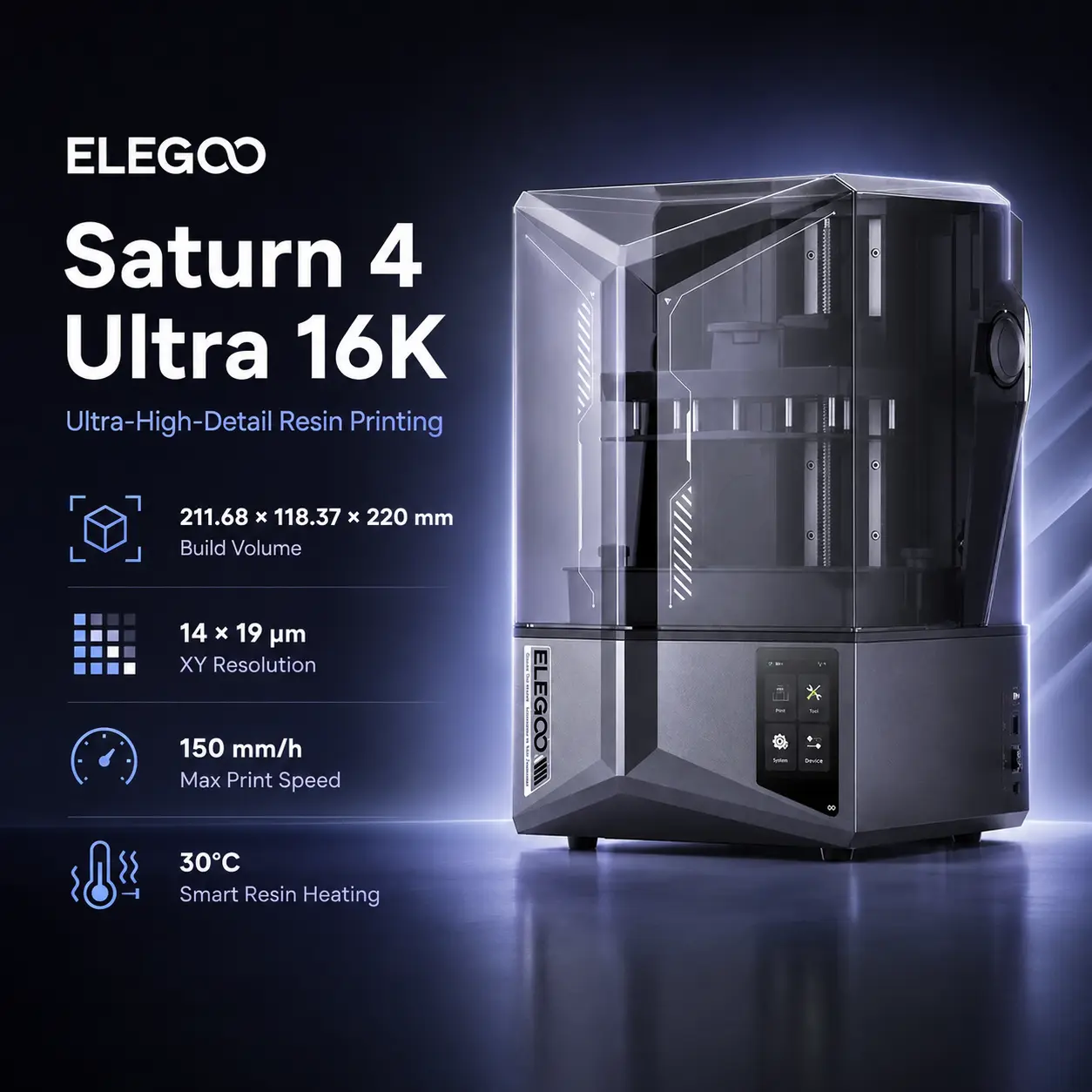
| ELEGOO Saturn 4 Ultra 16K | 211.68 × 118.37 × 220 mm | 14 × 19 µm | 150 mm/h | 30°C target | No automatic feed | Finer pixel pitch + tilt release |
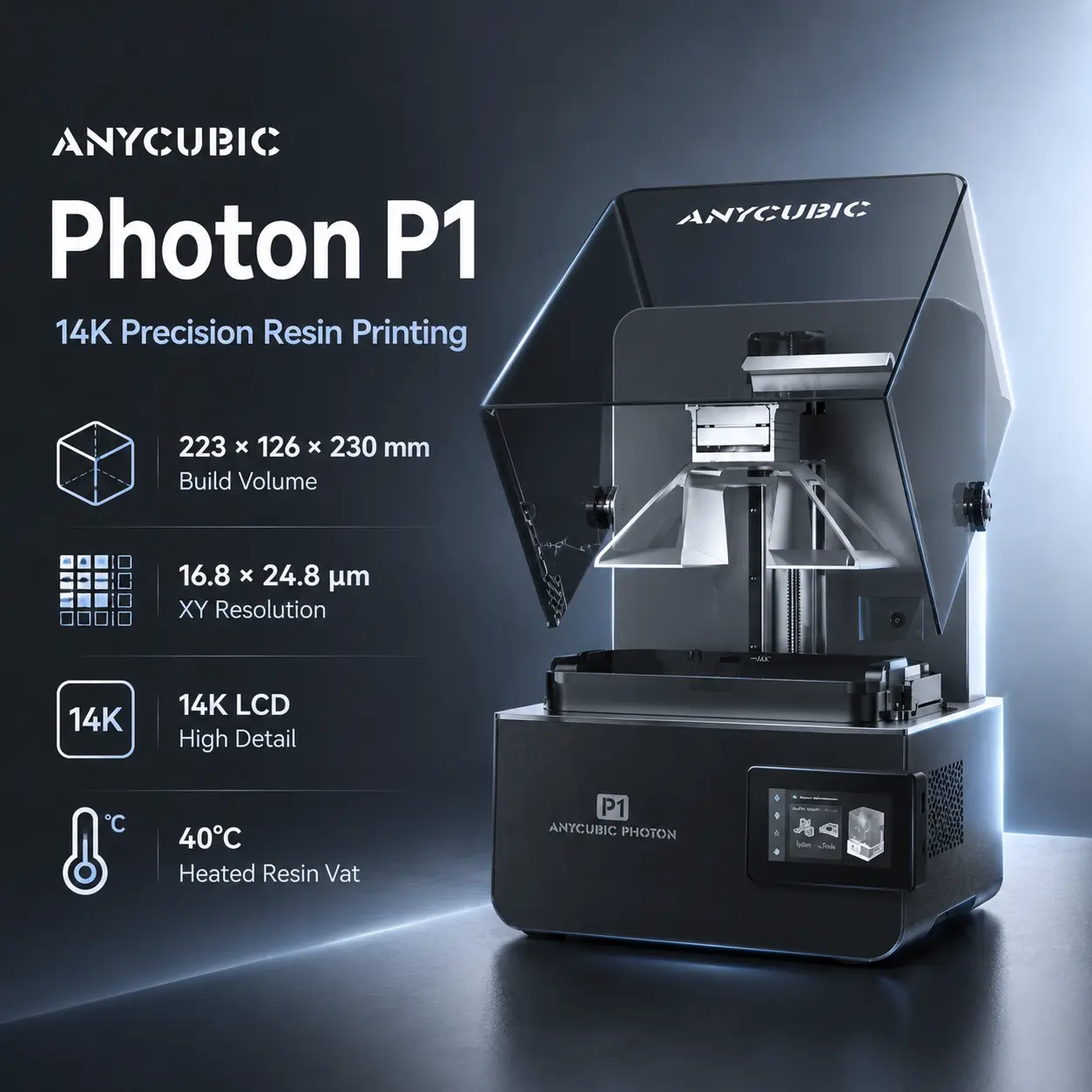
| Anycubic Photon P1 | 223 × 126 × 230 mm | 16.8 × 24.8 µm | Precision-focused workflow | Heated vat | Automatic feed | Ball screw + newer precision platform |
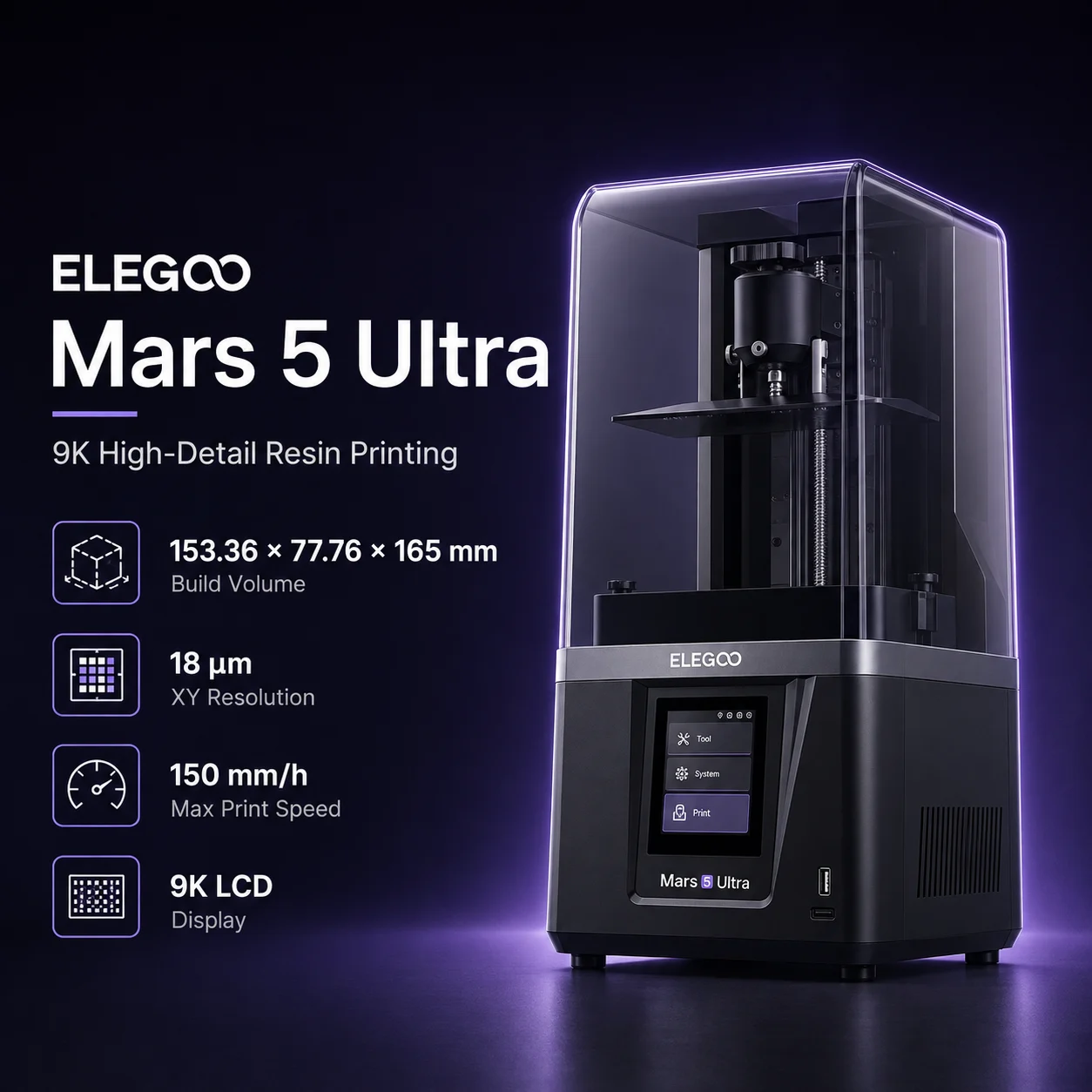
| ELEGOO Mars 5 Ultra | 153.36 × 77.76 × 165 mm | 18 × 18 µm | 150 mm/h | No integrated vat heater | No | Compact value option |
| Formlabs Form 4 | 200 × 125 × 210 mm | 50 µm pixel | Up to 100 mm/h | Precision resin heating | Automatic dispensing | Professional materials and workflow |
Pixel pitch, LCD resolution, and maximum vertical speed are not interchangeable with dimensional accuracy or real production throughput.
The Photon Mono M7 Pro vs Photon Mono M7 comparison is the most important same-family choice.
Both use a 10.1-inch 14K exposure system, the same 223 × 126 × 230 mm build volume, the same 16.8 × 24.8 µm XY pixel pitch, and the same 0.01–0.15 mm layer range.
The standard Photon Mono M7 is rated up to 150 mm/h with high-speed resin and up to 90 mm/h with standard resin in Anycubic's current comparison data.
The M7 Pro raises those figures to 170 mm/h and 130 mm/h, while also adding the 20–40°C heated vat and automatic resin refill/withdrawal.
Choose M7 when lower purchase cost matters and manual resin handling is acceptable. Choose M7 Pro when resin-temperature control, automatic refill, and the faster standard-resin workflow justify the premium.
The Anycubic Photon Mono M7 Pro vs ELEGOO Saturn 4 Ultra 16K comparison is one of the strongest enthusiast-resin searches.
The indexed ELEGOO Saturn 4 Ultra 16K has a 211.68 × 118.37 × 220 mm build volume, 14 × 19 µm XY pixel pitch, 150 mm/h maximum rated speed, tilt-release technology, automatic leveling, a smart tank heater targeting about 30°C, AI camera, residue/resin-level sensing, and power-loss recovery.
M7 Pro provides slightly more build volume, a higher 170 mm/h high-speed-resin rating, adjustable 20–40°C vat temperature, and automatic resin refill/withdrawal.
Saturn 4 Ultra 16K has the finer nominal XY pixel pitch, tilt release, integrated AI camera, and power-loss resume.
Choose M7 Pro for resin automation, adjustable heating, and speed. Choose Saturn 4 Ultra 16K for finer pixel pitch, camera monitoring, tilt release, and a strong miniature-focused workflow.
The indexed Anycubic Photon P1 is the newer precision-focused alternative within Anycubic's resin range.
It uses the same general 223 × 126 × 230 mm class of build volume and 16.8 × 24.8 µm XY pixel pitch, while shifting emphasis toward an industrial-grade ball screw, newer release-control system, high-viscosity resin handling, automated checks, and an optional dual-material workflow.
The M7 Pro remains the stronger speed/value choice for conventional high-speed and standard-resin printing.
Choose M7 Pro for fast, feature-rich everyday resin printing. Choose Photon P1 when repeatability, precision-oriented mechanics, high-viscosity materials, or the newer dual-material ecosystem matter more.
The ELEGOO Mars 5 Ultra is a smaller, lower-cost alternative for miniatures.
It provides a 153.36 × 77.76 × 165 mm build volume, 18 × 18 µm XY pixel pitch, 150 mm/h maximum speed, tilt release, automatic leveling, AI camera, and power-loss recovery.
M7 Pro gives substantially more build area and height, plus automatic resin refill and adjustable vat heating.
Choose Mars 5 Ultra for compact miniature printing and lower hardware cost. Choose M7 Pro when batch capacity, taller models, resin automation, and adjustable resin temperature matter more.
The Photon Mono M7 Pro vs Formlabs Form 4 comparison is consumer/prosumer value versus professional workflow control.
The indexed Formlabs Form 4 uses Formlabs' Low Force Display system with a 200 × 125 × 210 mm build volume, 25–200 µm material-dependent layers, automatic resin dispensing, precision resin heating, force sensing, debris detection, a 5 MP camera, and the PreForm/Dashboard software ecosystem.
Formlabs also publishes feature-size-dependent dimensional tolerances and supports a broad engineering-material portfolio, with Open Material Mode available for third-party 405 nm resins.
M7 Pro costs far less and offers a finer nominal XY pixel pitch plus a higher maximum vertical speed under Anycubic's high-speed-resin test.
Choose M7 Pro for affordable high-detail models, miniatures, and fast general-purpose resin printing. Choose Form 4 for documented dimensional performance, professional materials, fleet management, and a validated production workflow.
The Anycubic Photon Mono M7 Pro is currently available for US$562, approximately €481 in Europe, £413 in the UK, C$775 in Canada, A$791 in Australia, ₹53,808 in India, and AED 2,064 in the UAE.
Actual pricing may vary by region depending on VAT or local taxes, shipping costs, exchange rates, stock availability, resin packages, selected bundles, Wash & Cure combinations, and promotional offers. For the most accurate current price and availability, check the live manufacturer listing before purchase.
223 × 126 × 230 mm.
A 10.1-inch 14K monochrome LCD with 13312 × 5120 pixels.
16.8 × 24.8 µm.
0.01–0.15 mm.
Up to 170 mm/h with High-Speed Resin at 0.1 mm and up to 130 mm/h with Standard Resin at 0.1 mm.
Yes. The dynamic resin vat is adjustable from 20°C to 40°C.
Yes. Automatic refill and withdrawal are supported.
Anycubic lists the M7 Pro as leveling-free.
Yes. It includes failed-print, resin-residue, resin-level, and release-film-life monitoring.
No.
High-speed, standard, water-washable, ABS-like, and plant-based resin families.
Yes. Anycubic also lists USB and LAN transfer.
Yes. The fine XY pixel pitch, useful mid-size plate, and high-speed workflow make it well suited to miniatures and batch printing.
It is suitable for dental models with appropriate resin profiles. Biocompatible intraoral applications require a validated resin and compliant workflow.
Both share the same build volume and 14K XY pixel pitch. M7 Pro adds faster standard-resin printing, adjustable vat heating, and automatic resin refill/withdrawal.
M7 Pro has slightly more build volume, adjustable 20–40°C heating, and automatic resin management; Saturn 4 Ultra 16K has finer nominal XY pixel pitch, tilt release, an AI camera, and power-loss recovery.
The Anycubic Photon Mono M7 Pro is currently available from US$562, approximately €481 in Europe, £413 in the UK, C$775 in Canada, A$791 in Australia, ₹