Engineering GradeIndustrial GradeHigh-Rebound Flexible Resin83A Elastomeric ResinTear-Resistant Flexible ResinRubber-Like Engineering ResinHigh-Elongation Elastomer
FFormlabs
Formlabs
# Formlabs Flexible 80A Resin V2
Formlabs Flexible 80A Resin V2 is a resilient elastomeric SLA material developed for rubber-like prototypes and end-use parts that need to bend, stretch, compress, absorb impact, and recover their shape repeatedly. Formlabs positions it as an alternative to firm rubbers, TPUs, and approximately 80A cast urethanes.
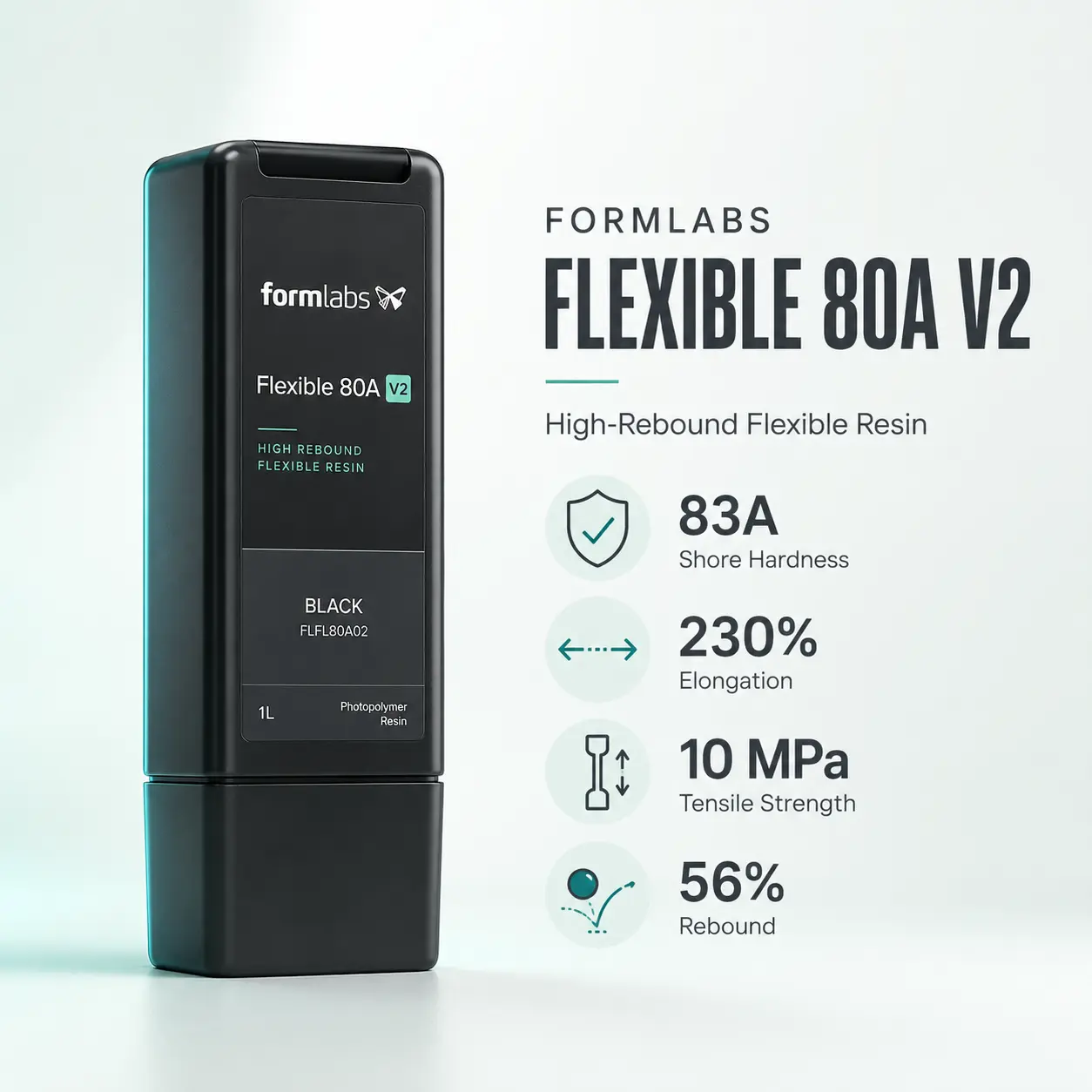
The V2 formulation is designed for the Form 4 generation and combines 83A Shore hardness, 230% elongation at break, 28 kN/m tear strength, 56% pendulum rebound, and 10 MPa ultimate tensile strength. Compared with the previous Flexible 80A generation, Formlabs reports substantially higher tear strength, elongation, rebound, flex-fatigue performance, and improved aging behavior.
Printed parts have a matte black appearance and can achieve a tack-free surface when the specified wash and two-stage cure workflow is followed.
For the current manufacturer specification, see the official Formlabs Flexible 80A Resin V2 page.
| Specification | Value |
|---|---|
| Material Type | Resin |
| Material Class | Elastomeric photopolymer |
| Printing Compatibility | Form 4 Series SLA |
| Applications | Prototype, Engineering, Industrial, Production |
| Key Property | High-rebound, tear-resistant 83A elastomer |
| Ultimate Tensile Strength | 10 MPa |
| Elongation at Break | 230% |
| Shore Hardness | 83A |
| Tear Strength | 28 kN/m |
| Pendulum Rebound | 56% |
| Ross Flex Fatigue | 12,800 cycles in Formlabs internal testing |
| Compression Set | 32% at 25% strain |
| Appearance | Matte black |
| Finished Surface | Tack-free after correct post-processing |
| Format | 1 L and 5 L |
| Compatible Printers | Form 4, Form 4B, Form 4L, Form 4BL |
| Current Starting Price | From US$199 |
Note: Mechanical values are manufacturer test results obtained under defined print, cure, and test conditions. Finished-part performance depends on geometry, orientation, wall thickness, support strategy, post-curing, temperature, and loading conditions.
Flexible 80A Resin V2 is a Form 4-generation material rather than a generic open resin intended for every 405 nm SLA, MSLA, or DLP machine.
Validated printers are:
Compatible build platforms include the standard and Flex platforms for Form 4 and Form 4L, with the corresponding Form 4 or Form 4L Resin Tank.
The Formlabs Form 4 is the most directly relevant indexed Print3DIndex printer for this material. Its Low Force Display print engine, automatic resin handling, PreForm workflow, and validated Flexible 80A V2 profile provide a tightly integrated route from print preparation through washing and curing.
Important: The catalog-level `SLA / MSLA / DLP` compatibility field reflects the Print3DIndex admin category. Actual manufacturer validation for Flexible 80A Resin V2 is limited to the supported Form 4 Series printers listed above.
Flexible 80A Resin V2 is designed for repeated deformation rather than rigid structural loading.
| Property | Value |
|---|---|
| Ultimate tensile strength | 10 MPa |
| Elongation at break | 230% |
| Shore hardness | 83A |
| Tear strength | 28 kN/m |
| Pendulum rebound | 56% |
| Ross Flex fatigue | 12,800 cycles |
| Compression set | 32% at 25% strain |
| Behavior | Resilient, flexible, tear resistant |
| Surface | Matte black, tack-free after correct curing |
The combination of elongation, rebound, and tear resistance makes the resin useful for components that need to flex or compress and then recover rather than remain permanently deformed.
Typical examples include:
Formlabs also reports that V2 survives substantially more Ross Flex cycles than the previous generation and retains 87% of its initial elongation at break after 1,000 hours of accelerated indoor aging in the manufacturer's test program.
A useful distinction with elastomeric materials is that tensile strength alone does not describe how the part will behave.
The published 56% pendulum rebound indicates strong elastic recovery after deformation. This is relevant to bumpers, grips, protective inserts, and components expected to spring back after loading.
The 28 kN/m tear strength is important for thin features, flexible covers, and parts that may be stretched around corners or fastening points.
Formlabs reports 12,800 Ross Flex cycles for Flexible 80A Resin V2 in its internal test conditions, approximately five times the result of the previous generation.
These figures are useful for comparing material behavior, but they should not be treated as guaranteed life predictions for a finished component.
Flexible 80A Resin V2 is a high-viscosity elastomeric resin. Filling and draining the resin tank can therefore be slower than with lower-viscosity general-purpose materials.
For washing, Formlabs specifies:
Flexible 80A Resin V2 is not compatible with Formlabs Resin Washing Solution according to the current material guidance.
After drying, the material requires a two-stage post-cure to achieve its intended mechanical properties and tack-free surface.
The process consists of:
Exact time and temperature depend on the selected curing equipment. Use the current Formlabs Form Cure settings for the relevant cure unit.
Flexible resins behave differently from rigid photopolymers during printing and in service.
Thin sections will flex more easily, while thicker walls can feel considerably firmer even though the material hardness is unchanged.
Sharp internal corners, thin tabs, small holes, and abrupt section changes can concentrate stress in repeatedly flexed parts. Rounded transitions and appropriate wall thickness can improve durability.
Flexible parts can deform during support removal more easily than rigid resin parts. Support placement should balance print reliability, surface finish, and ease of removal.
For seals, pads, and compressive parts, geometry is as important as material hardness. Compression set, preload, groove design, surface finish, and operating temperature should all be considered.
Flexible 80A V2 has improved aging and fatigue performance compared with its predecessor, but application-specific testing is still important for production parts exposed to repeated loads, chemicals, heat, UV, or long service intervals.
Properly processed Flexible 80A Resin V2 produces:
The V2 formulation is specifically intended to improve finished-part aesthetics compared with the previous generation.
Because the material is black, it is particularly suitable for functional components such as grips, bumpers, protective housings, and flexible fixtures where a finished engineering appearance is useful without painting.
Flexible 80A Resin V2 and TPU filament can both produce rubber-like components, but they use different manufacturing processes and should not be treated as direct substitutes.
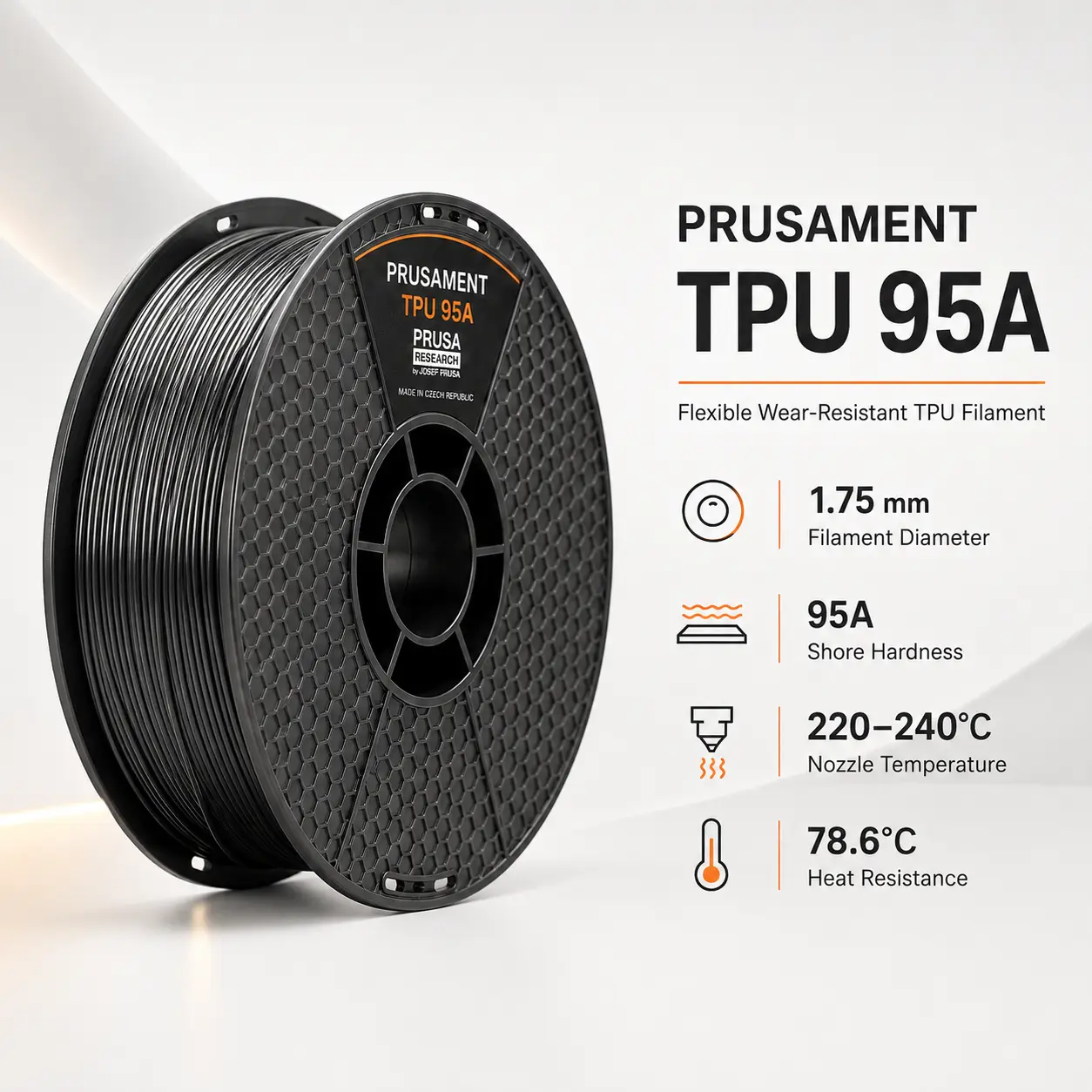
For an FDM alternative, compare Prusament TPU 95A.
| Feature | Flexible 80A Resin V2 | Prusament TPU 95A |
|---|---|---|
| Process | Formlabs SLA | FDM |
| Shore hardness | 83A | 95A |
| Flexibility | High | High |
| Elongation | 230% | Material-specific FDM behavior |
| Surface detail | Fine resin detail | Layered extrusion surface |
| Typical strength | Tear-resistant elastomeric resin | Wear-resistant flexible thermoplastic |
| Post-processing | IPA wash + two-stage UV cure | Support removal / filament finishing |
| Best fit | Detailed rubber-like parts, seals, grips, fixtures | Durable flexible FDM parts, guards, tires, cable protection |
The resin is especially attractive when fine surface detail, complex small geometry, and a cast-urethane-like appearance matter. TPU filament can be more convenient for larger flexible parts, abrasion-heavy use, or workflows already centered on FDM.
Flexible 80A Resin V2 should not be confused with BioMed Flex 80A Resin.
Flexible 80A V2 is an engineering elastomer and Formlabs does not present it as a biocompatible medical material. For workflows requiring documented biocompatibility, Formlabs provides the separate BioMed Flex 80A Resin, which has different mechanical properties, color, manufacturing controls, and validated biological-contact claims.
This distinction is important when selecting material for:
Use the material specifically validated for the intended medical application rather than assuming similar Shore hardness implies equivalent regulatory suitability.
Formlabs currently offers Flexible 80A Resin V2 for the Form 4 Series in:
The current US listing starts at approximately US$199, with volume discounts available for larger orders.
Pricing can vary by region, package size, taxes, and commercial account terms.
Recommended use: Choose Formlabs Flexible 80A Resin V2 for detailed rubber-like prototypes and low-volume functional parts that require repeated bending, compression, rebound, and strong tear resistance, particularly when the Form 4 workflow and fine SLA surface quality are valuable.
It is a resilient elastomeric SLA resin for rubber-like prototypes and end-use parts that bend, compress, stretch, and recover their shape.
Formlabs reports 83A Shore hardness after the specified post-processing workflow.
The manufacturer reports 230% elongation at break.
Formlabs reports 10 MPa ultimate tensile strength.
Formlabs reports 28 kN/m.
Formlabs reports 56% pendulum rebound.
The published value is 32% at 25% strain.
Formlabs validates it for Form 4, Form 4B, Form 4L, and Form 4BL.
It should not be presented as a generally validated open resin. The current manufacturer compatibility is the Form 4 Series.
Formlabs specifies clean IPA at 90% concentration or higher and recommends at least 30 minutes of air drying after washing.
No. Formlabs states that Flexible 80A Resin V2 is not compatible with its Resin Washing Solution.
Yes. It uses a two-stage cure process: a water-bath UV cure followed by drying and a second cure in air at elevated temperature.
It is not the Formlabs biocompatible 80A material. For documented medical and biocompatible applications, use the separate BioMed Flex 80A Resin appropriate to the intended workflow.
Seals, gaskets, bumpers, grips, padding, flexible housings, protective inserts, soft fixtures, and detailed rubber-like functional prototypes.
Flexible 80A V2 provides fine SLA detail and a cast-urethane-like finish, while an FDM material such as Prusament TPU 95A is better suited to filament-based flexible-part workflows and different wear or scale requirements.