Engineering GradeIndustrial GradeHigh-Heat Chemical-Resistant PA11-CFHigh-Wear Carbon Fibre NylonLow-Friction Engineering Material
PPrusa
Prusa
Compact row for standout or material-specific features only.
# Prusament PA11 Carbon Fiber
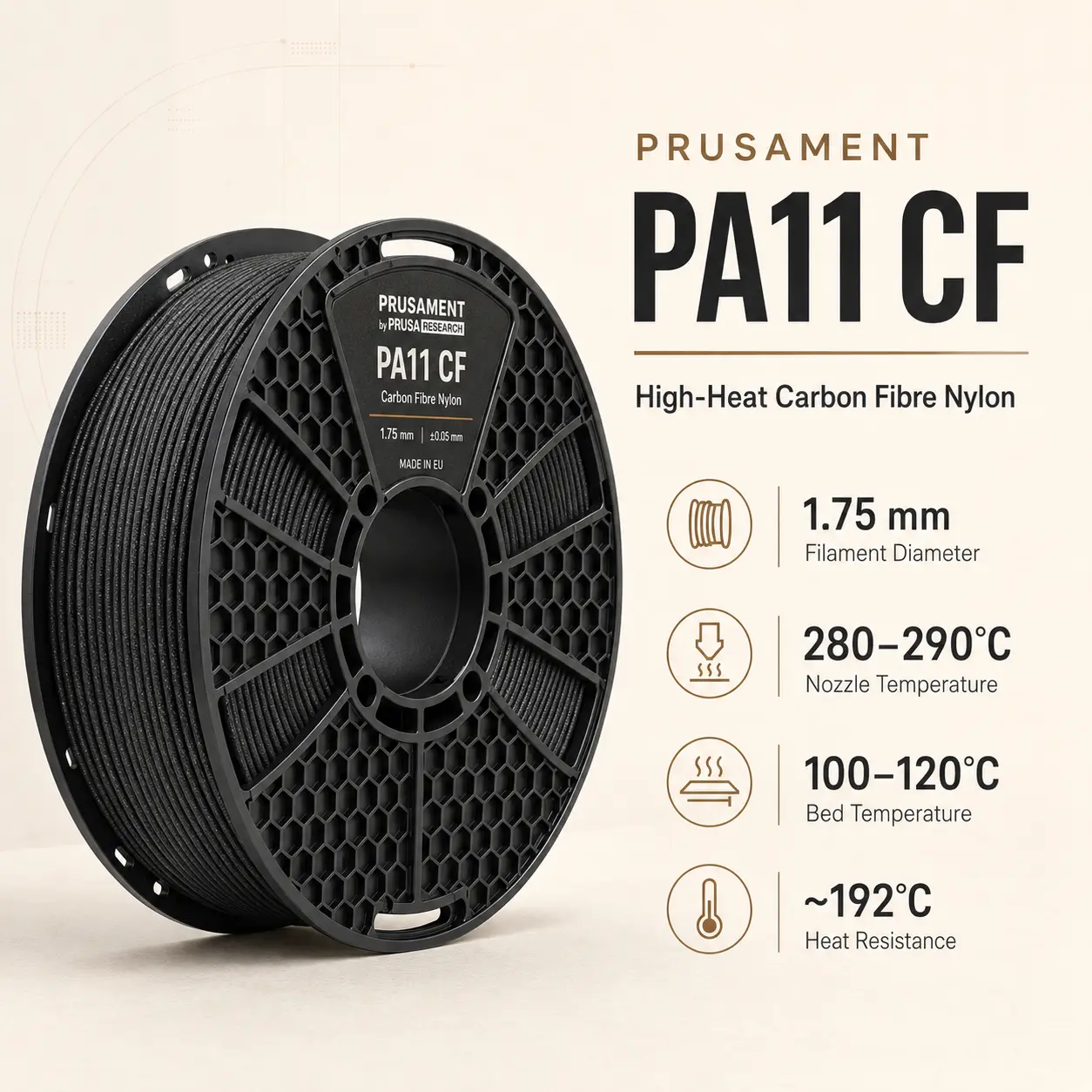
Prusament PA11 Carbon Fiber is a carbon-fibre-filled polyamide 11 composite from Prusa Polymers for demanding engineering, automotive, aerospace and production applications. PA11 provides excellent heat, chemical and mechanical resistance, while recycled carbon fibres improve dimensional stability and reduce warping.
Prusament states that printed parts can withstand temperatures up to approximately 190°C depending on load. The technical data sheet reports 192°C HDT at 0.45 MPa and 152°C at 1.80 MPa. The material also offers low friction, high wear resistance, strong impact performance and much slower moisture absorption than many other polyamides.
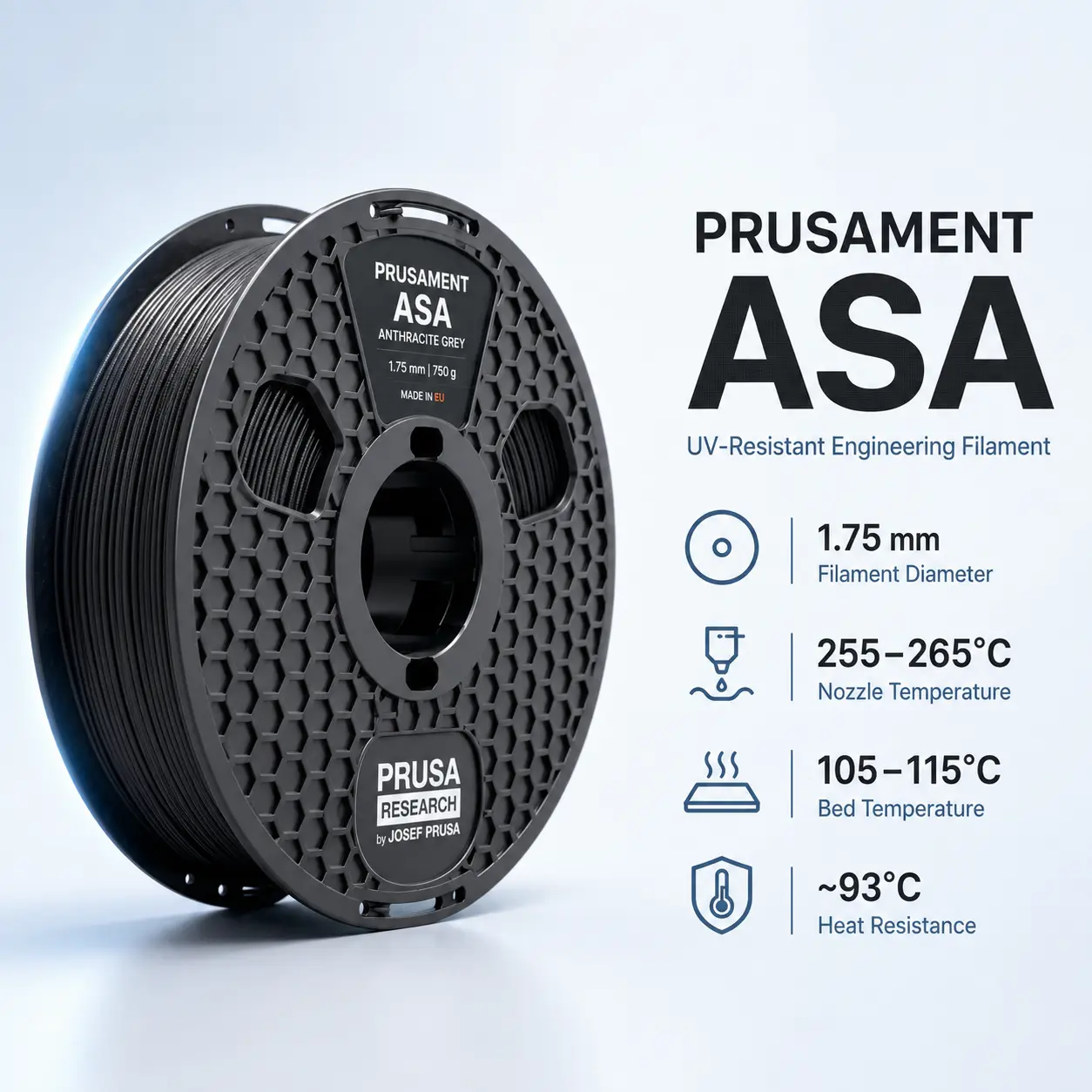
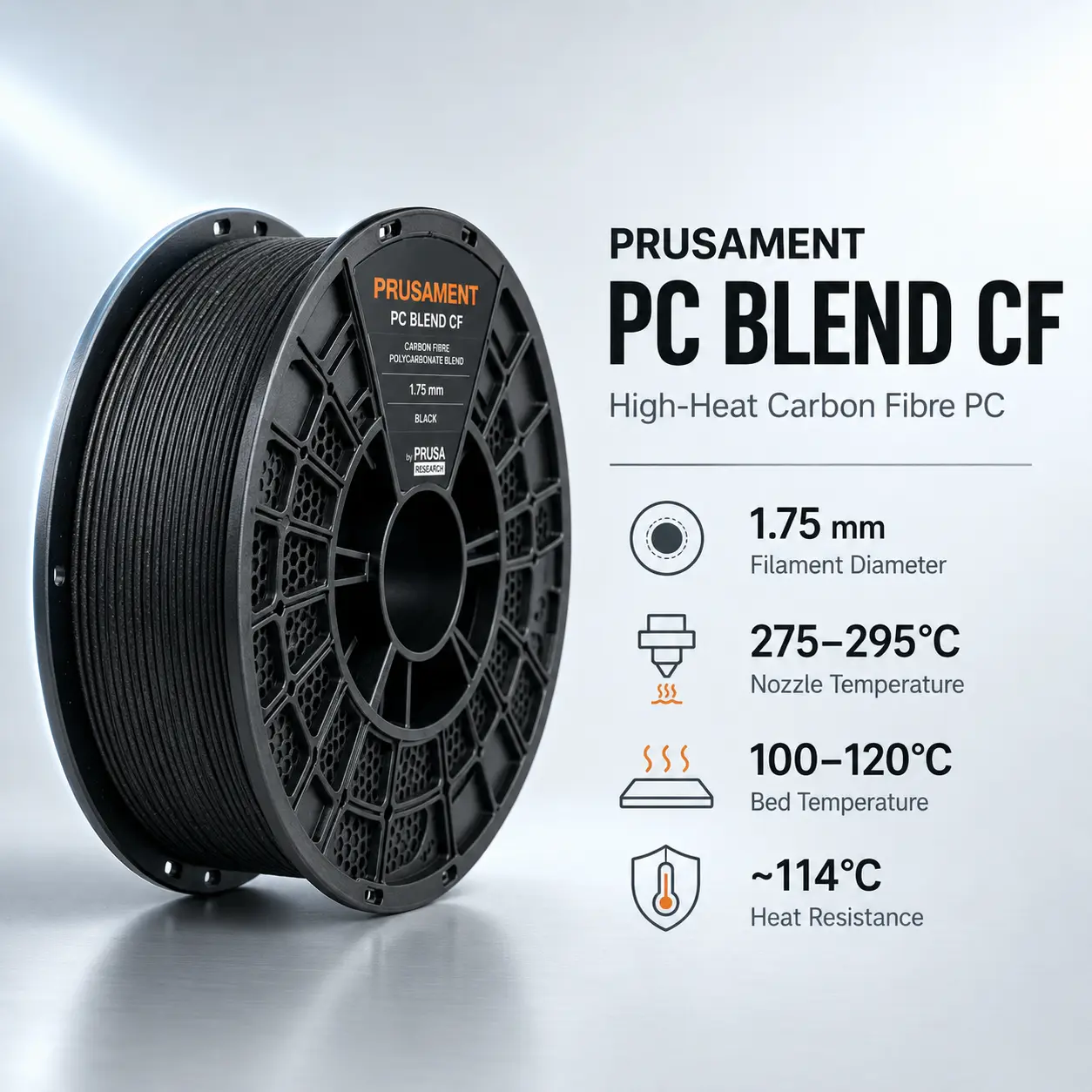
Compared with Prusament PC Blend Carbon Fiber, PA11-CF provides substantially higher documented heat resistance and stronger chemical resistance. Prusament ASA is easier for UV-focused outdoor parts, while Prusament PETG is easier for general-purpose engineering parts.
| Specification | Value |
|---|---|
| Material Type | Composite |
| Chemistry | Polyamide 11 filled with carbon fibres |
| Printing Compatibility | FDM |
| Applications | Prototype, Engineering, Automotive, Aerospace, Industrial, Production |
| Key Property | High heat, chemical and wear resistance |
| Nozzle Temperature | 285 ±10°C current product guidance |
| Heatbed Temperature | 110 ±10°C |
| TDS Print Speed | Up to 100 mm/s |
| Cooling Fan | 20% in the documented TDS setup |
| Format | 1.75 mm, 800 g spool |
| Diameter Tolerance | ±0.04 mm |
| Recommended Nozzle | 0.4 mm hardened non-high-flow nozzle |
| Recommended Surface | Special PA Nylon sheet |
| Tensile Yield Strength | 42 ±1 MPa horizontal; 49 ±2 MPa vertical XZ |
| Tensile Modulus | 2.5 ±0.1 GPa horizontal; 3.3 ±0.1 GPa vertical XZ |
| Flexural Strength | 63 ±2 MPa horizontal; 103 ±3 MPa vertical XZ |
| Interlayer Adhesion | 20 ±5 MPa |
| Heat Deflection Temperature | 192°C at 0.45 MPa; 152°C at 1.80 MPa |
| Abrasive | Yes |
| Enclosure | Not required for dimensional stability |
| Storage / Drying | 90°C for 6 hours; keep dry between uses |
| Colour / Finish | Black; matte carbon-fibre finish |
| Price | Check current US price — manufacturer’s current listing |
Note: Mechanical and thermal values are manufacturer test results and depend on print orientation, geometry, processing conditions and test method.
Important: Carbon fibres are highly abrasive. Use the recommended hardened wear-resistant nozzle; a standard brass nozzle is not suitable.
Prusa currently lists profiles for CORE One/+, making the Prusa CORE One+ the strongest directly documented indexed match. The printer's temperature capability covers the material profile, but an appropriate hardened nozzle and PA-compatible build surface are still required.
The Bambu Lab H2D and Creality K2 Plus are also technically suitable high-temperature, fibre-reinforced-material platforms. Both exceed the central 285°C / 110°C thermal requirements, but use printer-specific profiles and wear-resistant hardware because Prusament does not publish a dedicated validation profile for these machines.
The Bambu Lab P2S uses hardened extrusion hardware and reaches the central material temperatures. Its 110°C bed limit means the Prusament profile must remain within that maximum, and exact PA11-CF performance should be validated for the printer.
Important: Prusament states that PA11-CF has very low shrinkage and can print large models without an enclosure. An enclosure is therefore not a material requirement for dimensional stability.
Important: The material produces significant odor. Use good ventilation or an enclosure with active filtration.
| Property | Information |
|---|---|
| Tensile yield strength | 42 ±1 MPa horizontal; 49 ±2 MPa vertical XZ |
| Tensile modulus | 2.5 ±0.1 GPa horizontal; 3.3 ±0.1 GPa vertical XZ |
| Flexural strength | 63 ±2 MPa horizontal; 103 ±3 MPa vertical XZ |
| Flexural modulus | 3.0 ±0.1 GPa horizontal; 6.2 ±0.3 GPa vertical XZ |
| Interlayer adhesion | 20 ±5 MPa |
| Charpy impact strength | 30 ±4 kJ/m² horizontal; 51 ±4 kJ/m² vertical XZ |
| Notched Charpy impact | 12 ±2 kJ/m² horizontal; 17 ±1 kJ/m² vertical XZ |
| HDT | 192°C at 0.45 MPa; 152°C at 1.80 MPa |
| Hardness | Shore D 77 |
| Moisture absorption | 0.20% / 24 h; 0.50% / 7 days under documented conditions |
| Warping | Low |
| Abrasivity | High |
Note: These values are useful for comparison but are not guaranteed finished-part design limits.
Prusament PA11-CF is resistant to a broad range of chemicals including bases, alcohols, toluene, acetone, motor oil, petrol and diesel. Combined with low friction and wear resistance, this suits gears, moving parts, automotive components and machinery exposed to heat or chemicals.
Prusament describes temperature resistance up to approximately 190°C depending on mechanical stress, while the TDS provides 192°C HDT at 0.45 MPa and 152°C at 1.80 MPa.
Print at approximately 285 ±10°C with a 110 ±10°C heatbed. The dedicated TDS used 285°C nozzle, 110°C bed, up to 100 mm/s and 20% cooling. A hardened nozzle is mandatory.
Use the Special PA Nylon sheet or another surface specifically prepared for polyamide. A brim is recommended for larger parts. Despite being a polyamide, PA11-CF has low shrinkage and normally does not require an enclosure for dimensional control.
PA11 remains hygroscopic. Prusa's current drying guide specifies 90°C for 6 hours for PA11 Carbon Fiber and recommends dry storage between uses.
Use good ventilation or active filtration because the material produces noticeable odor during printing.
| Feature | Prusament PA11 Carbon Fiber | Prusament PC Blend Carbon Fiber | Prusament ASA | Prusament PETG |
|---|---|---|---|---|
| Material family | PA11-CF | PC-CF | ASA | PETG |
| Nozzle temperature | 285 ±10°C | 275–295°C | 255–265°C | 240–260°C |
| HDT / heat resistance | 192°C at 0.45 MPa; 152°C at 1.80 MPa | 114°C at 0.45 MPa; 106°C at 1.80 MPa | 93°C at 0.45 MPa; 86°C at 1.80 MPa | ~68°C HDT |
| Chemical resistance | Excellent | Good | Good | General-purpose |
| Warping | Low | Low | High | Low |
| Abrasive | Yes | Yes | No | No |
| Hardened nozzle | Required | Required | No | No |
| Enclosure required | No | No | Recommended for larger parts | No |
| Typical use | Heat-, chemical- and wear-stressed engineering parts | High-temperature rigid engineering parts | Outdoor / automotive parts | General engineering parts |
Recommended use: Choose Prusament PA11 Carbon Fiber when extreme temperature capability, chemical resistance, friction performance and durability justify its higher material and hardware requirements. Choose Prusament PC Blend Carbon Fiber for a lower-temperature rigid carbon-fibre composite, Prusament ASA for UV-focused outdoor parts, or Prusament PETG for easier general engineering printing.
Recommended use: Best for demanding automotive, aerospace, industrial and production components exposed to heat, chemicals, friction or mechanical loads. The Prusa CORE One+ has a directly supported Prusa profile, while the Bambu Lab H2D and Creality K2 Plus provide suitable high-temperature hardware when configured and validated for PA11-CF.
It is a carbon-fibre-filled PA11 composite for high-temperature, chemically resistant and mechanically demanding FDM parts.
Current Prusa guidance specifies approximately 285 ±10°C nozzle and 110 ±10°C heatbed.
Yes. Prusa recommends a 0.4 mm hardened non-high-flow nozzle because the carbon fibres are highly abrasive.
No. Prusament states that its low shrinkage allows even large models to be printed without an enclosure. Use ventilation or active filtration for odor control.
Prusament states up to approximately 190°C depending on load. The TDS reports 192°C HDT at 0.45 MPa and 152°C at 1.80 MPa.
The TDS reports 42 ±1 MPa horizontally and 49 ±2 MPa vertically in the documented printed specimens.
Yes, PA11 is hygroscopic. Prusa's drying guide specifies 90°C for 6 hours and recommends keeping PA11-CF dry between uses.
Yes. Prusament highlights resistance to NaOH, methanol, ethanol, toluene, acetone, motor oils, petrol and diesel.
The Prusa CORE One+ has a directly listed Prusa PA11-CF profile. The Bambu Lab H2D, Bambu Lab P2S and Creality K2 Plus have suitable high-temperature or fibre-reinforced-material hardware, but use printer-specific validation and profiles.
PA11-CF provides much higher documented heat resistance and stronger chemical resistance, while Prusament PC Blend Carbon Fiber is a lower-temperature carbon-fibre engineering alternative.