Engineering GradeEasy to PrintDurable PETG Filament
PPrusa
Prusa
Compact row for standout or material-specific features only.
# Prusament PETG
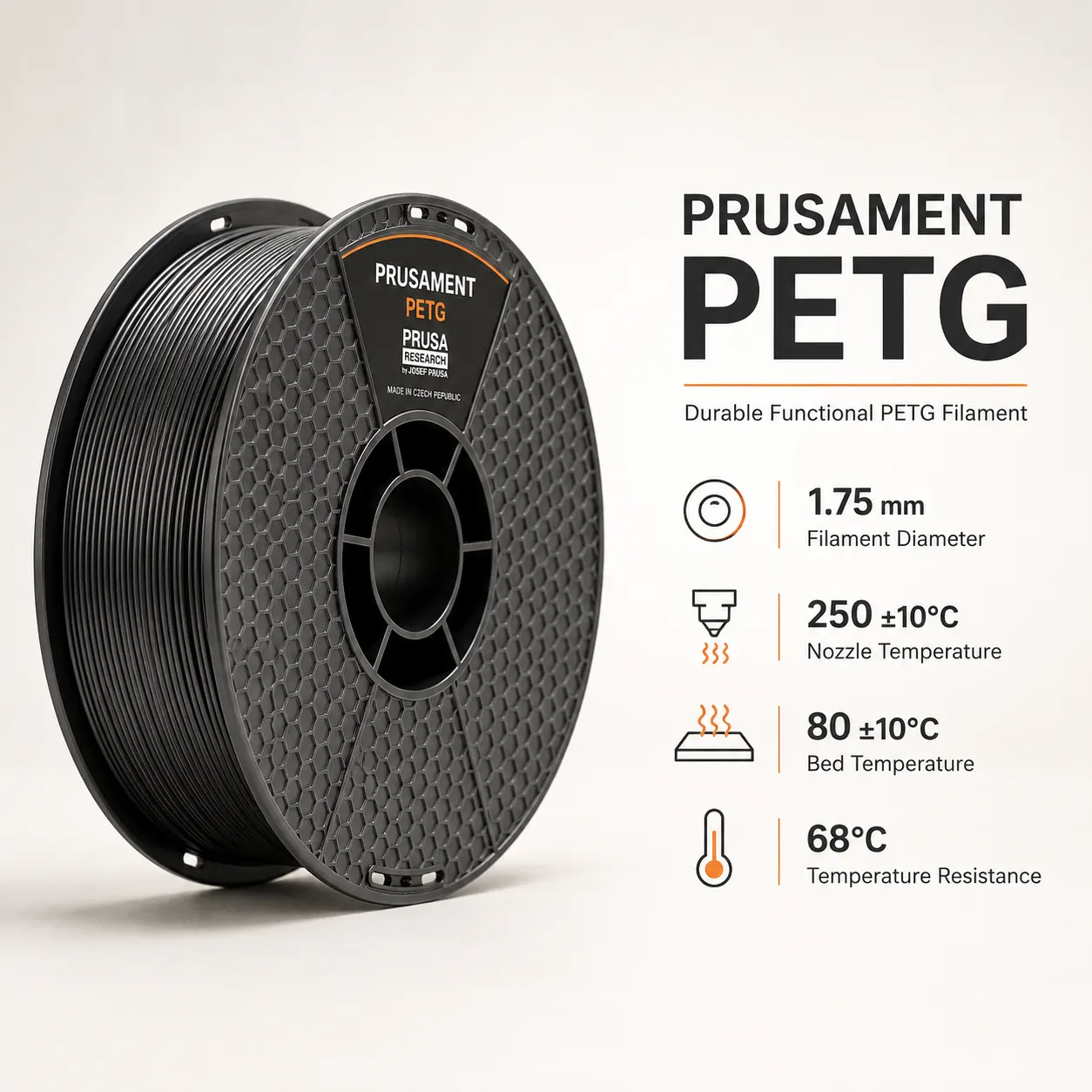
Prusament PETG is a 1.75 mm PETG filament manufactured by Prusa Polymers. It combines high toughness, strong layer adhesion, low warping, and relatively easy printing, making it well suited to functional and mechanically stressed parts.
Compared with PLA, PETG is more flexible, less brittle, and more temperature resistant. It is commonly used for engineering components, holders, clamps, printer parts, functional prototypes, and tooling applications requiring durable parts with good dimensional stability.
Prusament PETG is suitable for many 1.75 mm PETG-capable FDM printers already indexed on Print3DIndex, including the Prusa CORE One+, Bambu Lab A1, and Bambu Lab P2S, provided the selected printer and build surface are configured for PETG.
| Specification | Value |
|---|---|
| Material Type | Filament |
| Chemistry | PETG |
| Printing Compatibility | FDM |
| Applications | Engineering, Prototype, Tooling |
| Key Property | Tough, durable and low warping |
| Print / Process Temperature | 240–260°C |
| Bed Temperature | 70–90°C |
| Enclosure | Not required |
| Format | 1.75 mm filament |
| Diameter Tolerance | ±0.02 mm |
| Mechanical Profile | High toughness and strong layer adhesion |
| Tensile Yield Strength | Approximately 47 MPa for the documented horizontal printed specimen |
| Heat Deflection Temperature | 68°C |
| Flexibility | Low |
| Abrasive | No |
| Post-Processing | Wet or dry sanding |
| Storage / Drying | Keep dry and store sealed when not in use |
| Colour / Finish | Multiple colours; smooth and glossy with transparent and selected matte variants |
| Availability | Available — check current variant |
| Price | US$29.99 per standard 1 kg spool — check manufacturer’s current listing |
Note: Prusa Polymers recommends approximately 250 ±10°C nozzle temperature and 80 ±10°C bed temperature. Recommended settings can vary by printer, colour, build surface, and print profile.
Note: The approximately 47 MPa value is the documented tensile yield strength of a horizontally printed test specimen. Printed-part properties depend on orientation, geometry, settings, and test method.
Compatible indexed printers include the Prusa CORE One+, Bambu Lab A1, Bambu Lab P2S, and Creality K2 Plus, all of which support PETG-class printing workflows.
Important: PETG can adhere very strongly to smooth PEI. Follow the printer and build-surface guidance for PETG and use an appropriate separation layer where recommended.
| Property | Information |
|---|---|
| Toughness | High |
| Warping | Low |
| Elasticity | Low |
| Tensile yield strength | Approximately 47 MPa, horizontal printed specimen |
| Heat deflection temperature | 68°C |
| Layer adhesion | Strong |
| Abrasivity | None |
Note: The Prusament technical datasheet reports 47 ± 2 MPa tensile yield strength for the documented horizontal specimen and 50 ± 1 MPa for the documented vertical XZ specimen. Mechanical properties depend on print orientation, settings, geometry, and testing method.
Prusament PETG is designed for conventional FDM printing and does not require a heated enclosure. Prusa Polymers recommends approximately 250 ±10°C nozzle temperature and 80 ±10°C bed temperature.
PETG may string or ooze more than PLA. Correct temperature, retraction, cooling, and validated slicer profiles help reduce these effects. Printers such as the Prusa CORE One+ can use manufacturer-provided Prusament profiles through PrusaSlicer, while other compatible printers should use validated PETG profiles for their hardware.
| Feature | Prusament PETG | PLA | ASA |
|---|---|---|---|
| Printing difficulty | Easy to medium | Easy | Medium |
| Toughness | High | Medium | High |
| Warping | Low | Very low | Higher |
| Heat resistance | Approximately 68°C HDT | Generally lower | Generally higher |
| Enclosure | Not required | Not required | Recommended |
| Typical use | Engineering parts and tooling | Models and prototypes | Outdoor and higher-temperature parts |
Note: These are general material-category comparisons. Exact properties vary by formulation, manufacturer, and print conditions.
Recommended use: Choose Prusament PETG for durable engineering parts, prototypes, and tooling that need greater toughness and temperature resistance than typical PLA without requiring an enclosed printer. It is suitable for PETG-capable machines such as the Prusa CORE One+, Bambu Lab A1, and Bambu Lab P2S.
Prusament PETG is a 1.75 mm PETG filament manufactured by Prusa Polymers for engineering parts, prototypes, tooling, and other durable functional applications.
Prusa Polymers recommends approximately 250 ±10°C.
Approximately 80 ±10°C.
No. An enclosure is not required for standard Prusament PETG.
Standard Prusament PETG is classified as non-abrasive and does not require a wear-resistant nozzle. Specialty filled Prusament PETG formulations may have different requirements.
The Prusament technical datasheet lists a heat deflection temperature of 68°C under its documented test conditions.
It is well suited to engineering parts, functional prototypes, holders, clamps, printer components, jigs, fixtures, and general tooling.
Yes. Prusament describes PETG as suitable for both wet and dry sanding.
Yes. PETG is generally more ductile, less b