Intelligent DesignIndustrialLarge Format Industrial SLSHigh Throughput Powder PrintingAI-Monitored SLS printing
FFormlabs
Formlabs
# Formlabs Fuse X1
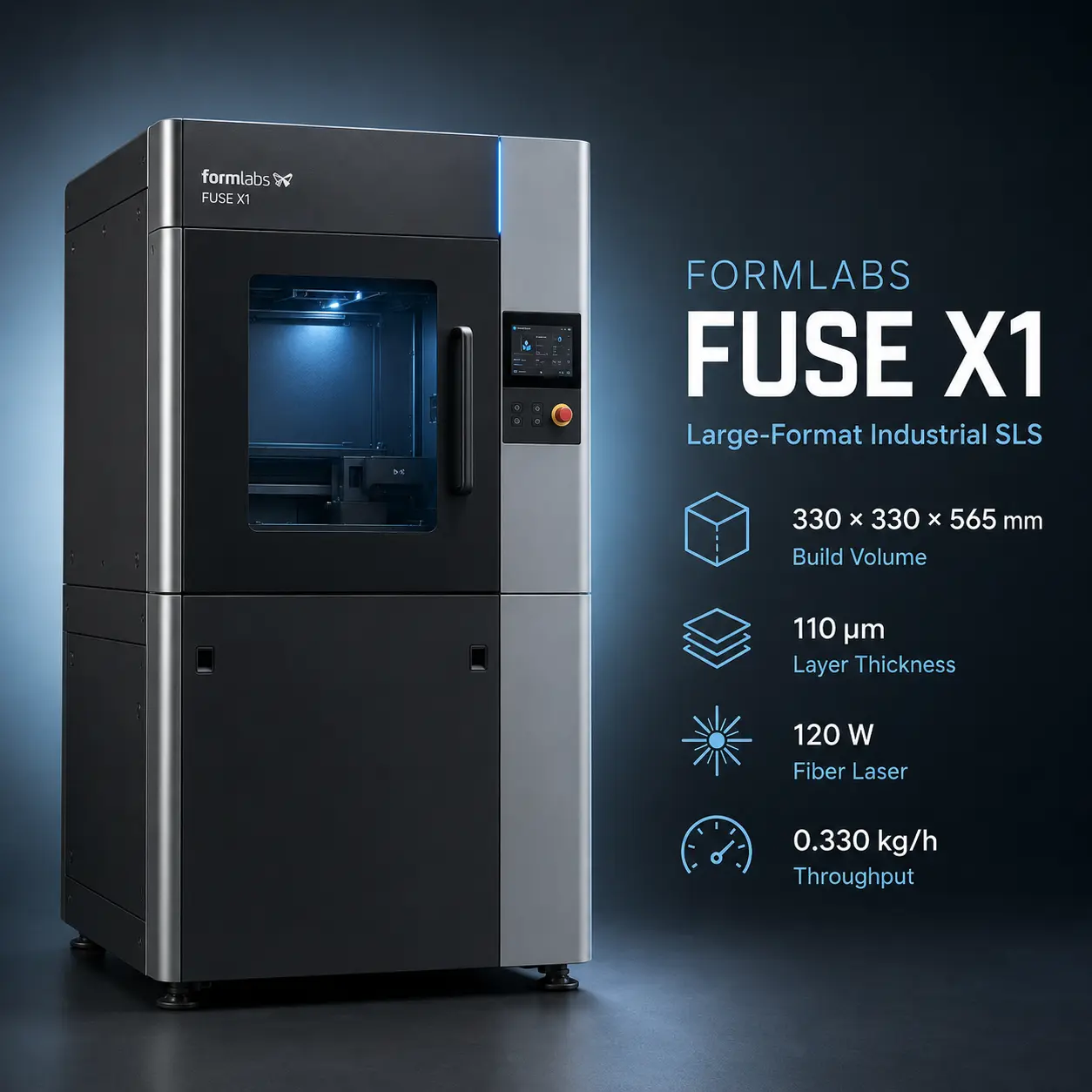
The Formlabs Fuse X1 is a large-format industrial Selective Laser Sintering (SLS) system developed for high-throughput polymer production, large functional prototypes, tooling, manufacturing aids, and end-use parts.
Its powder-bed workspace measures 330 × 330 × 565 mm, providing 61.5 L of addressable build volume. Because unsintered powder supports the parts during printing, components can be nested throughout the three-dimensional build space without conventional support structures.
Fuse X1 uses a 120 W ytterbium fiber laser operating at 1064 nm, a fixed 110 µm layer thickness, and a 330 µm FWHM laser spot size. Formlabs publishes throughput up to 0.330 kg of sintered material per hour and packing density above 30% by volume.
The platform also introduces Adaptive Thermal Control and Print Intelligence. Thermal imaging feeds 13 independently managed heating zones, while computer vision monitors each layer for anomalies and can mask affected regions or parts in subsequent layers to protect the rest of the build.
The printer can be ordered now, but Formlabs states that customer deliveries begin in Q4 2026. For current specifications and ordering information, see the official Formlabs Fuse X1 page. Detailed comparative specifications are available on the official Fuse Series technical-specification page.
| Specification | Value |
|---|---|
| Printing technology | Selective Laser Sintering (SLS) |
| Build volume | 330 × 330 × 565 mm |
| Build capacity | 61.5 L |
| Maximum diagonal part length | Approximately 713 mm |
| Layer thickness | 110 µm |
| Laser | 120 W ytterbium fiber |
| Laser wavelength | 1064 nm |
| Laser spot size | 330 µm FWHM |
| Throughput | Up to 0.330 kg/h sintered material |
| Maximum packing density | 30%+ by volume; 48%+ by mass |
| Hopper capacity | 105 L |
| Support structures | Not required |
| Maximum internal temperature | Up to 210°C |
| Temperature control | Thermal camera + quartz heating + 13 independent zones |
| Print atmosphere | External nitrogen / inert-gas supply |
| Air handling | Pressure-controlled two-stage filtration with replaceable HEPA and carbon media |
| Connectivity | Dual-band Wi-Fi, Gigabit Ethernet, USB-C |
| Display | 15.55-inch touchscreen, 1080 × 1920 |
| Software | PreForm |
| Printer dimensions | 157 × 83 × 193 cm |
| Printer weight | 570 kg without build chamber or powder |
| Operating environment | 18–28°C; RH below 30% |
| Electrical input | 208–240 VAC single phase, 50/60 Hz |
| Current tech-spec electrical rating | 50 A |
| Published power | 3.5 kW typical; 7.5 kW max at 208 VAC |
| Laser safety | Class 1 laser product |
Critical power note: Formlabs' current detailed Fuse Series technical-specification page lists 208–240 VAC, 50 A, with 3.5 kW typical and 7.5 kW maximum at 208 VAC. A separate current Fuse X1 sell sheet lists a 200–240 VAC / 40 A requirement. Because Formlabs' own documents are inconsistent, facility electrical planning should follow the latest site-preparation documentation or direct Formlabs guidance before installation.
SLS speed note: Fuse X1 is better characterized by throughput, layer thickness, build time, and packing density than by an FDM-style linear print speed in mm/s.
Fuse X1 provides a 330 × 330 × 565 mm build space, roughly 7.5 times the build volume of the Fuse 1+ 30W.
Formlabs also states that a part can reach approximately 713 mm in maximum length when positioned diagonally within the powder bed.
SLS does not require conventional supports, so parts can be stacked and nested through the available Z height.
That allows the machine to serve two different production patterns:
Formlabs demonstrates production builds above 30% volumetric packing density, but achievable density depends on part geometry, spacing rules, material, thermal behavior, and PreForm packing strategy.
The Fuse X1 uses a 120 W ytterbium fiber laser.
Current Formlabs technical data lists:
The higher-power print engine contributes to the system's published throughput of 0.330 kg/h.
That throughput should not be interpreted as a constant production rate for every build. Real output depends on packing density, material, part cross-section, geometry, thermal strategy, and total job height.
Large, densely packed SLS builds are sensitive to temperature uniformity.
Fuse X1 uses Adaptive Thermal Control with thermal imaging and 13 independent heating zones.
Formlabs states that the system processes substantially more thermal data than the Fuse 1+ 30W and uses that information to maintain a stable powder-bed temperature throughout the print.
The current technical specification lists an internal temperature of up to 210°C.
Stable thermal control is especially important for:
Print Intelligence is Formlabs' AI-powered monitoring and failure-prevention system for Fuse X1.
The system combines computer vision with thermal monitoring to inspect the powder bed layer by layer.
When an anomaly is detected, Fuse X1 can selectively mask the affected region or remove the affected part from subsequent layers rather than automatically sacrificing the entire build.
This is especially valuable in high-density production, where one local defect could otherwise jeopardize many hours of machine time and a large quantity of powder.
Important: Print Intelligence is a failure-mitigation system, not a guarantee that every defect will be detected or that every build will complete successfully.
At launch, Formlabs identifies Nylon 12 Powder as the validated proprietary production material for Fuse X1.
Fuse X1 supports Open Material Mode for compatible third-party powders designed around a 1064 nm SLS process.
This can be useful for:
Open Material Mode does not mean every 1064 nm powder will automatically print successfully.
Users remain responsible for validating:
For official program information, see Formlabs Open Material Mode.
Current Fuse X1 literature lists a material refresh rate as low as 20%, depending on the material and workflow.
Refresh rate describes how much fresh powder must be mixed with recovered material before reuse.
Lower refresh rates can reduce material cost, but the correct ratio depends on the validated material profile and the history of the used powder.
Packing density and refresh rate are separate concepts:
Fuse X1 uses an external inert-gas supply and is listed with a nitrogen print environment.
Controlled atmosphere is part of the machine's industrial SLS process and should be considered during installation planning.
The printer also uses pressure-controlled two-stage filtration with replaceable HEPA and activated-carbon media.
Formlabs' launch information says the system is intended to install without specialized HVAC retrofits, but facility requirements, local regulations, powder handling, and nitrogen supply should still be reviewed before installation.
Fuse X1 uses a removable Fuse X1 Build Unit.
The build unit allows the powder cake to cool outside the printer while another prepared unit is installed for the next job.
Formlabs promotes print changeovers in approximately five minutes under its workflow assumptions.
This architecture separates printing from cooling and unpacking, increasing potential printer utilization in production environments.
The larger Fuse X1 ecosystem includes Fuse Sift X1 for powder recovery.
Formlabs describes:
The Fuse X1 Vacuum Conveyor moves powder between stages to reduce manual handling.
These workflow components are separate parts of the production ecosystem and should not automatically be assumed to be included in every base-printer quotation.
After powder recovery, parts can be processed in Fuse Blast.
Formlabs' high-capacity Fuse X1 workflow supports larger cleaning batches, while the optional polishing configuration can create a smoother, semi-gloss, dye-ready surface.
Post-processing requirements depend on final application and cosmetic expectations.
Fuse X1 supports:
Formlabs Dashboard adds remote status, alerts, and fleet-management features.
The printer itself uses a 15.55-inch interactive touchscreen with 1080 × 1920 resolution.
Print preparation uses Formlabs PreForm.
Current Fuse Series documentation lists support for:
PreForm can orient, hollow, label, estimate print time, and automatically pack parts into the powder bed.
Automatic packing can improve utilization, but production users should still review orientation, thermal concentration, nesting, and part spacing for critical builds.
| Feature | Fuse X1 | Fuse 1+ 30W |
|---|---|---|
| Build volume | 330 × 330 × 565 mm | 165 × 165 × 300 mm |
| Build capacity | 61.5 L | 8.2 L |
| Laser | 120 W fiber | 30 W fiber |
| Laser spot | 330 µm | 247 µm |
| Published throughput | 0.330 kg/h | 0.063 kg/h |
| Print environment | Nitrogen | Air and nitrogen |
| Primary positioning | Large-format industrial production | Benchtop professional SLS |
| Starting hardware price | US$84,999 | US$24,649 |
The Fuse 1 remains relevant for users who need a smaller and less expensive SLS platform.
Fuse X1 is justified when production volume, large parts, build density, and throughput outweigh the substantially higher equipment and facility cost.
SLS and SLA solve different manufacturing problems.
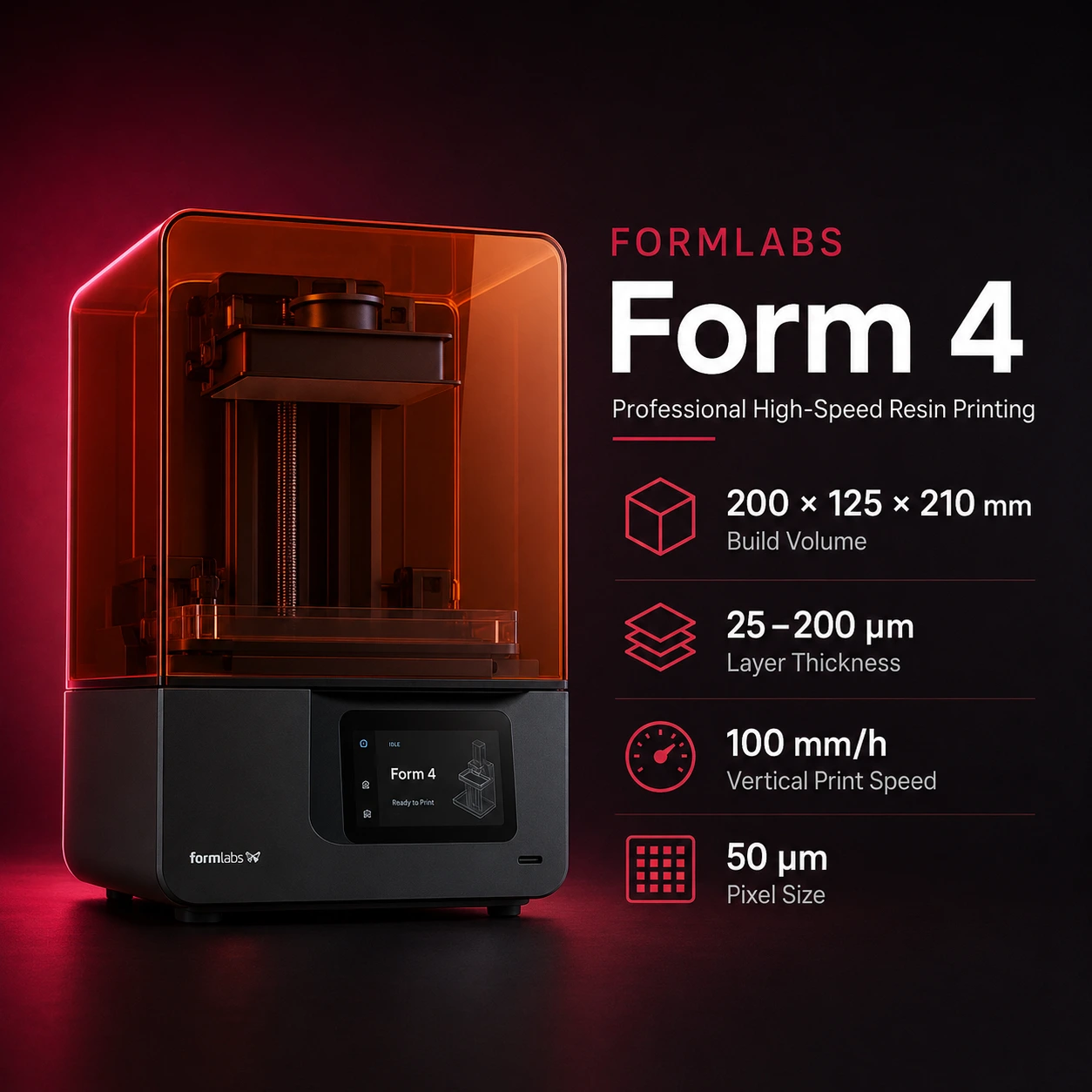
The indexed Formlabs Form 4 is better suited to high-detail photopolymer parts and applications where resin-specific surface finish or fine features matter most.
Fuse X1 instead prioritizes:
For broader platform comparisons, use the Print3DIndex comparison tool.
Fuse X1 is industrial equipment.
Current detailed specifications list:
Recommended use: Choose Fuse X1 when large-format nylon SLS, dense batch production, industrial throughput, and support-free thermoplastic manufacturing justify a dedicated powder-bed production workflow. Smaller organizations or teams with lower throughput requirements may find Fuse 1+ 30W more economical.
330 × 330 × 565 mm, providing 61.5 L of addressable build volume.
Formlabs states that parts up to approximately 713 mm long can fit when positioned diagonally.
110 µm.
A 120 W ytterbium fiber laser operating at 1064 nm.
Formlabs publishes throughput up to 0.330 kg of sintered material per hour. SLS throughput is more meaningful than an FDM-style mm/s speed.
No. Unsintered powder supports the parts during printing.
Nylon 12 Powder is available at launch. Nylon 11 is planned by the end of 2026, while Nylon 12 GF and TPU 90A are planned by June 2027.
Yes, through Open Material Mode for compatible 1064 nm SLS powders, subject to process validation.
Yes. Formlabs lists a nitrogen print environment and an interface to an external inert-gas supply.
It is Formlabs' computer-vision and thermal-monitoring system that detects anomalies and can mask affected regions or parts during subsequent layers to protect the rest of a build.
PreForm.
Dual-band Wi-Fi, Gigabit Ethernet, and USB-C mass-storage transfer.
Formlabs lists hardware starting at US$84,999.
It can be ordered now, but Formlabs states that customer deliveries begin in Q4 2026.