NewaddedIndustrialNext-GenUltra-High-Temperature FFF150°C Heated ChamberHigh-Performance Polymer Printing
RR3 Printing
R3 Printing
# R3 Printer Ultra
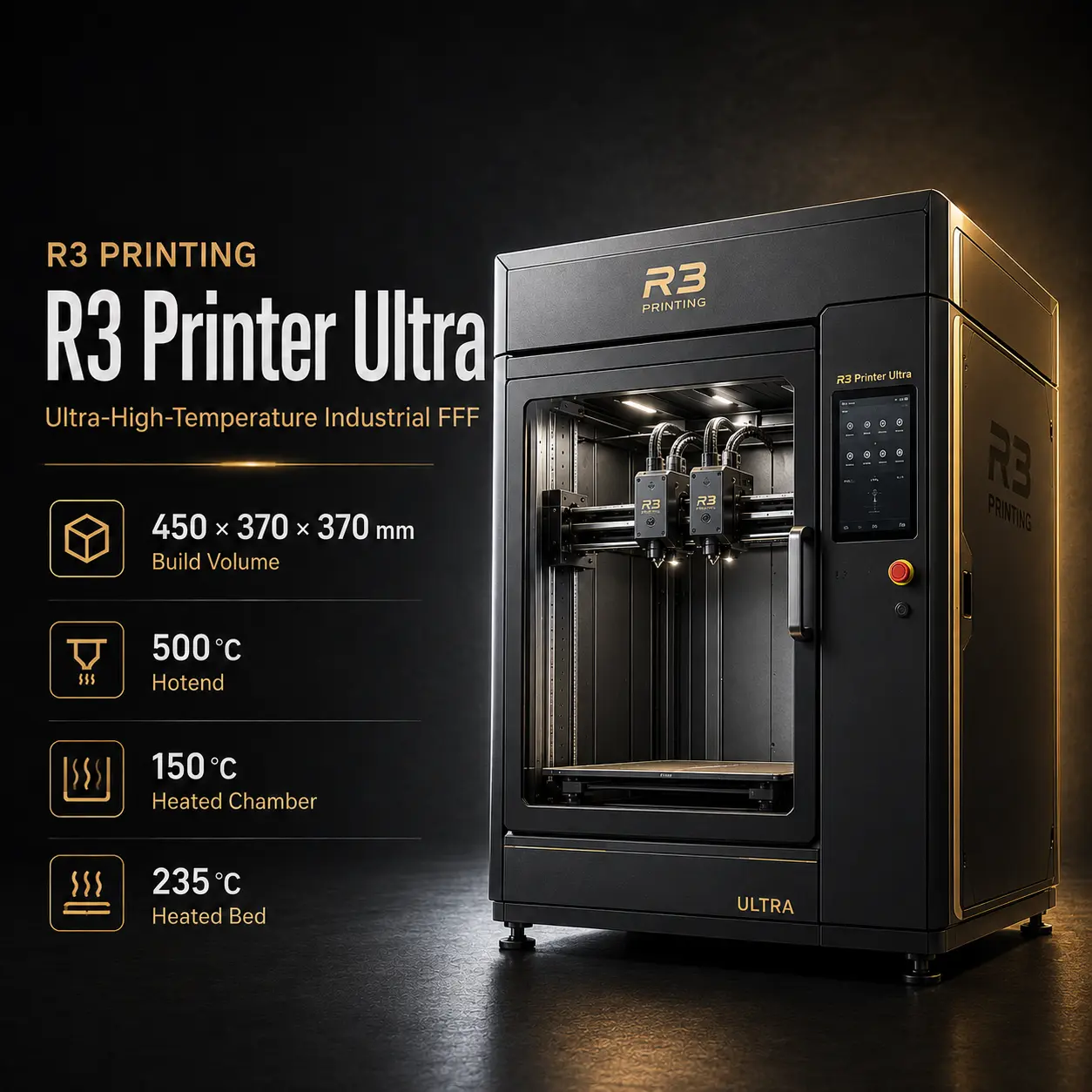
The R3 Printer Ultra is an industrial dual-nozzle FFF system designed for ultra-high-temperature thermoplastics and demanding production environments. Its core thermal specification is substantially beyond typical enclosed desktop printers: 500°C maximum nozzle temperature, 235°C maximum build-plate temperature, and a 150°C actively heated build chamber.
R3 Printing pairs that thermal platform with a 450 × 370 × 370 mm build volume, dual-nozzle printing with inactive-nozzle lift, a liquid-cooled printhead, automatic first-layer and printhead calibration, hardened-steel nozzles, and an open material system.
The manufacturer specifically lists PEEK, PEKK, PEI/Ultem, TPI, PSU, PES, and PPSU alongside lower-temperature engineering materials such as PPS, PPA/HTN, PVDF, PC, PA/Nylon, ASA, ABS, and reinforced polymers.
The printer is designed and built in the United States and is currently listed by R3 Printing at US$49,500, with shipping scheduled to begin August 31, 2026.
For current technical and purchasing information, see the official R3 Printer Ultra page.
| Specification | Value |
|---|---|
| Printing technology | FFF |
| Printhead | Dual nozzle with inactive-nozzle lift |
| Build volume | 450 × 370 × 370 mm |
| Maximum nozzle temperature | 500°C |
| Maximum chamber temperature | 150°C |
| Maximum build-plate temperature | 235°C |
| Layer height | 0.05–1.0 mm |
| Default layer height | 0.20 mm |
| Published X/Y resolution | ±150 µm |
| Standard nozzle diameter | 0.4 mm |
| Supported nozzle diameters | 0.25–1.4 mm |
| Nozzle material | Abrasion-resistant hardened steel with non-stick coating |
| Filament diameter | 1.75 mm |
| Dual-material printing | Yes |
| Build plate | Removable spring steel with matte high-temperature coating |
| Machine dimensions | 605 × 585 × 770 mm |
| Machine weight | 70 kg |
| Chassis | 5052-H32 aluminum exoskeleton |
| Electrical input | 120 V AC, 20 A required |
| Frequency | 50–60 Hz |
| Connectivity | Ethernet, Wi-Fi, USB |
| Cloud requirement | None |
| Supported file types | STL, OBJ, AMF, 3MF, STEP |
| Country of manufacture | United States |
Critical specification note: R3 Printing publishes ±150 µm as X/Y resolution. That should not be interpreted as a guaranteed ±0.15 mm finished-part dimensional accuracy. Final part accuracy depends on material shrinkage, thermal history, calibration, geometry, slicing, nozzle condition, and print orientation.
Speed note: R3 Printing does not currently publish a standardized maximum print speed in mm/s for the R3 Printer Ultra. The catalog therefore leaves `maxPrintSpeedMmS` as `null`.
The R3 Printer Ultra is built around sustained elevated temperatures rather than simply a high-temperature nozzle.
Its thermal envelope is:
That combination matters because high-performance polymers such as PEEK, PEKK, and PEI require more than hot extrusion. Large temperature gradients can produce warping, residual stress, cracking, weak layer bonding, or dimensional instability.
A high chamber temperature helps reduce those gradients while the heated build surface supports first-layer adhesion and thermal consistency.
The system's liquid-cooled printhead is intended to keep the upper extrusion path within a controlled operating range even while the nozzle and chamber are extremely hot.
R3 Printing specifically lists the following ultra-performance polymers for the Ultra:
These materials are used when conventional thermoplastics cannot meet the required combination of temperature resistance, chemical resistance, mechanical performance, flame behavior, or long-term service conditions.
The printer's thermal capability makes these materials technically processable, but successful printing still depends on the exact filament grade.
Different PEEK, PEKK, and PEI formulations can require different:
Important: Printer capability does not guarantee that every grade of PEEK, PEKK, or PEI will produce equivalent mechanical performance. Use the filament manufacturer's processing and qualification data for the exact grade being printed.
R3 Printing also lists a broad range of lower-temperature materials:
This breadth is useful in production environments where one machine may need to move between commodity polymers, engineering materials, support materials, and ultra-performance thermoplastics.
For lower-temperature engineering work, compare indexed materials such as Prusament ASA, Prusament PC Blend Carbon Fiber, and Prusament PA11 Carbon Fiber.
The Ultra's thermal capability exceeds what those materials require, but its open-material architecture allows the machine to cover both conventional and extreme-temperature workflows.
R3 Printing explicitly lists reinforced-material capability, including carbon- and glass-fiber-filled polymers.
The standard nozzle material is:
Abrasion-resistant hardened steel with a non-stick coating
This is important because reinforced polymers can rapidly wear conventional brass nozzles.
The supported nozzle range of 0.25–1.4 mm also gives users flexibility to choose larger nozzles for heavily filled materials where clogging risk or high throughput matters more than very fine feature size.
Recommended use: Match nozzle diameter to the fiber length and filler loading specified by the filament manufacturer rather than assuming every reinforced material is appropriate for the default 0.4 mm nozzle.
The Ultra uses a dual-nozzle printhead with an inactive-nozzle lift mechanism.
Supported workflows include:
Lifting the inactive nozzle reduces the chance that an unused nozzle will drag across the current layer or interfere with the print.
This architecture is particularly useful for soluble or breakaway support materials, or when combining two polymers with different functional roles.
Material pairing still needs compatible thermal behavior. A dual-nozzle machine cannot solve fundamental incompatibilities in bed temperature, chamber temperature, adhesion, or polymer shrinkage.
R3 Printing lists both:
These functions are especially important on a dual-nozzle industrial machine because nozzle-to-bed and nozzle-to-nozzle alignment directly affect first-layer consistency and multi-material registration.
Automation can reduce operator setup time, but it does not remove the need for routine inspection of:
The Ultra includes several monitoring functions aimed at long production runs:
These systems are particularly relevant when running a 150°C chamber because electronics, filament feeds, motors, seals, and printhead components experience more severe thermal conditions than on conventional desktop printers.
These monitoring functions are production safeguards rather than guarantees against every failure.
R3 Printing specifies rapid nozzle changes without tools.
Supported diameters range from:
Smaller nozzles favor fine geometry and thin walls, while larger nozzles can improve throughput and reduce clogging risk with some fiber-filled materials.
The selected nozzle must remain compatible with the filament's filler size, extrusion temperature, and production goals.
One of the Ultra's strongest industrial advantages is its open, non-proprietary material architecture.
Users are not limited to a closed cartridge or manufacturer-only filament catalog.
That can be valuable for:
Open material access also places more responsibility on the user to validate process settings, drying, thermal treatment, and part performance.
The Ultra uses a removable spring-steel build plate with a matte high-temperature coating.
R3 Printing publishes the printable build volume as 450 × 370 × 370 mm but does not separately publish the physical X/Y dimensions of the removable build plate.
For that reason, `buildPlateX` and `buildPlateY` are left `null` rather than assuming that the physical plate dimensions are exactly equal to the printable area.
The supported layer-height range is:
The 50 µm value represents minimum published layer height, so `layerResolutionMicrons` is correctly set to `50`.
The separately published ±150 µm X/Y resolution is a different metric.
Neither value should be presented as a universal finished-part dimensional tolerance.
The Ultra supports:
R3 Printing states that cloud or internet access is not required and that all functions can operate without an internet connection.
This is particularly relevant to:
For regulated or security-sensitive deployment, network architecture and cybersecurity should still be reviewed according to the organization's own IT requirements.
R3 Printing lists:
STEP support is useful for CAD-centered manufacturing workflows, though import and preparation behavior should be validated before standardizing a production pipeline.
The Ultra requires:
R3 Printing explicitly states that a 20-amp outlet is required.
This is a more substantial electrical requirement than a typical desktop printer and should be considered during facility planning.
The current official page does not publish a separate wattage figure, so the catalog should not derive a nominal wattage simply by multiplying circuit voltage and amperage.
A 20 A branch-circuit requirement is an installation specification, not necessarily the machine's continuous power draw.
Machine dimensions are:
605 × 585 × 770 mm
Machine weight is:
70 kg
The chassis uses a 5052-H32 aluminum exoskeleton.
At 70 kg, the Ultra should be installed on a suitably rated industrial workbench or stand with adequate service clearance, ventilation, filament-drying space, and access to the required 20 A electrical circuit.
PEEK, PEKK, PEI, PA, PPA, PPS, PPSU and related polymers can be highly sensitive to moisture.
Material drying and dry storage can be as important as nozzle or chamber temperature.
Poorly conditioned filament can cause bubbles, surface defects, weak layers, stringing, dimensional inconsistency, and reduced mechanical performance. Drying conditions should come from the exact filament supplier rather than from one universal printer setting.
High-temperature FFF printing can produce fumes, particulates, and thermal degradation products whose composition depends on the polymer and processing temperature.
Use appropriate room ventilation, material-specific SDS guidance, suitable filtration where required, heat-resistant handling procedures, and proper PPE during maintenance or machining of reinforced parts. A 150°C chamber and 235°C plate also create significant burn hazards.
The standard R3 Printer is designed for advanced engineering materials but stops below the Ultra's thermal range.
| Feature | R3 Printer Ultra | Standard R3 Printer |
|---|---|---|
| Build volume | 450 × 370 × 370 mm | 450 × 370 × 370 mm |
| Max chamber temperature | 150°C | 90°C |
| Max build-plate temperature | 235°C | 155°C |
| Ultra-performance polymers | PEEK, PEKK, PEI/Ultem, TPI, PSU, PES, PPSU | Not positioned for the Ultra material group |
| Reinforced polymers | Yes | Yes |
| Power requirement | 120 V, 20 A required | 120 V, 15 A; 20 A recommended |
| Current price | US$49,500 | US$29,500 |
Choose the standard model when the target materials are primarily ABS, ASA, PC, PA, PPS, PPA, PVDF, or reinforced engineering polymers.
Choose the Ultra when the application genuinely needs the higher chamber and plate temperatures associated with PEEK, PEKK, PEI/Ultem, and similar ultra-performance polymers.
The R3 Printer Ultra occupies a very different class from mainstream enclosed desktop printers.
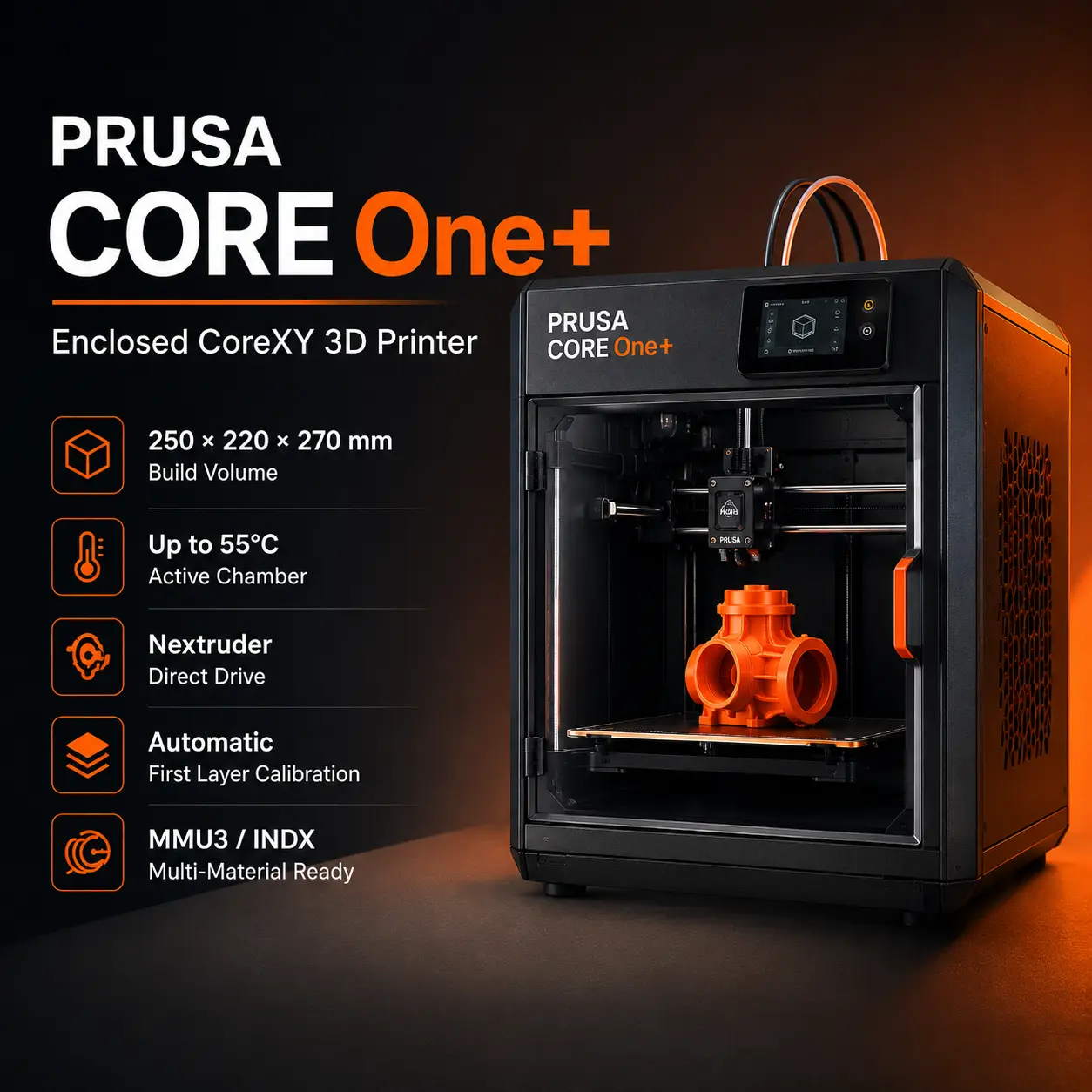
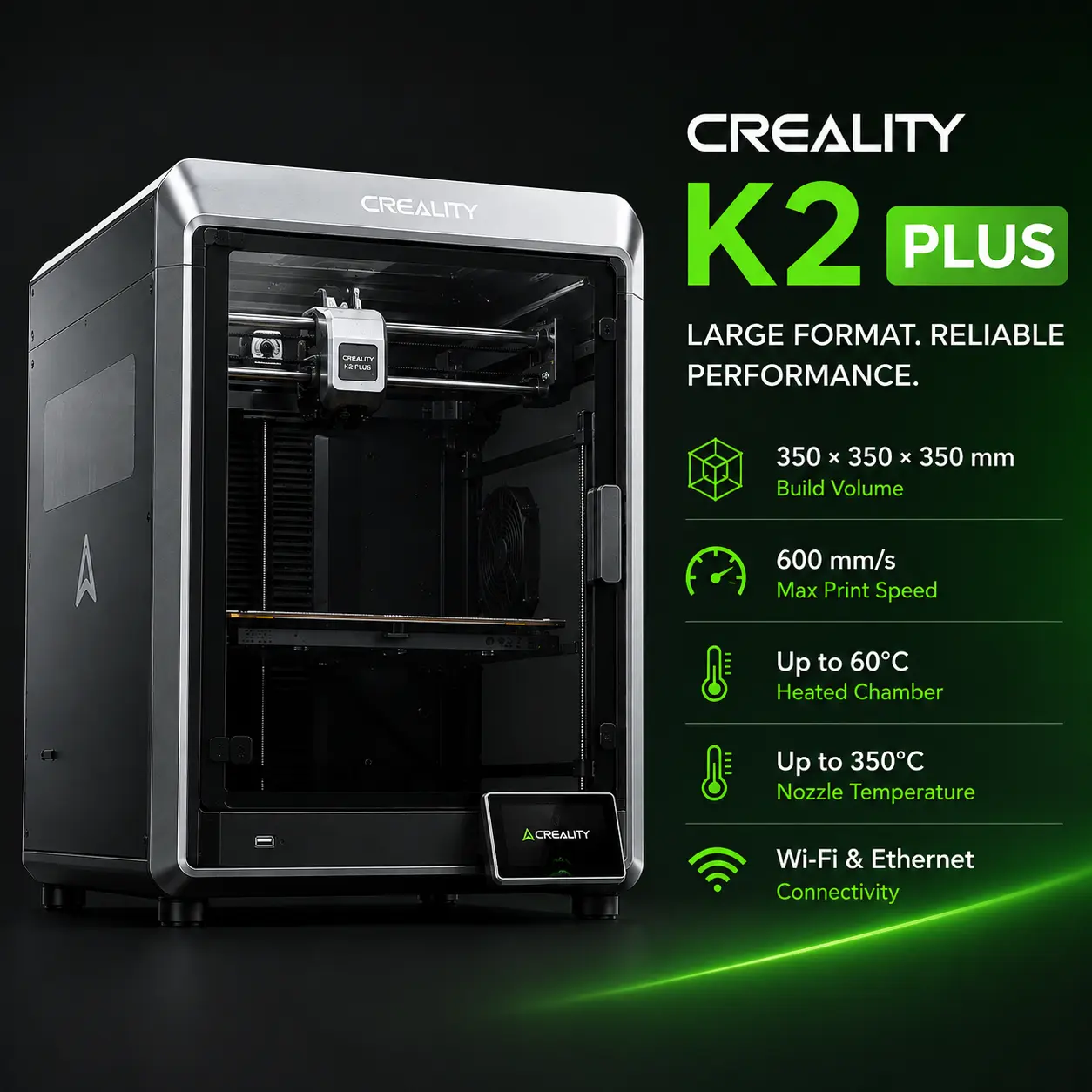
For context, the Bambu Lab H2D, Creality K2 Plus, and Prusa CORE One+ are capable engineering-material platforms, but their temperature envelopes are aimed at lower-temperature thermoplastics rather than 150°C-chamber PEEK-class production.
Those machines may be better choices for ordinary ABS, ASA, PA, PC, and selected composite work when the Ultra's high-temperature capability is unnecessary.
R3 Printing currently lists the R3 Printer Ultra at US$49,500.
The official purchase page states:
Shipping on August 31, 2026
Because the current date is before that first shipping date, this listing remains `"coming_soon"` rather than treating the machine as already normally shipping.
The product can currently be ordered directly from R3 Printing.
Check the official R3 Printer Ultra purchase page immediately before publication for shipping status or pricing changes.
Recommended use: Choose the R3 Printer Ultra when the production requirement genuinely includes PEEK, PEKK, PEI/Ultem, PPSU, PSU, PES, or similarly demanding polymers and when open-material access, dual-nozzle support printing, a 150°C chamber, and industrial offline networking justify the investment. For lower-temperature engineering materials, the standard R3 Printer or a less expensive enclosed engineering platform may be more economical.
R3 Printing specifies a 450 × 370 × 370 mm printable build volume.
500°C.
The chamber is actively heated up to 150°C.
235°C.
Yes. R3 Printing explicitly lists PEEK and PEKK along with PEI/Ultem, TPI, PSU, PES, and PPSU.
Yes. R3 Printing explicitly lists carbon- and glass-fiber-reinforced material capability, and the printer uses abrasion-resistant hardened-steel nozzles.
0.05–1.0 mm, with 0.20 mm listed as the default.
No. R3 Printing labels ±150 µm as X/Y resolution. It should not be interpreted as a guaranteed finished-part tolerance.
0.25–1.4 mm, with 0.4 mm as the default.
Yes. R3 Printing lists primary-plus-support, dual-material, and dual-color workflows.
No. R3 Printing states that all functions are available without internet access.
Ethernet client and direct/point-to-point modes, Wi-Fi client and access-point modes, WPA3-Enterprise, and USB.
R