Futuristic500 W Fiber LaserAdjustable Laser BeamInert Gas ProcessingOpen Process ParametersLayer-by-Layer MonitoringCompact Metal Research Platform
LLasefinity
Lasefinity
# Lasefinity Fusion X
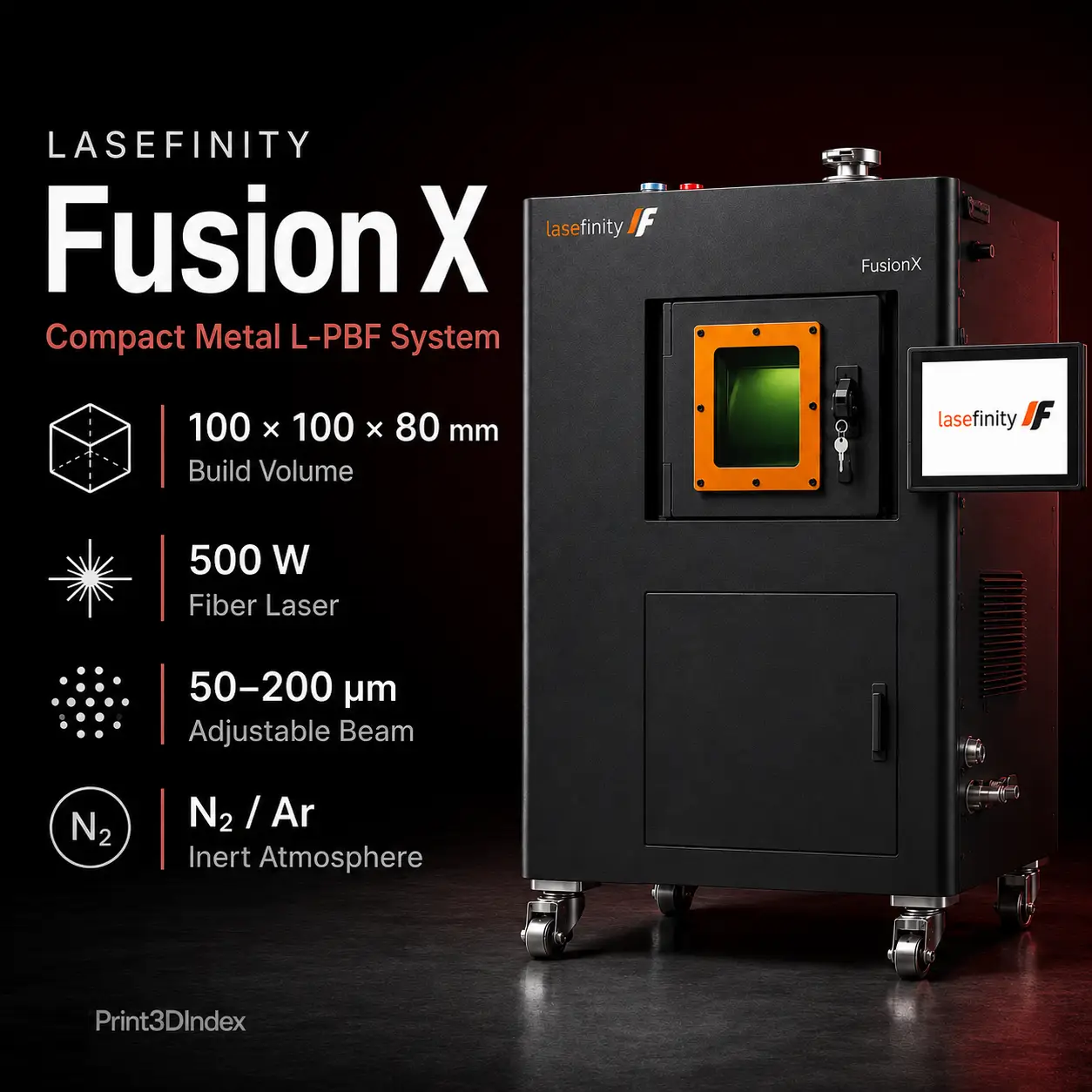
The Lasefinity Fusion X (FX-500) is a compact industrial Laser Powder Bed Fusion (L-PBF) metal 3D printer developed by Sheffield-based Lasefinity. It is aimed at research laboratories, universities, alloy-development teams, engineering groups, and smaller manufacturers that need direct metal fusion without the footprint of a full-size production L-PBF platform.
The standard FX-500 combines a 100 × 100 × 80 mm build volume with a 500 W fiber laser and an adjustable 50–200 µm beam spot. Lasefinity positions the variable beam as a process-development tool: a smaller spot can support finer localized processing, while a larger spot can be used when energy distribution and throughput are more important.
The build chamber operates under nitrogen or argon, with the manufacturer specifying oxygen levels below 500 ppm during processing. An upper-feed soft-blade recoater spreads powder between layers, while integrated monitoring tracks laser power, scan speed, chamber atmosphere, and powder-spread quality.
The current machine footprint is 600 × 650 × 860 mm at approximately 120 kg, making Fusion X unusually compact for a true metal powder-bed-fusion system. Lasefinity currently lists the system from £24,999, including commissioning support, a two-day operator-training program, a 12-month warranty, and its Layer Slicing software.
For current specifications and ordering, see the official Lasefinity Fusion X page. For independent launch coverage, see TCT Magazine's Fusion X launch report.
| Specification | Value |
|---|---|
| Printing technology | Laser Powder Bed Fusion (L-PBF) |
| Model | Fusion X / FX-500 |
| Build volume | 100 × 100 × 80 mm |
| Laser | 500 W fiber laser |
| Adjustable beam spot | 50–200 µm |
| Protective atmosphere | Nitrogen or argon |
| Chamber oxygen | Below 500 ppm manufacturer specification |
| Recoating | Upper-feed soft blade |
| Process monitoring | Integrated real-time layer-by-layer monitoring |
| Monitored conditions | Laser power, scan speed, chamber atmosphere, powder spread |
| Filtration | HEPA-grade, ≥30,000-hour manufacturer-rated lifetime |
| Software | Lasefinity Layer Slicing |
| Supported input formats | STL, STEP |
| Machine dimensions | 600 × 650 × 860 mm |
| Machine weight | 120 kg |
| Published power output | 1.5 kW |
| Current listed price | From £24,999 |
| Warranty | 12 months |
| Included support | Commissioning + two-day operator training |
The 500 W laser can vary its beam spot from 50 to 200 µm. Beam diameter affects energy density, melt-pool geometry, scan strategy, and potential productivity.
A smaller spot can support finer localized energy delivery; a larger spot can distribute energy across more area. The smallest spot should not be interpreted as dimensional accuracy.
Final part quality depends on the full parameter set, including layer thickness, scan speed, hatch spacing, power, contour strategy, powder characteristics, recoating, thermal history, supports, and alloy behavior.
Lasefinity does not currently publish one universal dimensional-accuracy figure for Fusion X.
TCT's launch coverage reports that Fusion X is open to third-party consumables and user-developed process parameters.
That makes it relevant to:
An open platform gives research teams more control but also places more responsibility on the user for process qualification, traceability, and safety.
Lasefinity currently lists:
Powder chemistry, particle-size distribution, morphology, flowability, oxygen content, layer thickness, atmosphere, laser settings, and post-processing all influence final density and properties.
Fusion X supports nitrogen or argon and is specified to maintain oxygen below 500 ppm during processing.
Argon capability is important for titanium and other reactive alloys.
Reactive-metal powder workflows still require professional powder handling, grounding, housekeeping, PPE, fire-risk controls, inert-gas safety, and appropriate facility procedures. A compact machine does not make titanium powder a consumer-safe material.
The upper-feed soft-blade recoater spreads powder between layers.
Recoating quality is critical because uneven powder can contribute to lack of fusion, layer streaks, collisions, density variation, or build interruption.
Fusion X also integrates real-time monitoring of:
Lasefinity advertises a ≥30,000-hour HEPA-grade filter lifetime.
That should be treated as a manufacturer service-life claim for the filtration system, not a guarantee that the complete machine can operate for 30,000 hours without maintenance.
Optics, recoater components, seals, gas systems, sensors, and powder-contact surfaces still require inspection and service.
Lasefinity Layer Slicing is the supplied build-preparation software.
The manufacturer lists:
STEP support can reduce conversion steps for some engineering workflows, although the final L-PBF build still depends on triangulation, supports, orientation, and process parameters.
Fusion X belongs to the broader laser metal powder-bed-fusion family.
Common search terms include:
L-PBF is the standards-oriented generic term.
This is fundamentally different from bound-metal filament printing. Fusion X directly fuses metal powder during the build rather than producing a binder-rich green part that later requires sintering.
L-PBF parts usually require downstream work such as:
| Printer | Build Volume | Laser | Beam / Spot | Layer Range | Main Positioning |
|---|---|---|---|---|---|
| Lasefinity Fusion X FX-500 | 100 × 100 × 80 mm | 500 W | 50–200 µm adjustable | Not currently published | Compact open research / production |
| One Click Metal MPRINTpro | 150 × 150 × 150 mm | 500 W | 80 µm | 20–120 µm | Accessible industrial LPBF ecosystem |
| Xact Metal XM200G | 150 × 150 × 150 mm | 100 / 200 / 400 W; single or dual | 50 / 100 µm | Parameter-dependent | Configurable affordable metal production |
| Farsoon FS121M | 120 × 120 × 100 mm | 500 W | Not listed in current sheet | 20–80 µm | Open industrial small-frame LPBF |
| AconityMINI | Ø140 × 190 mm class | Highly configurable | 80 µm F-Theta; variable options | Configuration-dependent | Advanced research and process development |
The Lasefinity Fusion X vs One Click Metal MPRINTpro comparison is highly relevant for laboratories and smaller manufacturers.
The One Click Metal MPRINTpro provides a 150 × 150 × 150 mm build volume, 500 W fiber laser, 80 µm focus diameter, and 20–120 µm layer range. One Click Metal also offers interchangeable standard, heated, extended, and laboratory build modules.
MPRINTpro is much larger and heavier at roughly 500 kg and is designed as part of a broader powder-handling ecosystem.
Fusion X is smaller at 120 kg with a 100 × 100 × 80 mm build area. Its differentiators are the adjustable 50–200 µm beam, much smaller footprint, and lower published entry price.
Choose MPRINTpro for build volume and an established integrated ecosystem. Choose Fusion X for compact installation, low powder use, adjustable beam size, and acquisition cost.
The Xact Metal XM200G provides a 150 × 150 × 150 mm standard build volume and can be configured with one or two lasers at 100, 200, or 400 W.
Xact Metal offers 50 or 100 µm spot sizes, reactive and non-reactive configurations, open materials, open parameters, and optional glovebox hardware.
Fusion X has a smaller volume but a more powerful standard 500 W laser and adjustable 50–200 µm beam.
Choose XM200G for a mature configurable platform, larger build area, and broader powder-handling options. Choose Fusion X for higher standard laser power, compact footprint, and lower advertised entry price.
The Farsoon FS121M is a close compact industrial comparison.
Farsoon publishes a 120 × 120 × 100 mm build cylinder, 500 W fiber laser, 20–80 µm layer thickness, up to 10 m/s scan speed, nitrogen or argon processing, and open machine parameters.
FS121M is much larger at about 780 × 1000 × 1700 mm and roughly 700 kg.
Choose FS121M for an established industrial platform with a published layer range and mature software/service ecosystem. Choose Fusion X for a far smaller footprint, lower price, and adjustable beam.
The Fusion X vs AconityMINI comparison is most relevant to advanced research.
The AconityMINI supports build-space configurations around Ø140 × 190 mm, laser configurations from hundreds of watts into multi-kilowatt options, and preheating configurations up to 500°C or 800°C with reduced build diameters.
Aconity is substantially more configurable for exotic materials, beam shaping, preheating, and custom research.
Fusion X offers a simpler buying proposition: 500 W, 100 × 100 × 80 mm, adjustable 50–200 µm beam, and current pricing from £24,999.
Choose AconityMINI for deep research customization. Choose Fusion X when a compact open-parameter system with simpler deployment is sufficient.
The Lasefinity Fusion X starts from £24,999 in the UK, approximately US$34,078 in the United States, €29,190 in Europe, C$46,972 in Canada, A$47,889 in Australia, ₹3,262,980 in India, and AED 125,226 in the UAE. Actual regional pricing may vary depending on local taxes or VAT, import duties, shipping, exchange rates, availability, and distributor pricing.
Laser Powder Bed Fusion, or L-PBF.
100 × 100 × 80 mm.
A 500 W fiber laser.
It is the adjustable laser beam/spot diameter, not layer thickness or accuracy.
316L stainless steel, Ti-6Al-4V, pure titanium, Inconel 625, Inconel 718, maraging steel, cobalt-chrome, high-entropy alloys, and custom alloys.
Yes. The system supports argon, and Lasefinity lists titanium materials.
Below 500 ppm during processing.
Launch coverage emphasizes open consumables and user-developed process parameters.
Yes. Lasefinity lists laser-power, scan-speed, chamber-atmosphere, and powder-spread monitoring.
Lasefinity Layer Slicing.
STL and STEP.
It belongs to the same broader laser metal powder-bed-fusion family; L-PBF is the generic standards-oriented term.
Yes. The small build volume, open process positioning, 500 W laser, and variable beam make research a core use case.
Yes for small direct-metal parts and low-volume work, but the 100 × 100 × 80 mm build envelope limits part size.
Lasefinity currently lists Fusion X from £24,999 · US$34,078 · €29,190 EUR · C$46,972 CAD · A$47,889 AUD · ₹3,262,980 INR · AED 125,226. Actual regional pricing may vary with taxes, import duties, shipping, exchange rates, availability, and distributor pricing.