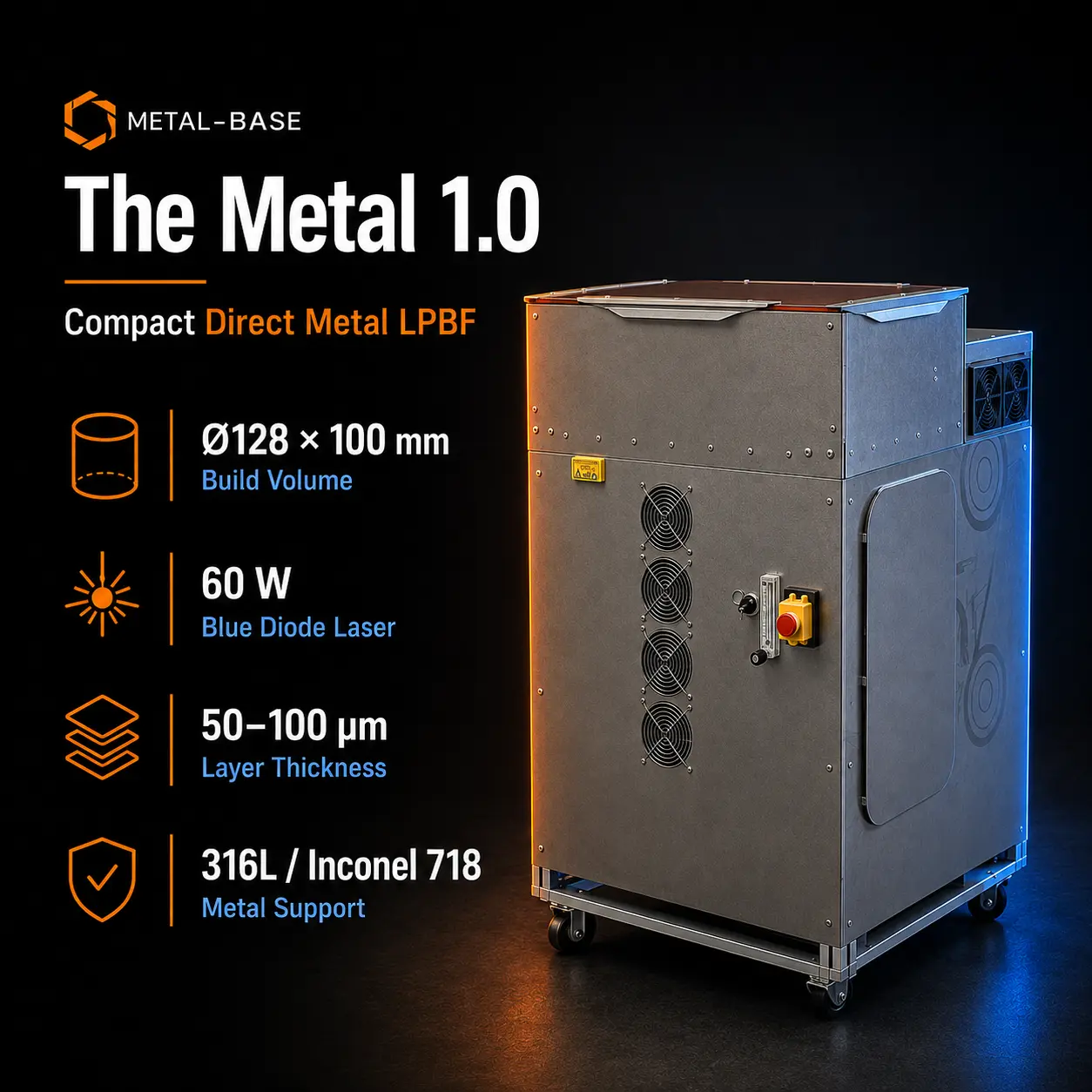
Affordable Blue Laser LPBFDirect Metal LPBF60 W Blue Diode LaserOpen Process ControlNitrogen Atmosphere Printing50 to 100 Micron LayersCompact Metal Research Platform
MMetal-Base
Metal-Base
# Metal-Base The Metal 1.0
The Metal-Base The Metal 1.0 is a compact floor-standing Laser Powder Bed Fusion (LPBF) metal 3D printer developed to lower the entry cost of direct metal powder-bed fusion for laboratories, startups, R&D teams, universities, and small manufacturing groups.
Unlike bound-metal filament systems, The Metal 1.0 fuses metal powder directly during the build. Its current production design uses a 60 W, 445 nm blue diode laser on an XY gantry, a cylindrical Ø128 × 100 mm standard build area, and typical 50–100 µm layers. An optional Z-axis upgrade increases the build height to 150 mm.
The machine uses mechanical recoating, nitrogen, oxygen monitoring, webcam monitoring, and an open Klipper + OrcaSlicer workflow. Metal-Base publishes approximately 1.5–2.5 cm³/h throughput and less than 800 W continuous power.
The Kickstarter campaign was funded in April 2026. Metal-Base plans backer shipments for October–November 2026, regular orders from October 2026, and first regular shipments for December 2026–January 2027. The base machine is €8,500 excluding VAT and requires roughly 20–30 hours of final assembly.
For current specifications and pricing, see the official Metal-Base printer page, Metal-Base safety guidance, and Metal-Base LPBF process guide. You can also browse the Print3DIndex metal 3D printer directory.
| Specification | Value |
|---|---|
| Printing technology | Laser Powder Bed Fusion (LPBF) |
| Motion system | XY gantry with stepper drives |
| Laser | 60 W blue diode |
| Laser wavelength | 445 nm |
| Standard build area | Ø128 × 100 mm |
| Optional build area | Ø128 × 150 mm |
| Typical layer thickness | 0.05–0.10 mm |
| Recoating | Mechanical thin-layer recoater |
| Powder handling | Supply + overflow bins |
| Protective atmosphere | Nitrogen |
| Nitrogen consumption | Approx. 6 L/min continuous |
| Throughput | Approx. 1.5–2.5 cm³/h, geometry-dependent |
| Connectivity | Wi-Fi + Ethernet |
| Monitoring | Webcam + oxygen monitoring |
| Process control | Live parameter tuning |
| Control platform | Klipper-based |
| Slicing | OrcaSlicer-based |
| Continuous electrical consumption | 800 W |
| Standard installation | Grounded standard outlet |
| Optional nitrogen generator air requirement | Approx. 80 L/min at 8 bar |
| Current base price | €8,500 excluding VAT |
| Base-printer assembly | Partly assembled; approx. 20–30 h remaining |
The Metal 1.0 takes a very different optical approach from conventional compact LPBF machines that use higher-power infrared fiber lasers.
Its 445 nm blue diode laser is mounted on an XY gantry rather than steered by a traditional galvanometer scanner.
Laser wattage alone does not predict density, feature size, or productivity; results also depend on spot size, scan strategy, powder chemistry, layer thickness, recoating, and atmosphere.
Metal-Base's own development history also shows the limits of the 60 W design. Aluminum did not process successfully, while copper remains a lower-density experimental material rather than a production-ready option.
Metal-Base currently positions these as its strongest materials:
The current printer page describes both as near-full-density workflows.
Metal-Base has published third-party tensile testing from the University of Zagreb showing roughly 607 MPa UTS, 434 MPa yield strength, and 49% total elongation on tested as-built 316L specimens. These results do not guarantee every build or powder batch.
Bronze is supported, but current detailed data reports about 80–90% density and 300–320 MPa tensile strength on tested samples, so it should not be described as near-full-density LPBF without qualification.
Copper remains experimental / under development.
Metal-Base currently publishes relatively low measured density for its copper trials and does not position it alongside 316L and Inconel as a mature production material.
SS CX / Corrax is also listed as under development.
This is a major safety limitation.
Metal-Base's current safety guidance explicitly prohibits reactive powders such as titanium and aluminum in The Metal 1.0.
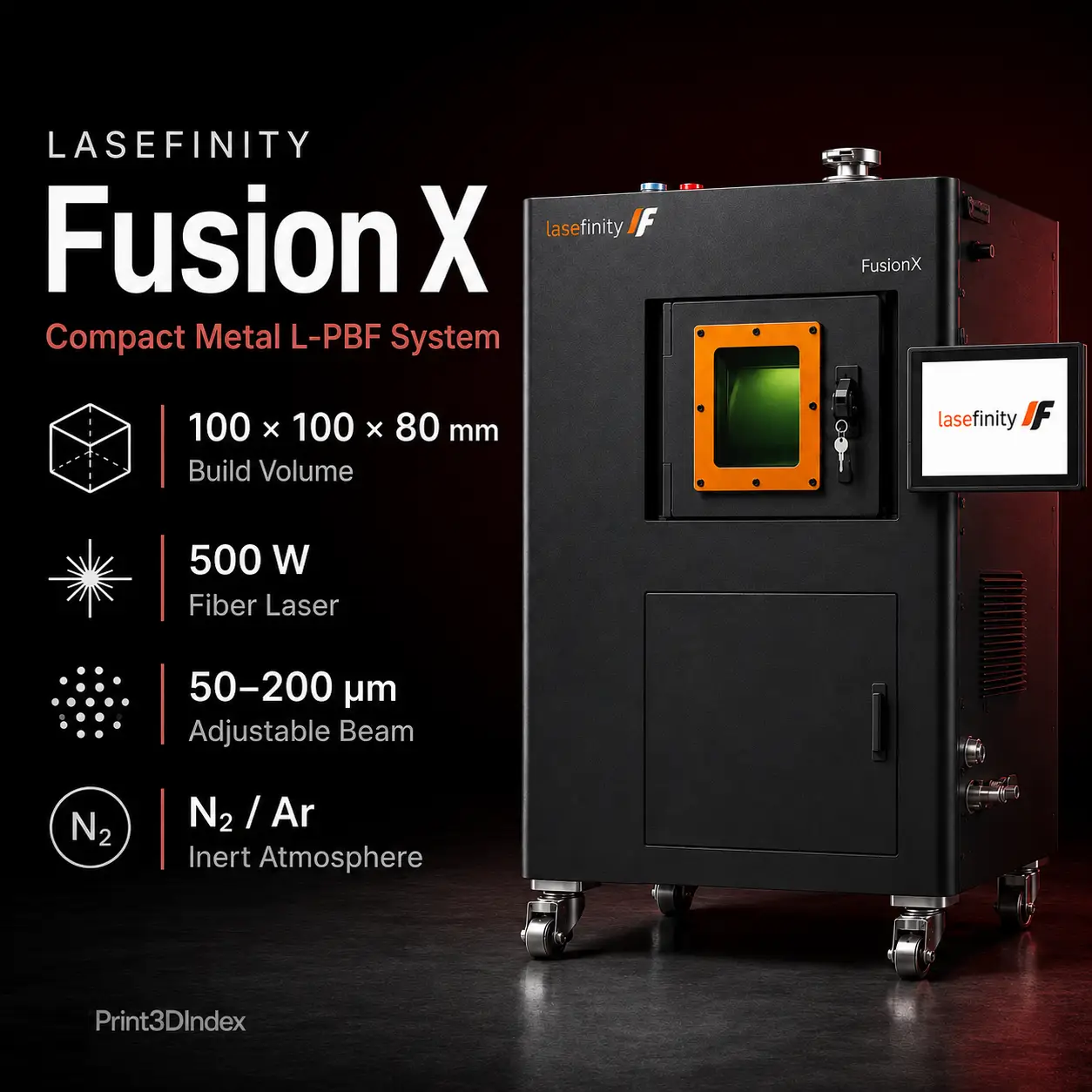
The machine therefore should not be positioned as a general-purpose titanium LPBF system. Buyers needing reactive alloys should compare it with the indexed Lasefinity Fusion X, which supports argon and titanium materials.
The Metal 1.0 uses nitrogen during printing and publishes approximately 6 L/min continuous nitrogen consumption.
Users can provide bottled nitrogen or purchase the optional nitrogen generator.
The optional generator requires approximately 80 L/min compressed air at 8 bar.
Metal-Base's current safety guidance says that when external nitrogen bottles are used, the room must be adequately ventilated because nitrogen accumulation can create an asphyxiation risk. An oxygen-depletion monitor is recommended for that setup.
The Metal 1.0 is an industrial powder-processing system even though it runs from standard electrical service.
Metal-Base describes the closed machine as a Class 1 laser product during normal operation, while the enclosure contains an internal Class 4 60 W laser source. Door interlocks disable the laser when the enclosure is opened.
Current manufacturer safety guidance also calls for:
This is not a consumer desktop appliance simply because the electrical demand is low.
One of The Metal 1.0's most distinctive features is its open software approach.
Metal-Base uses:
That suits R&D teams experimenting with scan paths, laser parameters, layer settings, and materials, but open access also increases responsibility for process qualification and safety.
The Metal 1.0 directly melts metal powder during printing.
That differs from bound-metal filament machines such as the indexed Kare S1, where metal powder is carried inside a polymer binder.
LPBF provides direct metallurgical consolidation; bound-metal extrusion reduces open-powder handling but adds debinding and sintering.
LPBF does not eliminate post-processing.
Typical work after printing may include:
No debinding or furnace sintering is required for basic LPBF consolidation, but many parts still need conventional metal post-processing.
| Printer | Build Volume | Laser | Layer Range | Reactive Metals | Main Positioning |
|---|---|---|---|---|---|
| Metal-Base The Metal 1.0 | Ø128 × 100 mm | 60 W, 445 nm blue diode | 50–100 µm | Titanium / aluminum prohibited | Lowest-cost open LPBF concept |
| Lasefinity Fusion X | 100 × 100 × 80 mm | 500 W fiber | Not published | Titanium supported with argon | Compact open research / production |
| One Click Metal MPRINTpro | 150 × 150 × 150 mm | 500 W fiber | 20–120 µm | Material/configuration dependent | Integrated accessible LPBF ecosystem |
| Xact Metal XM200G | 150 × 150 × 150 mm | 100 / 200 / 400 W fiber | 20–100 µm in published data | Reactive configuration available | Configurable affordable metal production |
| Farsoon FS121M | 120 × 120 × 100 mm | 500 W fiber | 20–80 µm | Titanium supported in current material data | Established compact industrial LPBF |
The Metal 1.0 competes on price, openness, standard electrical service, and low powder demand; it gives up laser power, reactive-metal support, and commercial maturity.
The Metal-Base The Metal 1.0 vs Lasefinity Fusion X comparison is one of the most useful current searches for affordable compact LPBF.
The indexed Lasefinity Fusion X uses a 500 W fiber laser, a 100 × 100 × 80 mm build volume, adjustable 50–200 µm beam size, nitrogen or argon atmosphere, and integrated layer-by-layer monitoring.
Fusion X starts at £24,999, versus €8,500 for the partly assembled Metal 1.0. Metal-Base offers lower power demand and a more open Klipper/OrcaSlicer workflow; Fusion X brings far higher laser power, titanium support, and a more turnkey industrial package.
Wait for The Metal 1.0 for low-cost non-reactive LPBF research and 316L/Inconel experimentation. Choose Fusion X when titanium, higher laser power, broader alloy development, and a more turnkey industrial package matter more.
The One Click Metal MPRINTpro provides a 150 × 150 × 150 mm build volume, 500 W fiber laser, 20–120 µm layer range, 80 µm focus diameter, nitrogen/argon operation, and interchangeable build modules.
Its ecosystem also includes dedicated powder-handling equipment and build modules, while Metal-Base targets much lower acquisition cost and simpler installation.
Choose MPRINTpro when an integrated industrial powder ecosystem, larger build volume, and 500 W laser capability are required. Choose The Metal 1.0 when cost, openness, compact installation, and low-volume R&D are more important.
The Xact Metal XM200G provides a 150 × 150 × 150 mm standard build volume and configurable 100, 200, or 400 W fiber lasers, with single- and dual-laser versions.
Published Xact Metal data includes 50 or 100 µm spot-size options, open materials, open parameters, and reactive/non-reactive configurations.
XM200G also offers higher throughput and a more established industrial service footprint.
Choose XM200G when performance, reactive materials, build volume, and industrial configuration options matter most. Choose The Metal 1.0 when the goal is the lowest practical entry cost into real LPBF experimentation.
The Farsoon FS121M is one of the closest build-size comparisons.
Farsoon publishes:
FS121M weighs roughly 700 kg, making Metal-Base far easier to place in a small workshop or lab.
Choose FS121M for established industrial deployment, higher laser power, titanium capability, and mature software/service support. Choose The Metal 1.0 for much lower cost and easier workshop installation.
From €8,500 · US$9,922 · £7,280 GBP · C$13,679 CAD · A$13,946 AUD · ₹949,832 INR · AED 36,442. Actual regional pricing may vary with VAT, taxes, import duties, shipping, exchange rates, availability, assembly options, and promotions.
Laser Powder Bed Fusion, using a 60 W blue diode laser to fuse metal powder layer by layer.
The standard cylindrical build volume is Ø128 × 100 mm. An optional upgrade increases Z height to 150 mm.
Metal-Base publishes a typical 0.05–0.10 mm range, or 50–100 µm.
A 60 W blue diode laser at 445 nm.
Approximately 1.5–2.5 cm³/h depending on geometry.
Metal-Base currently positions 316L stainless steel and Inconel 718 as its strongest near-full-density workflows.
Yes, but current detailed data shows lower density than 316L and Inconel, so bronze should not be treated as equivalent to the near-full-density workflows.
Copper is experimental / under development rather than a mature production material.
No. Metal-Base's current safety guidance explicitly prohibits titanium and aluminum powders.
No polymer-binder debinding or furnace sintering is required for normal LPBF consolidation. Other post-processing such as stress relief, machining, polishing, or heat treatment may still be needed.
Nitrogen.
Approximately 6 L/min continuously during printing.
Metal-Base states that it uses less than 800 W continuously and can operate from a standard grounded outlet. Exact AC input voltage is not published on the current specification page.
It uses standard electrical service, but it is still industrial laser and metal-powder equipment requiring proper PPE, ventilation, fire controls, and powder procedures.
Klipper-based machine control and an OrcaSlicer-based slicing workflow.
Kickstarter machines are scheduled for October–November 2026. Regular orders are planned to open in October, with first regular shipments targeted for December 2026–January 2027.
From €8,500 · US$9,922 · £7,280 GBP · C$13,679 CAD · A$13,946 AUD · ₹949,832 INR · AED 36,442. Actual regional pricing may vary with VAT, taxes, import duties, shipping, exchange rates, availability, assembly options, and promotions.