Fresh ConceptIntelligent DesignIndustrialRising StarNext-GenFuturistic550°C High-Temp Hotend150°C Heated ChamberPEEK Material SupportBound-Metal Filament PrintingCeramic-Filled Material ReadyWater-Cooled Toolhead
KKARE 3D
KARE 3D
# Kare S1
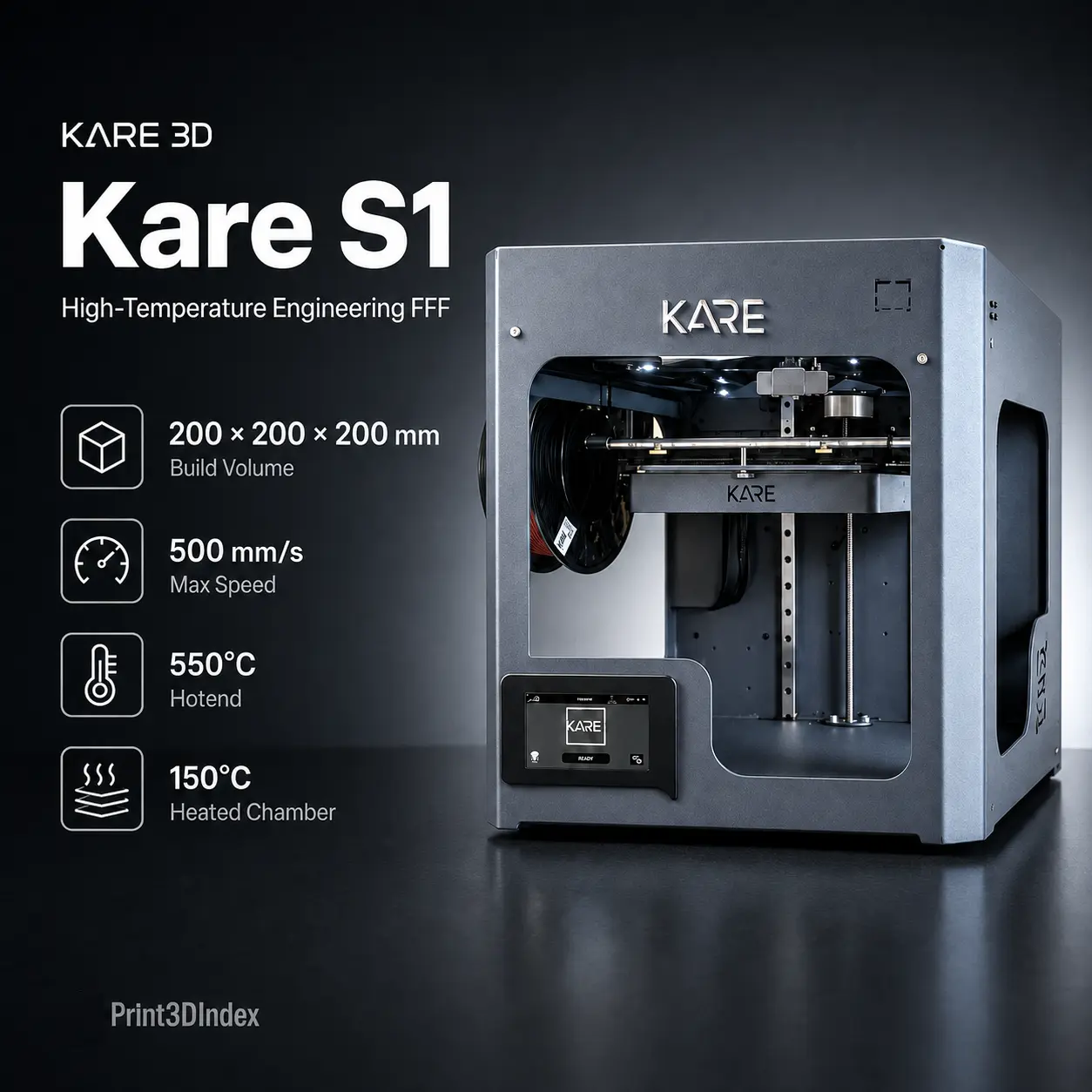
The Kare S1 is a compact, fully enclosed high-temperature FFF/FDM printer being developed by Istanbul-based Kare 3D. Its defining specification is an unusually aggressive desktop thermal envelope: a 550°C hotend, 150°C heated bed, and actively heated chamber advertised up to 150°C.
The standard S1 provides a 200 × 200 × 200 mm build volume. Kare positions it for ordinary thermoplastics, high-performance polymers such as PEEK, and bound-metal or ceramic filaments used in material-extrusion workflows.
The metal capability needs careful interpretation. The S1 does not melt solid metal like laser powder-bed fusion, binder jetting, or directed-energy-deposition systems. Metal-filled filament produces a polymer-bound green part that must be debound and sintered before it becomes a dense metal component. Shrinkage, distortion, furnace conditions, support strategy, and sintering process control all affect the final dimensions and properties.
Kare also advertises print speeds up to 500 mm/s, an Orbiter-style direct-drive extruder, water-cooled toolhead, 4.3-inch touchscreen, Wi-Fi connectivity, remote monitoring, and compatibility with Kare Slicer plus common third-party slicers.
The S1 remains a crowdfunding-stage product. Its Kickstarter campaign is scheduled to run through August 27, 2026, so the published hardware, price, delivery plan, and performance claims should be treated as pre-production specifications rather than established retail specifications.
For current campaign details, see the official Kare 3D Kickstarter campaign. For a broader comparison of high-performance engineering-material platforms, see Best 3D Printers for Carbon Fiber Materials.
| Specification | Value |
|---|---|
| Printing technology | FDM / FFF / material extrusion |
| Printer format | Fully enclosed high-temperature desktop |
| Build volume | 200 × 200 × 200 mm |
| Maximum print speed | Up to 500 mm/s manufacturer claim |
| Maximum nozzle temperature | 550°C |
| Maximum bed temperature | 150°C |
| Maximum chamber temperature | 150°C active heating |
| Extrusion | Direct drive |
| Extruder | Orbiter-style direct-drive system |
| Toolhead thermal management | Water cooled |
| Display | 4.3-inch touchscreen |
| Connectivity | Wi-Fi |
| Software | Kare Slicer; Cura and Simplify3D compatibility |
| Commercial status | Active Kickstarter Campaign |
A 550°C hotend gives the S1 an unusually high advertised temperature ceiling for a compact FFF printer.
That specification is relevant primarily to high-temperature polymers and research materials. PEEK and related PAEK materials require much more thermal control than PLA, PETG, ABS, or conventional nylon.
A high nozzle-temperature number by itself does not guarantee successful PEEK printing. Reliable PEEK production also depends on chamber temperature and uniformity, bed temperature, thermal insulation, hotend materials, sensor accuracy, heater stability, extrusion flow, filament drying, build-surface chemistry, and controlled cooling.
The S1's 150°C active chamber is therefore at least as important as the 550°C hotend when evaluating its high-performance-polymer potential.
Kare advertises the enclosed chamber at up to 150°C.
That is far above the chamber temperatures of most consumer and prosumer enclosed printers. For semi-crystalline polymers such as PEEK, a hotter and more uniform chamber can reduce thermal gradients, warping, cracking, and weak interlayer bonding.
Sustaining 150°C in a compact printer also creates significant engineering demands. Motors, bearings, wiring, connectors, sensors, lubricants, electronics, plastics, and insulation must tolerate the environment or be isolated from it.
The campaign does not currently publish a chamber-temperature map, heat-up time, measurement location, or long-duration uniformity data. Those factors will matter more than the headline maximum when judging production PEEK capability.
Kare specifically positions S1 for PEEK and other engineering thermoplastics.
PEEK is attractive for applications requiring high heat resistance, chemical resistance, mechanical strength, low flammability, and long-term dimensional stability.
PEEK printing is substantially more demanding than PLA or PETG. Material grade, chamber temperature, build-surface preparation, annealing, and cooling rate can materially change final properties.
The Kare S1 vs INTAMSYS FUNMAT HT comparison is one of the most relevant PEEK-printer searches.
The INTAMSYS FUNMAT HT is an established desktop high-temperature FFF platform with a 260 × 260 × 260 mm build volume, 450°C hotend, 160°C bed, and 90°C heated chamber. INTAMSYS publishes compatibility with PEEK, PEEK-CF, PEEK-GF, PEKK, PA-CF, PC, ABS, and other engineering polymers.
Kare S1 is smaller but advertises a substantially hotter 150°C chamber and 550°C hotend, plus a much higher 500 mm/s headline print speed.
The critical difference is maturity. FUNMAT HT has published manuals, material guidance, service documentation, and years of field use. Kare S1 is still crowdfunding.
Choose FUNMAT HT when validated PEEK workflows, service documentation, and established industrial support matter most.
The Kare S1 vs Apium P220 comparison is technically interesting because both platforms target high-performance polymers and metal-filled filament.
The historical Apium P220 specification lists:
That puts the P220 very close to the S1's thermal concept.
Apium P220 was an established industrial system with documented heating control and professional support. Its original product page is no longer active, although the platform remains in research use.
Kare S1 offers a larger cubic build area and much higher advertised motion speed, but still needs long-duration production validation.
The indexed Bambu Lab H2D represents a modern engineering printer rather than a true PEEK machine.
H2D provides:
Kare S1 has a much smaller build volume but a dramatically higher advertised chamber and nozzle ceiling.
For materials such as Bambu Lab PPS-CF, the H2D already provides a current, commercially available workflow with defined material profiles.
Choose H2D for an established, automated engineering-polymer ecosystem.
Wait for Kare S1 when PEEK-class temperature capability or bound-metal experimentation is a core requirement.
The indexed Prusa CORE One+ is a different type of engineering desktop printer.
CORE One+ provides a 250 × 220 × 270 mm build volume, 290°C standard hotend, 120°C bed, and 55°C active chamber control. It focuses on reliable ABS, ASA, PC, PA, reinforced polymers, repairability, open software, and long-term serviceability.
Kare S1 is much more thermally ambitious but also much less mature.
Choose CORE One+ for normal engineering thermoplastics, supportability, and a proven production ecosystem.
Wait for Kare S1 when the application genuinely requires temperatures beyond mainstream engineering FFF, particularly PEEK development or bound-metal research.
The phrase metal 3D printer can be misleading when applied to the S1.
Kare S1 uses bound-metal filament extrusion. The filament contains metal powder inside a polymer binder.
The workflow is:
The printed green part is not yet a finished metal component.
Forward AM's documented Ultrafuse metal-filament workflow follows the same general principle: printing is followed by debinding and sintering to obtain final metal properties.
This distinction matters when comparing Kare S1 metal printing vs direct metal laser sintering, Kare S1 vs metal powder-bed fusion, or metal FFF vs DMLS.
Metal-filled filament does not automatically require an ultra-high-temperature hotend.
For example, Forward AM's documented Ultrafuse 316L process used approximately 230–250°C nozzle temperatures before that material line was discontinued.
The real technical challenge in bound-metal extrusion is the complete process: green-part quality, binder removal, sintering atmosphere, furnace temperature, shrinkage compensation, part support, density, porosity, distortion, and final mechanical properties.
Kare's 550°C hotend is therefore more significant for PEEK and experimental high-temperature polymers than for conventional 316L-style metal-filled filament itself.
Bound-metal parts shrink during post-processing. Final dimensions depend on filament chemistry, binder system, print orientation, furnace cycle, geometry, and support strategy.
A professional workflow needs material-specific oversizing, controlled debinding and sintering, suitable furnace conditions, dimensional inspection, and process qualification. Kare's separate post-processing equipment is therefore part of the complete metal workflow rather than simple finishing hardware.
The S1 should not be compared as though it were a compact laser powder-bed-fusion machine.
Both can ultimately produce metal parts, but the manufacturing process is fundamentally different.
Kare uses water cooling to isolate the cold side of the extrusion system from a hotend rated to 550°C. Long-term pump, hose, seal, insulation, and thermal-cycling reliability will be important once production machines ship.
Kare advertises up to 500 mm/s, but that is a maximum motion claim rather than an expected PEEK or metal-filament production speed. Real throughput depends on volumetric flow, material viscosity, nozzle size, layer height, acceleration, geometry, and chamber conditions.
Kare positions the platform for:
The campaign also discusses stainless-steel bound-metal workflows.
Compatibility should be understood as campaign-stage material positioning, not a finalized list of qualified material profiles.
For users considering demanding carbon-fiber engineering polymers that are already commercially profiled, the indexed Bambu Lab PPS-CF illustrates how much drying, chamber control, nozzle selection, and process guidance can matter even below PEEK-class processing temperatures.
| Printer | Build Volume | Hotend | Bed | Chamber | High-Temp Positioning |
|---|---|---|---|---|---|
| Kare S1 | 200 × 200 × 200 mm | 550°C | 150°C | 150°C active | PEEK + bound-metal/ceramic crowdfunding platform |
| INTAMSYS FUNMAT HT | 260 × 260 × 260 mm | 450°C | 160°C | 90°C active | Established desktop PEEK platform |
| Apium P220 | 205 × 155 × 150 mm | 540°C | 160°C | Adaptive heating up to 180°C | Historical industrial PEEK + metal-filled platform |
| Bambu Lab H2D | Up to 350 × 320 × 325 mm | 350°C | 120°C | 65°C active | Commercial engineering polymers, PPS/PPA composites |
| Prusa CORE One+ | 250 × 220 × 270 mm | 290°C standard | 120°C | 55°C active | Mainstream enclosed engineering thermoplastics |
The Kare S1 is expected to start from around US$2,500, approximately €2,140 in Europe, £1,834 in the UK, C$3,446 in Canada, A$3,511 in Australia, ₹239,331 in India, and AED 9,181 in the UAE. Actual pricing may differ by region due to taxes, VAT, import duties, shipping, exchange rates, availability, and promotions.
A crowdfunding-stage fully enclosed high-temperature FFF printer aimed at PEEK, engineering polymers, and bound-metal or ceramic filament workflows.
200 × 200 × 200 mm.
Kare advertises up to 550°C.
150°C.
Yes. Kare advertises chamber heating up to 150°C.
Up to 500 mm/s is advertised, but real speed depends heavily on the material and extrusion flow.
Kare positions the S1 for PEEK. Final production capability still depends on chamber uniformity, material profiles, drying, build surface, and sustained thermal control.
It can print bound-metal filament, but it does not directly fuse solid metal. Printed green parts require debinding and sintering.
Not necessarily. Some established bound-metal filaments have been extruded at conventional FFF temperatures. The 550°C ceiling is more relevant to PEEK-class and experimental high-temperature polymers.
The green part must be debound and sintered. It shrinks during the process and requires material-specific dimensional compensation.
Yes. A complete workflow requires appropriate debinding and sintering equipment or an external processing service.
A taller version with a 200 × 200 × 480 mm build volume.
Kare advertises a hotter chamber and hotend, while FUNMAT HT is an established 260 mm-cube PEEK printer with published manuals, material profiles, and industrial support.
H2D has much lower thermal limits but is a mature commercial engineering printer with dual nozzles and a larger build volume. S1 targets PEEK-class temperatures and bound-metal experimentation.
It is currently offered through Kickstarter rather than normal, established retail distribution.
The Kare S1 is expected to start from around US$2,500, approximately €2,140 in Europe, £1,834 in the UK, C$3,446 in Canada, A$3,511 in Australia, ₹239,331 in India, and AED 9,181 in the UAE. Actual pricing may differ by region due to taxes, VAT, import duties, shipping, exchange rates, availability, and promotions.