Four Independent ToolheadsBeltless Linear-Motor MotionFour-Zone Batch PrintingNative Multi-Material PrintingLow-Waste Tool SwitchingAI-Assisted Production Workflow
LLightMake
LightMake
# LightMake L4
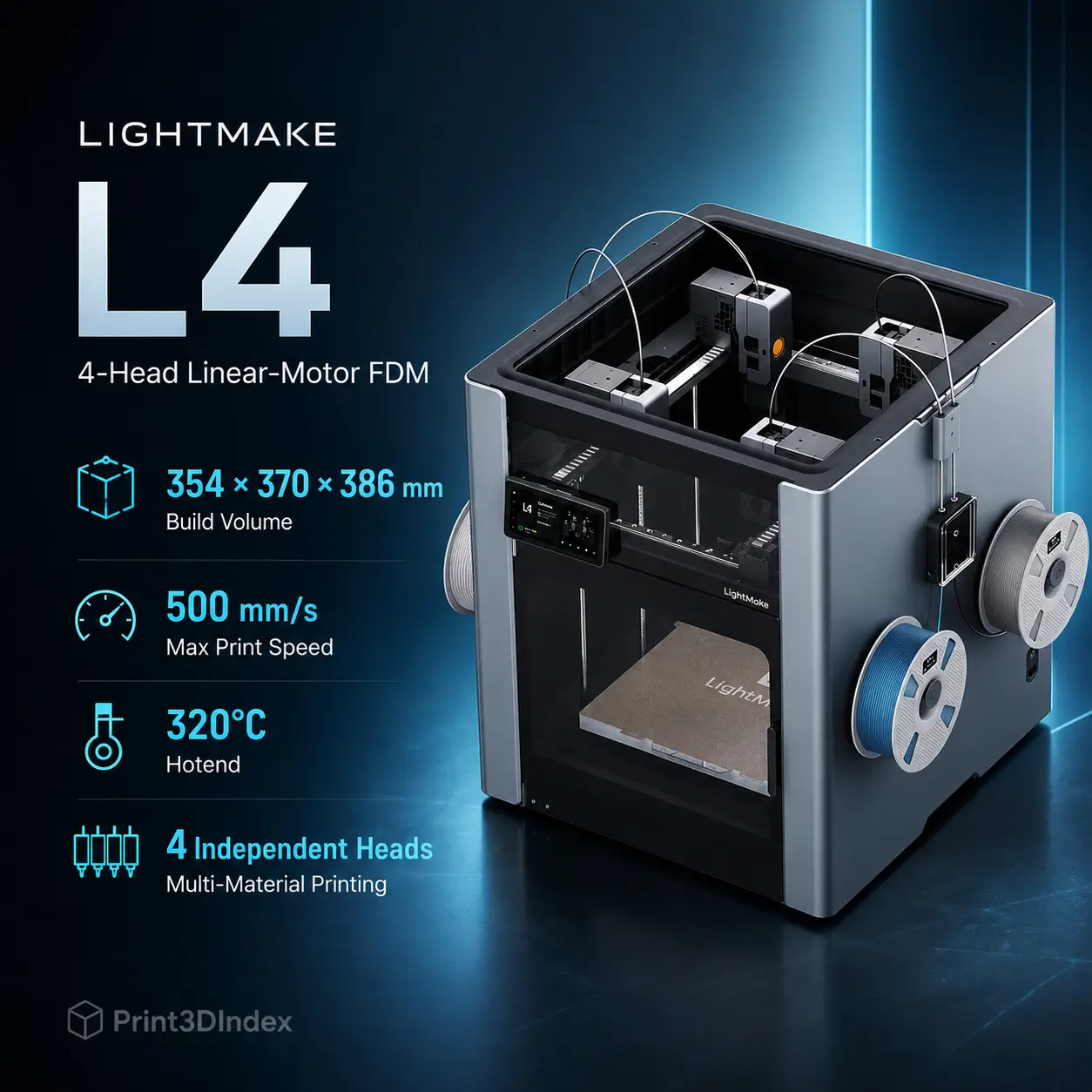
The LightMake L4 is a pre-launch large-format FDM/FFF printer built around four independent printheads and a beltless XY linear-motor motion system. Its architecture is aimed at low-purge multi-color printing, mixed-material prototypes, soluble-support workflows, and parallel production without routing every filament through one shared nozzle.
LightMake currently publishes a 354 × 370 × 386 mm single-color build volume and a 354 × 350 × 386 mm multi-color volume on a 395 × 395 mm PEI build plate. The motion system is rated for 500 mm/s print speed, 1000 mm/s travel speed, and 20,000 mm/s² acceleration.
Each of the four toolheads can remain loaded and preheated with its own material. LightMake advertises a 1-second mechanical toolhead switch, but that figure refers specifically to the interval from one head stopping to the next taking over; it should not be interpreted as the complete color-change cycle for every print. A small prime structure or other conditioning can still be required.
The standard toolheads use 0.4 mm hardened-steel nozzles rated to 320°C, with 0.2, 0.6, and 0.8 mm options. The bed reaches 110°C. LightMake lists PLA, ABS, PETG, TPU, ASA, PVA, PET, PLA-CF, and PETG-CF as suitable materials, with PA and PC described as printable under more demanding conditions.
The L4 is open-frame in its standard configuration. LightMake says it is developing an optional transparent enclosure with active chamber heating targeting approximately 65°C and integrated filtration. That enclosure is not part of the current standard printer specification.
For current product information, see the official LightMake L4 page.
| Specification | Value |
|---|---|
| Printing technology | FDM / FFF |
| Architecture | Open-frame independent 4-head printer |
| XY motion | Beltless direct-drive linear motors |
| Independent printheads | 4 |
| Linear-motor sets | 8 |
| Single-color build volume | 354 × 370 × 386 mm |
| Multi-color build volume | 354 × 350 × 386 mm |
| Build plate | 395 × 395 mm PEI |
| Standard nozzle | 0.4 mm hardened steel |
| Optional nozzle sizes | 0.2 / 0.6 / 0.8 mm |
| Maximum nozzle temperature | 320°C |
| Maximum bed temperature | 110°C |
| Maximum print speed | 500 mm/s |
| Maximum travel speed | 1000 mm/s |
| Maximum print acceleration | 20,000 mm/s² |
| Mechanical toolhead switch | Approx. 1 second |
| Multi-head alignment | 30 µm manufacturer-rated absolute alignment |
| Motion positioning | ±1 µm closed-loop motion-positioning claim |
| Toolhead lift | 5 mm independent lift mechanism |
| Cameras | 2 × 1560 × 720, 30 fps |
| Display | 6.5-inch color touchscreen |
| Storage | 4 GB onboard storage, USB-expandable |
| Slicer | LightMake Slicer, based on OrcaSlicer |
| Firmware updates | OTA supported |
| Standard enclosure | No |
| Planned enclosure | Optional, active chamber target ~65°C + filtration |
| Native colors/material paths | 4 |
| Planned expansion | Up to 16 inputs with optional filament expansion/drying system |
Each toolhead can carry its own filament, hotend, and nozzle. Instead of unloading one filament and purging another through the same melt path, the printer switches which head is active.
This is useful for:
Dedicated heads reduce cross-contamination and shared-nozzle purge.
LightMake's 1-second figure is specifically the mechanical switching interval between active printheads.
The company states that each head can remain preheated, so the next tool does not need to start from room temperature.
Real transition time can still include:
LightMake's advertised 79%+ time saving comes from one internal four-color fox benchmark and should not be treated as a universal result.
The independent-head layout is also used for duplicate and mirror workflows.
Current LightMake mode dimensions include:
| Mode | Usable Area |
|---|---|
| Single Color | 354 × 370 × 386 mm |
| Multi-Color | 354 × 350 × 386 mm |
| 2-Zone Mirror | 145.5 × 350 × 386 mm per zone |
| 2-Zone Duplicate | 178 × 350 × 386 mm per zone |
| 4-Zone Mirror | 145.5 × 167.5 × 386 mm per zone |
| 4-Zone Duplicate | 178 × 195 × 386 mm per zone |
Four-zone production is synchronized duplicate or mirror printing inside divided areas, not four unrelated arbitrary jobs. It can still materially improve throughput for repeated parts.
L4 replaces conventional XY timing belts with direct-drive linear motors and closed-loop position control.
LightMake publishes:
The ±1 µm figure is not printed-part dimensional accuracy; extrusion, shrinkage, bed flatness, tool alignment and temperature still affect final dimensions.
LightMake also claims more than 50,000 hours of motor service life.
Using four nozzles on one model requires accurate tool-to-tool calibration.
LightMake publishes 30 µm absolute alignment for its optical multi-head calibration workflow. The system scans actual deposited material to compensate for XY differences among toolheads.
This is more relevant to visible multi-color seams than the motor-positioning claim, but final production accuracy still needs validation on shipping hardware.
LightMake currently lists the following as suitable materials:
It separately describes these as printable materials:
The standard L4 is open-frame, so ABS, ASA, PA and PC are more sensitive to drafts and uneven cooling than PLA or PETG. For broader context, see Best 3D Printers for Carbon-Fiber Materials.
LightMake explicitly lists PLA-CF and PETG-CF, and the hardened-steel nozzles are suitable for abrasive filled filament. That does not establish universal support for PA-CF, PC-CF, PPA-CF or PPS-CF.
LightMake's current FAQ says an optional transparent enclosure is being developed with:
LightMake is also developing an optional filament expansion and drying system. Current FAQ language describes a concept with up to four filament inputs per toolhead, potentially increasing total managed inputs to 16 colors or materials.
The expansion hardware is planned rather than part of the current reservation configuration.
-AI monitoring for failure-detection aid
| Printer | Tool Architecture | Build Volume | Speed Figure | Nozzle / Bed | Main Difference |
|---|---|---|---|---|---|
| LightMake L4 | 4 independent heads + linear motors | 354 × 370 × 386 mm single color | 500 mm/s max print | 320°C / 110°C | Large volume + four-zone production |
| Snapmaker U1 | 4 SnapSwap toolheads | 270 × 270 × 270 mm | 500 mm/s max toolhead | 300°C / 100°C | Mature compact 4-tool workflow |
| Flashforge Creator 5 | 4 independent toolheads | 256 × 256 × 256 mm | 300 mm/s max print | 320°C / 120°C | Production-ready compact 4-head platform |
| Prusa XL+ | Up to 5 independent toolheads | 360 × 360 × 360 mm | No single universal max mm/s published | 290°C / 120°C | Established 5-tool large-format ecosystem |
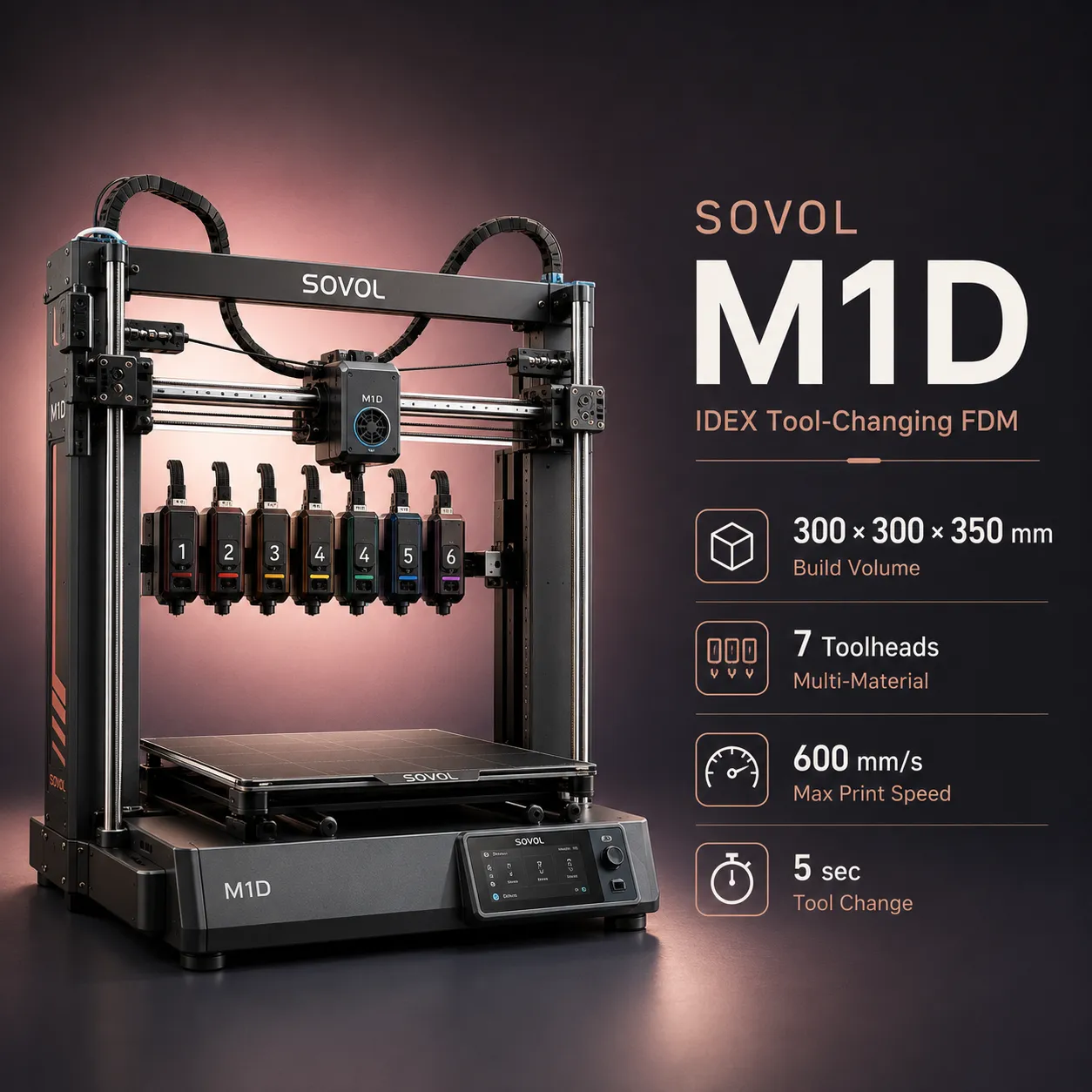
| Sovol M1D | IDEX + 1 fixed / 6 swappable tools | Up to 300 × 300 × 350 mm | 600 mm/s max print | 300°C / 100°C | Up to 7 materials + IDEX modes |
The LightMake L4 vs Snapmaker U1 comparison is the closest four-toolhead matchup.
The Snapmaker U1 includes four complete SnapSwap toolheads, a 270 × 270 × 270 mm build volume, 500 mm/s maximum toolhead speed, 20,000 mm/s² acceleration, 300°C hotends, and a 100°C bed.
Snapmaker states about five seconds per normal tool swap. LightMake claims a one-second mechanical switch and offers a much larger build volume plus four-zone production.
Choose U1 for a current, documented four-tool ecosystem. Choose L4 when larger parts and parallel production justify waiting for the launch.
The LightMake L4 vs Flashforge Creator 5 comparison puts two true four-head printers against each other.
The Flashforge Creator 5 uses four independent toolheads in a 256 × 256 × 256 mm build volume. Flashforge publishes a 300 mm/s maximum print speed, 600 mm/s maximum travel speed, 30,000 mm/s² acceleration, 320°C nozzle, and 120°C bed.
Creator 5 also includes automatic multi-toolhead offset calibration, dynamic flow calibration, Wi-Fi and a 720p camera.
L4 is much larger and publishes higher 500 mm/s print and 1000 mm/s travel figures. Choose Creator 5 for established four-head hardware; choose L4 for build volume, parallel production and linear motors.
The LightMake L4 vs Prusa XL+ comparison focuses on large-format multi-tool printing.
The Prusa XL+ provides a 360 × 360 × 360 mm build volume and supports up to five independent Nextruder toolheads.
Prusa uses a 290°C nozzle, 120°C segmented bed, automatic load-cell calibration, Input Shaper and up to five independent tools. It does not publish one universal maximum mm/s figure.
L4 is slightly taller, uses 320°C hardened nozzles and adds four-zone parallel production. Choose XL+ for proven large-format multi-material hardware; choose L4 when parallel production and the pre-launch price are worth the added platform risk.
The LightMake L4 vs Sovol M1D comparison is four simultaneous heads versus a hybrid IDEX/toolchanger.
The Sovol M1D uses one fixed primary toolhead plus six swappable secondary tools for up to seven colors or materials. Sovol publishes 300 × 300 × 350 mm in Single Mode, 240 × 300 × 350 mm in seven-head overlap mode, 600 mm/s maximum print speed, 300°C hotends, and a 100°C bed.
M1D also supports Copy and Mirror modes, with about five-second tool swaps. L4 provides a larger single-color volume, four simultaneously usable heads, 320°C hardened nozzles and linear-motor XY motion.
Choose M1D for seven-material IDEX flexibility; choose L4 for four simultaneous heads, larger build space and four-zone production.
The LightMake L4 vs Bambu Lab H2C comparison is relevant for buyers focused on low-waste multi-material printing.
The Bambu Lab H2C uses dual-nozzle printing plus the Vortek induction-hotend system rather than four permanently independent heads. It is a fully enclosed engineering platform with a 350°C nozzle, 120°C bed, and active chamber heating up to 65°C.
L4 offers four installed heads and dedicated four-zone production. H2C has the stronger current advantage for enclosed high-temperature materials, AMS integration and product maturity.
Choose H2C for current enclosed engineering work; choose L4 for four-head parallel production and linear motors.
The LightMake L4 is not yet in standard retail availability. LightMake currently indicates an estimated starting price of US$2,399, approximately €2,055 in Europe, £1,759 in the UK, C$3,304 in Canada, A$3,368 in Australia, ₹229,643 in India, and AED 8,810 in the UAE based on current exchange rates.
The final retail price may change before wider availability and can vary by region, local taxes or VAT, import duties, shipping costs, exchange rates, bundles, and promotions.
It is a pre-launch large-format FDM printer with four independent toolheads and beltless XY linear motors.
354 × 370 × 386 mm.
354 × 350 × 386 mm.
Four.
LightMake publishes 500 mm/s maximum print speed and 1000 mm/s maximum travel speed.
20,000 mm/s² maximum print acceleration.
320°C.
A 0.4 mm hardened-steel nozzle on each toolhead.
LightMake publishes approximately one second for the mechanical switch from one active head to the next.
Dedicated nozzles eliminate most shared-hotend flushing, but LightMake's own workflow still shows a small prime structure. Near-zero shared-nozzle purge is the more accurate description.
Yes. LightMake positions the four independent heads for combinations of rigid, flexible, support, and other compatible materials.
It supports four-zone duplicate and mirror modes for synchronized production within reduced per-zone build areas.
No. The standard printer is open-frame.
Yes. LightMake says it is developing an optional enclosure targeting approximately 65°C active chamber heating with filtration.
LightMake explicitly lists PLA-CF and PETG-CF, and the printer uses hardened-steel nozzles.
Four colors/material paths are native. LightMake is developing an optional filament expansion and drying system intended to increase managed inputs up to 16.
The LightMake L4 is expected to start from US$2,399 — about €2,055, £1,759, C$3,304, A$3,368, ₹229,643, or AED 8,810. Final pricing may vary by region, taxes, shipping, exchange rates, availability, and promotions.
Not as a normal retail product. It remains in the pre-launch reservation stage ahead of its planned Kickstarter campaign.