Industrial GradePolypropylene Like Tough ResinHigh Ductility Engineering ResinImpact Resistant ResinFunctional Prototype ResinSnap-Fit Engineering Resin.
FFormlabs
Formlabs
# Formlabs Tough 1500 Resin V2
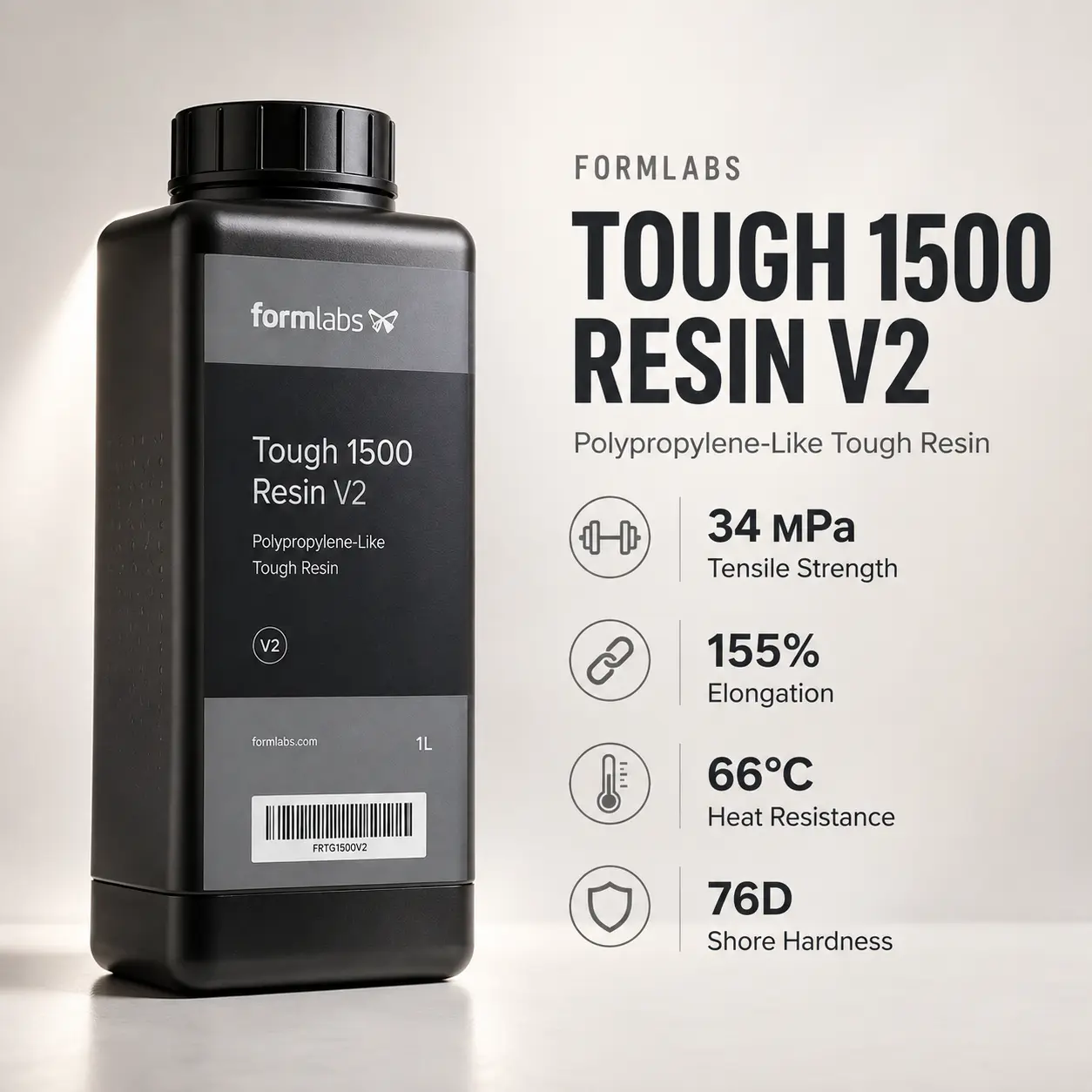
Formlabs Tough 1500 Resin V2 is an engineering SLA resin for parts that need stiffness, ductility, impact resistance, and resilience in the same material. Formlabs positions it in a polypropylene-like mechanical range, making it useful for functional prototypes, snap fits, compliant mechanisms, rugged housings, jigs, fixtures, connectors, and end-use parts that must flex without behaving like a soft elastomer.
The V2 formulation is significantly tougher than the previous Tough 1500 generation. Formlabs reports 10× higher fracture toughness, 34 MPa ultimate tensile strength, 155% elongation at break, and 1,011 J/m² work of fracture after post-curing. Post-cured heat-deflection temperature is 66°C at 0.45 MPa and 53°C at 1.8 MPa.
Tough 1500 Resin V2 sits between the more ductile Tough 1000 Resin and the stronger, stiffer Tough 2000 Resin V2. That middle position is useful for parts that need to bend, latch, flex, or absorb impact while still holding structural shape.
For current product information and pricing, see the official Tough 1500 Resin V2 product page. Detailed test methods are available in the official Tough 1500 Resin V2 technical data sheet.
| Specification | Value |
|---|---|
| Material type | Resin |
| Technology | SLA |
| Formulation | Tough 1500 Resin V2 |
| Color | Grey |
| Available volumes | 1 L / 5 L |
| Layer settings | 50 µm / 100 µm |
| Ultimate tensile strength | 34 MPa post-cured |
| Tensile modulus | 1,460 MPa post-cured |
| Elongation at break | 155% post-cured |
| Flexural strength | 41 MPa post-cured |
| Flexural modulus | 1,370 MPa post-cured |
| Notched Izod | 42 J/m post-cured |
| Unnotched Izod | 910 J/m post-cured |
| Work of fracture | 1,011 J/m² post-cured |
| Maximum stress-intensity factor | 1.7 MPa·m½ |
| Ross flex fatigue | 8,000 cycles |
| HDT at 0.45 MPa | 66°C post-cured |
| HDT at 1.8 MPa | 53°C post-cured |
| Shore hardness | 76D |
| Viscosity at 25°C | 1,000 cP |
| Liquid density | 1.02 g/mL |
| Skin-contact evaluation | ISO 10993-1 endpoints with validated processing |
Published values are typical Formlabs test results and can vary with geometry, print orientation, settings, post-processing, and temperature.
Tough 1500 Resin V2 is designed to behave more like a tough thermoplastic than a brittle standard photopolymer.
It remains structurally stiff, but its high elongation allows features such as snap hooks, latches, compliant clips, protective housings, and temporary interference fits to deform substantially before failure.
This makes it useful for prototypes that will eventually be molded in polypropylene. The resin is not chemically identical to PP, but its mechanical range can make functional evaluation more meaningful than using a rigid visual-prototyping resin.
Formlabs reports the following post-cured values:
| Property | Value |
|---|---|
| Ultimate tensile strength | 34 MPa |
| Tensile modulus | 1,460 MPa |
| Elongation at break | 155% |
| Flexural strength | 41 MPa |
| Flexural modulus | 1,370 MPa |
| Notched Izod | 42 J/m |
| Unnotched Izod | 910 J/m |
| Work of fracture | 1,011 J/m² |
The 155% elongation figure is important, but the impact and fracture data explain why the material is useful for thin walls and functional features that need to bend or absorb load without shattering.
Formlabs also reports 10× higher fracture toughness than the previous Tough 1500 formulation.
Post-cured Tough 1500 Resin V2 has two published HDT values:
The lower-load value is useful for comparison, but the 53°C result is the more conservative reference under the higher load.
Thermal suitability should therefore be evaluated using actual service stress rather than treating 66°C as a universal operating temperature.
Formlabs reports less than 3% strain after two weeks under a 4 MPa load at 22°C in its creep evaluation.
That makes Tough 1500 Resin V2 relevant to loaded clips, latches, fastened housings, fixtures, and alignment features where long-term deformation matters.
Creep increases with temperature and time, so production parts should still be tested under their real service conditions.
Tough 1500 Resin V2 is designed for Form 4-generation systems.
Current Formlabs compatibility resources support:
The material uses Form 4-generation resin tanks and validated PreForm profiles. Current settings are 50 µm and 100 µm.
The V2 formulation depends on Form 4-generation hardware and is not the same profile as legacy Tough 1500 formulations used on older Form 2 or Form 3 systems.
Formlabs recommends using current PreForm software and the correct Tough 1500 Resin V2 profile.
A practical requirement is that Tough 1500 Resin should be printed on supports rather than directly on the build platform.
For snap fits, flexures, and other critical functional geometry, orientation and support placement should be chosen around load direction and the surfaces that need the best finish.
Printed parts must be washed, dried fully, and post-cured before they reach their intended final properties.
Formlabs recommends following the current Form Wash or Form Wash L settings and allowing parts to dry fully before curing. The product page recommends at least 10 minutes of air drying after washing for good surface finish.
The current TDS mechanical values were measured on Form 4 parts printed at 100 µm and post-cured at 70°C for 12 minutes in a Form Cure V2. Users should still follow the latest cure settings for their specific Form Cure or Form Cure L model because Formlabs updates material profiles over time.
Formlabs lists Tough 1500 Resin V2 for skin-contact use when the validated workflow is followed.
The TDS reports ISO 10993-1 evaluation endpoints including:
For skin-contact use, Formlabs specifies washing in ≥99% IPA for 20 minutes in a Form Wash before drying and curing.
This does not imply broad medical-device approval. The qualified processing workflow and intended contact category still matter.
Formlabs has published support guidance for the newest Tough-family cartridges because the bite valve can swell over time.
For cartridges from lot 20251022 or later, Formlabs provides a printable shim to reduce dispensing interruptions. Earlier lots have different handling instructions and should follow current support guidance rather than automatically using the shim.
See Using Tough 1500 Resin V2 for the latest cartridge, washing, and curing instructions.
| Property | Tough 1000 Resin | Tough 1500 Resin V2 | Tough 2000 Resin V2 | Flexible 80A Resin V2 |
|---|---|---|---|---|
| Comparable behavior | HDPE-like | Polypropylene-like | ABS-like | 80A urethane / hard rubber |
| Tensile strength | 26.3 MPa | 34 MPa | 40.4 MPa | 10 MPa |
| Tensile modulus | 932 MPa | 1,460 MPa | 1,800 MPa | Elastomeric |
| Elongation at break | 180% | 155% | 79% | 230% |
| Gardner impact at ~0.8 mm | 13.1 J | 5.9 J | 1.6 J | Different elastomeric profile |
| Work of fracture | 3,200 J/m² | 1,011 J/m² | 305 J/m² | Not the primary selection metric |
| HDT at 0.45 MPa | 55.3°C | 66°C | 70°C | Not directly comparable |
| Best fit | Maximum ductility and wear resistance | Balanced stiffness + ductility | Higher strength and stiffness | Rubber-like flexibility |
Tough 1000 Resin is more ductile, with 180% elongation at break, and is designed around wear, fatigue resistance, and low-friction behavior.
Tough 1500 V2 is stronger and stiffer at 34 MPa tensile strength and 1,460 MPa tensile modulus, compared with 26.3 MPa and 932 MPa for Tough 1000.
Choose Tough 1000 for highly ductile, low-friction, or fatigue-heavy parts. Choose Tough 1500 V2 when polypropylene-like stiffness, snap-fit behavior, and a higher HDT are more important.
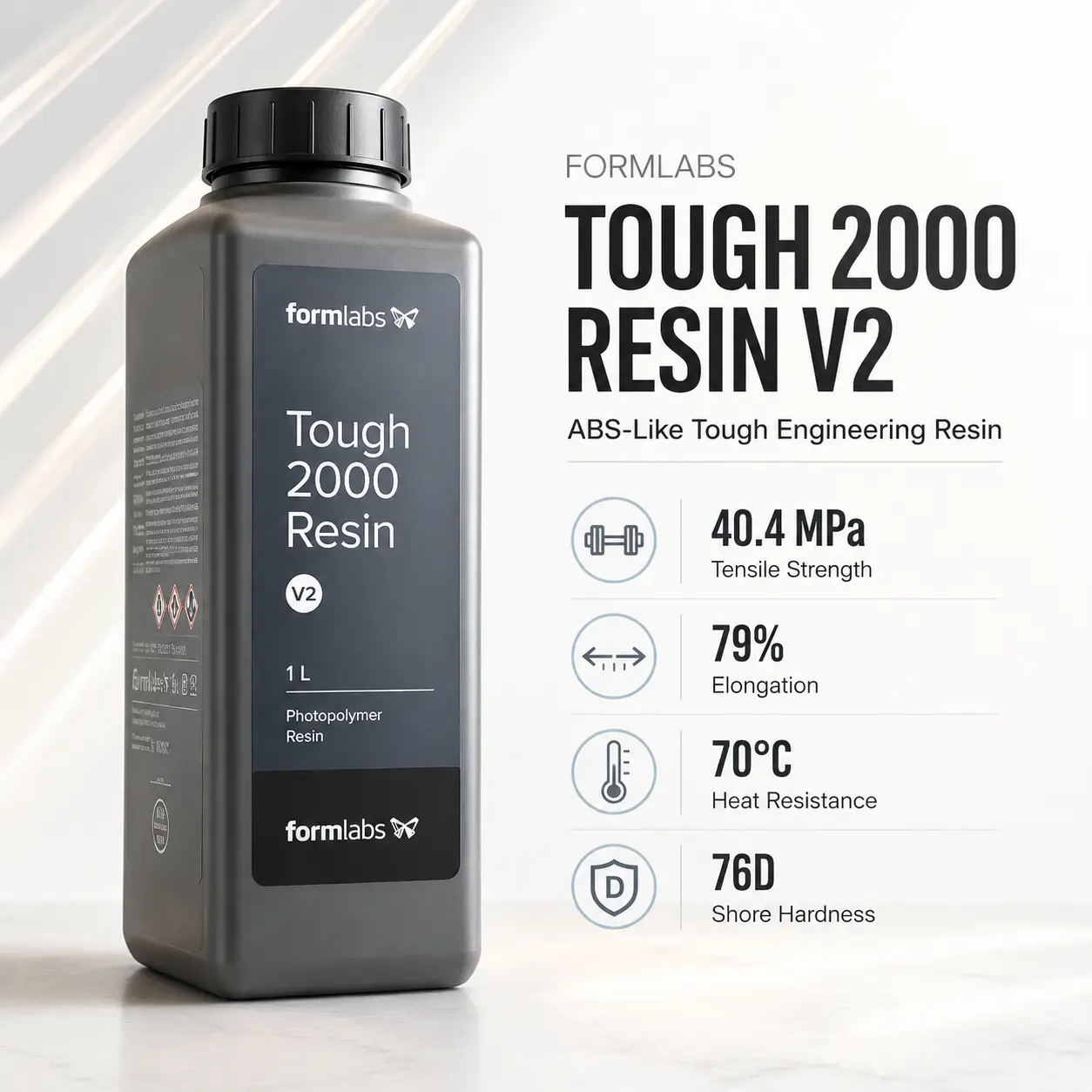
Tough 2000 Resin V2 is the stronger and stiffer option, with 40.4 MPa tensile strength, 1,800 MPa tensile modulus, 79% elongation, and 70°C HDT at 0.45 MPa.
Tough 1500 V2 gives up some stiffness and heat resistance in exchange for much greater elongation and work of fracture.
Choose Tough 2000 V2 for robust fixtures, protective shells, and rigid functional parts. Choose Tough 1500 V2 for snap fits, compliant mechanisms, and housings that need to flex before failure.
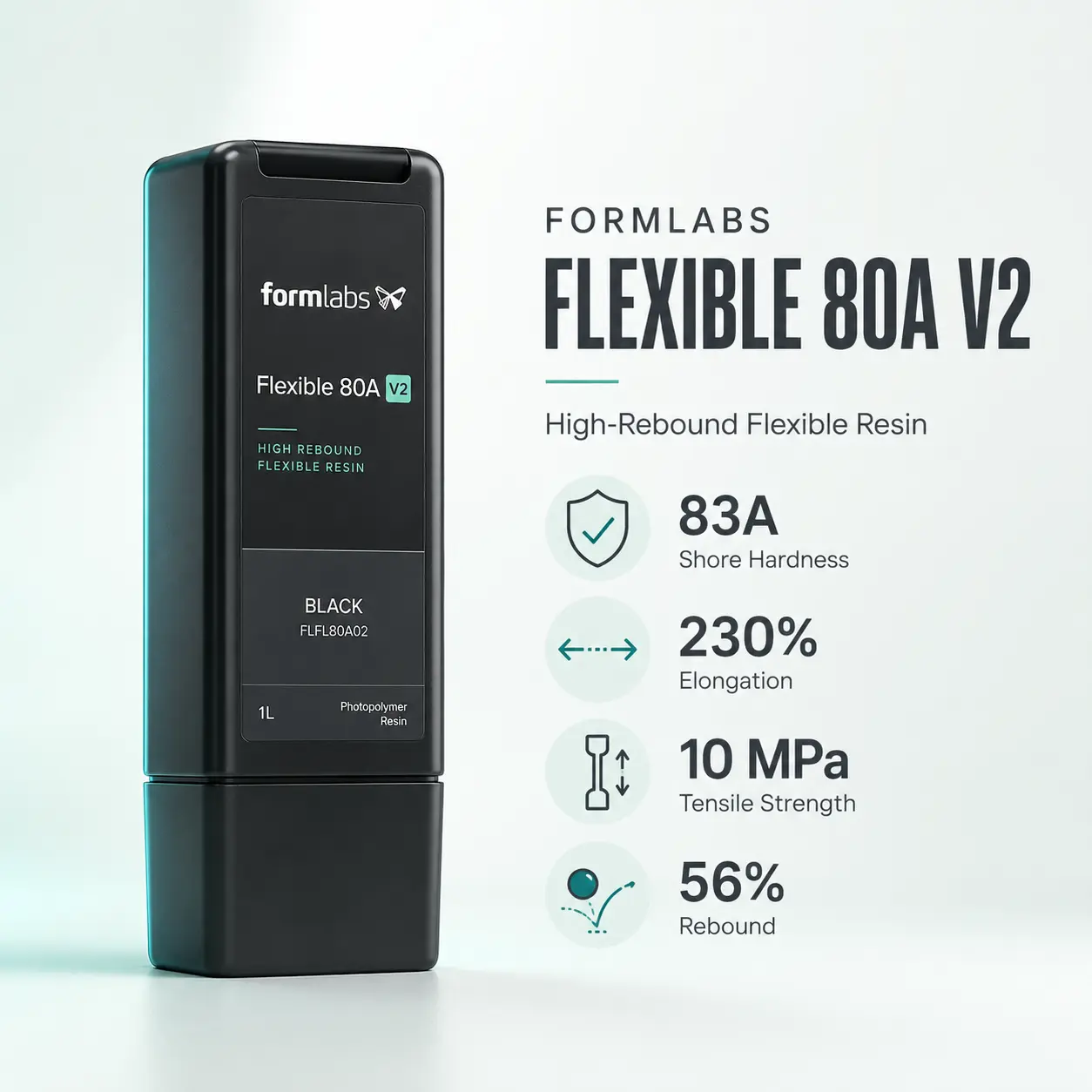
Flexible 80A Resin V2 is a true elastomeric resin with approximately 83A Shore hardness, 10 MPa tensile strength, and 230% elongation at break.
Tough 1500 V2 remains much more structurally rigid. It is intended for parts that must hold shape and carry load while still tolerating substantial deflection.
Choose Flexible 80A V2 for seals, gaskets, soft inserts, padding, grips, and rubber-like components. Choose Tough 1500 V2 for structural polypropylene-like parts.
Formlabs uses extrusion-grade polypropylene as a reference material for Tough 1500 Resin V2.
| Property | Tough 1500 Resin V2 | Polypropylene Reference |
|---|---|---|
| Ultimate tensile strength | 34 MPa | 29.2 MPa |
| Tensile modulus | 1,460 MPa | 1,600 MPa |
| Elongation at break | 155% | 125% |
| Gardner impact at ~0.8 mm | 5.9 J | 2.7 J |
This makes Tough 1500 V2 useful for evaluating fit, snap behavior, deflection, and functional concepts before molded polypropylene production.
The materials are not chemically identical, so final production qualification should still use the actual thermoplastic and manufacturing process.
Formlabs currently lists Tough 1500 Resin V2 from US$149 in the United States, approximately €128.62 in Europe, £109.86 in the United Kingdom, AED 547.20 in the UAE, C$206.33 in Canada, A$209.38 in Australia, ₹14,243 in India.
It is offered in 1 L and 5 L configurations, with volume discounts available for larger orders. Actual regional prices may differ because of local pricing, taxes, shipping charges, exchange-rate changes, promotions, and availability.
It is a resilient engineering SLA resin designed to balance stiffness, ductility, impact resistance, and fracture toughness in a polypropylene-like mechanical range.
Formlabs reports 34 MPa after post-curing.
155% after post-curing.
HDT is 66°C at 0.45 MPa and 53°C at 1.8 MPa.
1,011 J/m² after post-curing.
Current Form 4-generation compatibility resources support Form 4, Form 4B, Form 4L, and Form 4BL.
50 µm and 100 µm.
Yes. Formlabs instructs users to print Tough 1500 Resin on supports rather than directly on the build platform.
Yes.
The current TDS uses 70°C for 12 minutes in Form Cure V2 for its post-cured test specimens.
Formlabs has evaluated it for skin contact under ISO 10993-1 endpoints when the validated processing workflow is followed.
Tough 1000 is more ductile and wear-focused, while Tough 1500 V2 is stronger, stiffer, and more polypropylene-like.
Tough 2000 V2 is stronger and stiffer, while Tough 1500 V2 has much greater elongation and fracture resistance for compliant parts.
Flexible 80A V2 is rubber-like. Tough 1500 V2 is a structural engineering resin that can flex substantially while retaining much higher stiffness.
Formlabs currently lists Tough 1500 Resin V2 from US$149 in the United States, approximately €128.62 in Europe, £109.86 in the United Kingdom, AED 547.20 in the UAE, C$206.33 in Canada, A$209.38 in Australia, ₹14,243 in India. It is offered in 1 L and 5 L configurations, with volume discounts available for larger orders. Actual regional prices may differ because of local pricing, taxes, shipping charges, exchange-rate changes, promotions, and availability.