ABS Like Tough ResinHigh Creep Resistance ResinRugged Functional ResinImpact Resistant ResinHeavy Duty SLA ResinHigh Frade Engineering Resin
FFormlabs
Formlabs
# Formlabs Tough 2000 Resin V2
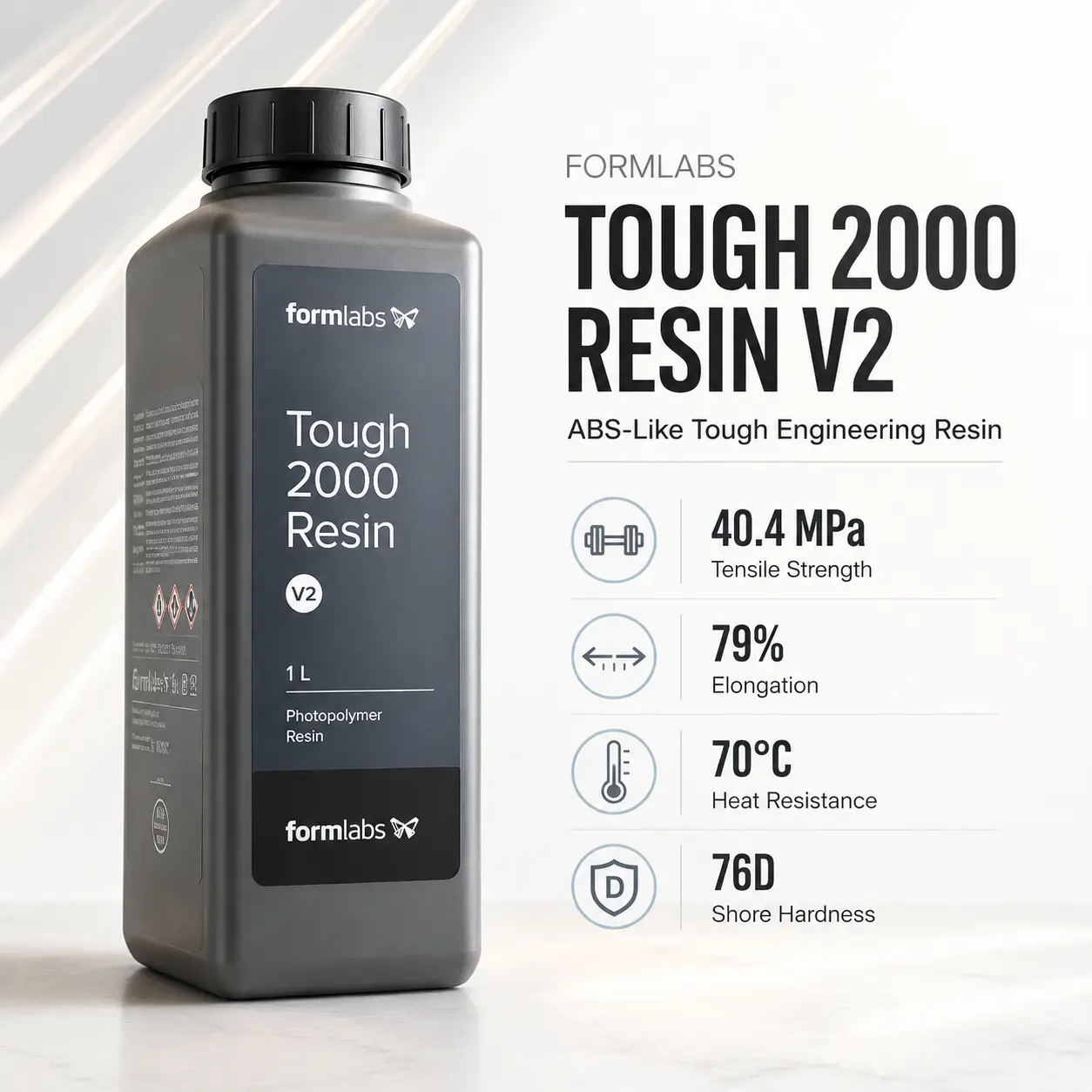
Formlabs Tough 2000 Resin V2 is a rugged engineering SLA resin designed for parts that need ABS-like strength and stiffness without the brittle behavior of a typical rigid photopolymer. It is the strongest and stiffest material in Formlabs' current Tough family and is aimed at jigs, fixtures, protective housings, snap-fit enclosures, manufacturing aids, and functional end-use parts.
Formlabs reports 40.4 MPa post-cured ultimate tensile strength, 1,800 MPa tensile modulus, 79% elongation at break, and a 70°C HDT at 0.45 MPa. At the higher 1.8 MPa load, HDT is 57°C.
Compared with the previous Tough 2000 generation, V2 delivers 3× higher fracture toughness, improved temperature performance, better creep resistance, greater material longevity, and a darker matte-grey finish. Post-cured fracture data includes a 1.65 MPa·m½ maximum stress-intensity factor and 305 J/m² work of fracture.
For current product information and pricing, see the official Tough 2000 Resin V2 product page. Detailed material data is available in the official Tough 2000 Resin V2 technical data sheet.
| Specification | Value |
|---|---|
| Material type | Resin |
| Technology | SLA |
| Formulation | Tough 2000 Resin V2 |
| Comparable thermoplastic | ABS-like mechanical behavior |
| Color | Dark Grey |
| Finish | Matte |
| Available volumes | 1 L / 5 L |
| Layer settings | 50 µm / 100 µm |
| Ultimate tensile strength | 40.4 MPa post-cured |
| Tensile modulus | 1,800 MPa post-cured |
| Tensile strength at yield | 39.3 MPa post-cured |
| Elongation at yield | 4.5% post-cured |
| Elongation at break | 79% post-cured |
| Flexural strength | 67 MPa post-cured |
| Flexural modulus | 1,701 MPa post-cured |
| Notched Izod | 25 J/m post-cured |
| Unnotched Izod | 325 J/m post-cured |
| Notched Charpy | 2.4 kJ/m² post-cured |
| Unnotched Charpy | 31 kJ/m² post-cured |
| Gardner impact, 0.79 mm | 1.6 J post-cured |
| Ross flex fatigue | 3,560 cycles post-cured |
| Work of fracture | 305 J/m² post-cured |
| Maximum stress-intensity factor | 1.65 MPa·m½ |
| HDT at 0.45 MPa | 70°C post-cured |
| HDT at 1.8 MPa | 57°C post-cured |
| Shore hardness | 76D |
| Viscosity at 25°C | 2,680 cP |
| Bulk density | 1.09 g/mL |
| Liquid density | 1.03 g/mL |
Published values are typical Formlabs test results and can vary with geometry, orientation, print settings, post-processing, conditioning, and temperature.
Formlabs positions Tough 2000 Resin V2 as the Tough-family material closest to ABS in overall mechanical character.
Its 40.4 MPa tensile strength and 1,800 MPa tensile modulus give it a more structural feel than Tough 1500 Resin V2 or Tough 1000 Resin, while 79% elongation at break still gives it much more ductility than many high-modulus SLA materials.
That makes it useful for rigid snap-fit housings, functional brackets, protective shells, assembly fixtures, tooling components, and prototypes intended to approximate ABS-like stiffness and feel.
The ABS comparison is mechanical rather than chemical. Tough 2000 Resin V2 should not be assumed to match injection-molded ABS in every chemical, thermal, aging, fatigue, or UV condition.
Tough 2000 Resin V2 has the highest HDT in the current Formlabs Tough family:
The 57°C value is the more conservative reference under higher load.
Formlabs also evaluates flexural creep under ISO 6602 at 22°C and 4 MPa over 14 days and positions V2 for better long-term dimensional retention under sustained load.
For highly loaded production parts, actual geometry, orientation, temperature, and service duration should still be validated.
Tough 2000 Resin V2 is tough, but it is not the Tough-family choice for high-cycle flexing.
The TDS reports 3,560 Ross flex cycles for post-cured specimens. Formlabs support guidance does not recommend Tough 2000 Resin for parts requiring significant cyclic loading above roughly 4,000 cycles.
For repeated hinges, flexible mechanisms, or wear-heavy movement, Tough 1000 Resin is generally a better fit.
Tough 2000 V2 is strongest when rigidity, sustained loading, and occasional impact matter more than continuous flex fatigue.
Current Formlabs compatibility tables support Tough 2000 Resin V2 on:
Validated 50 µm and 100 µm print settings are available across the Form 4 generation.
The material uses Form 4-generation resin tanks and build platforms and should not be treated as the same profile as legacy Tough 2000 formulations used on older Form 2 or Form 3 systems.
Use the current version of PreForm and select the correct Tough 2000 Resin V2 profile.
Formlabs recommends printing Tough 2000 Resin with supports rather than directly on the build platform, because parts can be difficult to remove from the platform.
Orientation should account for load direction, critical dimensions, support contact points, surface-finish requirements, snap-fit geometry, and any machining allowance.
Bulky parts may need larger support touchpoints than ordinary visual-prototyping resins.
All printed parts must be washed to remove uncured resin.
The current TDS test workflow used a Form Wash V2 with a 10 + 5 minute wash in at least 99% isopropyl alcohol.
Formlabs recommends allowing Tough 2000 Resin V2 parts to air dry for at least 10 minutes before handling or post-curing for good surface finish. Parts should be fully dry before curing.
The post-cured TDS values were obtained from Form 4 specimens printed at 100 µm and cured at:
70°C for 12 minutes in Form Cure V2
Current machine-specific Form Cure settings should be followed in production.
Formlabs specifically notes that Tough 2000 Resin can be machined after printing.
Useful finishing operations can include:
Printed geometry should still be designed with machining loads and print orientation in mind.
Formlabs has published support guidance for the newest Tough-family cartridges because the bite valve can swell over time.
For cartridges from lot 20251022 or later, Formlabs provides a printable shim to reduce dispensing interruptions. Earlier lots have different handling instructions.
See Using Tough 2000 Resin V2 for current guidance.
| Property | Tough 1000 Resin | Tough 1500 Resin V2 | Tough 2000 Resin V2 | Flexible 80A Resin V2 |
|---|---|---|---|---|
| Comparable behavior | HDPE-like | Polypropylene-like | ABS-like | 80A urethane / hard rubber |
| Tensile strength | 26.3 MPa | 34 MPa | 40.4 MPa | 10 MPa |
| Tensile modulus | 932 MPa | 1,460 MPa | 1,800 MPa | Elastomeric |
| Elongation at break | 180% | 155% | 79% | 230% |
| Work of fracture | 3,200 J/m² | 1,011 J/m² | 305 J/m² | Different elastomeric profile |
| Ross flex fatigue | 100,000 cycles | 8,000 cycles | 3,560 cycles | Elastomeric fatigue profile |
| HDT at 0.45 MPa | 55.3°C | 66°C | 70°C | Not directly comparable |
| Best fit | Ductility, wear, repeated flex | Balanced stiffness and compliance | Strength, rigidity, rugged fixtures | Rubber-like flexible parts |
The table shows the tradeoff clearly: moving from Tough 1000 toward Tough 2000 V2 increases stiffness and heat resistance while reducing elongation, fracture energy, and repeated-flex capability.
The Tough 2000 Resin V2 vs Tough 1500 Resin V2 decision is mainly about rigidity versus compliance.
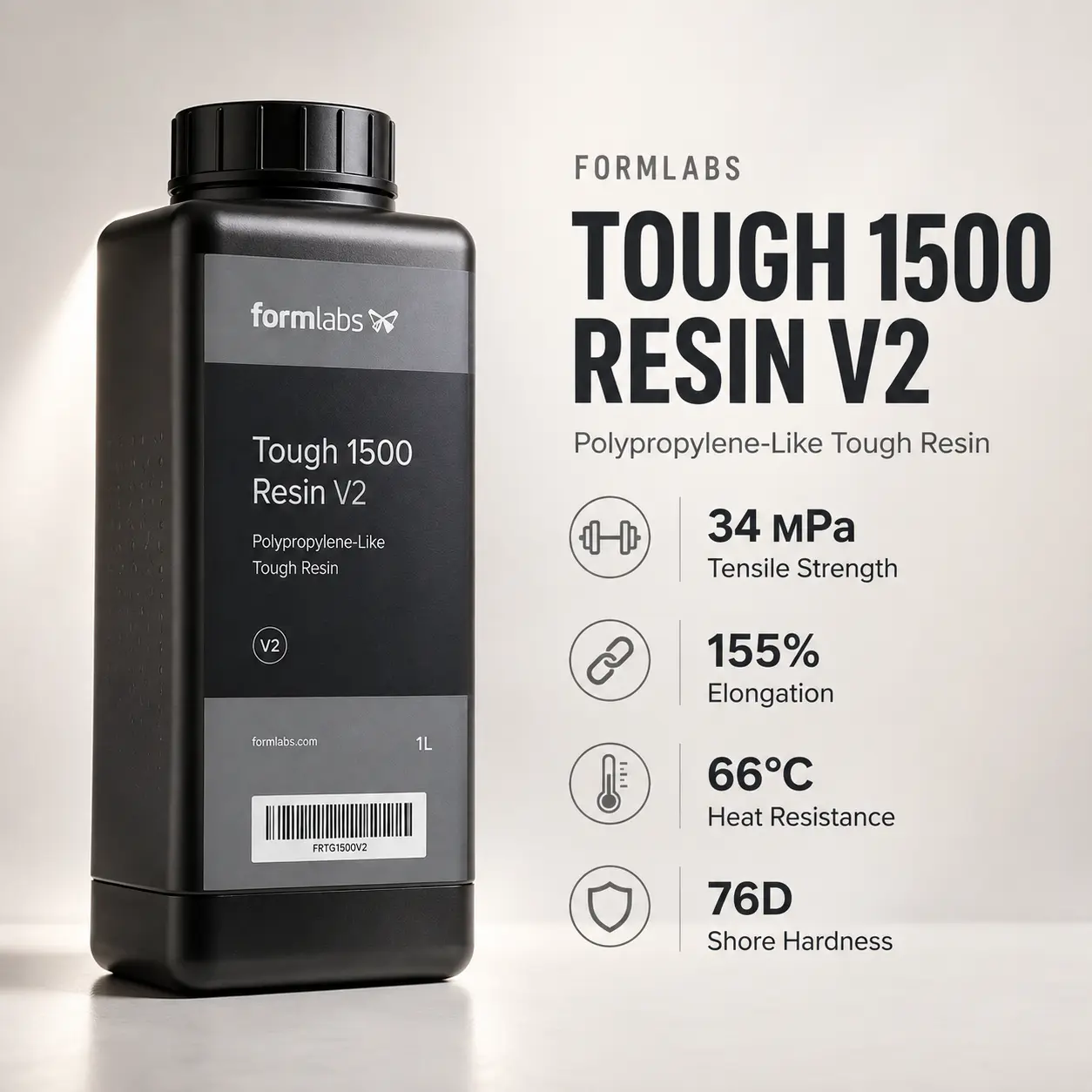
Tough 1500 Resin V2 provides 34 MPa tensile strength, 1,460 MPa tensile modulus, and 155% elongation at break.
Tough 2000 V2 increases strength to 40.4 MPa and modulus to 1,800 MPa, but elongation drops to 79%.
Choose Tough 2000 V2 for robust fixtures, protective shells, and structurally firm parts. Choose Tough 1500 V2 when snap fits, clips, and compliant features need much more bending before failure.
Tough 1000 Resin is the most ductile current Tough-family material.
It reaches 180% elongation, 3,200 J/m² work of fracture, and more than 100,000 Ross flex cycles in Formlabs' published comparison data.
Choose Tough 1000 for low-friction parts, wear surfaces, squeezable prototypes, hinges, and repeated deformation. Choose Tough 2000 V2 for rigid manufacturing aids and components that must resist static or sustained mechanical loads.
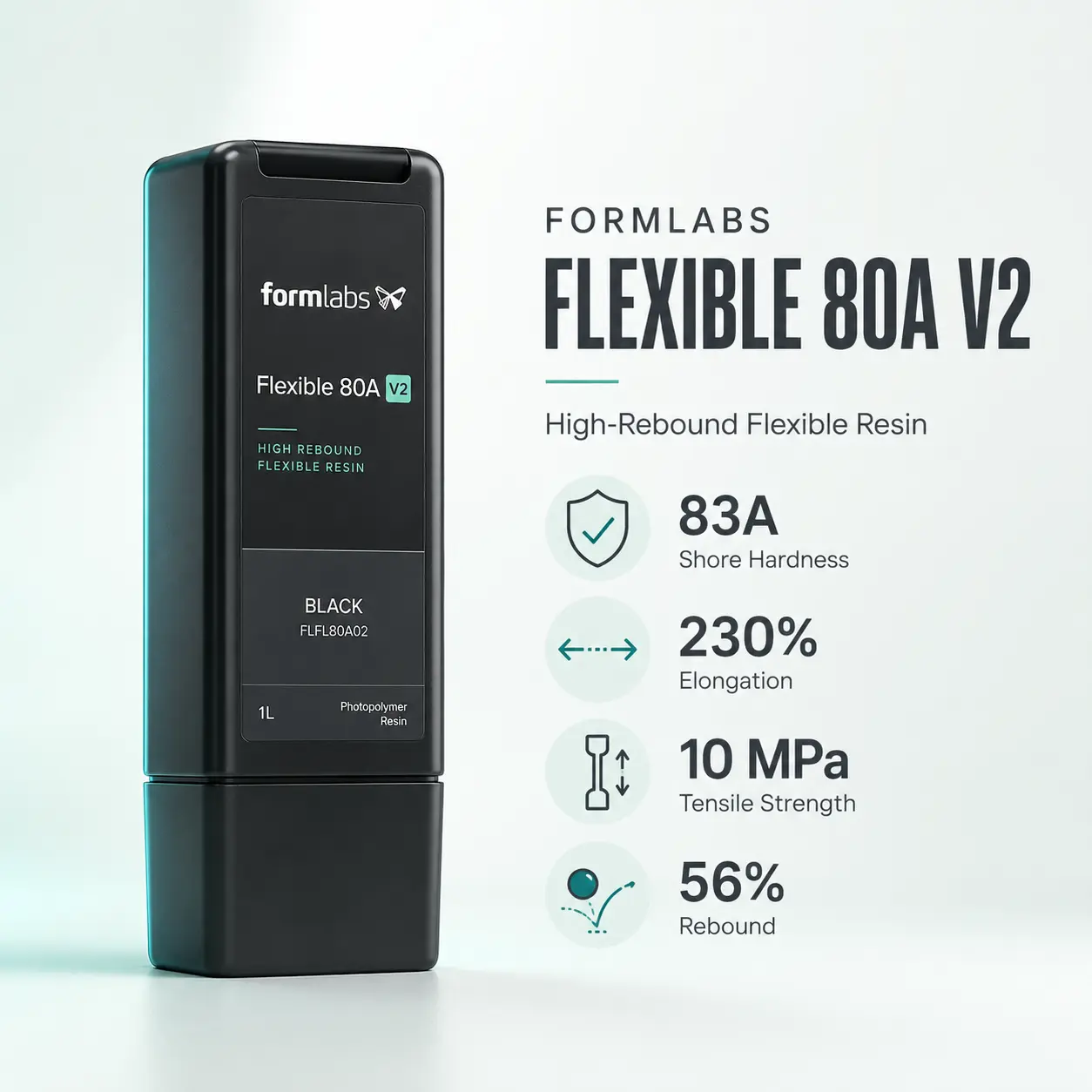
Flexible 80A Resin V2 is a true elastomer with approximately 10 MPa tensile strength and 230% elongation at break.
Its job is to bend, compress, rebound, and behave more like hard rubber or TPU.
Tough 2000 V2 is a structural engineering resin. Choose Flexible 80A V2 for seals, gaskets, grips, padding, and soft inserts. Choose Tough 2000 V2 when the part must remain stiff enough to function as a housing, fixture, bracket, or structural component.
Formlabs describes Tough 2000 Resin V2 as comparable to ABS in strength and stiffness.
That makes it useful for evaluating enclosure stiffness, mounting features, fit, snap behavior, assembly ergonomics, and other concepts intended for ABS production.
However, Tough 2000 V2 is still a crosslinked photopolymer, not injection-molded ABS. Chemical resistance, fatigue, UV aging, thermal cycling, and long-term behavior can differ.
Final production qualification should use the actual intended material and manufacturing process.
Formlabs currently lists Tough 2000 Resin V2 from US$149 in the United States, approximately €128.62 in Europe, £109.86 in the United Kingdom, AED 547.20 in the UAE, C$206.33 in Canada, A$209.38 in Australia and ₹14,243 in India.
It is offered in 1 L and 5 L configurations, with volume discounts available for larger orders. Actual regional prices may differ because of local pricing, taxes, shipping charges, exchange-rate changes, promotions, and availability.
It is a rugged engineering SLA resin designed to provide ABS-like strength and stiffness with much more ductility than a typical rigid photopolymer.
40.4 MPa after post-curing.
1,800 MPa after post-curing.
79% after post-curing.
HDT is 70°C at 0.45 MPa and 57°C at 1.8 MPa.
305 J/m² after post-curing.
It is tough, but Formlabs does not recommend it for significant cyclic-loading applications above roughly 4,000 cycles. Tough 1000 is better for high-cycle flexing.
Current Formlabs compatibility tables support Form 4, Form 4B, Form 4L, and Form 4BL.
50 µm and 100 µm.
Formlabs recommends printing it with supports rather than directly on the build platform.
Yes.
70°C for 12 minutes in Form Cure V2.
Yes. Formlabs specifically notes that printed Tough 2000 parts can be machined.
Tough 2000 V2 is stronger and stiffer, while Tough 1500 V2 has much greater elongation for compliant parts.
Tough 1000 is much more ductile and fatigue-resistant; Tough 2000 V2 is better for rigid, load-bearing fixtures and housings.
Formlabs currently lists Tough 2000 Resin V2 from US$149 in the United States, approximately €128.62 in Europe, £109.86 in the United Kingdom, AED 547.20 in the UAE, C$206.33 in Canada, A$209.38 in Australia and ₹14,243 in India.It is offered in 1 L and 5 L configurations, with volume discounts available for larger orders. Actual regional prices may differ because of local pricing, taxes, shipping charges, exchange rate changes, promotions, and availability.