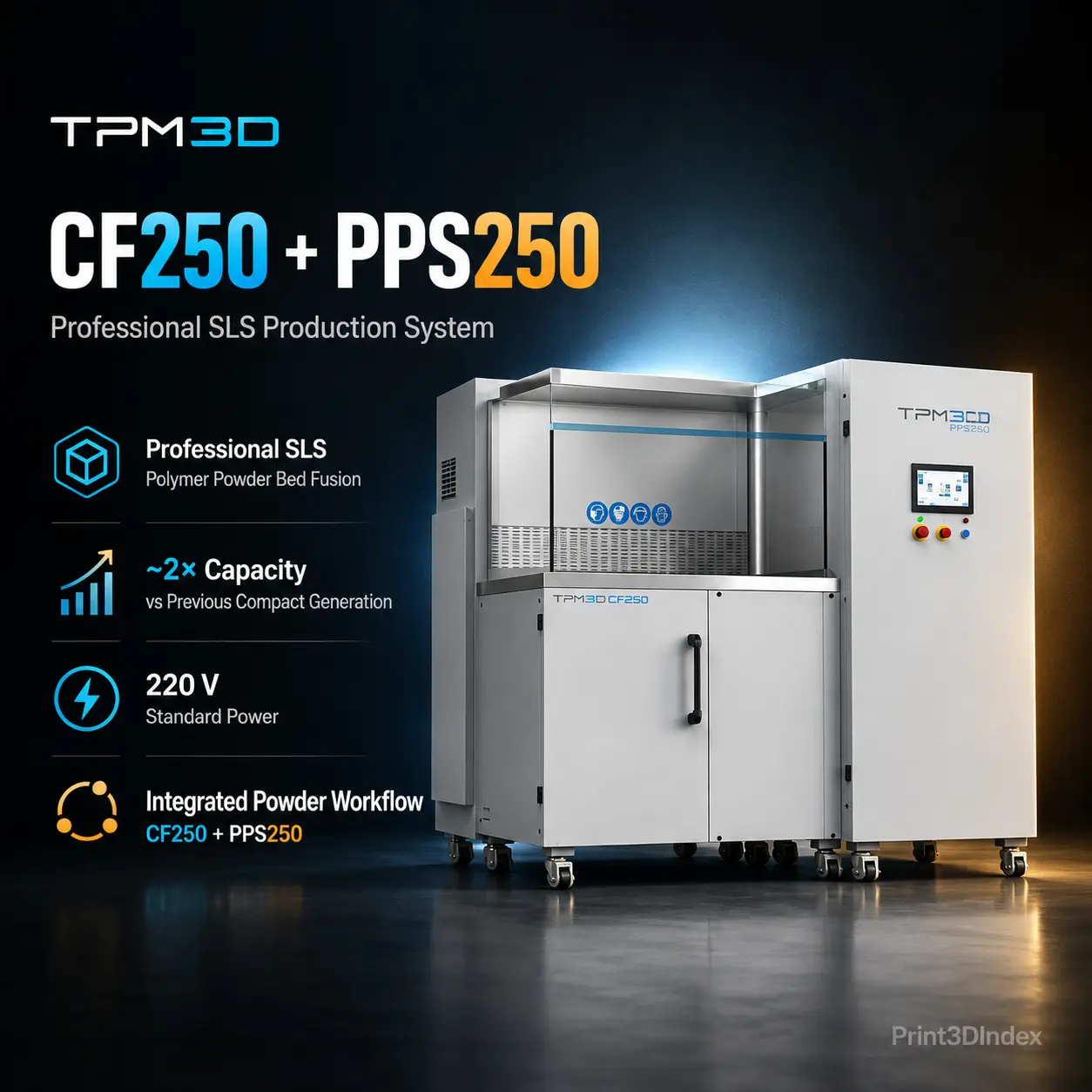
Professional Polymer SLSIntegrated Powder ProcessingHigh-Capacity Batch Production220 V Industrial WorkflowCompact Production SLS PlatformCF250 + PPS250 System
TTPM3D
TPM3D
# TPM3D CF250 + PPS250
The TPM3D CF250 + PPS250 is an upcoming professional Selective Laser Sintering (SLS) production system that pairs the new CF250 polymer powder-bed-fusion printer with the PPS250 powder-processing station. TPM3D is positioning the platform between compact professional SLS equipment and its larger industrial production systems, with a focus on engineering, service-bureau work, functional prototyping, and small-batch manufacturing.
TPM3D will make the CF250 + PPS250's global debut at Formnext Asia Shenzhen on August 26, 2026. The company has confirmed an expanded build chamber, approximately twice the production capacity of its previous compact professional generation, a compact footprint, standard 220 V operation, and an integrated powder-handling workflow.
For the launch announcement and current manufacturer information, see the official TPM3D CF250 + PPS250 announcement. Sales inquiries can be submitted through the official TPM3D contact page.
| Specification | Confirmed Information |
|---|---|
| Printing technology | Selective Laser Sintering (SLS) |
| Process category | Polymer Powder Bed Fusion |
| Printer | CF250 |
| Powder-processing system | PPS250 |
| Build chamber | Expanded versus TPM3D's previous compact professional generation |
| Production capacity | Approximately 2x previous compact professional generation |
| Electrical supply | Standard 220 V |
| Workflow | Integrated powder handling and management |
| Market position | Compact professional SLS |
| Primary production role | Prototyping and small-batch production |
| Global debut | August, 2026 |
Compact professional SLS systems are attractive because they reduce the floor space, utility, and workflow barriers that can make powder-bed fusion difficult to bring in-house.
The trade-off is usually production capacity. A smaller powder bed limits the number of parts that can be nested in one job and can force larger components to be split or moved to a larger machine.
TPM3D's CF250 addresses that issue by increasing the production capacity of the company's compact professional platform while retaining the practical characteristics that made the earlier generation easier to install:
Selective Laser Sintering fuses polymer powder layer by layer. Unsintered powder surrounding each part supports overhangs and internal geometry during the build, so conventional support structures are generally unnecessary.
The CF250 is the printing stage of the system, while the PPS250 is the dedicated powder-processing companion.
TPM3D describes the new platform as retaining an integrated powder handling and management workflow. A practical powder-bed process includes build preparation, powder loading, printing, cooling, breakout, powder recovery, mixing, refilling, and final cleaning.
TPM3D's broader powder-processing equipment portfolio includes depowdering, powder recovery, mixing, feeding, sieving, and dust-management solutions. The PPS250 is the new companion platform associated with the CF250 generation.
The strongest direct comparison for the new platform is TPM3D CF250 vs CF200, as the CF250 is the next step in the same compact, professional product line.
The TPM3D CF200 + PPS200 uses a 200 x 200 x 320 mm build chamber, a 30 W fiber laser, 0.1 mm layers, and a published 0.5-0.8 L/h print-speed metric. TPM3D lists PA11, PA12, PA12 GF, PA12 CF, and TPU for that established system.
| Feature | CF250 + PPS250 | CF200 + PPS200 |
|---|---|---|
| Product generation | New 2026 platform | Previous compact professional platform |
| Process | SLS / polymer powder bed fusion | SLS / polymer powder bed fusion |
| Build chamber | Larger than previous generation | 200 x 200 x 320 mm |
| Production capacity | Approximately 2x previous generation | Established compact baseline |
| Electrical supply | 220 V | 220 V AC |
| Powder-processing system | PPS250 | PPS200 |
| Positioning | Higher-capacity compact professional SLS | Compact professional SLS |
| Primary role | Prototyping and small-batch production | Flexible production, prototyping, labs |
The comparison should be treated as a generational workflow comparison rather than a complete specification contest until the CF250 production datasheet is released.
The TPM3D P360 sits higher in the company's established industrial portfolio. It uses a 360 x 360 x 600 mm build chamber, a 60 W CO2 laser, adjustable 0.06-0.2 mm layers, and a heavier industrial installation with 380 V three-phase power.
That gives the two platforms different roles.
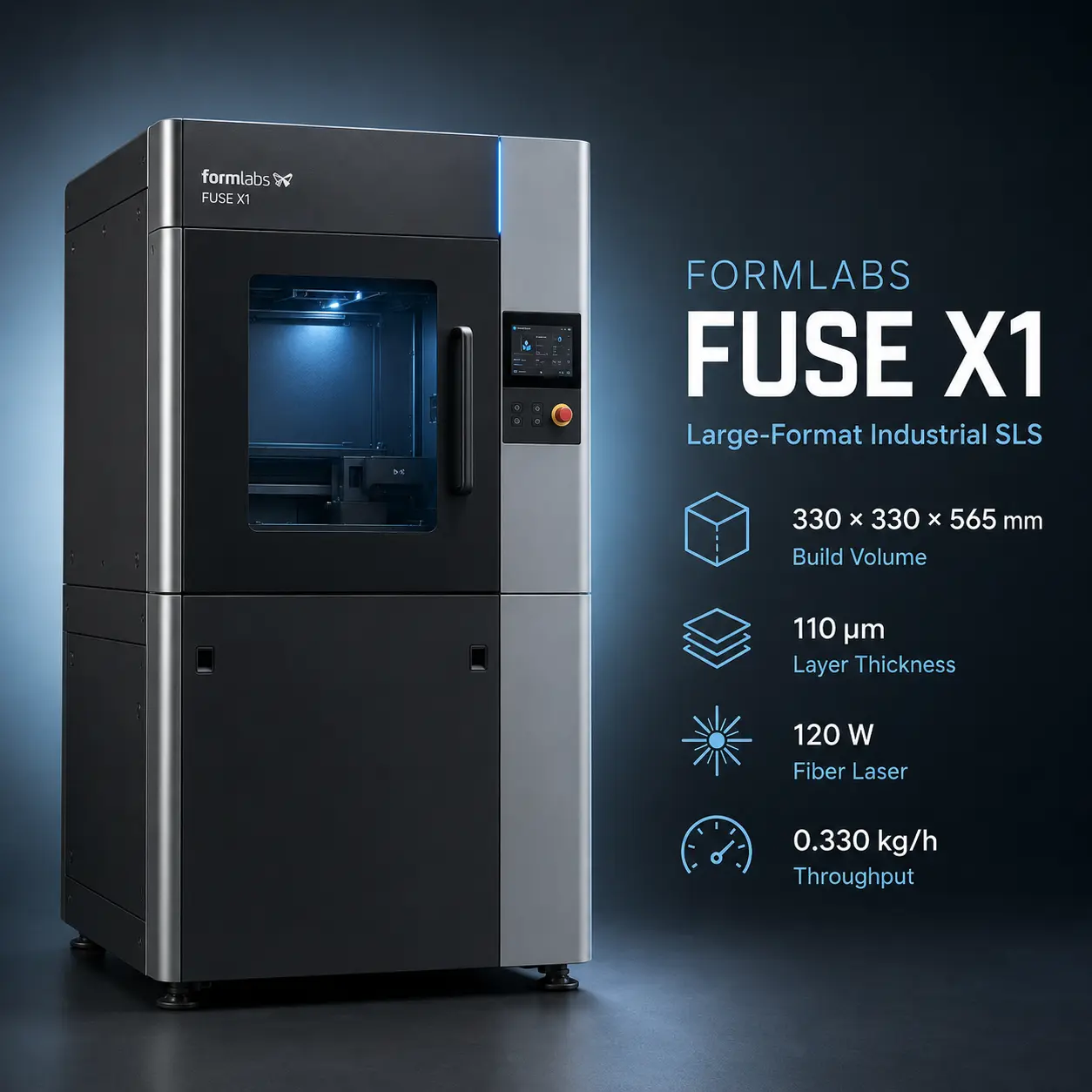
The Formlabs Fuse X1 is another current professional-to-industrial SLS platform, but it targets a substantially larger production class.
Formlabs publishes a 330 x 330 x 565 mm build volume, 120 W fiber laser, 110 micrometer layers, and up to 0.330 kg/h throughput for Fuse X1.
The CF250's positioning is different: TPM3D emphasizes compact footprint, 220 V installation, and a professional small-batch workflow.
Key decision factors include part size, batch size, utilities, material qualification, powder workflow, service, and budget.
Use the Print3DIndex comparison tool when comparing structured specifications across listed systems.
The HP Multi Jet Fusion 1200 competes for some of the same organizations looking for compact industrial polymer powder-bed production, but it uses HP's Multi Jet Fusion (MJF) process rather than SLS.
HP publishes a 320 x 165 x 230 mm / 12 L build volume, sub-12-hour full-height Standard-mode PA12 printing, automated powder management, and launch pricing below US$60,000 for the complete solution.
The official HP MJF 1200 page provides the current platform specifications.
The CF250 is therefore best understood as a compact professional SLS platform rather than a direct specification-for-specification substitute for HP MJF.
One of the most commercially important confirmed CF250 features is standard 220 V operation.
Large industrial SLS systems can require three-phase electrical service and more demanding facility infrastructure. TPM3D's established P360, for example, uses 380 V three-phase power.
A 220 V professional SLS platform can be easier to place in engineering offices, product-development labs, university and R&D facilities, service bureaus, small manufacturing cells, and existing workshops.
Powder storage, housekeeping, ventilation, safety, and post-processing space still need to be planned.
TPM3D maintains a broad polymer SLS material portfolio covering PA12, PA11, TPU, PP, reinforced nylons, PPS, PEKK, PEEK, and other formulations across its printer range.
The manufacturer's SLS materials library provides the broader ecosystem context.
Material qualification is machine-specific, however. The CF250 launch announcement does not identify the final production material list for the new platform, so materials used on CF200, P360, or other TPM3D machines should not be assumed to carry over automatically.
TPM3D positions its compact professional SLS platform around engineering, professional prototyping, and small-batch manufacturing.
The CF250 + PPS250 is particularly relevant to functional prototypes, product-development iterations, jigs and fixtures, low-volume production, replacement parts, service-bureau jobs, research, and end-use polymer components.
TPM3D is also presenting broader SLS applications at Formnext Asia Shenzhen across medical, industrial manufacturing, robotics, and footwear. Those examples demonstrate the company's wider SLS ecosystem rather than a complete CF250-specific application or material qualification list.
The CF250 + PPS250 is an upcoming system ahead of its global debut on August 26, 2026.
TPM3D has not published a retail price in the pre-launch announcement. The commercial route is currently request a quote through TPM3D sales.
The CF250 is most interesting for you if you want more production capacity than TPM3D's earlier compact professional platform without moving immediately to a large three-phase industrial SLS machine.
The main purchase questions are build volume, batch size, utilities, powder workflow, materials, service, throughput, and installed cost.
If you are searching for a professional SLS 3D printer, compact industrial SLS printer, SLS printer for small-batch production, 220 V SLS printer, CF250 vs CF200, CF250 vs Fuse X1, or SLS vs MJF, these workflow factors are more useful.
Recommended use: Choose the TPM3D CF250 + PPS250 when your organization wants a higher-capacity professional SLS workflow with integrated powder processing and standard 220 V installation, while remaining below the footprint and infrastructure class of TPM3D's larger industrial systems.
It is an upcoming professional SLS production solution combining the CF250 polymer powder-bed-fusion printer with the PPS250 powder-processing system.
TPM3D plans its global debut for August 26, 2026 at Formnext Asia Shenzhen.
TPM3D states that CF250 has an expanded build chamber and approximately twice the production capacity of the previous compact professional generation while retaining 220 V operation and an integrated powder workflow.
TPM3D has not published the final numerical build dimensions in its pre-launch announcement.
TPM3D states that the new platform retains standard 220 V operation.
PPS250 is the powder-processing companion for the CF250 and forms part of the integrated powder-handling workflow.
Conventional supports are generally unnecessary because unsintered powder supports the parts during printing.
TPM3D has not yet published the CF250-specific validated material list.
TPM3D positions it as a compact professional SLS system for prototyping and small-batch production, below the scale of larger industrial platforms such as its P360.
CF250 is positioned around compact professional SLS and 220 V installation. Fuse X1 is a substantially larger industrial SLS platform with a published 330 x 330 x 565 mm build volume.
Both target organizations bringing professional polymer powder-bed production in-house, but CF250 uses SLS while HP MJF 1200 uses Multi Jet Fusion.
TPM3D has not published a retail price ahead of the August 26 launch. The current sales route is request a quote.