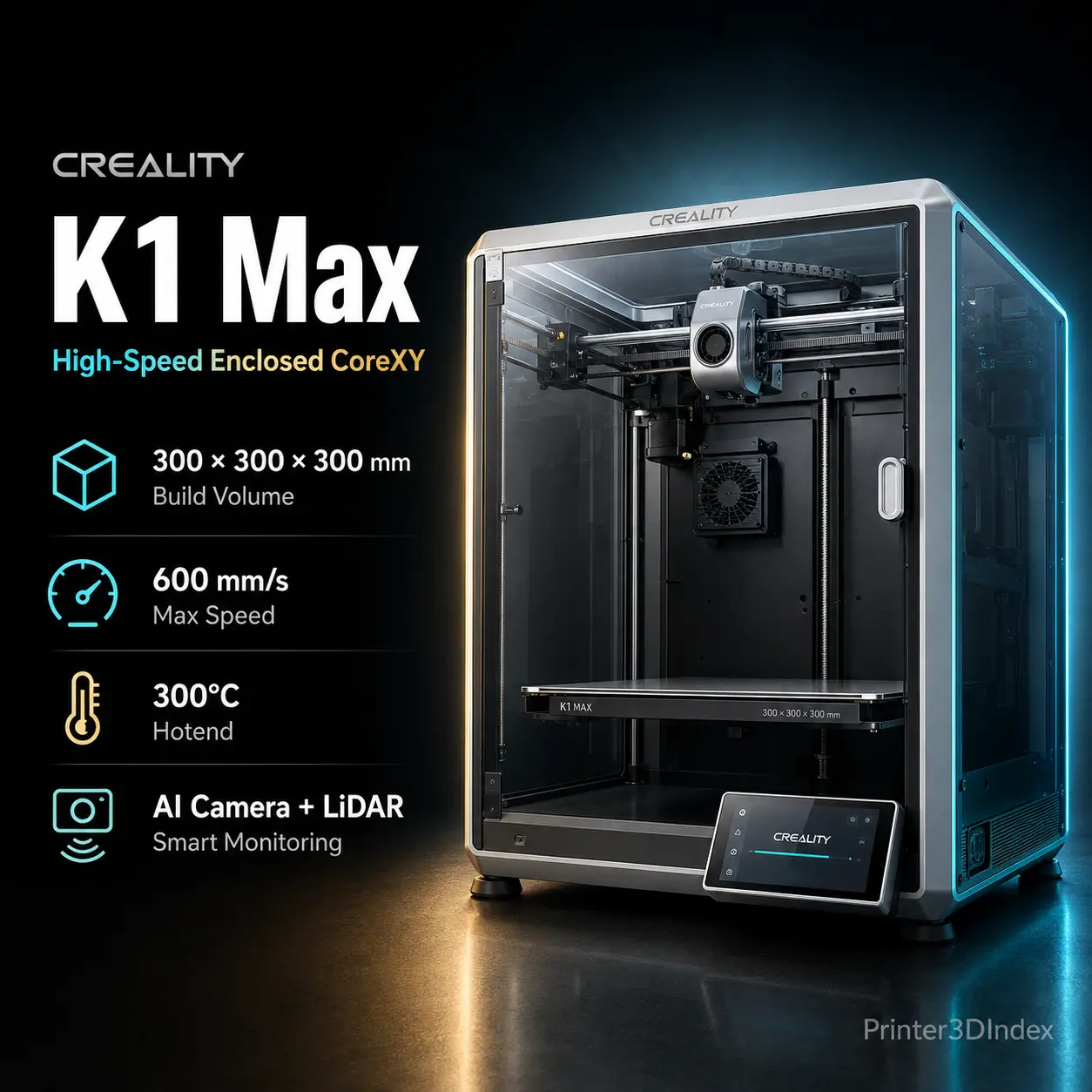
600 mm/s High-Speed CoreXY300 mm Cubic Build VolumeAI Camera MonitoringLiDAR-Assisted CalibrationCarbon-Fiber Material ReadyCFS-C Multi-Color Compatible
CCreality
Creality
# Creality K1 Max
The Creality K1 Max is a fully enclosed CoreXY FDM/FFF printer built around a 300 × 300 × 300 mm build volume, high-speed motion, automatic calibration, and camera/LiDAR-assisted monitoring. It is aimed at larger functional parts, prototypes, fixtures, and small-batch production.
Creality specifies 600 mm/s maximum print speed, 300 mm/s typical speed, 20,000 mm/s² maximum acceleration, and up to 32 mm³/s hotend flow. The printer uses a 300°C direct-drive hotend, a 100°C heated bed, and a fully enclosed but passively heated chamber.
The K1 Max also includes hands-free automatic leveling, input shaping, an AI LiDAR, a 1080p AI camera, Ethernet, Wi-Fi, USB transfer, 8 GB internal storage, and Creality OS. Creality's current US retail page markets the latest revision as K1 Max 2025, while its support documentation continues to cover K1 Max and K1 Max 2025 together.
For current specifications and pricing, see the official Creality K1 Max page and Creality K1-series comparison. For broader buying guidance, see Best 3D Printers for Small Business & Prototyping in 2026 and Best 3D Printers for Carbon-Fiber Materials in 2026.
| Specification | Value |
|---|---|
| Printing technology | FDM / FFF |
| Motion system | CoreXY |
| Build volume | 300 × 300 × 300 mm |
| Layer height | 0.10–0.35 mm |
| Standard nozzle | 0.4 mm hardened-steel configuration |
| Optional nozzle sizes | 0.6 / 0.8 mm |
| Maximum print speed | 600 mm/s |
| Typical print speed | 300 mm/s |
| Travel speed | Up to 800 mm/s |
| Maximum acceleration | 20,000 mm/s² |
| Maximum hotend flow | 32 mm³/s |
| Maximum nozzle temperature | 300°C |
| Maximum bed temperature | 100°C |
| Chamber | Fully enclosed, passive heating |
| Extruder | Dual-gear direct drive |
| Bed leveling | Hands-free automatic leveling |
| Input shaping | Yes |
| Build plate | Flexible build plate |
| Display | 4.3-inch 800 × 480 touchscreen |
| AI camera | 1080p |
| AI LiDAR | Yes |
| Internal storage | 8 GB |
| Connectivity | Wi-Fi / Ethernet / USB |
| Cloud workflow | Creality Cloud |
| Power-loss recovery | Yes |
| Filament runout sensor | Yes |
| Air filtration | Activated-carbon filter |
| Product dimensions | 435 × 462 × 526 mm |
| Net weight | 18 kg |
| Rated voltage | 100–240 V AC, 50/60 Hz |
| Rated power | 1000 W |
| Primary slicer | Creality Print |
| Other slicers listed by Creality | Cura / Simplify3D / PrusaSlicer |
Speed note: Creality's 600 mm/s maximum was measured under controlled conditions; Creality lists about 300 mm/s as the typical speed. Actual throughput depends on material, nozzle size, geometry, cooling, and flow demand.
The K1 Max's 300 × 300 × 300 mm capacity is a major advantage over compact enclosed printers. It is useful for larger housings, functional prototypes, tooling, fixtures, RC and robotics parts, workshop organizers, production batches, and design-verification models.
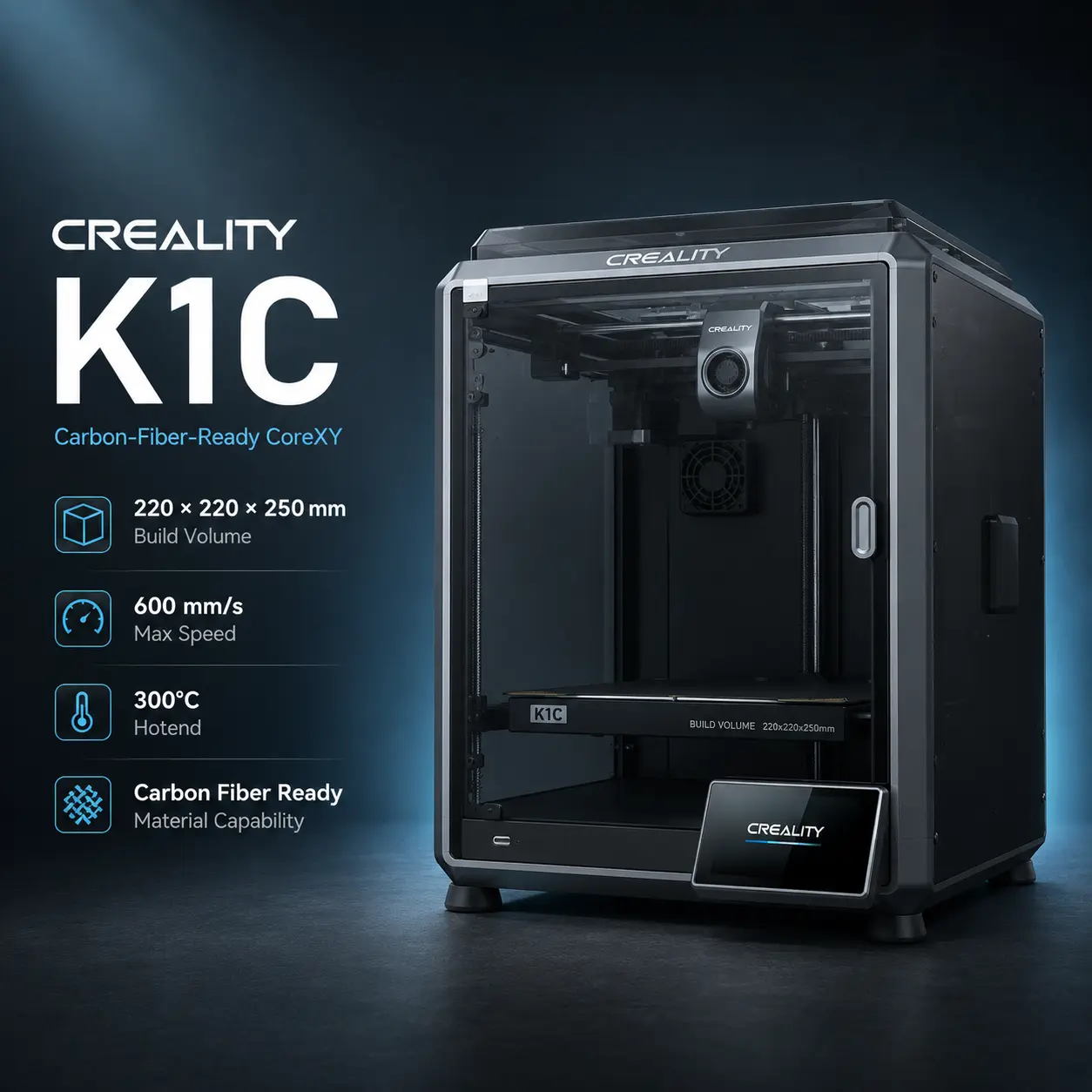
For users who mainly print smaller components, the Creality K1C offers much of the same K1-series speed in a more compact 220 × 220 × 250 mm format.
Creality specifies 600 mm/s maximum print speed, 300 mm/s typical print speed, 800 mm/s travel speed, 20,000 mm/s² maximum acceleration, and 32 mm³/s maximum hotend flow.
The flow figure is important because maximum toolhead speed and extrusion throughput are not the same thing. A large nozzle, high layer height, or viscous engineering filament can reach the hotend's flow limit long before the machine reaches its headline speed.
Creality's current K1 Max material list includes PLA, PETG, PET, TPU, ABS, ASA, PA, PC, PLA-CF, PA-CF, and PET-CF.
Current Creality retail documentation describes a hardened-steel nozzle, making the printer more suitable for abrasive carbon-fiber-filled materials than a brass-nozzle machine.
For carbon-fiber printing, nozzle wear is only part of the process. PA-CF and similar materials also require careful drying, stable chamber conditions, and material-specific profiles.
The K1 Max enclosure helps retain heat but has no active chamber heater. That limits its process control compared with printers designed for PPA-CF, PPS-CF, and other chamber-sensitive polymers.
For general functional printing, Prusament PETG is a lower-warp option. For enclosure-dependent printing, Prusament ASA illustrates why stable ambient temperature and ventilation matter.
The K1 Max is fully enclosed, but Creality specifies passive chamber heating.
An enclosure can improve ABS, ASA, PA, and PC printing by reducing drafts and retaining heat. An actively heated chamber goes further by controlling the air temperature rather than relying on waste heat from the bed and hotend.
For routine PLA, PETG, TPU, ABS, ASA, and selected CF-filled materials, the K1 Max remains capable. For large high-temperature engineering parts, an actively heated platform such as the indexed Creality K2 Plus or QIDI Plus4 is the stronger fit.
The K1 Max combines strain-sensor bed leveling with AI-assisted monitoring.
Creality documents:
Creality also documents important limits. Its current AI guide says LiDAR flow calibration does not currently calibrate TPU, PA, or carbon-fiber materials, and camera/first-layer detection can miss faults or create false alerts depending on lighting, color, and geometry.
These features are useful safeguards, not substitutes for checking the first layer and validating an engineering-material profile.
Creality now officially lists K1 Max and K1 Max 2025 as compatible with CFS-C.
The official CFS-C adds four filament slots, an external cutter and buffer, RFID recognition for supported Creality spools, automatic filament relay, runout detection, tangle detection, cutter-wear monitoring, and a temperature/humidity display.
The standard K1 Max does not include CFS-C.
CFS-C is different from the CFS used with K2-series printers.
Creality currently specifies:
The K1 Max should therefore be described as optional four-color capable, not as a 16-color system.
The printer itself supports more materials than the CFS-C feed system. Do not assume TPU, PA-CF, PET-CF, or every other K1 Max-compatible filament can be routed through CFS-C.
K1 Max supports Wi-Fi, RJ45 Ethernet, USB flash drive, LAN printing, Creality Cloud printing, OTA firmware updates, and 8 GB internal storage.
Creality Cloud is a software/service layer rather than a physical connection method, so the structured connectivity list is limited to Wi-Fi, Ethernet, and USB.
Creality Print is the primary slicer. Current Creality documentation also lists Cura, Simplify3D, and PrusaSlicer compatibility.
| Printer | Build Volume | Speed Figure | Nozzle / Bed / Chamber | Monitoring | Multi-Color |
|---|---|---|---|---|---|
| Creality K1 Max | 300 × 300 × 300 mm | 600 mm/s print | 300°C / 100°C / passive | AI camera + LiDAR | CFS-C, 4 slots |
| Creality K1C | 220 × 220 × 250 mm | 600 mm/s print | 300°C / 100°C / passive | AI camera | CFS-C compatible |
| Bambu Lab P1S | 256 × 256 × 256 mm | 500 mm/s toolhead | 300°C / 100°C / passive | 720p low-rate camera | AMS ecosystem |
| Bambu Lab P2S | 256 × 256 × 256 mm | 600 mm/s class | 300°C / 110°C / no active heater | 1080p AI camera | AMS / AMS 2 Pro |
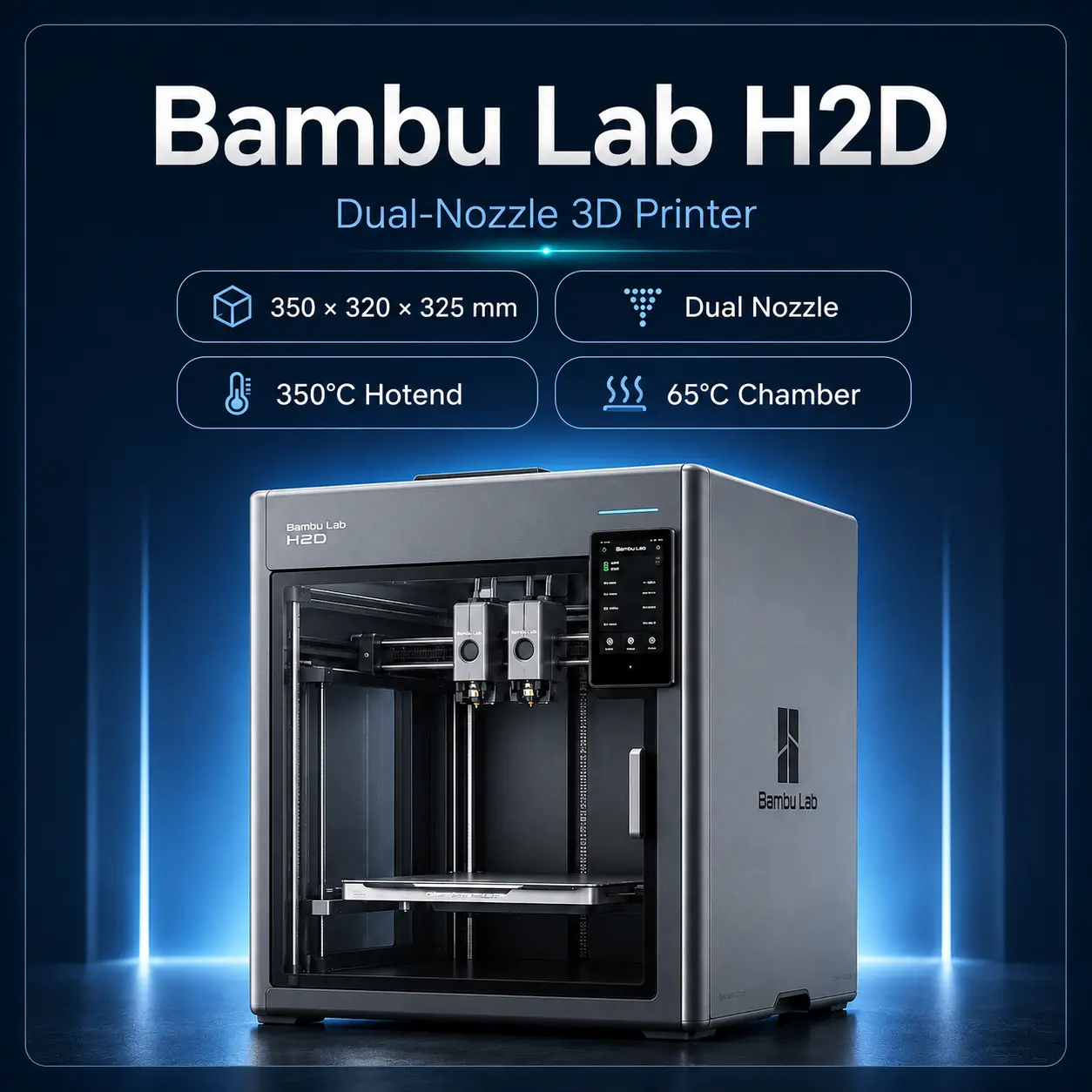
| Creality K2 Plus | 350 × 350 × 350 mm | 600 mm/s print | 350°C / 120°C / 60°C active | Dual AI cameras | CFS, up to 16 colors |
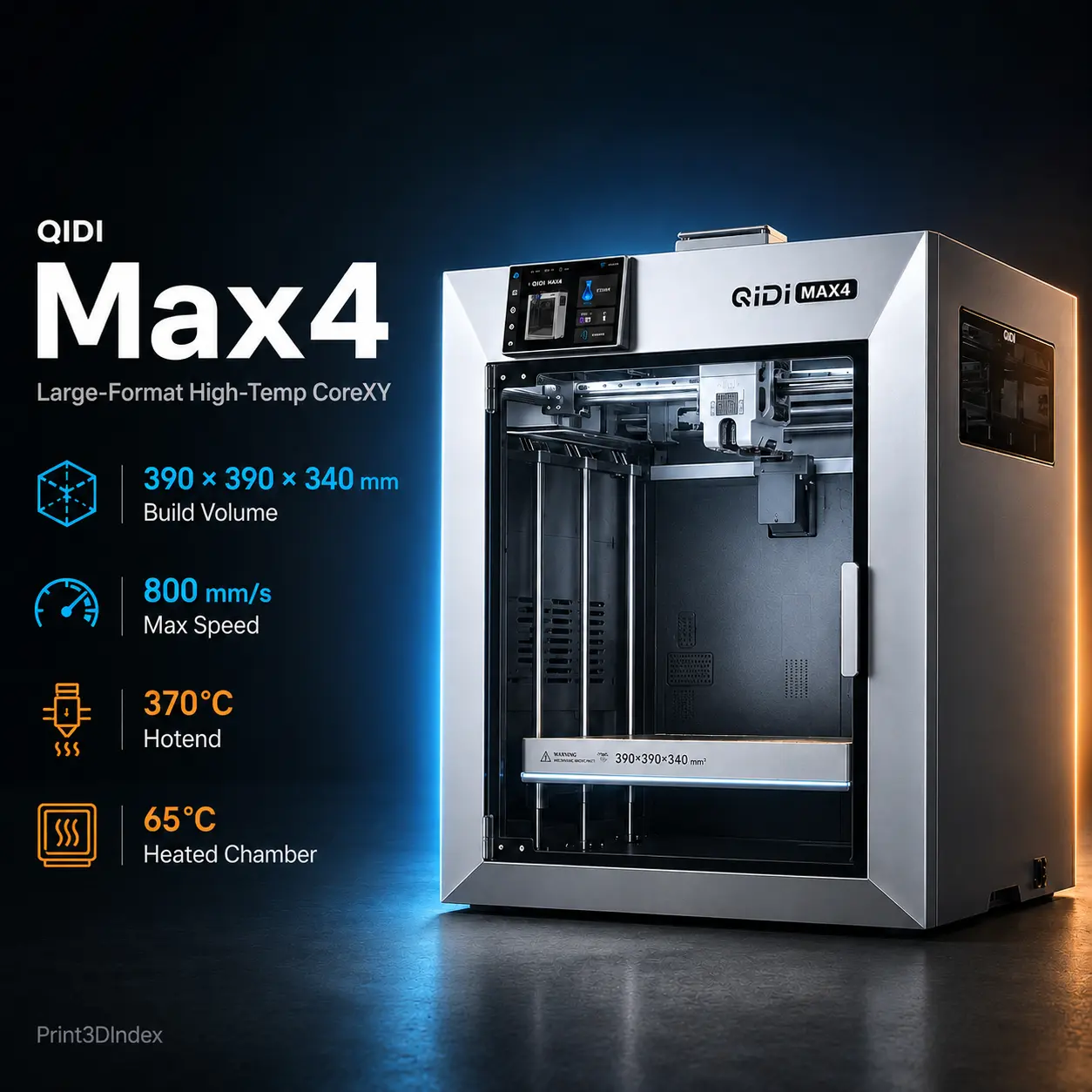
| QIDI Plus4 | 305 × 305 × 280 mm | 600 mm/s toolhead | 370°C / 120°C / 65°C active | 1080p camera | QIDI Box |
The K1 Max remains competitive on build volume, AI LiDAR, price, and stock composite capability, but newer platforms offer stronger chamber control, newer automation, or larger multi-material ecosystems.
The K1 Max vs K1C comparison is mainly large build volume and LiDAR versus compact size and easier servicing.
The indexed Creality K1C provides a 220 × 220 × 250 mm build volume, the same 600 mm/s maximum print speed, 300°C hotend, 100°C bed, and enclosed CoreXY architecture.
K1C uses Creality's quick-swap tri-metal steel-tipped nozzle and has an integrated AI camera. K1 Max provides much more build space at 300 × 300 × 300 mm, Ethernet, and AI LiDAR.
Choose K1C when desk space, quick nozzle servicing, and smaller CF-filled parts are the priority. Choose K1 Max when 300 mm capacity and LiDAR-assisted calibration justify the larger chassis.
See the official Creality K1C page.
The K1 Max vs Bambu Lab P1S comparison remains one of the most common enclosed-printer decisions.
The indexed Bambu Lab P1S provides a 256 × 256 × 256 mm build volume, 500 mm/s maximum toolhead speed, 300°C hotend, 100°C bed, automatic bed leveling, camera monitoring, and AMS compatibility.
K1 Max offers a much larger 300 mm cube, 600 mm/s maximum print-speed claim, Ethernet, AI LiDAR, and a current hardened-steel nozzle suited to selected CF-filled materials.
P1S has the more mature AMS ecosystem and a streamlined Bambu Studio/Handy workflow, but its standard stainless-steel nozzle is not recommended for regular CF/GF printing without an upgrade.
Choose K1 Max for build size, LiDAR, Ethernet, and stock abrasive-material capability. Choose P1S when AMS integration and Bambu's established software workflow matter more than 300 mm capacity.
See the official Bambu Lab P1S page.
The K1 Max vs Bambu Lab P2S comparison pits larger capacity against newer-generation automation.
The indexed Bambu Lab P2S keeps a 256 × 256 × 256 mm build volume but adds a 5-inch touchscreen, PMSM servo extruder, automatic flow-dynamics calibration, 1080p high-rate camera, AI error detection, quick-swap hotend, hardened extrusion hardware, and AMS 2 Pro compatibility.
P2S also increases bed temperature to 110°C.
K1 Max remains substantially larger at 300 mm cubed and includes AI LiDAR, Ethernet, and a competitive US price.
Choose K1 Max when extra build volume is essential. Choose P2S when newer extrusion monitoring, automatic flow calibration, camera quality, quick hotend changes, and AMS 2 Pro matter more.
See Bambu Lab's official P2S introduction.
The K1 Max vs K2 Plus comparison shows the biggest generational jump within Creality's enclosed lineup.
The indexed Creality K2 Plus provides a 350 × 350 × 350 mm build volume, 600 mm/s maximum print speed, 30,000 mm/s² acceleration, 350°C nozzle, 120°C bed, 60°C actively heated chamber, step-servo motors, dual AI cameras, and CFS expansion to as many as 16 colors.
K1 Max is smaller and thermally less capable, but also much less expensive and remains useful for PLA, PETG, TPU, ABS, ASA, PA, PC, and selected CF-filled materials.
Choose K1 Max for value, 300 mm-class prototyping, and CFS-C four-color upgrades. Choose K2 Plus for larger parts, active chamber heating, high-temperature engineering materials, and the full CFS ecosystem.
See the official Creality K2 Series page.
The K1 Max vs QIDI Plus4 comparison is especially relevant for engineering-material users.
The official QIDI Plus4 provides a 305 × 305 × 280 mm build volume, 600 mm/s maximum toolhead speed, 370°C hotend, 120°C bed, and 65°C active chamber heating.
QIDI Plus4 also uses hardened extrusion components, hands-free leveling, a 1080p camera, Klipper-based software, Ethernet, and optional QIDI Box multi-color support.
K1 Max is taller at 300 mm Z, includes AI LiDAR, and currently costs less in the US. Plus4 has dramatically stronger thermal hardware for PA, PC, high-temperature composites, and chamber-sensitive engineering parts.
Choose K1 Max for larger Z, LiDAR, lower current price, and general enclosed printing. Choose QIDI Plus4 when 370°C / 65°C thermal capability is more important than LiDAR or Creality's ecosystem.
The Creality K1 Max is currently available from US$549 through Creality’s store, approximately €470 in Europe, £402 in the UK, C$756 in Canada, A$767 in Australia, ₹52,540 in India, and AED 2,016 in the UAE.
Availability and final pricing can vary by region depending on local stock, VAT or sales tax, import duties, shipping costs, exchange rates, hardware revision, bundles, and promotional discounts.
300 × 300 × 300 mm.
Creality specifies 600 mm/s maximum and approximately 300 mm/s typical printing speed.
20,000 mm/s².
Creality publishes up to 32 mm³/s.
300°C.
100°C.
No. The chamber is enclosed and passively warmed.
Yes. Creality uses LiDAR for first-layer inspection and compatible flow-calibration workflows.
Yes. It includes a 1080p camera with AI-assisted monitoring functions.
Creality lists PLA-CF, PA-CF, and PET-CF. The current hardened-steel nozzle configuration is suitable for selected abrasive composites.
Yes. Creality officially lists both K1 Max and K1 Max 2025 as CFS-C compatible.
Four filament slots. Creality states that multiple CFS-C units are not supported.
No. It is an optional upgrade unless sold in a specific bundle.
Yes. It supports RJ45 Ethernet, Wi-Fi, and USB.
K1 Max has a much larger 300 mm cube and AI LiDAR. K1C is smaller and uses Creality's compact quick-swap tri-metal nozzle system.
K1 Max is larger and includes AI LiDAR and Ethernet. P1S has a smaller 256 mm cube but a more established AMS multi-color ecosystem.
K2 Plus is larger and adds a 350°C nozzle, 120°C bed, 60°C active chamber, step-servo motion, and up to 16-colo