CoreXZ High-Speed Motion600 mm/s Large-Format Printing300°C Quick-Swap HotendCarbon-Fiber Filament ReadyAutomatic Bed LevelingDual Y-Axis Stability
CCreality
Creality
# Creality Ender-3 V3 Plus
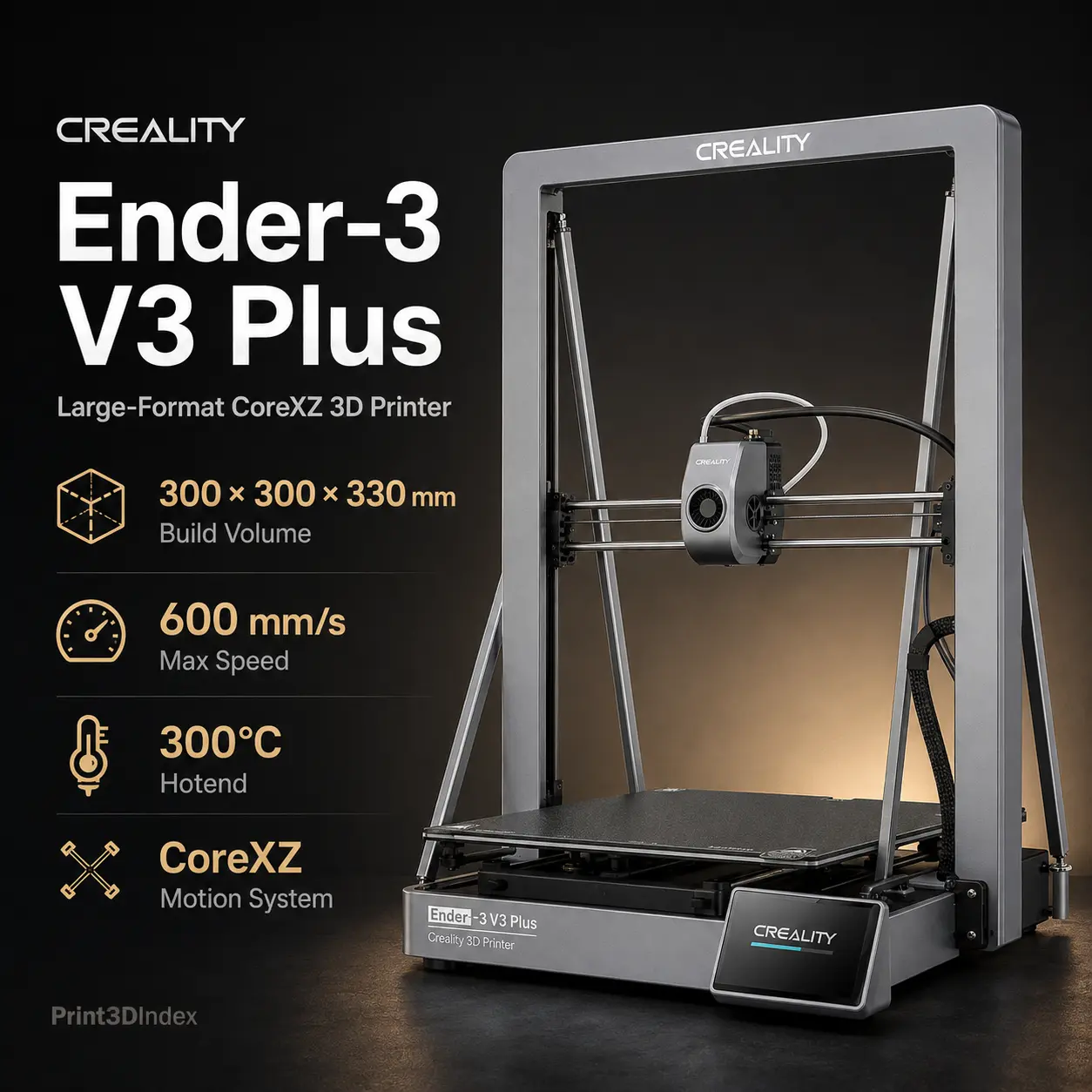
The Creality Ender-3 V3 Plus is a large-format open-frame CoreXZ FDM/FFF printer with a 300 × 300 × 330 mm build volume, 600 mm/s maximum speed, 20,000 mm/s² maximum acceleration, and a 300°C quick-swap tri-metal hotend. It expands the Ender-3 V3 platform for larger functional parts, cosplay pieces, workshop projects, and batch printing while keeping the same high-speed CoreXZ concept.
Creality lists 300 mm/s as the typical print speed, a 0.10–0.35 mm layer range, 100°C heated bed, automatic leveling, G-sensor input shaping, and a direct-drive extruder. The Plus also adds dual Y-axis motors and two gantry support rods to stabilize the larger moving bed and taller Z axis.
Material support is broader than a basic hobby printer. Creality officially lists PLA, TPU 95A, PETG, ABS, PLA-CF, PETG-CF, and CR-Carbon. The quick-swap nozzle uses a hardened-steel tip, which makes the machine more suitable for abrasive-filled filaments than printers supplied with a standard brass nozzle.
For manufacturer specifications, see the official Creality Ender-3 V3 Plus page and Creality Ender-3 V3 Series comparison.
| Specification | Value |
|---|---|
| Printing technology | FDM / FFF |
| Motion system | CoreXZ |
| Build volume | 300 × 300 × 330 mm |
| Layer height | 0.10–0.35 mm |
| Printing accuracy | ±0.2 mm manufacturer specification |
| Typical print speed | 300 mm/s |
| Maximum print speed | 600 mm/s |
| Maximum acceleration | 20,000 mm/s² |
| Standard nozzle | 0.4 mm |
| Nozzle type | Quick-swap tri-metal, hardened-steel tip |
| Maximum nozzle temperature | 300°C |
| Maximum bed temperature | 100°C |
| Extruder | High-speed direct drive |
| Hotend heater | 60 W |
| Bed leveling | Automatic |
| Input shaping | G-sensor included |
| XZ belt tensioning | Automatic |
| Y-axis drive | Dual motors |
| Gantry support | Two Z-axis support rods |
| Build plate | Flexible build plate |
| Display | 4.3-inch HD color touchscreen |
| Connectivity | Wi-Fi |
| File transfer | USB drive / WLAN / Creality Cloud |
| Slicer | Creality Print |
| Supported file formats | STL / OBJ / 3MF |
| Power-loss recovery | Yes |
| Filament runout sensor | Yes |
| Optional camera | Nebula Camera |
| Machine dimensions | 410 × 445 × 577 mm |
| Net weight | 11.5 kg |
| Rated voltage | 100–120 V / 200–240 V AC, 50/60 Hz |
| Rated power | 350 W |
Speed note: 600 mm/s is the maximum published speed. Creality lists 300 mm/s as the typical speed, and real throughput depends on filament, nozzle size, cooling, geometry, and flow demand.
The Ender-3 V3 Plus uses CoreXZ, where the X and Z axes are driven together by two high-torque motors and timing belts.
This differs from a conventional Cartesian bed-slinger, where one motor primarily controls X and separate lead-screw hardware controls Z.
Creality combines CoreXZ with automatic XZ belt tensioning, linear rods on Z, dual Y-axis motors, two gantry support rods, and G-sensor input shaping.
The result is a faster-moving printhead system while the enlarged bed still moves along Y. The Plus is therefore not a CoreXY printer, which matters when comparing tall or heavy parts with enclosed CoreXY alternatives.
The Plus offers substantially more room than the standard Ender-3 V3's 220 × 220 × 250 mm volume.
That extra space is useful for cosplay armor sections, masks, large brackets, electronics housings, workshop fixtures, RC and robotics parts, architectural models, product prototypes, and multiple smaller parts per plate.
For wearable projects, 300 mm XY capacity can reduce splitting compared with a 220–256 mm printer, though the largest helmets may still require orientation changes or sectioning.
For broader large-part guidance, see Best 3D Printers for Cosplay Props and Helmets in 2026.
The printer uses Creality's high-speed direct-drive extruder with a quick-swap tri-metal nozzle.
Creality specifies a hardened-steel nozzle tip integrated with the heatbreak. That matters for abrasive materials such as PLA-CF and PETG-CF, which can wear a conventional brass nozzle quickly.
The 300°C temperature ceiling is sufficient for the materials Creality officially lists, but nozzle temperature alone does not make the printer suitable for every engineering composite.
Higher-temperature nylon, PPA, PC, PPS, and similar materials can require stronger chamber control, drying, and validated profiles than the open Ender-3 V3 Plus provides.
For wider composite-printer guidance, see Best 3D Printers for Carbon-Fiber Materials in 2026.
Creality officially lists:
These are the easiest everyday materials for the open-frame Plus.
Prusament PETG is a useful reference for durable, low-warp functional printing where an enclosure is not normally required.
The direct-drive extruder supports flexible filament such as TPU 95A.
Prusament TPU 95A illustrates a typical 95A flexible-material use case for grips, covers, spacers, and wear-resistant components.
Creality explicitly notes that an additional enclosure is required when printing ABS and other high-temperature filaments.
That is especially important on larger parts, where uneven cooling increases the risk of warping and layer splitting.
The hardened-steel nozzle tip makes the Plus a better fit for abrasive carbon-fiber-filled PLA and PETG than printers supplied with brass nozzles.
That does not make it equivalent to an enclosed PA-CF or PPA-CF engineering system. Carbon-fiber capability depends on the base polymer as well as nozzle wear resistance.
The Plus includes automatic leveling and a G-sensor for input shaping.
Creality positions the workflow as fully automatic calibration, removing the need for traditional manual paper leveling during normal setup.
The printer also supports automatic Z offset, filament runout detection, power-loss recovery, and automatic XZ belt tensioning.
These systems reduce setup time, but keeping the build surface clean and checking mechanical condition still matter on a 300 mm bed.
The Plus adds hardware specifically to handle the larger platform.
Two 500 mN·m Y-axis motors drive the moving bed, while two support rods connect the gantry to the base to form a stiffer triangular structure.
This is more important on the Plus than on the smaller Ender-3 V3 because the larger bed carries heavier prints and creates higher inertial loads.
The design improves stability, but the machine is still a bed-slinger. Very tall or heavy models may benefit from lower acceleration than the headline 20,000 mm/s² maximum.
Creality lists Wi-Fi, USB drive transfer, WLAN transfer, and Creality Cloud.
Creality Cloud is a software/service workflow rather than a physical connection interface, so Wi-Fi and USB are the relevant hardware connection types.
The optional Nebula Camera adds remote monitoring, timelapse capture, and AI-assisted failure detection. It is not included as standard equipment.
| Printer | Build Volume | Max Speed | Nozzle / Bed | Enclosure | Composite Focus |
|---|---|---|---|---|---|
| Creality Ender-3 V3 Plus | 300 × 300 × 330 mm | 600 mm/s | 300°C / 100°C | No | PLA-CF / PETG-CF / CR-Carbon |
| ELEGOO Neptune 4 Plus | 320 × 320 × 385 mm | 500 mm/s | 300°C / 100°C | No | Brass nozzle; wear-resistant upgrade advised |
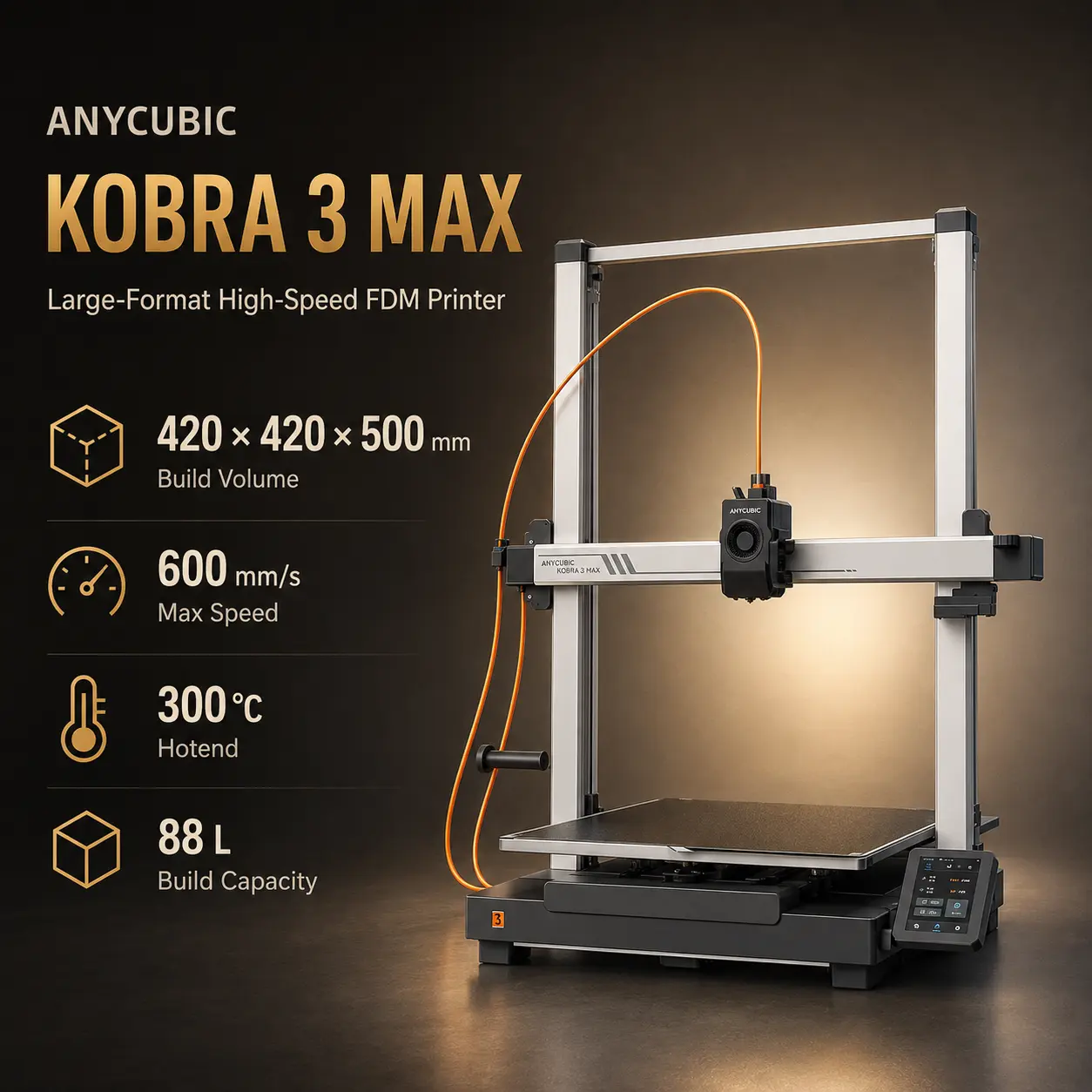
| Anycubic Kobra 3 Max | 420 × 420 × 500 mm | 600 mm/s | 300°C / 90°C | No | Huge volume + optional multi-color |
| Creality K2 Plus | 350 × 350 × 350 mm | 600 mm/s | 350°C / 120°C | 60°C active | PA/PPA/PPS and CF/GF engineering materials |
| Bambu Lab A1 | 256 × 256 × 256 mm | 500 mm/s | 300°C / 100°C | No | Everyday materials + AMS lite |
The Ender-3 V3 Plus is strongest when buyers want a 300 mm-class platform, 600 mm/s headline speed, hardened nozzle tip, and lower complexity than a large enclosed CoreXY machine.
The Ender-3 V3 Plus vs Ender-3 V3 comparison is primarily about build volume.
The official Ender-3 V3 uses the same CoreXZ concept with a 220 × 220 × 250 mm build volume, 600 mm/s maximum speed, 20,000 mm/s² acceleration, 300°C nozzle, and a hotter 110°C bed.
The standard V3 is smaller, lighter, and easier to place.
The Plus expands capacity to 300 × 300 × 330 mm, adds dual Y motors and support rods, and retains the same high-speed CoreXZ architecture.
Choose Ender-3 V3 when 220 mm XY capacity is sufficient and desk space matters. Choose Ender-3 V3 Plus for larger functional parts, cosplay pieces, and batch printing.
The Ender-3 V3 Plus vs ELEGOO Neptune 4 Plus comparison is one of the closest large-format value matchups.
The indexed ELEGOO Neptune 4 Plus provides a larger 320 × 320 × 385 mm build volume, 500 mm/s maximum speed, 12,000 mm/s² maximum acceleration, 300°C hotend, 100°C bed, Klipper, Wi-Fi/LAN/USB, and 121-point bed leveling.
Ender-3 V3 Plus is smaller but faster on paper at 600 mm/s and 20,000 mm/s². Its hardened-steel nozzle tip is also better suited to Creality's officially supported PLA-CF and PETG-CF workflows than the Neptune 4 Plus's stock brass nozzle.
Choose Neptune 4 Plus when larger build volume, Klipper, and wired LAN matter most. Choose Ender-3 V3 Plus when higher acceleration, CoreXZ, hardened nozzle hardware, and a smaller footprint are stronger priorities.
See the official ELEGOO Neptune 4 Plus page.
The Ender-3 V3 Plus vs Anycubic Kobra 3 Max comparison is compact 300 mm-class printing versus ultra-large-format capacity.
The indexed Anycubic Kobra 3 Max provides a much larger 420 × 420 × 500 mm build volume, 600 mm/s maximum speed, 10,000 mm/s² maximum acceleration, 300°C hotend, 90°C bed, and optional 4- or 8-color ACE Pro support.
Kobra 3 Max is a much larger machine and better suited to full helmets, large props, tall housings, and very large production parts.
Ender-3 V3 Plus is easier to place, has a hotter bed, higher maximum acceleration, and official PLA-CF/PETG-CF support through its hardened nozzle tip.
Choose Kobra 3 Max when raw build volume or optional multi-color printing dominates the decision. Choose Ender-3 V3 Plus when 300 mm capacity is enough and you value compactness, CoreXZ motion, and easier composite filament use.
See the official Anycubic Kobra 3 Max page.
The Ender-3 V3 Plus vs Creality K2 Plus comparison is open-frame value versus enclosed engineering capability.
The indexed Creality K2 Plus provides a 350 × 350 × 350 mm build volume, 600 mm/s maximum speed, 350°C nozzle, 120°C bed, and a 60°C actively heated chamber.
K2 Plus supports a much broader engineering-material range, including PA, PC, PA-CF, PAHT-CF, PET-CF, PPA-CF, PPS, and other reinforced polymers.
The Ender-3 V3 Plus is substantially smaller and simpler but remains a strong value option for PLA, PETG, TPU, ABS with an enclosure, and lower-temperature CF-filled materials.
Choose Ender-3 V3 Plus for open-frame prototyping, hobby use, PLA-CF/PETG-CF, and a smaller workshop footprint. Choose K2 Plus when chamber heating, high-temperature engineering materials, larger volume, and CFS expansion justify the higher cost.
The Creality Ender-3 V3 Plus currently starts from US$339 in the US. That is approximately €290 in Europe, £249 in the UK, C$467 in Canada, A$473 in Australia, ₹32,442 in India, and AED 1,245 in the UAE.
Actual pricing may vary by region depending on VAT or local taxes, shipping costs, exchange rates, stock availability, regional bundles, and promotional discounts
300 × 300 × 330 mm.
600 mm/s. Creality lists 300 mm/s as the typical speed.
20,000 mm/s².
0.10–0.35 mm.
300°C.
100°C.
A 0.4 mm quick-swap tri-metal nozzle with a hardened-steel tip.
Yes. Creality lists automatic leveling and automatic Z-offset calibration.
Yes. Wi-Fi is built in, with USB drive and Creality Cloud workflows also supported.
Creality officially lists PLA-CF, PETG-CF, and CR-Carbon. More demanding high-temperature composites may require an enclosed actively heated printer.
Yes, but Creality recommends an additional enclosure for ABS and other high-temperature filaments.
Yes. Creality officially lists TPU 95A.
No. The Nebula Camera is optional.
CoreXZ mechanically couples X and Z motion through belts and two motors. The printer still moves the build plate along Y, so it is not CoreXY.
Neptune 4 Plus is larger and offers Klipper plus wired LAN. Ender-3 V3 Plus is smaller, faster on paper, and includes a hardened nozzle tip suitable for its supported CF-filled filaments.
Kobra 3 Max is dramatically larger and supports optional multi-color printing. Ender-3 V3 Plus is easier to place and has higher maximum acceleration and a hotter bed.
The Creality Ender-3 V3 Plus currently starts from US$339 in the US