General-Purpose SLS NylonHigh-Accuracy PA12 PowderReusable Powder Production MaterialLow-Moisture SLS NylonFunctional Manufacturing PA12Durable End-Use SLS Powder
FFormlabs
Formlabs
# Formlabs Nylon 12 Powder
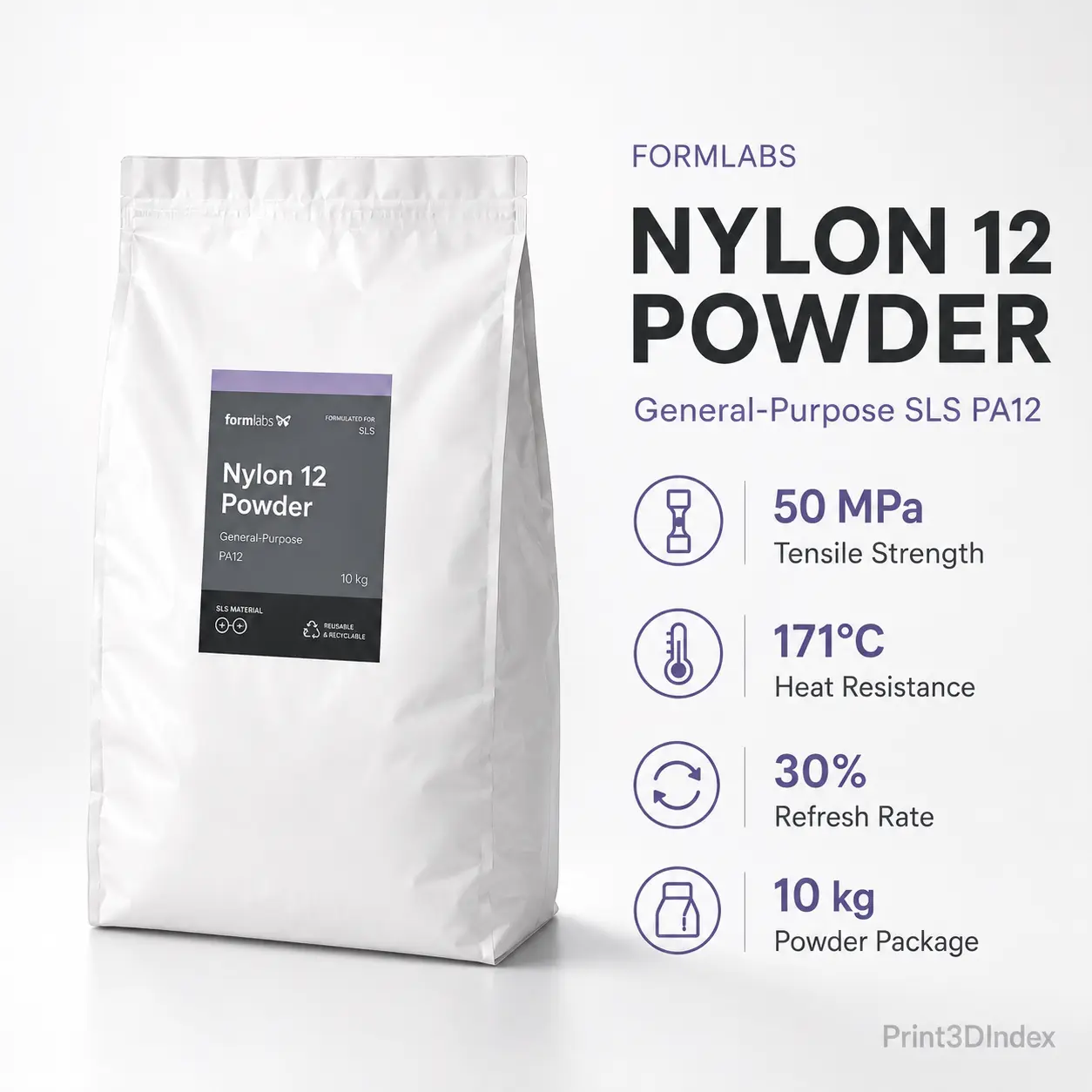
Formlabs Nylon 12 Powder is a general-purpose PA12 powder for selective laser sintering on the Formlabs Fuse Series. It is designed for functional prototypes, complex assemblies, manufacturing aids, tooling, medical applications, and end-use production where dimensional accuracy, environmental stability, and repeatable mechanical performance matter.
Formlabs publishes 50 MPa tensile strength, 1850 MPa tensile modulus, 11% XY elongation, and 171°C HDT at 0.45 MPa; at 1.8 MPa, HDT is 87°C. The load condition matters, so 171°C should not be treated as a universal service temperature.
Formlabs also lists Nylon 12 among its best Fuse powders for dimensional accuracy, surface finish, print speed, and fine-feature resolution. It is biocompatible for specified skin-contact and mucosal-membrane-contact applications, with finished medical devices still requiring application-specific validation.
For current specifications and pricing, see the official Formlabs Nylon 12 Powder page, Formlabs SLS powder-selection guide, and Formlabs medical certifications reference.
| Specification | Value |
|---|---|
| Material | PA12 polymer powder |
| Printing process | SLS |
| Package size | 10 kg |
| Color | Grey |
| Compatible printers | Fuse X1 / Fuse 1+ 30W / Fuse 1 |
| Recommended atmosphere | Air |
| Refresh rate | 30% fresh powder |
| Recovered-powder fraction | Up to 70% in validated blend |
| Ultimate tensile strength | 50 MPa |
| Tensile modulus | 1850 MPa |
| Elongation at break XY | 11% |
| Elongation at break Z | 6% |
| Flexural strength | 66 MPa |
| Flexural modulus | 1600 MPa |
| Notched Izod impact | 32 J/m |
| HDT at 0.45 MPa | 171°C |
| HDT at 1.8 MPa | 87°C |
| Biocompatibility | Skin contact / mucosal membrane contact |
| Supports required | No separate support structures |
| Post-processing | Depowdering + media blasting; optional dyeing/coating/machining |
Material values are manufacturer test data. Formlabs explicitly notes that final performance varies with design and manufacturing practice, so production parts should be validated for their intended load, environment, and regulatory use.
Formlabs currently lists Nylon 12 Powder as compatible with:
The indexed Formlabs Fuse X1 is the newest relevant Print3DIndex-listed Formlabs SLS platform for this powder.
Nylon 12 is recommended for printing in air, making it simpler than powders such as Nylon 11 or Nylon 12 White that benefit from nitrogen workflows.
The 30% refresh rate means a validated blend of 30% fresh powder and 70% recovered unsintered powder.
Recovered powder is not infinitely reusable; repeated heat exposure ages it. Formlabs validates performance around specific refresh-rate and print-setting combinations, so deviating from the tested blend can change results.
For a new workflow, Formlabs recommends aging powder and tuning bed temperature before the first standard build. Aging creates the recovered powder needed for the initial 70/30 blend, after which Nylon 12 generally needs little additional tuning compared with more specialized Fuse powders.
Because surrounding powder supports the build, Nylon 12 can produce nested assemblies, moving mechanisms, internal channels, interlocking parts, and complex shapes without conventional supports. Enclosed cavities still need powder-removal access, and packing/orientation affects yield and surface quality.
Nylon 12 is a balanced PA12 rather than Formlabs' toughest or stiffest powder. It combines 50 MPa tensile strength, 1850 MPa modulus, 11% XY elongation, 32 J/m notched Izod, and 171°C / 87°C HDT at 0.45 / 1.8 MPa.
For warm, mechanically loaded parts, the 87°C figure at 1.8 MPa is often more informative than the low-load 171°C value.
Formlabs lists Nylon 12 Powder for skin and mucosal membrane contact and documents steam, gamma, EtO, and e-beam sterilization compatibility within its testing framework.
That does not automatically certify every printed device. Medical use still requires validation of the print, cleaning, sterilization, geometry, contact duration, and applicable regulatory pathway.
Formlabs treats loose polymer powder as a combustible particulate material. Follow the SDS, avoid ignition sources and dust clouds, use suitable PPE, and use an approved grounded/bonded vacuum for cleanup.
Store powder closed and dry. Formlabs recommends 50% RH or lower around Nylon 12 printing, storage, and powder-handling equipment.
Parts are depowdered and reusable powder recovered through Fuse Sift or an approved equivalent, then media blasted or finished with Fuse Blast. Parts can subsequently be dyed, coated, polished, tumbled, or machined. Natural Nylon 12 has a lightly textured grey SLS surface.
For users searching Formlabs Nylon 12 Powder price or SLS powder cost per kg, the current US price is US$999 per 10 kg, or about US$99.90/kg before bulk discounts.
Actual part cost also depends on the 30% refresh ratio, build packing, powder loss, yield, post-processing labor, and machine utilization.
The Formlabs Nylon 12 vs Nylon 12 Tough comparison is stiffness and loaded heat performance versus ductility and impact tolerance.
| Property | Nylon 12 | Nylon 12 Tough |
|---|---|---|
| Tensile strength | 50 MPa | 42 MPa |
| Tensile modulus | 1850 MPa | 1450 MPa |
| Elongation | 11% | 25% |
| Notched Izod | 32 J/m | 60 J/m |
| HDT @ 0.45 MPa | 171°C | 161°C |
| HDT @ 1.8 MPa | 87°C | 46°C |
| Refresh rate | 30% | 20% |
Choose Nylon 12 for general-purpose functional parts and better loaded heat resistance; choose Nylon 12 Tough for snaps, hinges, impact, long parts, and higher ductility.
The Nylon 12 vs Nylon 12 GF comparison is balanced performance versus glass-filled stiffness. Nylon 12 GF reaches 2800 MPa tensile modulus and 113°C HDT at 1.8 MPa, but elongation falls to 4% and refresh rises to 50%.
Choose Nylon 12 for versatility and ductility; choose GF for rigid tooling and higher loaded heat resistance.
The Formlabs Nylon 12 vs Nylon 11 comparison is stiffness and dimensional stability versus flexibility and impact. Nylon 11 offers 40% elongation and 71 J/m notched Izod, making it better for clips, hinges, orthotics, and repeated flexing.
Nylon 12 is better for rigid assemblies and routine production, and it prints in air while Formlabs recommends nitrogen for Nylon 11 on Fuse 1+ 30W.
The Nylon 12 vs Nylon 12 White comparison is broad production flexibility versus white aesthetics. Nylon 12 White offers 47 MPa tensile strength, 8% elongation, and 177°C HDT at 0.45 MPa, but is limited to Fuse 1+ 30W and benefits from nitrogen to preserve color.
Choose standard Nylon 12 for routine production; choose White for medical visualization, branded parts, and dyeing.
The keyword SLS Nylon 12 vs MJF PA12 compares different process ecosystems. Formlabs Nylon 12 is validated for the Fuse SLS platform and is not a drop-in MJF powder.
Both processes can make support-free PA12 parts, but energy delivery, powder management, surface finish, refresh strategy, and cost structure differ by machine/material system.
| Material | Primary Advantage | Tensile Strength | Elongation | HDT @ 1.8 MPa | Refresh |
|---|---|---|---|---|---|
| Nylon 12 Powder | Best general-purpose balance | 50 MPa | 11% | 87°C | 30% |
| Nylon 12 Tough | Ductility / reduced warpage | 42 MPa | 25% | 46°C | 20% |
| Nylon 12 GF | Stiffness / loaded heat resistance | 38 MPa | 4% | 113°C | 50% |
| Nylon 11 | Flexibility / impact resistance | 49 MPa | 40% | 46°C | 30% |
| Nylon 12 White | White finish / dyeability | 47 MPa | 8% | 87°C | 30% |
Different powders also have different printer and atmosphere requirements, so material selection should consider workflow as well as mechanical values.
Formlabs currently lists Nylon 12 Powder at US$999 per 10 kg package, equal to about US$99.90/kg. For regional reference, US$999 is approximately €855.12 in Europe, £735.76 in the UK, AED 3,669.28 in the UAE, C$1,381.62 in Canada, A$1,404.37 in Australia, and ₹95,459 in India. Actual pricing may vary by region, taxes, shipping, stock, and exchange rates.
It is a general-purpose PA12 SLS powder for strong, dimensionally accurate functional prototypes and end-use parts on the Formlabs Fuse platform.
Formlabs publishes 50 MPa ultimate tensile strength.
11% in XY and 6% in Z.
HDT is 171°C at 0.45 MPa and 87°C at 1.8 MPa.
Formlabs currently lists Fuse X1, Fuse 1+ 30W, and Fuse 1.
No. Formlabs recommends printing standard Nylon 12 Powder in air.
30%, meaning a validated blend of 30% fresh and 70% recovered powder.
No separate support structures are needed because surrounding unsintered powder supports the build.
Formlabs recommends an initial powder-aging and bed-temperature-tuning workflow to establish the normal 30% refresh mixture.
Formlabs lists it for skin-contact and mucosal-membrane-contact applications under its documented biocompatibility testing. Finished medical devices still require application-specific validation.
Parts are depowdered, sieved/recovered through Fuse Sift or an approved workflow, then media blasted or processed with Fuse Blast before optional dyeing, coating, polishing, or machining.
The current US store lists US$999 for 10 kg, or about US$99.90 per kg before bulk discounts.
Standard Nylon 12 is stiffer and has much better HDT at 1.8 MPa; Nylon 12 Tough has higher ductility, higher impact resistance, and a lower 20% refresh rate.
Nylon 12 GF is stiffer and has higher loaded heat resistance but much lower elongation and a higher 50% refresh rate.
Nylon 11 is much more flexible and impact resistant; Nylon 12 is stiffer, more dimensionally stable, and easier as a general production material.
It is formulated and validated for Formlabs Fuse SLS printers and should not be treated as a drop-in MJF powder.