High-Heat PA-CF FilamentLow-Moisture Carbon Fibre NylonHigh-Strength Engineering NylonImpact-Resistant PAHT-CFDimensionally Stable Nylon CompositeIndustrial Carbon Fibre Polyamide
BBambu Lab
Bambu Lab
# Bambu Lab PAHT-CF
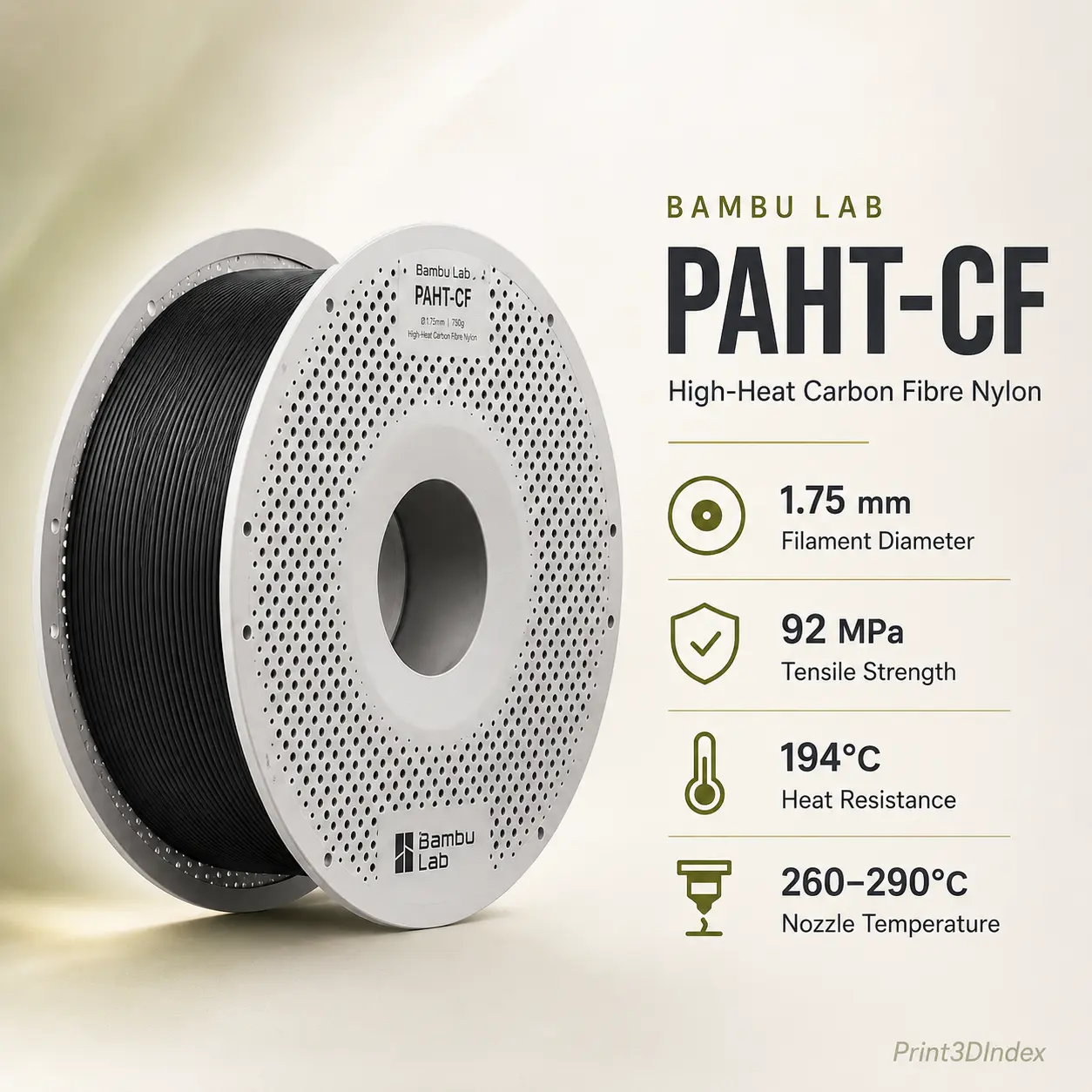
Bambu Lab PAHT-CF is a 1.75 mm carbon-fiber-reinforced engineering nylon made from PA12 and other long-chain polyamides. It is designed for functional prototypes, machining fixtures, molds, jigs, automotive components, tooling, and low-volume production parts that need high strength, heat resistance, dimensional stability, and better wet-condition property retention than conventional PA6-based carbon-fiber nylon.
Bambu publishes 92 ± 7 MPa XY tensile strength, 57.5 ± 3.4 kJ/m² XY impact strength, 125 ± 7 MPa XY bending strength, and 194°C HDT at 0.45 MPa. The current TDS also lists 170°C HDT at 1.8 MPa, 220°C Vicat softening temperature, 225°C melting temperature, and approximately 1.06 g/cm³ density.
Its defining advantage is moisture behavior: Bambu reports 0.88% saturated water absorption, versus 2.35% for Bambu PA6-CF, with much better wet-condition property retention. It still requires pre-drying, an enclosure, and a hardened nozzle.
For current manufacturer data, see the official Bambu Lab PAHT-CF page and Bambu Lab filament guide.
| Specification | Value |
|---|---|
| Material | PA12 + other long-chain PA, carbon fiber |
| Printing process | FDM / FFF |
| Diameter | 1.75 ± 0.03 mm |
| Formats | 0.5 kg / 1 kg with high-temperature reusable spool |
| Nozzle temperature | 260–290°C |
| Bed temperature | 80–100°C |
| Chamber temperature | 45–60°C |
| Print speed | ≤100 mm/s |
| Cooling fan | 0–40% |
| Recommended nozzle | 0.6 mm hardened steel |
| Supported nozzles | 0.4 / 0.6 / 0.8 mm hardened steel |
| 0.2 mm nozzle | Not compatible |
| Stainless-steel nozzle | Not recommended |
| Enclosure | Required |
| Drying | 80°C for 8–12 hours |
| Storage / printing humidity | Below 20% RH |
| Density | 1.06 g/cm³ |
| Glass transition temperature | 70°C |
| Crystallization temperature | 140°C |
| Melting temperature | 225°C |
| Vicat softening temperature | 220°C |
| HDT at 0.45 MPa | 194°C |
| HDT at 1.8 MPa | 170°C |
| XY tensile strength | 92 ± 7 MPa |
| Z tensile strength | 47 ± 5 MPa |
| XY Young's modulus | 3860 ± 230 MPa |
| Z Young's modulus | 2180 ± 130 MPa |
| XY elongation at break | 8.4 ± 1.8% |
| Z elongation at break | 4.1 ± 1.2% |
| XY bending strength | 125 ± 7 MPa |
| Z bending strength | 61 ± 5 MPa |
| XY bending modulus | 4230 ± 210 MPa |
| Z bending modulus | 1820 ± 170 MPa |
| XY impact strength | 57.5 ± 3.4 kJ/m² |
| Z impact strength | 13.3 ± 0.8 kJ/m² |
| Saturated water absorption | 0.88% at 25°C / 55% RH |
| Abrasive | Yes |
Bambu's current PAHT-CF process window is:
Bambu recommends a 0.6 mm hardened-steel nozzle to balance clog resistance and detail. Stainless-steel and 0.2 mm nozzles are not recommended/supported.
PAHT-CF requires an enclosed printer with a hardened hotend and an 80–100°C-capable bed.
The indexed Bambu Lab H2D is a strong match for PAHT-CF because it combines high hotend capability with active chamber heating and hardened nozzle options.
Other enclosed Bambu systems may support PAHT-CF when their current material profile and hardware meet these requirements. See Best 3D Printers for Carbon Fiber Materials for broader options.
PAHT-CF must be dry before printing.
Bambu recommends:
Low saturated water absorption improves service stability, but it does not eliminate pre-drying or dry storage requirements.
Current Bambu documentation lists PAHT-CF as compatible with:
It is not compatible with AMS Lite.
The Bambu Lab AMS 2 Pro can feed/store PAHT-CF but tops out at 65°C, so Bambu says it cannot fully perform the required 80°C drying cycle. AMS HT reaches 85°C and is the better Bambu drying option.
PAHT-CF's 0.88% saturated water absorption is much lower than Bambu PA6-CF at 2.35%. Bambu also shows markedly better wet-condition strength and stiffness retention than its conventional PA-CF reference.
It is still hygroscopic enough that wet filament can cause bubbles, rough surfaces, dimensional inconsistency, and poor layer quality, so drying remains mandatory.
PAHT-CF should not be marketed as broadly chemical-resistant simply because it is an engineering nylon.
Bambu's PAHT-CF TDS states:
Validate the exact chemical, concentration, temperature, and exposure duration before fluid-contact or chemical-process use.
Bambu publishes:
HDT load matters: 194°C at 0.45 MPa is not a universal continuous-use rating. Bambu documents optional annealing at 80–130°C for about 5–12 hours, with possible warping or dimensional change.
PAHT-CF publishes 92 MPa XY / 47 MPa Z tensile strength, 125 MPa XY / 61 MPa Z bending strength, and 57.5 / 13.3 kJ/m² XY/Z impact strength.
Its relatively strong Z performance and wet-condition retention make it useful for fixtures, brackets, housings, and other parts where layer adhesion matters as much as headline XY strength.
The Bambu PAHT-CF vs PA6-CF comparison is moisture stability and toughness versus higher dry-state stiffness and bending strength.
Bambu's current comparison data shows:
| Property | PAHT-CF | Bambu PA6-CF |
|---|---|---|
| HDT @ 0.45 MPa | 194°C | 186°C |
| Saturated water absorption | 0.88% | 2.35% |
| XY impact strength, dry | 57.5 kJ/m² | 40.3 kJ/m² |
| XY bending strength, dry | 125 MPa | 151 MPa |
| XY bending modulus, dry | 4230 MPa | 5460 MPa |
| AMS compatibility | Yes | No |
Choose PAHT-CF for humidity stability, toughness, and AMS use; choose PA6-CF for maximum dry stiffness and bending strength.
The Bambu PAHT-CF vs PET-CF comparison is tougher nylon behavior versus lower-moisture, stiffer PET composite behavior.
The official Bambu PET-CF publishes:
Prefer PAHT-CF for toughness, Z performance, and AMS compatibility; choose PET-CF for stiffness, lower moisture uptake, and slightly higher HDT.
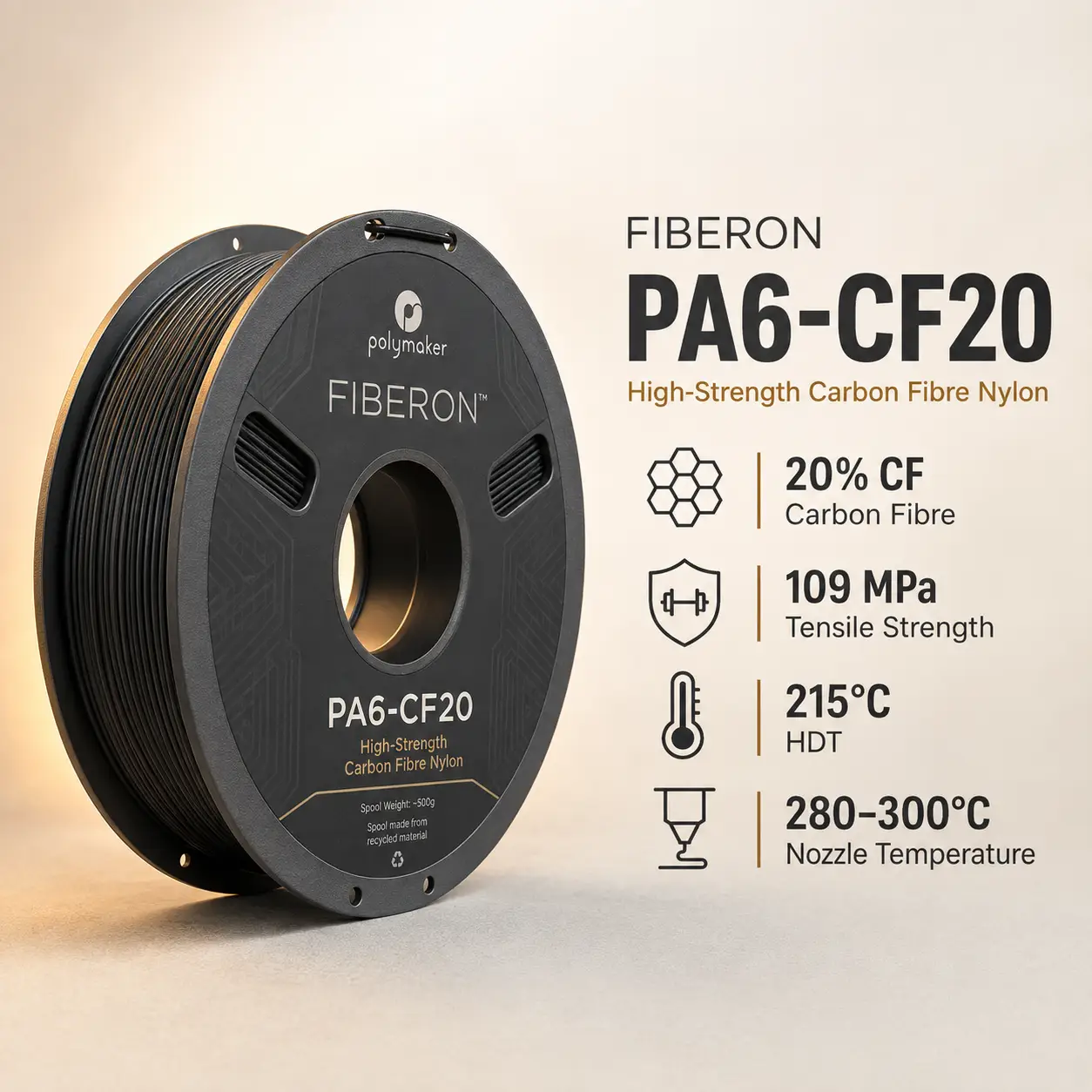
The indexed Polymaker Fiberon PA6-CF20 is a 20% carbon-fiber PA6 focused on very high stiffness and strength.
Polymaker publishes 109.3 MPa XY tensile strength, 8636 MPa dry Young's modulus, 215°C / 173°C HDT at 0.45 / 1.8 MPa, and about 3.3% equilibrium water absorption.
PAHT-CF is less stiff but absorbs much less moisture and retains properties better when wet.
Choose Fiberon PA6-CF20 when maximum stiffness, tensile performance, and annealed high-temperature performance are the priorities.
Choose PAHT-CF when humid-environment stability, impact toughness, and Bambu ecosystem integration matter more.
The indexed Prusament PA11 Carbon Fiber publishes about 192°C / 152°C HDT at 0.45 / 1.8 MPa and is attractive for wear, low friction, impact, chemical resistance, and enclosure-free printing.
PAHT-CF offers higher published tensile strength, higher 1.8 MPa HDT, and AMS integration.
Choose PA11-CF for wear, friction, chemical exposure, and more flexible printer requirements.
Choose PAHT-CF for stronger Bambu integration, high tensile performance, and low-moisture enclosed production.
| Material | Main Strength | HDT | Moisture Behavior | Typical Fit |
|---|---|---|---|---|
| Bambu PAHT-CF | Tough, low-moisture long-chain PA-CF | 194°C @ 0.45 / 170°C @ 1.8 MPa | 0.88% saturated | Humid engineering parts, fixtures |
| Bambu PA6-CF | Stiffer/stronger dry PA6-CF | 186°C @ 0.45 MPa | 2.35% saturated | Dry structural parts |
| Bambu PET-CF | Stiff, low-moisture PET-CF | 205°C @ 0.45 MPa | 0.37% saturated | Stable high-temp structures |
| Fiberon PA6-CF20 | Very high stiffness and tensile strength | 215°C @ 0.45 / 173°C @ 1.8 MPa | Higher PA6 moisture uptake | Structural engineering |
| Prusament PA11 Carbon Fiber | Wear, friction, impact, chemical resistance | 192°C @ 0.45 / 152°C @ 1.8 MPa | Low for nylon | Moving / wear parts |
Cross-manufacturer values use different print, conditioning, annealing, and test procedures. Use this table for material positioning rather than direct engineering substitution.
Bambu’s US store lists PAHT-CF from US$49.99 per 0.5 kg in USA. For buyers comparing PAHT-CF price per gram, that is about US$0.10/g. Regional approximate price is €42.71 in Europe • £36.59 in UK • AED 183.59 in UAE • C$68.72 in Canada • A$69.84 in Australia • ₹4,786 in India. Actual prices may vary by region, tax, shipping, promotions, stock, and exchange rates.
It is a carbon-fiber-reinforced engineering nylon made from PA12 and other long-chain polyamides, designed for high strength, heat resistance, layer adhesion, and improved wet-condition stability.
Bambu recommends 260–290°C.
It requires an enclosed printer. Bambu's TDS lists a 45–60°C chamber range.
HDT is 194°C at 0.45 MPa and 170°C at 1.8 MPa.
Bambu publishes 0.88% saturated water absorption at 25°C and 55% RH.
Yes with AMS, AMS 2 Pro, and AMS HT. AMS Lite is not compatible.
No. AMS 2 Pro tops out at 65°C, while Bambu recommends 80°C drying for PAHT-CF. AMS HT is the more appropriate Bambu drying system.
Bambu recommends 80°C for 8–12 hours and keeping it below 20% RH during printing and storage.
Not broadly. Bambu's TDS says it is not resistant to acids or alkalis and is not resistant to some organic solvents, although it resists most oils and greases.
PAHT-CF absorbs much less moisture and has higher impact toughness and slightly higher HDT, while PA6-CF offers higher dry bending strength and stiffness.
PET-CF is stiffer, absorbs less moisture, and has slightly higher HDT; PAHT-CF is tougher, has stronger Z impact performance, and is AMS compatible.