High-Heat PA6 Carbon FibreHigh-Heat Carbon Fibre Nylon20% Carbon Fibre ReinforcedHigh-Stiffness Engineering NylonHigh-Temperature PA6 CompositeTooling and Structural Grade
PPolymaker
Polymaker
# Polymaker Fiberon PA6-CF20
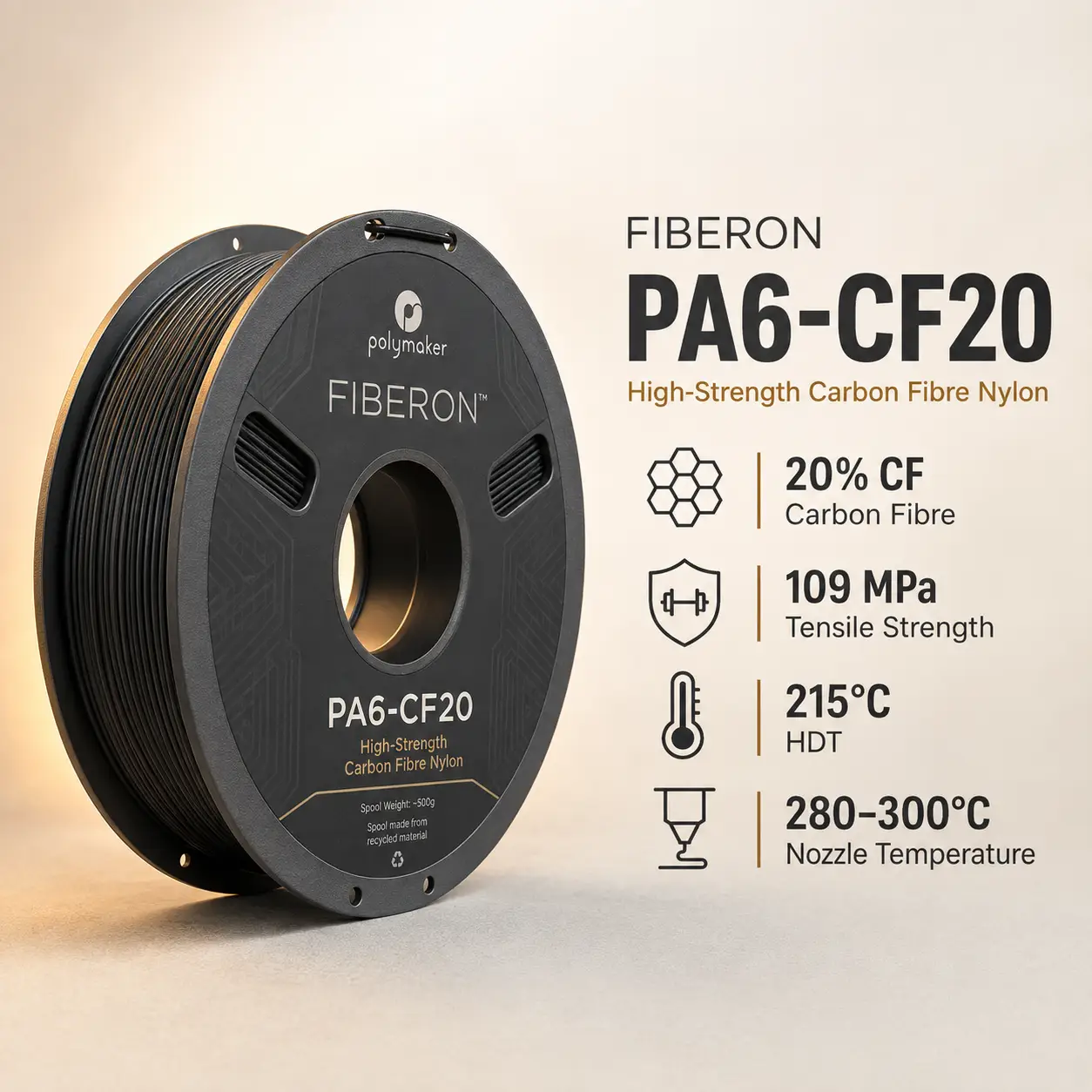
Polymaker Fiberon PA6-CF20 is a 20 wt% carbon-fiber-reinforced PA6 (Nylon 6) filament for rigid engineering parts, tooling, fixtures, automotive components, and low-volume production. It is the Fiberon-branded continuation of Polymaker's former PolyMide PA6-CF formulation.
The material combines high stiffness, strong dry mechanical performance, and unusually high heat-deflection values for a printable nylon composite. Polymaker's current technical data sheet reports 109.3 ± 2.4 MPa XY tensile strength, 8.64 GPa XY Young's modulus, 161.0 ± 3.9 MPa XY flexural strength, and 215°C HDT at 0.45 MPa for the characterized dry material.
Those headline numbers need context. Polymaker states that its dry and wet mechanical test specimens were annealed at 100°C for 16 hours, and PA6-CF20 is highly moisture sensitive. Moisture can substantially reduce tensile strength and stiffness while increasing ductility and impact behavior, so drying and humidity control are part of the engineering workflow.
For current manufacturer information, see the official Fiberon PA6-CF20 page and official PA6-CF20 technical data sheet.
| Specification | Value |
|---|---|
| Material Type | Composite |
| Chemistry | PA6 / Nylon 6 with carbon fiber |
| Carbon Fiber Content | 20 wt% |
| Printing Compatibility | FDM |
| Filament Diameter | 1.75 mm |
| Current Fiberon Spool Sizes | 500 g and 2 kg |
| Nozzle Temperature | 280–300°C |
| Bed Temperature | 40–50°C |
| Chamber | Room temperature |
| Cooling Fan | Off |
| Maximum Published Print Speed | Up to 300 mm/s |
| Drying | 100°C for 10 h when moisture has been absorbed |
| Annealing | 100°C for 16 h |
| Storage | Below approximately 20% RH |
| Nozzle | Wear-resistant nozzle required for practical use |
| Color | Black |
| Density | 1.17 g/cm³ at 23°C |
| Glass Transition Temperature | 74.2°C |
| Melting Temperature | 218.5°C |
| Vicat Softening Temperature | 219.2°C |
| HDT at 0.45 MPa | 215°C |
| HDT at 1.8 MPa | 173°C |
Mechanical-data note: The current Polymaker TDS states that the dry and wet mechanical test specimens were annealed at 100°C for 16 hours. The published tensile and modulus values should therefore not be presented as guaranteed as-printed properties.
Polymaker's dry, annealed printed-specimen data shows strong directional mechanical performance:
| Property | XY | Z |
|---|---|---|
| Tensile strength | 109.3 ± 2.4 MPa | 54.0 ± 5.2 MPa |
| Young's modulus | 8636.5 ± 211.4 MPa | 3759.5 ± 118.5 MPa |
| Elongation at break | 2.1 ± 0.2% | 1.9 ± 0.4% |
| Flexural strength | 161.0 ± 3.9 MPa | 71.3 ± 17.7 MPa |
| Flexural modulus | 7037.6 ± 205.4 MPa | 2975.3 ± 174.3 MPa |
The high modulus and low elongation make PA6-CF20 best suited to stiff, load-bearing geometry rather than flexible parts.
The difference between XY and Z properties also matters. Carbon fiber improves stiffness and dimensional behavior, but it does not eliminate FDM anisotropy. Critical parts should still be oriented so the most important loads are carried in the strongest print direction whenever possible.
PA6 is hygroscopic, and Fiberon PA6-CF20 should be treated as a moisture-sensitive engineering filament.
Polymaker's wet-condition data illustrates why this matters. After annealing and moisture conditioning to an average moisture content of approximately 5.3%, the published XY tensile strength falls to roughly 54.7 MPa and XY Young's modulus to about 2.51 GPa.
Moisture therefore changes the mechanical behavior of the nylon matrix rather than only affecting surface appearance.
For repeatable engineering results, control:
A dry TDS value should not automatically be used as the design value for a part that will operate in a humid environment.
Polymaker recommends storing and using PA6-CF20 under dry conditions with relative humidity below approximately 20%.
When the filament has absorbed moisture, Polymaker specifies:
100°C for 10 hours
Polymaker also lists a PolyDryer Level 3 cycle of approximately 18 hours.
Typical signs of wet PA6 include popping during extrusion, rough surfaces, stringing, bubbles, inconsistent flow, and changes in finished-part behavior.
For long jobs, feeding directly from a dry box or active dryer can help maintain more consistent processing.
The manufacturer's current recommended profile is:
A suitable printer should have:
The 300 mm/s figure is a maximum material-profile speed. Actual production speed depends on hotend flow, nozzle diameter, layer height, geometry, acceleration, and the printer's ability to melt a fiber-filled nylon consistently.
PA6-CF20 is highly abrasive.
Polymaker's current technical documentation specifically warns about rapid brass-nozzle wear and recommends wear-resistant hardware such as:
A worn nozzle can change extrusion width, flow calibration, dimensional accuracy, and surface quality over time.
For repeated production, nozzle condition should be included in normal process-control checks.
The dedicated Fiberon PA6-CF20 product profile specifies room-temperature chamber conditions and states that a heated chamber is not required.
That makes `requiresEnclosure: false` appropriate for the structured listing.
A conventional enclosure can still reduce drafts and make the local environment more consistent for large or warp-sensitive parts, but it should not be described as a mandatory material requirement.
Among indexed printers, the Bambu Lab H2D and Creality K2 Plus are relevant high-temperature composite platforms. The Bambu Lab P2S is another compact option when its nozzle, filament handling, and profile are configured for PA-CF.
Printer compatibility should be based on the full material path, not nozzle temperature alone.
Polymaker recommends annealing PA6-CF20 at:
100°C for 16 hours
The published dry mechanical data is based on annealed specimens.
Annealing can improve thermal and mechanical performance, but it may also cause small dimensional changes. For tolerance-critical production parts, print and anneal a representative coupon before finalizing compensation values.
A practical validation workflow is:
Polymaker publishes:
HDT is a standardized deflection test under a defined load. It is not the same as a guaranteed continuous service temperature.
Long-duration use at elevated temperature also depends on load, creep, humidity, orientation, thermal cycling, and chemical exposure.
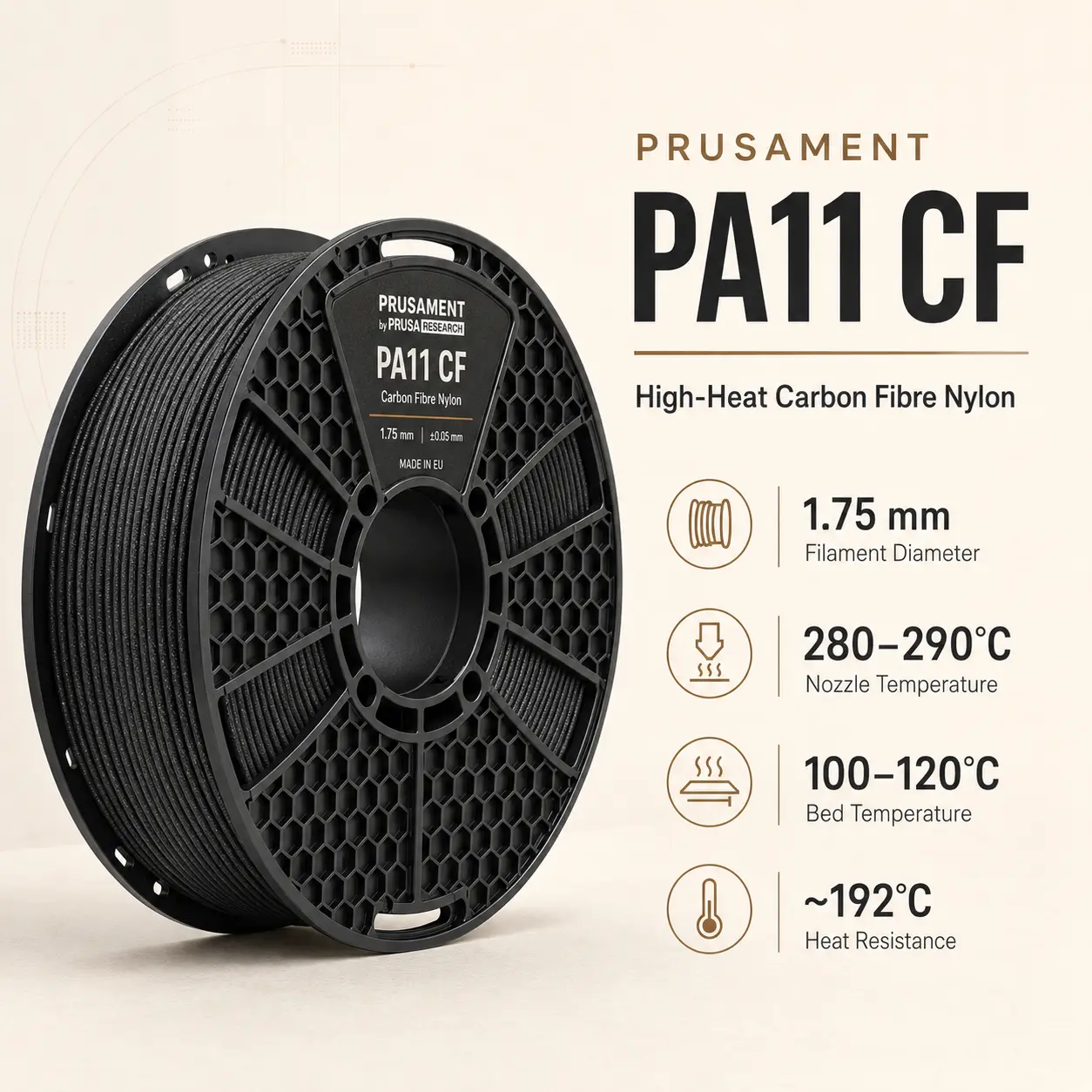
Prusament PA11 Carbon Fiber uses a different nylon chemistry with a stronger emphasis on toughness, wear behavior, chemical resistance, and lower moisture sensitivity than PA6.
Fiberon PA6-CF20 is the stronger choice when maximizing dry stiffness, tensile performance, and HDT is the main priority.
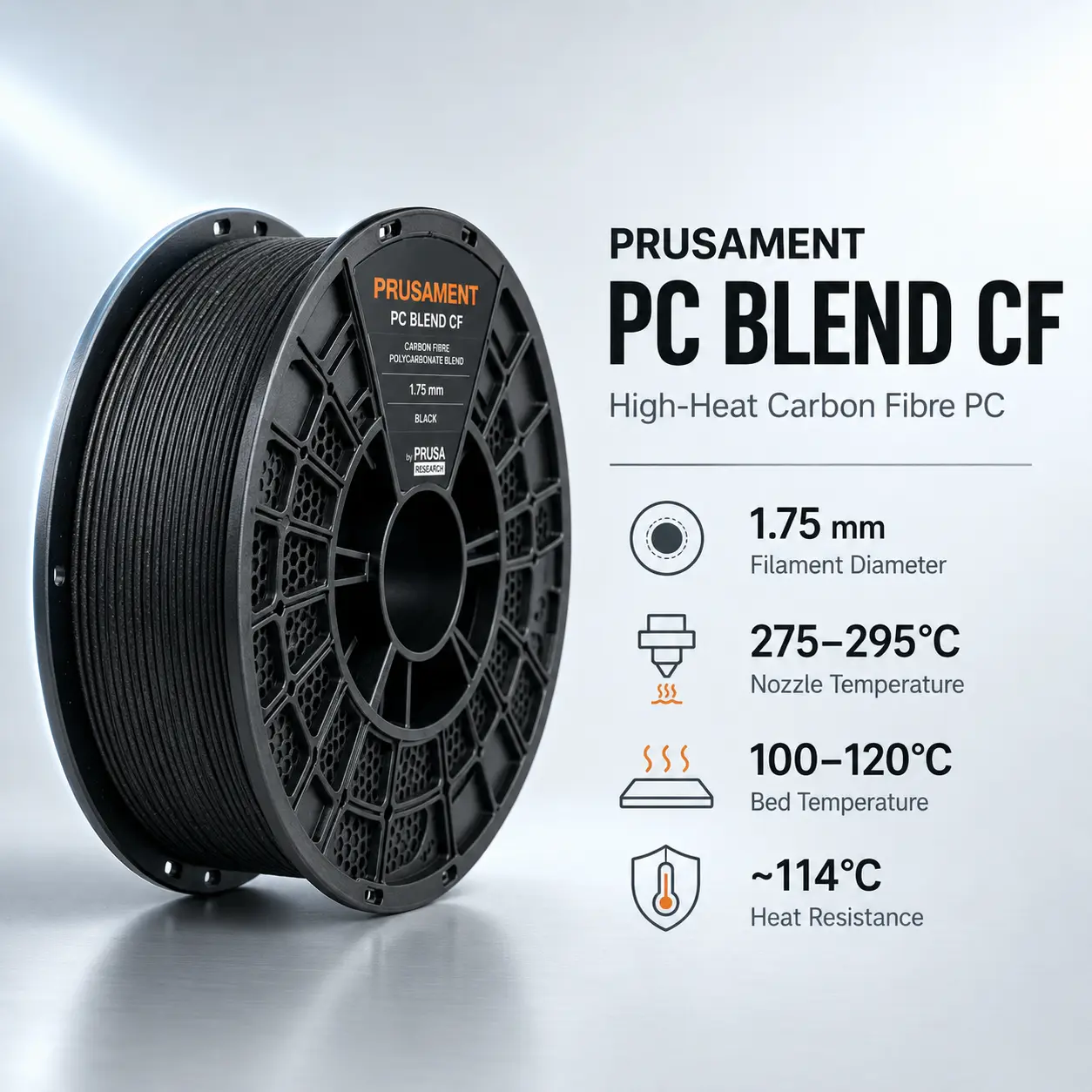
Prusament PC Blend Carbon Fiber provides a polycarbonate-based alternative with strong dimensional stability and less nylon-style moisture sensitivity.
PA6-CF20 offers substantially higher published HDT, while PC Blend CF can be easier to manage when moisture conditioning is a major concern.
For printer selection, see Best 3D Printers for Carbon-Fiber Materials in 2026.
Polymaker states that Fiberon PA6-CF20 uses the same proven formula as PolyMide PA6-CF.
The newer Fiberon material may have a slightly darker black appearance, but older PolyMide PA6-CF references remain relevant when checking historical profiles and application examples.
The dedicated Fiberon product page lists 1.75 mm filament in 500 g and 2 kg formats.
Polymaker's current US store lists pricing from US$39.99 for 500 g.
Recommended use: Choose Polymaker Fiberon PA6-CF20 when high dry stiffness, strong tensile performance, dimensional stability, and elevated-temperature capability justify disciplined drying, abrasive-material hardware, and post-print annealing.
It is a PA6 Nylon 6 filament reinforced with 20 wt% carbon fiber for high stiffness, strength, dimensional stability, and heat resistance.
Polymaker states that Fiberon PA6-CF20 uses the same core formula as the former PolyMide PA6-CF.
280–300°C.
40–50°C.
No. Polymaker's dedicated product profile specifies room-temperature chamber conditions.
Yes. A hardened steel, ruby, or comparable wear-resistant nozzle is strongly recommended.
The current TDS reports 109.3 ± 2.4 MPa in XY and 54.0 ± 5.2 MPa in Z for dry annealed specimens.
215°C at 0.45 MPa and 173°C at 1.8 MPa.
Yes. Polymaker recommends dry storage below about 20% RH and 100°C for 10 hours when moisture has been absorbed.
Polymaker recommends annealing at 100°C for 16 hours, and its published TDS mechanical specimens use that cycle.
Moisture substantially lowers stiffness and tensile strength compared with dry-condition values while increasing ductility and impact behavior.
Polymaker lists up to 300 mm/s, subject to the printer's flow capability and the selected geometry and profile.
The official US store lists the 500 g version from US$39.99.
The official US product page is currently marked sold out / unavailable at the main listing level, with some variants shown as backordered.