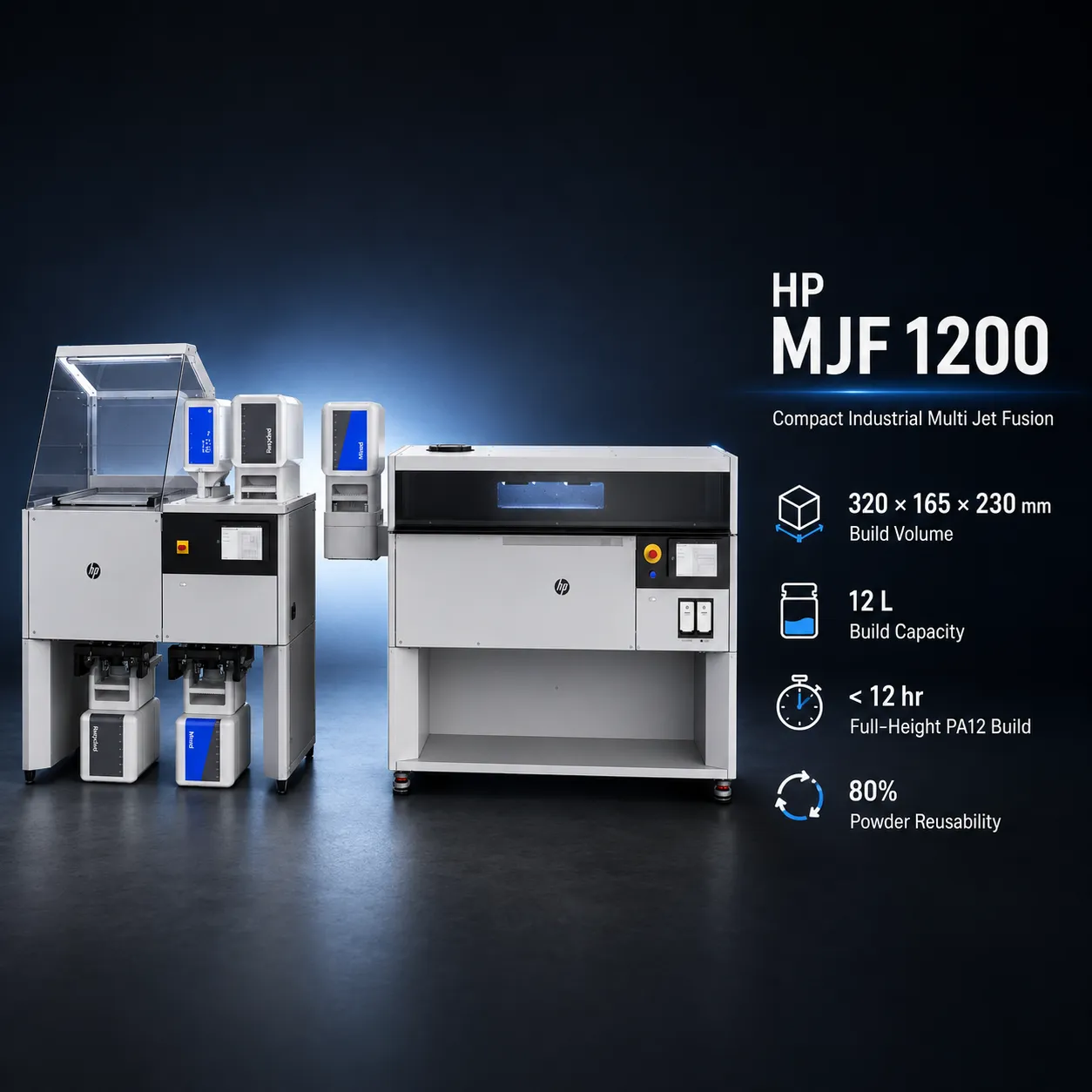
Compact Industrial MJF PrinterPA12 3D PrintingAutomated Powder HandlingSupport-Free PrintingIndustrial Nylon Printing
HHP
HP
# HP MJF 1200
The HP Multi Jet Fusion 1200 is a compact industrial polymer 3D-printing system designed to bring HP's production-oriented Multi Jet Fusion (MJF) process into smaller engineering, medical, product-development, and distributed-manufacturing environments.
The printer provides a 320 × 165 × 230 mm build volume, equivalent to approximately 12 liters. HP states that a full-height build using HP 3D High Reusability PA 12 enabled by Evonik can print in under 12 hours in Standard mode.
Unlike filament printers, the MJF 1200 builds parts inside a powder bed. Unsintered powder supports the geometry, so conventional support structures are not required and multiple parts can be nested throughout the available volume.
HP positions the MJF 1200 as an integrated solution rather than a printer-only purchase. The launch package is expected to start below US$60,000 in the US and EU and includes the printer, Material Management System, Natural Cooling Unit, two Material Tanks, and Magics Print for HP software.
General availability is planned for early 2027. For current launch information, pricing, and availability, see the official HP MJF 1200 product page.
| Specification | Value |
|---|---|
| Printing technology | HP Multi Jet Fusion |
| Process category | Polymer powder bed fusion |
| Build volume | 320 × 165 × 230 mm |
| Build capacity | Approximately 12 L |
| Launch material | HP 3D High Reusability PA 12 enabled by Evonik |
| Standard full-height print time | Under 12 hours |
| Powder reusability | Up to 80% |
| Published maximum volumetric packing density | Up to 20% per full mixed-material tank |
| Approximate corresponding mass packing density | About 40% |
| Minimum spacing between nested parts | Approximately 3 mm |
| Support structures | Not required |
| Electrical requirement | 200–240 V, 50/60 Hz, 2 × 16 A |
| Build-preparation software | Magics Print for HP by Materialise |
| Monitoring / fleet software | HP 3D Center |
| Launch availability | Planned for early 2027 |
| Launch solution price | Expected below US$60,000 in US/EU |
Process note: MJF is not meaningfully described by an FDM-style nozzle diameter, nozzle temperature, heated-bed temperature, or linear print-speed value in mm/s. Productivity is better compared through build time, packing density, workflow time, material reuse, and parts per build.
HP Multi Jet Fusion builds polymer parts layer by layer inside a powder bed. A thin layer of powder is spread across the build area, fusing and detailing agents are selectively deposited, and thermal energy fuses the regions defined by the print data.
Because MJF processes the layer as an area rather than tracing every feature point-by-point with a single laser, HP states that layer time remains predictable as more parts are packed into the same build height.
That makes the MJF 1200 relevant to organizations that want to increase parts per build without proportionally increasing print time.
For HP's broader technology portfolio, see the official HP MJF printer comparison page.
The MJF 1200 uses a 320 × 165 × 230 mm build chamber.
HP publishes up to 20% volumetric packing density per full mixed-material tank, equivalent to approximately 40% mass packing density under the stated condition, with roughly 3 mm minimum spacing between parts.
The 20% figure is a workflow parameter, not a statement that only 20% of the build volume is usable. Actual part count depends on geometry, orientation, spacing, material, and nesting strategy.
HP states that a full-height build can print in under 12 hours using Standard mode with HP 3D High Reusability PA 12 enabled by Evonik.
Actual time-to-part also includes preparation, cooling, unpacking, and any finishing operations.
For production planning, the complete workflow matters more than the printer-only cycle.
The planned launch material is HP 3D High Reusability PA 12 enabled by Evonik.
PA 12 is suited to functional prototypes, end-use components, housings, fixtures, mechanical assemblies, lightweight structures, and customized production parts.
HP currently states that additional compatible materials will be introduced after launch. Until HP validates and releases them for this system, the structured material list should remain limited to PA 12.
HP publishes up to 80% powder reusability for the launch PA 12 workflow.
Recovered powder is processed through the Material Management System and mixed for future builds according to the approved production workflow.
Material history, handling, storage, and contamination control still matter, so the 80% figure should not be interpreted as a universal reuse result for every operating condition.
The MJF 1200 is sold as an integrated workflow rather than only a standalone printer.
Builds are prepared in Magics Print for HP, powered by Materialise.
The printer spreads powder, jets agents, and fuses each layer.
The completed build is transferred into the Natural Cooling Unit, allowing the printer to prepare another build while the previous job cools.
The cooled build moves to the Material Management System, where vibration assists unpacking and excess powder is recovered for reuse.
This separation of printing, cooling, and powder handling is one of the system's main production advantages.
Loose powder supports the parts during printing, so conventional support structures are not required.
This allows:
Support-free printing does not eliminate post-processing. Parts still require powder removal and may need blasting, dyeing, smoothing, coating, or machining depending on the application.
Every MJF 1200 launch solution includes Magics Print for HP by Materialise for:
HP 3D Center supports monitoring and fleet-management workflows for connected HP additive-manufacturing equipment.
For more context, see HP's 3D printing software overview.
HP currently highlights MJF 1200 use cases across:
The system is particularly relevant to organizations that want industrial PA 12 parts without moving immediately to HP's largest MJF production platforms.
For broader use cases, see the official HP additive-manufacturing industries page.
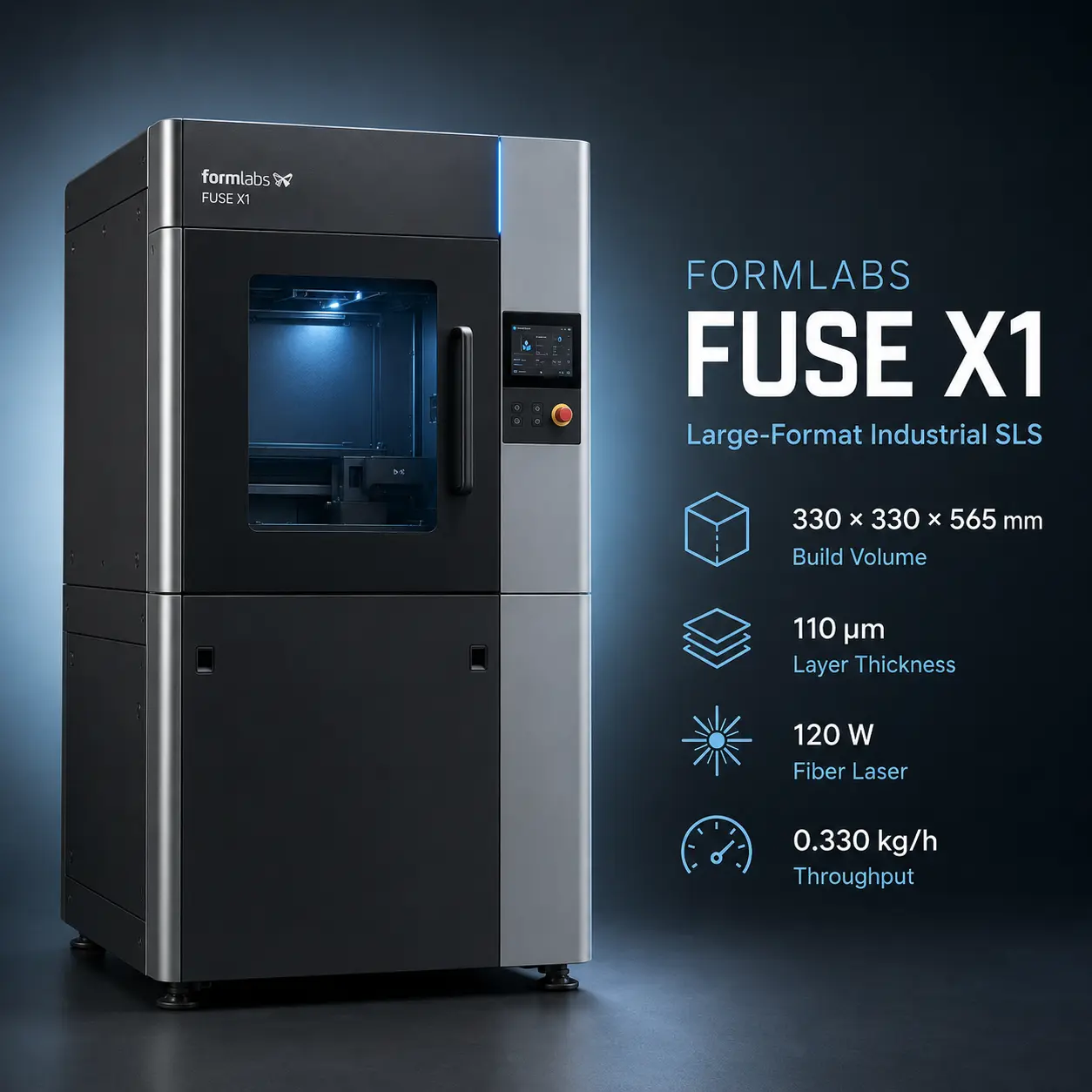
The MJF 1200 occupies a more compact class than large-format systems such as the Formlabs Fuse X1.
| Feature | HP MJF 1200 | Formlabs Fuse X1 |
|---|---|---|
| Process | Multi Jet Fusion | Selective Laser Sintering |
| Build volume | 320 × 165 × 230 mm | 330 × 330 × 565 mm |
| Launch material | HP HR PA 12 | Nylon 12 |
| Supports | Not required | Not required |
| Primary positioning | Compact industrial production | Large-format industrial SLS |
| Launch system price | Expected below US$60,000 | Starts substantially higher |
For cross-technology comparison, the indexed Formlabs Form 4 represents a resin workflow with different material, support, and post-processing requirements.
Use the Print3DIndex comparison tool when comparing different additive processes.
HP currently lists an electrical requirement of:
200–240 V, 50/60 Hz, 2 × 16 A
Powder-bed additive manufacturing also requires appropriate planning for powder storage, PPE, housekeeping, environmental control, material disposal, and workspace around the printer and material-management equipment.
Final facility requirements should follow the installation documentation provided for the production system.
HP currently describes the MJF 1200 as launching at a price point below US$60,000 in the US and EU.
That launch figure applies to the full solution, including:
HP states that general availability is planned for early 2027.
The product can currently be booked for priority access, but that is not the same as normal commercial availability.
Recommended use: Choose the HP MJF 1200 when your organization needs industrial PA 12 parts, support-free batch production, automated powder handling, and predictable MJF cycle times in a smaller production cell than HP's higher-volume platforms.
320 × 165 × 230 mm, equivalent to approximately 12 liters.
HP states that a full-height PA 12 build can print in under 12 hours in Standard mode.
HP 3D High Reusability PA 12 enabled by Evonik.
HP publishes up to 80% powder reusability.
No. Loose powder supports the parts during printing.
HP publishes up to 20% volumetric packing density per full mixed-material tank, equivalent to about 40% mass packing density under its stated conditions.
HP states approximately 3 mm minimum spacing.
HP states that the sub-US$60,000 launch solution includes the printer, Material Management System, Natural Cooling Unit, two Material Tanks, and Magics Print for HP.
Magics Print for HP by Materialise is included for build preparation. HP 3D Center supports monitoring and fleet workflows.
HP currently lists 200–240 V, 50/60 Hz, with two 16 A connections.
HP states that launch pricing is expected to start below US$60,000 for the complete solution in the US and EU.
HP currently plans general availability for early 2027.