NewaddedIntelligent DesignNext-GenIDEX Tool-Changing SystemSeven Material PrintingLow Waste multi-material7 toolheads
SSovol
Sovol
# Sovol M1D
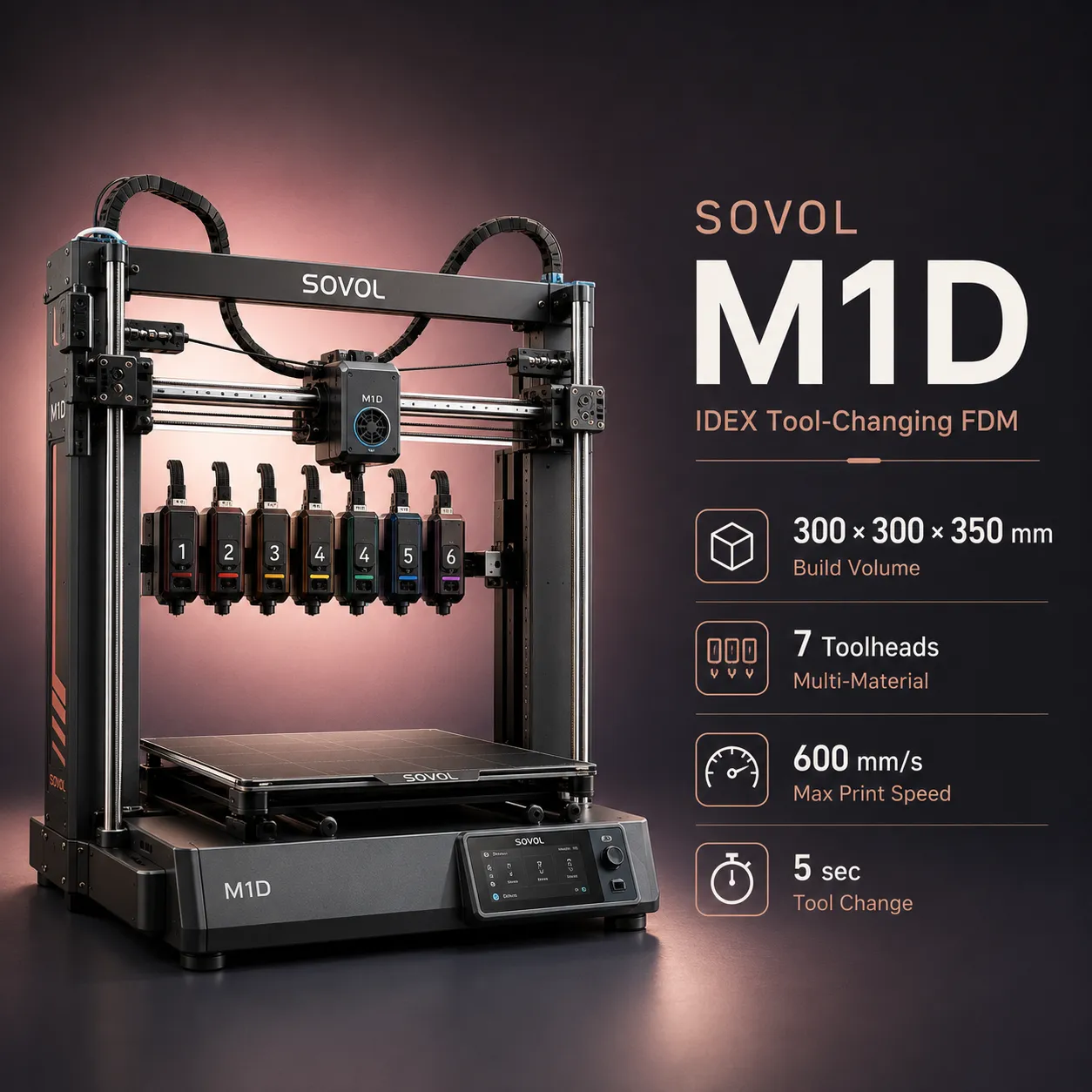
The Sovol M1D is a 300 mm-class FDM platform that combines independent dual extrusion (IDEX) with an automated tool changer. Sovol calls the architecture DualX: the left carriage carries one fixed toolhead, while the second carriage can automatically swap among six parked toolheads.
That gives the printer access to as many as seven colors or materials in one job, while retaining true IDEX functions such as Copy and Mirror printing.
The design is intended to reduce the purge waste and long filament-change cycles associated with single-nozzle multi-color systems. Each toolhead can remain loaded with its assigned filament and preheat before use. Sovol states that a mechanical tool swap can take about 5 seconds.
The M1D is currently a crowdfunded pre-production product, not a normally stocked retail printer. The Kickstarter campaign runs through August 27, 2026, with fulfillment currently expected to begin around November 2026. Production specifications, firmware behavior, schedules, reward availability, and shipping dates can still change before final delivery.
For official product information, see the Sovol M1D landing page. Current campaign pricing and delivery terms should be checked on the official Sovol M1D Kickstarter campaign.
| Specification | Value |
|---|---|
| Printing technology | FDM / FFF |
| Architecture | IDEX + automated tool changer |
| Sovol system name | DualX |
| Fixed toolheads | 1 |
| Swappable toolheads | 6 |
| Maximum available colors / materials | Up to 7 |
| Single Mode | 300 × 300 × 350 mm |
| 6-toolhead switching mode | 300 × 300 × 350 mm |
| Dual-overlap / 7-head mode | 240 × 300 × 350 mm |
| Copy Mode | Up to 178 × 300 × 350 mm per part |
| Mirror Mode | Up to 140 × 300 × 350 mm per part |
| Maximum print speed | Up to 600 mm/s |
| Maximum acceleration | Up to 10,000 mm/s² |
| Standard nozzle | 0.4 mm hardened steel |
| Maximum nozzle temperature | 300°C |
| Maximum bed temperature | 100°C |
| Tool-change time | Approximately 5 seconds |
| Leveling | Eddy-current automatic bed scanning |
| Toolhead XY calibration | Camera-assisted Auto Vision calibration |
| Secondary-toolhead Z control | Automatic real-time Z compensation |
| Filament automation | 6-channel Automatic Filament System |
| Display | 5-inch touchscreen |
| Essential frame | Open |
| Advanced chamber | Fully enclosed, actively heated to 60°C |
Important: The headline 300 × 300 × 350 mm volume does not apply to every IDEX workflow. Seven-head / dual-overlap printing reduces usable X width to 240 mm, Copy Mode to 178 mm per part, and Mirror Mode to 140 mm per part.
Note: The 5-second figure describes the mechanical tool swap. Total material-transition time can be longer because the printer may still wipe, prime, stabilize extrusion, move between docks, or perform other tool-change operations.
The M1D combines a fixed IDEX carriage with six swappable secondary toolheads.
The fixed toolhead can remain dedicated to the main model material, the most frequently used color, or a support material. The second carriage can choose among six parked tools, allowing different filaments to stay assigned to different hotends.
This is useful when several materials need different nozzle temperatures or when repeated filament unloading would otherwise dominate a multi-material job.
Sovol markets the M1D for up to seven colors or seven materials in one workflow.
The seven channels consist of one fixed primary toolhead plus six swappable secondary toolheads. The six-channel Automatic Filament System serves the swappable-tool workflow, while the fixed toolhead provides the seventh available path.
Useful combinations include multi-color PLA, PLA with PVA soluble support, rigid-plus-flexible parts, PETG with a dedicated support interface, and separate nozzle roles for different model features.
Material combinations still need compatible bed temperatures, shrinkage behavior, and inter-material adhesion.
Dedicated hotends can eliminate much of the large purge volume required by a shared single-nozzle material changer.
Sovol describes the M1D as producing near-zero purge waste. Its own current material guide also explains that small amounts of filament can still be used for priming, wiping, restoring nozzle pressure, or a prime tower.
For a neutral catalog, low-waste or near-zero-purge multi-material printing is more accurate than claiming every job is completely purge-free.
Maximum published volume: 300 × 300 × 350 mm.
Maximum published volume: 300 × 300 × 350 mm.
Published common working area: 240 × 300 × 350 mm.
This is the important figure when a job needs both independent carriages and the full seven-material workflow to reach the same model.
Published per-part area: 178 × 300 × 350 mm.
Sovol notes that the physical side limit is about 180 mm, but recommends staying within 178 mm to prevent overlap.
Published per-part area: 140 × 300 × 350 mm.
Important: Copy and Mirror modes increase throughput for suitably sized parts; they do not increase the physical bed size.
The M1D is offered in two configurations.
The base configuration indexed here is open-frame.
Sovol recommends it primarily for:
The standard hardened-steel nozzle hardware can handle compatible abrasive filaments, but chamber-sensitive engineering materials should not be represented as equivalent out-of-box use cases for the Essential.
The Advanced configuration adds a full enclosure and active chamber heating up to 60°C.
Sovol specifically recommends the Advanced version for:
For users who need a currently available enclosed engineering platform rather than a crowdfunding product, compare the Bambu Lab H2D, Creality K2 Plus, and Prusa CORE One+.
For indexed material examples, see Prusament PETG and Prusament TPU 95A.
The standard M1D uses 0.4 mm hardened-steel nozzles, and Sovol's material guidance discusses PLA-CF and PETG-CF. Hardened hardware reduces abrasive wear, but that does not make every reinforced polymer suitable for the open-frame Essential.
For example, Prusament PC Blend Carbon Fiber and Prusament PA11 Carbon Fiber have substantially more demanding thermal and moisture requirements than ordinary PLA-CF.
For an enclosure-sensitive material example, see Prusament ASA.
Cameras are used to measure toolhead offsets and automatically calibrate XY alignment. Sovol states that this process is up to 2.5 times faster than a traditional probe-based workflow under its comparison conditions.
The secondary carriage uses an automatic Z-lift mechanism that continuously compensates its height relative to the fixed toolhead.
An eddy-current sensor maps the build surface without physical probe contact and provides data for automatic bed leveling.
The M1D includes a six-channel Automatic Filament System for the swappable-tool workflow.
Sovol highlights automatic loading, filament runout detection, nozzle-clog detection, filament-tangle detection, and status indicator lights.
This is not the same architecture as a shared single-nozzle filament changer: the six feeds correspond to the swappable tools, while the fixed toolhead provides the additional seventh material/color path.
Sovol states that its metal automatic-grip mechanism can swap toolheads in about 5 seconds.
Parked toolheads can heat independently before being selected.
The practical transition time still depends on parking, pickup, wiping, priming, standby temperature, material viscosity, and slicer settings. The 5-second specification is therefore best understood as the mechanical swap time.
Sovol publishes up to 600 mm/s maximum print speed and up to 10,000 mm/s² acceleration.
These are maximum machine ratings, not guaranteed speeds for every seven-material print. Actual throughput depends on volumetric flow, filament, model geometry, cooling, tool-change frequency, and printing mode.
Both independent toolheads can print simultaneously in Copy and Mirror modes.
Copy Mode produces matching parts. Mirror Mode produces left/right mirrored parts.
When printing one multi-color or multi-material model, however, the toolheads generally work sequentially according to the sliced toolpath rather than both extruding onto the same model at the same time.
Sovol uses an OrcaSlicer-based ecosystem across its current printer range.
The Kickstarter FAQ says that the M1D software and firmware will be opened to the community after the product's official release, with files and documentation progressively published through the Sovol Wiki and GitHub.
That means the M1D should not yet be described as having a fully released open-source firmware package.
Important: Final slicer profiles, firmware features, source files, and production behavior should be rechecked when shipping units and documentation are released.
Sovol's current promotional material describes camera-assisted monitoring and fault detection.
Pre-release coverage has not been completely consistent about which AI-style detection functions will ship immediately and which may depend on firmware updates.
For a pre-production listing, these are best treated as campaign-stage capabilities requiring confirmation on production firmware.
| Printer | Architecture | Main Difference |
|---|---|---|
| Sovol M1D | IDEX + 1 fixed / 6 swappable tools | Seven-tool workflow plus Copy and Mirror modes |
| Bambu Lab H2D | Enclosed dual-nozzle CoreXY | Current retail platform with active chamber heating |
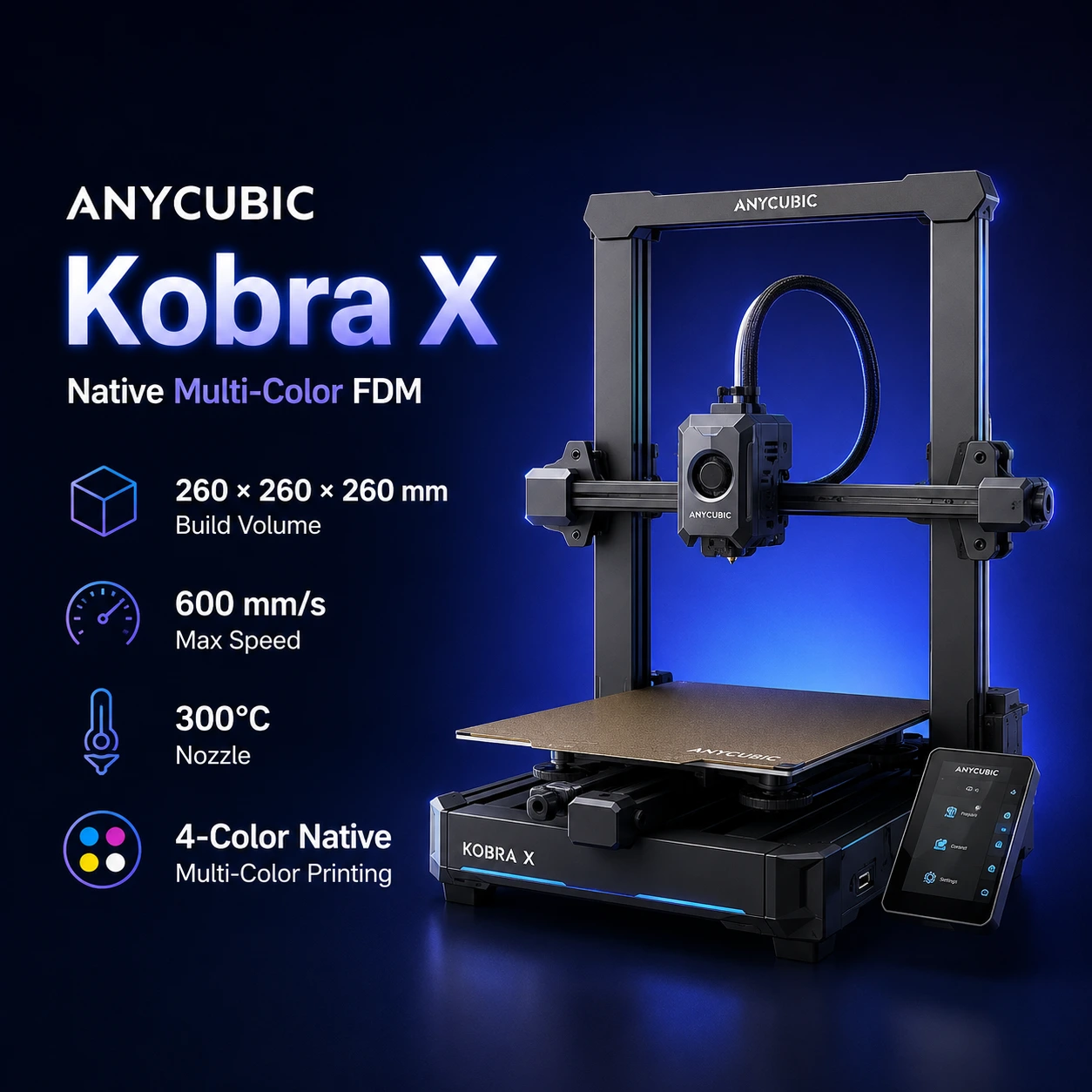
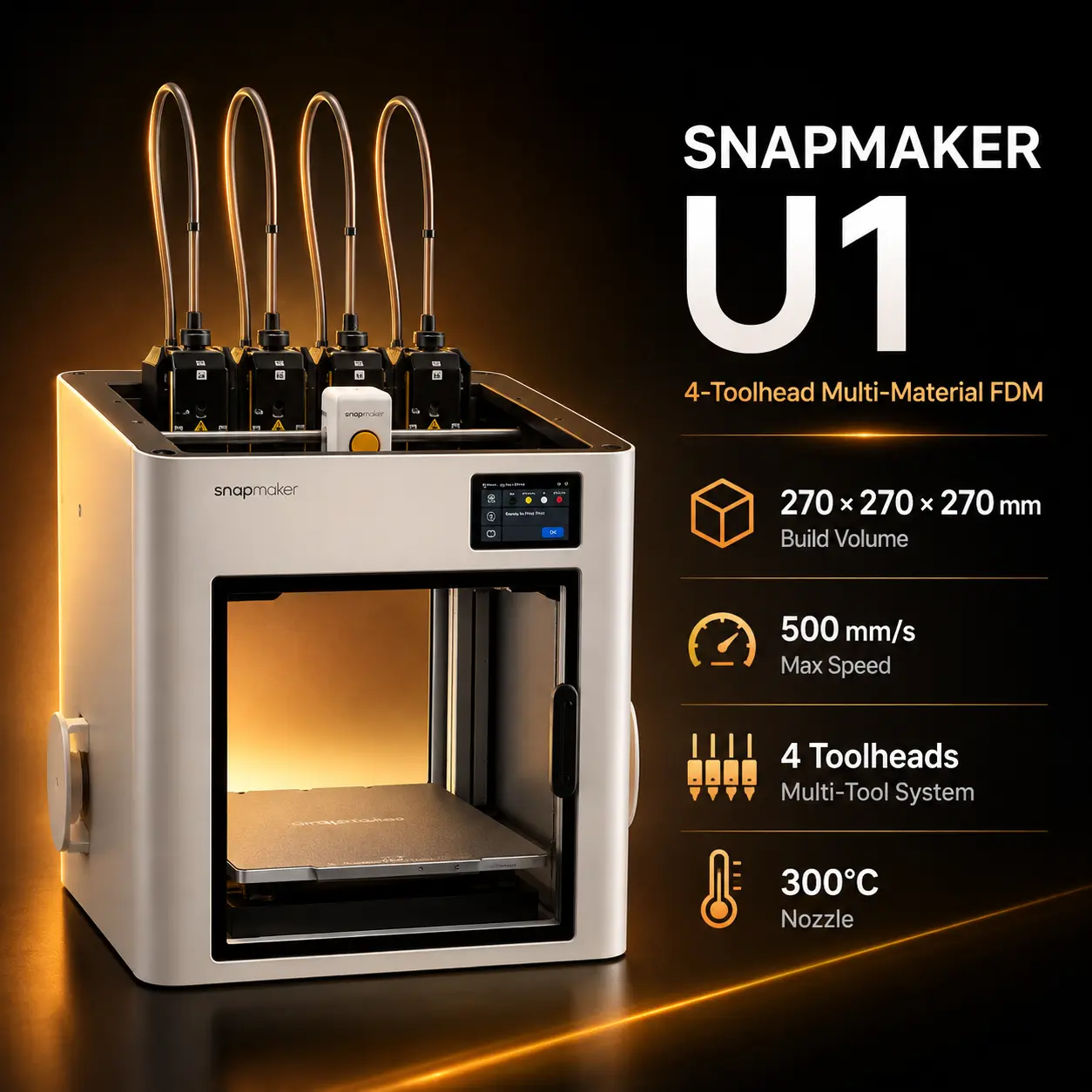
| Snapmaker U1 | Four independent toolheads | Four-tool low-purge desktop workflow |
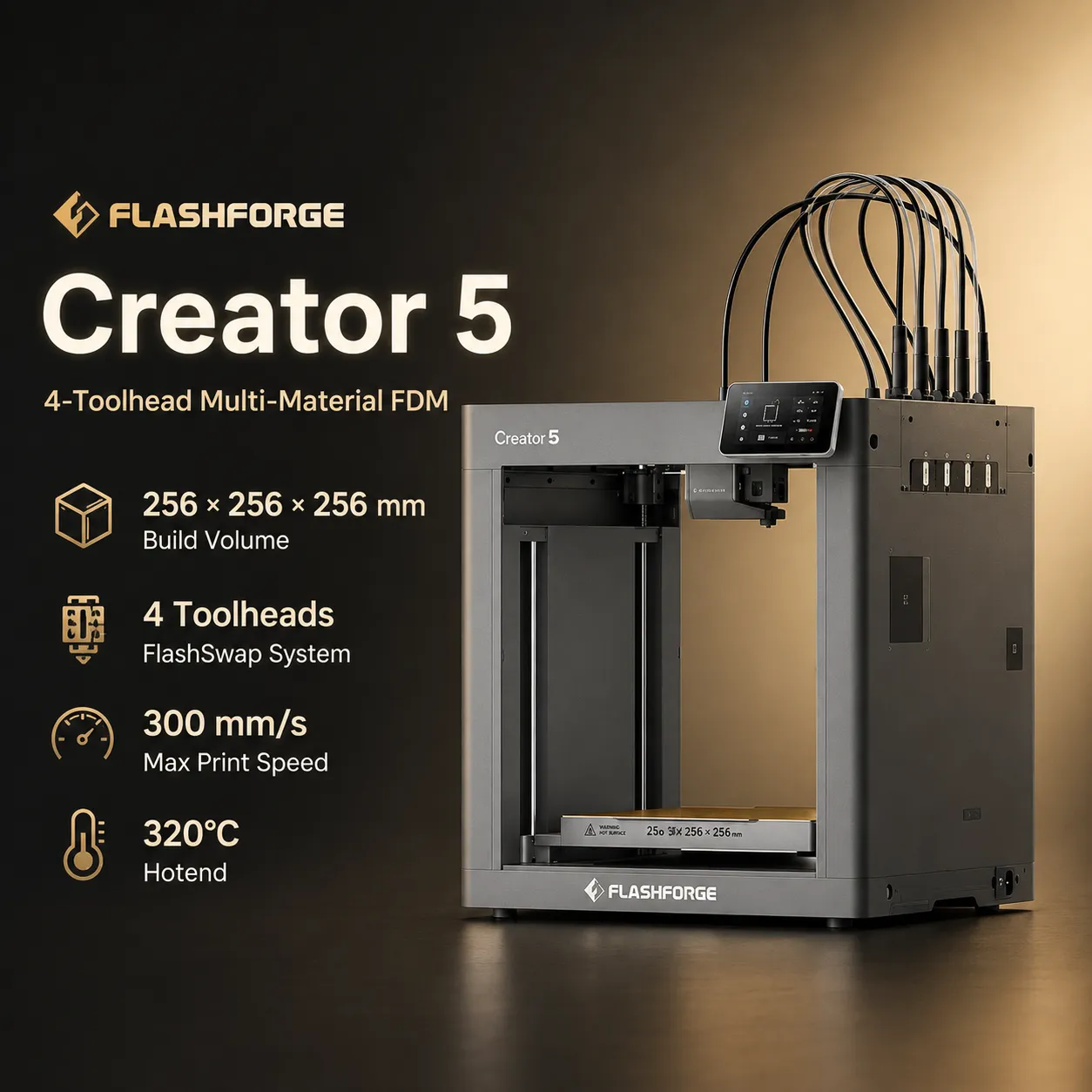
| Flashforge Creator 5 | Four independent FlashSwap toolheads | Four-tool open-frame multi-material workflow |
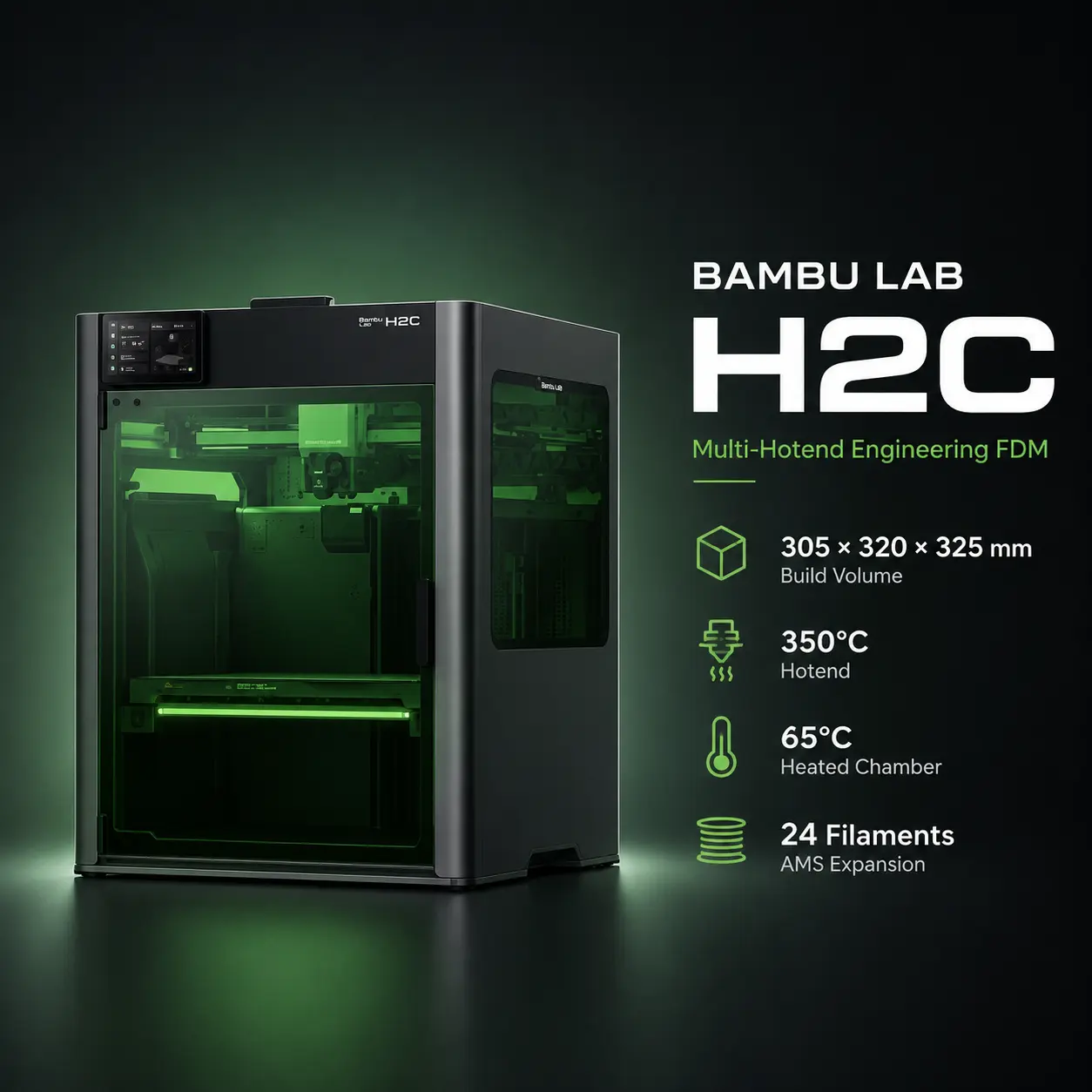
| Bambu Lab H2C | Multi-hotend Vortek system | Up to seven available hotends and broader engineering-material capability |
The M1D is unusual because IDEX adds parallel Copy and Mirror production on top of the multi-toolhead workflow.
The M1D is currently being offered through Kickstarter rather than normal retail distribution.
The campaign runs from July 28 through August 27, 2026.
Current launch-position pricing is:
Earlier deposit holders can qualify for separate VIP pricing after Sovol's rebate process, but the deposit reservation program closed when the Kickstarter launched. Those earlier VIP figures should not be presented as generally available pricing for new backers.
Sovol currently expects fulfillment to begin around November 2026.
Crowdfunding note: A successful Kickstarter campaign is not the same as normal retail availability. Final production timing, shipping fees, regional taxes, firmware maturity, specifications, and fulfillment schedules can change.
For current reward tiers and terms, check the official Kickstarter page.
Recommended use: Choose the M1D Essential if multi-color PLA/PETG, TPU integration, soluble PVA supports, and Copy/Mirror production are the main goals. Choose the Advanced configuration if ABS, ASA, PA, PC, or other chamber-sensitive engineering materials are a regular part of the workflow.
It is a hybrid IDEX and automated tool-changing FDM printer. One carriage has a fixed toolhead and the other can switch among six parked toolheads.
Sovol states up to seven colors or materials in one workflow.
Single Mode and six-toolhead switching can use up to 300 × 300 × 350 mm. Seven-head / dual-overlap printing is reduced to 240 × 300 × 350 mm.
Sovol publishes up to 178 × 300 × 350 mm per part in Copy Mode and 140 × 300 × 350 mm per part in Mirror Mode.
Sovol states approximately five seconds for the mechanical swap. Wiping, priming, movement, and extrusion stabilization can make the complete transition longer.
Not completely. Dedicated hotends avoid most shared-nozzle purging, but Sovol's own material guide says priming, wiping, or a prime tower can still generate a small amount of waste.
Sovol publishes up to 600 mm/s and up to 10,000 mm/s² acceleration.
Sovol lists 0.4 mm hardened-steel nozzles.
The standard specification is 300°C nozzle and 100°C bed.
Sovol explicitly states that the standard M1D is not officially rated or guaranteed for PPS or PPS-CF.
No. Essential is open-frame.
The Advanced version adds a full enclosure and active chamber heating up to 60°C.
Sovol's Kickstarter FAQ recommends PLA, PETG, TPU, and PVA.
The hardened-steel nozzles are suitable for compatible abrasive filaments, and Sovol discusses PLA-CF and PETG-CF in its material guidance. Exact material, chamber, nozzle, and drying requirements still need checking.
Yes in Copy and Mirror modes. On one multi-color or multi-material model, the toolheads generally operate sequentially.
No. It is currently a live Kickstarter project with fulfillment expected to begin around November 2026.
Kickstarter launch pricing starts around US$1,299 for Essential and US$1,599 for Advanced before shipping and applicable taxes. Reward availability can change during the campaign.