Fresh ConceptIntelligent Design4 Toolhead Low WasteMulti-Material printingAutomatic Toolhead CalibrationLow-Waste Color Switching
FFlashforge
Flashforge
# Flashforge Creator 5
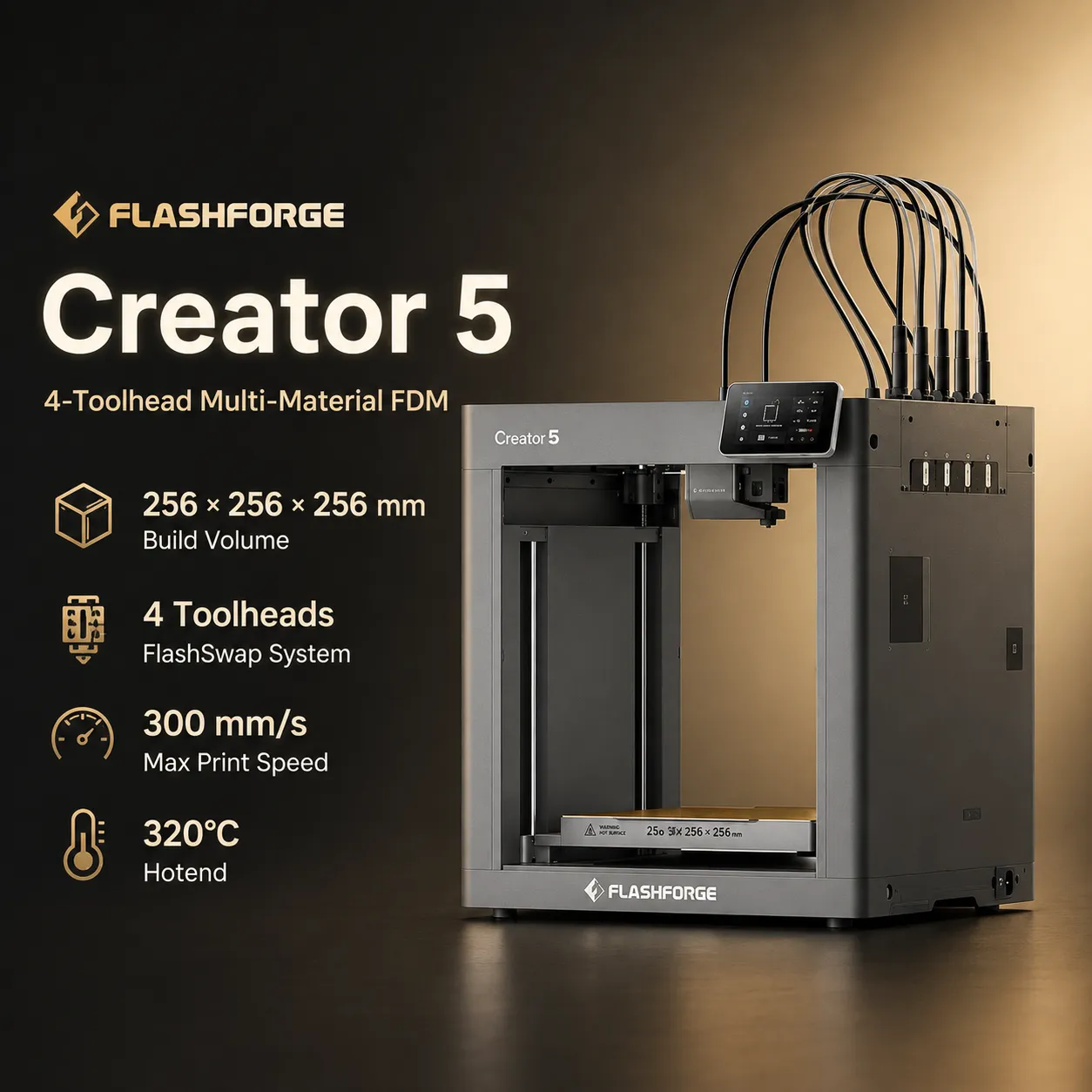
The Flashforge Creator 5 is an open-frame desktop FDM printer built around the FlashSwap four-toolhead system. Instead of repeatedly unloading and purging several filaments through one shared nozzle, the printer keeps four independent hotends available and switches among them during a multi-color or multi-material job.
That architecture is the Creator 5's main advantage. Dedicated hotends can greatly reduce color-change flushing and cross-contamination, which is useful for multi-color models, rigid-plus-flexible parts, and support-material workflows. It is more accurate to describe the system as low-waste or near-zero-purge rather than universally waste-free, because nozzle wiping, priming, calibration, and some material transitions can still consume filament.
The Creator 5 provides a 256 × 256 × 256 mm build volume, up to 300 mm/s maximum print speed, 600 mm/s maximum travel speed, acceleration up to 30,000 mm/s², a 320°C hotend, and a 120°C heated bed. Flashforge supplies hardened-steel nozzles, including a 0.4 mm standard size, which helps make PLA-CF and PETG-CF realistic standard-material options.
The standard Creator 5 is open-frame. Flashforge lists several higher-temperature engineering filaments as technically capable on the machine, but its own FAQ warns that those materials may not reach their full performance without an enclosure and recommends the separate enclosed Flashforge Creator 5 Pro for regular ABS, ASA, PA-CF, PPA-CF, PPS-CF, and similar workflows.
For current US pricing and stock, see the official Flashforge Creator 5 product page.
| Specification | Value |
|---|---|
| Printing technology | FDM / FFF |
| Toolhead system | FlashSwap |
| Independent toolheads | 4 |
| Build volume | 256 × 256 × 256 mm |
| Layer thickness | 0.10–0.40 mm |
| Standard nozzle | 0.4 mm hardened steel |
| Optional nozzle diameters | 0.25, 0.6, and 0.8 mm |
| Maximum print speed | 300 mm/s |
| Maximum travel speed | 600 mm/s |
| Maximum acceleration | 30,000 mm/s² |
| Published maximum flow rate | 32 mm³/s |
| Maximum hotend temperature | 320°C |
| Maximum bed temperature | 120°C |
| Build plate | Textured PEI flexible steel plate |
| Auto leveling | Supported |
| Dynamic flow calibration | Automatic PA calibration |
| Display | 4-inch 800 × 480 color touchscreen |
| Monitoring camera | 1280 × 720 at 30 fps |
| Wi-Fi | 2.4 GHz / 5 GHz |
| Local file transfer | USB |
| Slicing software | Orca-Flashforge / Flash Studio Desktop, OrcaSlicer |
| Physical size without filament tubes/holders | 436 × 432 × 480 mm |
| Physical size with filament tubes/holders | 520 × 443 × 710 mm |
| Net weight | 14 kg |
| Power input | 100–120 V / 200–240 V AC, 50/60 Hz |
| Rated power | 700 W |
| Frame | Open |
Note: Flashforge publishes 300 mm/s as maximum print speed. The widely advertised 600 mm/s figure is maximum travel speed, not extrusion print speed.
Note: Maximum flow, speed, and acceleration are hardware limits rather than guaranteed values for every material or model.
The Creator 5 uses four independent toolheads rather than one nozzle fed by several filament paths.
Each toolhead can keep its own filament loaded, allowing the printer to switch among up to four colors or materials without repeatedly flushing one melt zone clean.
This can reduce purge material, color contamination, material-change delays, wasted high-cost filament, and support-interface contamination. It can also make combinations such as rigid model material plus flexible or soluble support more practical.
Flashforge markets the Creator 5 around "zero purge waste," but real jobs can still generate some waste from nozzle wiping, priming, ooze control, calibration, or model-specific transition structures.
Flashforge's own Creator 5 support documentation includes a waste-filament box and discusses wiping-tower behavior.
For a neutral catalog, low-waste multi-toolhead printing is the more defensible description.
Four independent nozzles need accurate XY and Z alignment.
The Creator 5 includes automatic multi-toolhead offset calibration, and Flashforge says the full calibration process typically takes around 15–20 minutes when required.
Calibration is particularly relevant after initial setup, hotend replacement, nozzle contact with the bed or model, visible color/material offset, or toolhead maintenance.
The printer also includes automatic bed leveling and Dynamic Flow Calibration.
Flashforge lists the following as recommended for the open-frame Creator 5:
For indexed material examples, see Prusament PETG and Prusament TPU 95A.
Flashforge recommends PLA-CF and PETG-CF on the standard machine.
Its material guidance also recommends a 0.6 mm nozzle for fiber-filled filaments to reduce clogging risk, although the standard 0.4 mm hardened-steel nozzle can print supported reinforced materials.
Wear resistance and clog resistance are separate issues, so the larger nozzle is the more practical choice for regular abrasive-material work.
Flashforge's Creator 5 FAQ lists the open-frame machine as capable of printing materials such as:
However, Flashforge explicitly warns that these materials may not deliver their full performance on the open-frame Creator 5.
The standard Creator 5 does not include an enclosure or active chamber heater. Flashforge's current accessory catalog also does not show a dedicated Creator 5 enclosure kit.
For regular engineering-material use, the manufacturer instead recommends the separate Flashforge Creator 5 Pro, which is fully enclosed, actively heats the chamber to 65°C, and adds HEPA + activated-carbon filtration.
Important: Do not describe ABS, ASA, PA-CF, PPA-CF, or PPS-CF as equivalent out-of-box materials to PLA, PETG, TPU, PLA-CF, and PETG-CF on the standard Creator 5.
For users comparing enclosed engineering platforms already indexed on Print3DIndex, the Bambu Lab H2D and Creality K2 Plus offer active chamber heating, while the Prusa CORE One+ provides an enclosed, actively controlled chamber in a smaller professional platform.
The strongest reason to choose four toolheads is not decorative color alone.
Useful combinations can include:
Material combinations still need compatible processing conditions.
A four-toolhead printer cannot eliminate fundamental problems such as mismatched bed temperatures, poor inter-material adhesion, different shrinkage rates, or incompatible support chemistry.
Flashforge lists TPU 90A–95A and TPU 64D among supported materials.
TPU 90A is specifically recommended from a top external mount.
For regular flexible-material printing, keep the filament path smooth and use conservative speed settings. The exact TPU formulation still matters; softer flexible grades can behave differently from 95A material.
The Creator 5 includes:
The standard model does not have the Creator 5 Pro's enclosure-related door-open and chamber-temperature monitoring.
The Creator 5 supports:
Flashforge's current ecosystem is transitioning from Orca-Flashforge branding to Flash Studio Desktop, while the Creator 5 product specification also lists OrcaSlicer compatibility.
The Creator 5 Pro is a separate printer, not simply the standard Creator 5 with a small accessory added.
| Feature | Creator 5 | Creator 5 Pro |
|---|---|---|
| Frame | Open | Fully enclosed |
| Toolheads | 4 | 4 |
| Build volume | 256 × 256 × 256 mm | 256 × 256 × 256 mm |
| Max nozzle temperature | 320°C | 320°C |
| Max bed temperature | 120°C | 120°C |
| Active chamber heating | No | Up to 65°C |
| Air filtration | No integrated Pro filtration system | H13 HEPA + activated carbon |
| Standard use focus | Multi-color, support, PLA/PETG/TPU/CF | Broader engineering-material workflow |
| Weight | 14 kg | About 18 kg |
Choose the Pro if regular ABS, ASA, PA, PC, or high-temperature composite printing is more important than minimizing purchase cost.
The Creator 5's four-hotend architecture is unusual at its price point.
Other approaches include:
The right architecture depends on whether your priority is low purge waste, build volume, active chamber control, tool count, or ecosystem maturity.
Flashforge publishes two physical-size figures:
The second figure is the more realistic planning dimension for a working installation.
Flashforge's official US product page lists the Creator 5 at US$799, with a US$100 automatic cart discount at the time of this review.
That makes the effective checked US price US$699 before tax, while the page shows the printer In Stock.
Promotions can change without notice, so treat US$699 as a checked sale reference rather than a permanent MSRP.
Check the official Creator 5 listing for the current price.
Recommended use: Choose the Creator 5 when four dedicated hotends and low-purge multi-color or multi-material printing are more important than enclosure temperature control. For regular ABS, ASA, nylon, PPA, PPS, or high-temperature composite work, move to an enclosed platform such as the Creator 5 Pro or another actively heated engineering printer.
It has four independent FlashSwap toolheads, each with its own hotend and filament path.
The Creator 5 has a 256 × 256 × 256 mm build volume.
Flashforge specifies up to 300 mm/s maximum print speed. The separate 600 mm/s specification is maximum travel speed.
The Creator 5 supports hotend temperatures up to 320°C.
Flashforge lists a 0.4 mm hardened-steel nozzle. Optional 0.25, 0.6, and 0.8 mm sizes are available.
Flashforge specifies 0.10–0.40 mm, or 100–400 microns.
Yes. It includes automatic bed leveling and automatic multi-toolhead offset calibration.
Yes. Flashforge recommends PLA-CF and PETG-CF on the standard Creator 5. Flashforge also recommends a 0.6 mm nozzle for regular fiber-filled printing to reduce clogging risk.
Flashforge lists ABS and ASA as capable materials, but it warns that the open-frame Creator 5 may not deliver their full performance. For regular ABS, ASA, PA, PPA, PPS, or similar engineering use, Flashforge recommends the enclosed Creator 5 Pro.
Flashforge's current official accessories catalog does not list a dedicated Creator 5 enclosure kit. The Creator 5 Pro is the manufacturer's enclosed version.
Dedicated hotends greatly reduce shared-nozzle flushing, but real jobs can still use filament for wiping, priming, calibration, or transition structures. Low-waste or near-zero-purge is more accurate than claiming every job produces zero waste.
Yes. Flashforge lists a built-in 1280 × 720 camera at 30 fps for remote monitoring.
Yes. The Creator 5 supports dual-band 2.4 GHz and 5 GHz Wi-Fi.
Flashforge lists Orca-Flashforge and OrcaSlicer, while its current desktop software branding is transitioning toward Flash Studio Desktop.
The official US page lists US$799 with a US$100 automatic cart discount, making the checked effective price US$699. Pricing can change, so verify the current manufacturer listing.