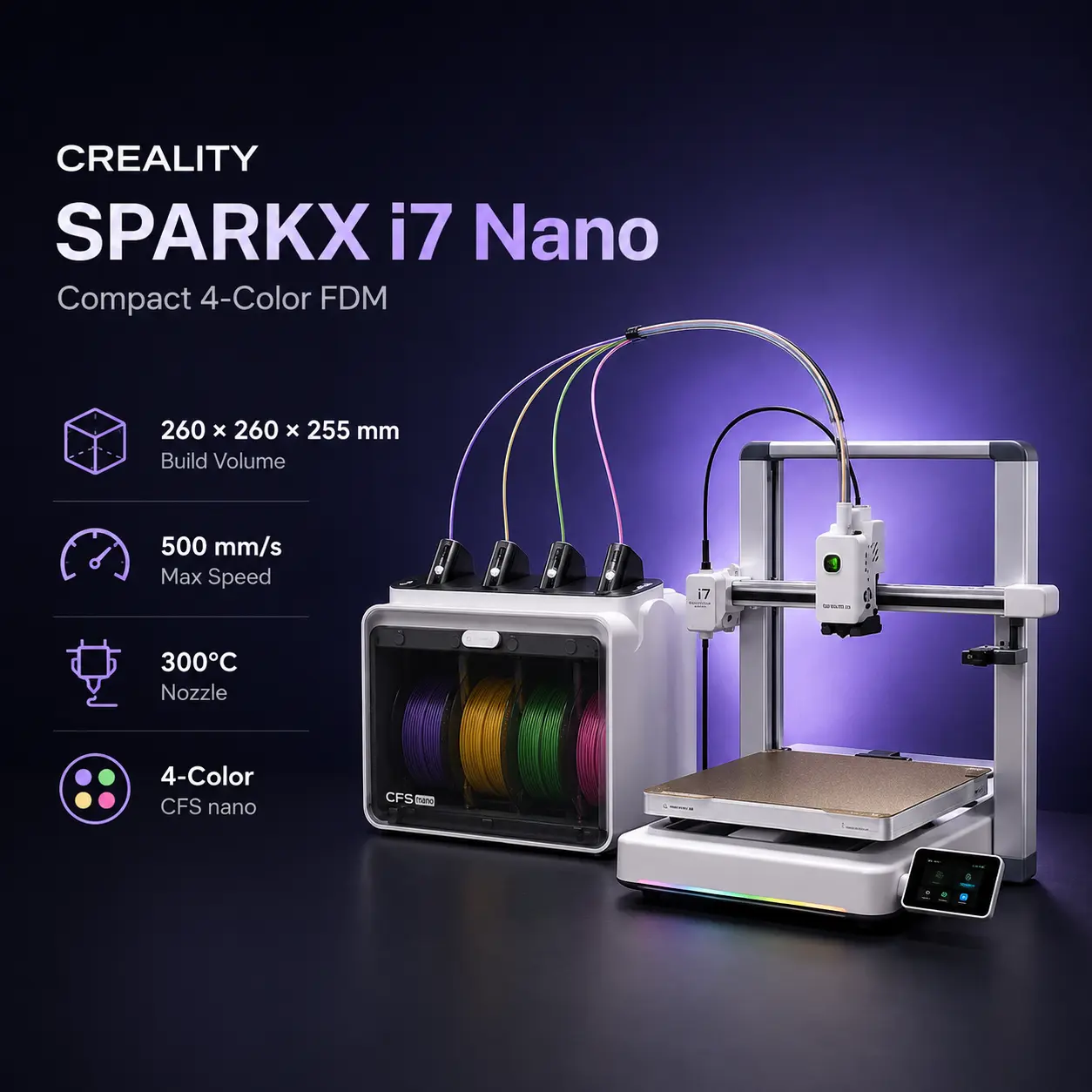
Four-Color CFS PrintingExpandable 16-Color System500 mm/s High-Speed Printing300°C Tri-Metal NozzleRFID Filament RecognitionAutomatic Filament Management
CCreality
Creality
# Creality Hi Combo
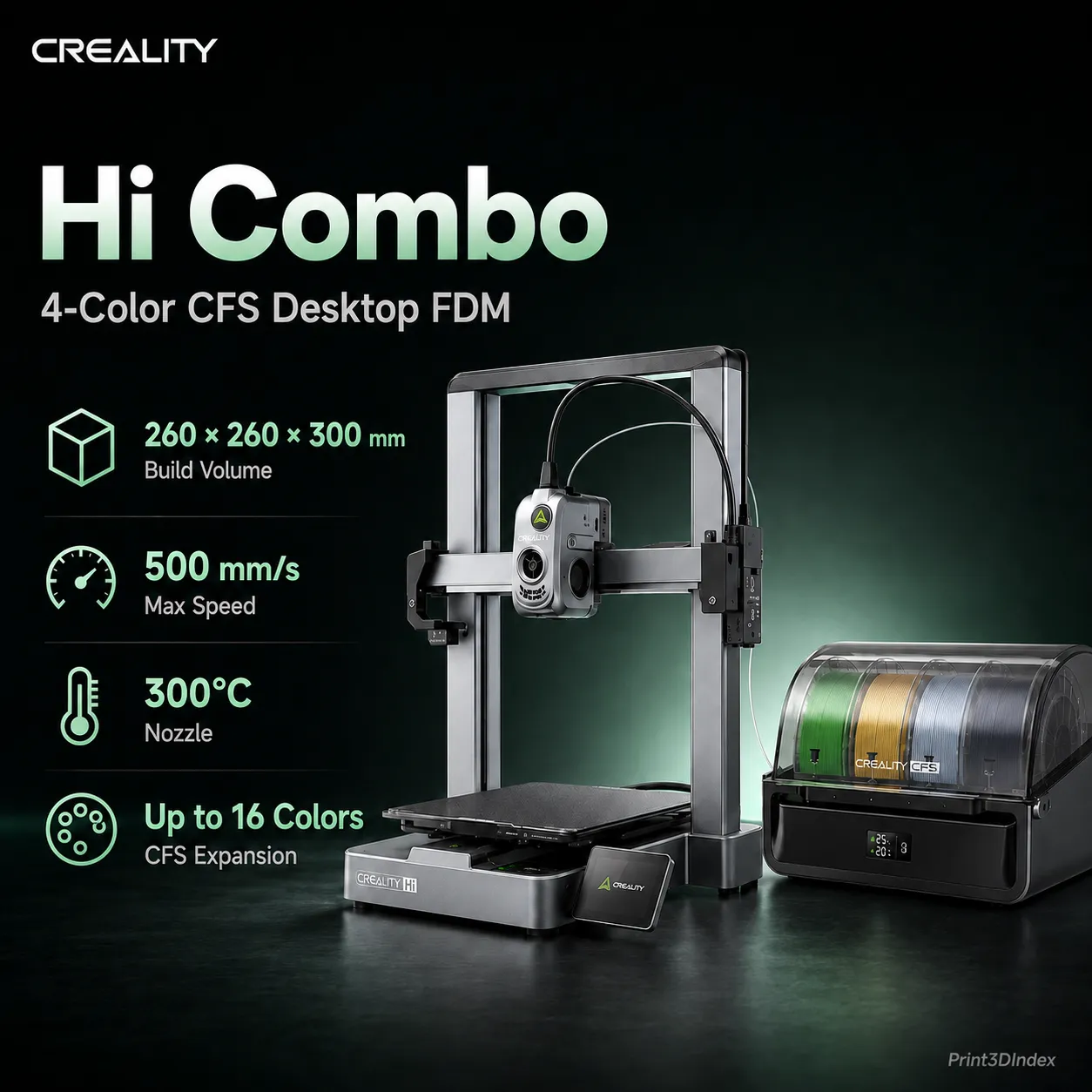
The Creality Hi Combo pairs the open-frame Creality Hi FDM printer with one CFS (Creality Filament System) for automated four-color printing. One CFS provides four filament slots; the Hi can connect to as many as four CFS units for up to 16 filament inputs. Reaching that maximum requires three additional CFS units and separate CFS power arrangements when two or more units are connected.
The printer offers a 260 × 260 × 300 mm build volume, 300°C tri-metal nozzle, 100°C heated bed, 500 mm/s maximum speed, and 12,000 mm/s² maximum acceleration. Creality lists 300 mm/s as the typical print speed. It also includes direct-drive extrusion, full-auto leveling, G-sensor input shaping, Wi-Fi/USB transfer, a monitoring camera, and a 3.2-inch touchscreen.
The CFS adds RFID filament recognition, automatic filament switching and relay, runout/tangle detection, temperature and humidity display, and sealed desiccant-based storage. It does not actively heat filament.
For current information, see the official Creality Hi Combo page, the official store page, and the official CFS compatibility guide.
| Specification | Value |
|---|---|
| Printing technology | FDM / FFF |
| Design | Open-frame Cartesian / bed-slinger |
| Build volume | 260 × 260 × 300 mm |
| Layer height | 0.10–0.35 mm |
| Typical print speed | 300 mm/s |
| Maximum print speed | 500 mm/s |
| Maximum acceleration | 12,000 mm/s² |
| Standard nozzle | 0.4 mm tri-metal |
| Optional nozzles | 0.6 / 0.8 mm |
| Maximum nozzle temperature | 300°C |
| Maximum bed temperature | 100°C |
| Extruder | Direct drive |
| X/Y motors | Step-servo |
| Build surface | Two-sided epoxy flexible plate |
| Leveling | Full-auto |
| Input shaping | G-sensor |
| Display | 3.2-inch color touchscreen |
| Monitoring camera | Yes |
| File transfer | USB drive / Wi-Fi |
| Software | Creality Print 5.1+ |
| File formats | G-code / 3MF |
| Internal storage | 8 GB eMMC |
| Printer dimensions | 409 × 392 × 477 mm |
| Rated voltage | AC 100–240 V, 50 Hz |
| Rated power | 1150 W @ 220 V / 390 W @ 110 V |
| Included CFS units | 1 |
| Included filament slots | 4 |
| Maximum CFS units | 4 |
| Maximum filament inputs | 16 |
| CFS dimensions | 379 × 314 × 276 mm |
| CFS power | 24 V DC / 20 W |
| CFS drying | No active heater; sealed desiccant storage |
| CFS RFID | Yes |
Speed note: 500 mm/s is the published maximum. Creality lists 300 mm/s as the typical print speed.
The standard Combo includes one CFS with four filament inputs. The CFS can switch filaments automatically, relay to a matching spool, detect runout or tangles, and identify compatible Creality RFID filament.
The Hi can connect to four CFS units for up to 16 inputs, but this is an expansion ceiling rather than an out-of-box capability. Three additional CFS units are required, and Creality specifies separate power for setups using two or more CFS units.
Because all colors share one nozzle, multi-color jobs still require filament changes and purge.
The original CFS uses an enclosed box and desiccant to help keep filament dry. It also displays temperature and humidity.
It is not an actively heated filament dryer. Wet filament should be dried separately before loading. This is an important difference when comparing the Hi Combo with newer systems that integrate heated drying.
Creality's current printer specification lists:
The CFS compatibility list is broader and includes PLA, PETG, ABS, ASA, PET, PLA-CF, HIPS, and properly dried PVA/BVOH under supported conditions.
These lists are not identical, so ASA and PET should not automatically be presented as fully qualified Hi printer materials simply because the CFS can feed them.
Creality explicitly warns against TPU and other soft elastic materials in the CFS feed path.
Compatible cardboard spools can work, including Creality Hyper-series spools, but damaged, warped, rough-edged, or incorrectly sized cardboard spools can jam.
PLA-CF is listed by Creality for both the printer and CFS. The tri-metal nozzle is more wear-resistant than ordinary brass, but abrasive filament still accelerates nozzle wear.
For broader guidance, see Best 3D Printers for Carbon Fiber Materials.
The Hi is open-frame and has no chamber heating.
Small ABS prints can be practical under suitable conditions, but larger ABS/ASA parts are more vulnerable to drafts and warping than PLA or PETG. Users who regularly print these materials should consider an enclosed option such as the indexed Bambu Lab P2S or Creality K2 Plus.
Creality Hi includes:
One important correction: Creality's current support specification lists Power Loss Recovery: No for the Hi.
The official Hi specification also does not clearly publish camera resolution, so no unverified 720p or 1080p figure is used.
| Printer | Build Volume | Speed | Nozzle / Bed | Multi-Color | Filament Storage | Enclosure |
|---|---|---|---|---|---|---|
| Creality Hi Combo | 260 × 260 × 300 mm | 500 mm/s max print | 300°C / 100°C | 4 included; up to 16 | CFS + desiccant | No |
| Bambu Lab A1 + AMS lite | 256 × 256 × 256 mm | 500 mm/s max toolhead | 300°C / 100°C | Up to 4 | Open AMS lite | No |
| Anycubic Kobra X | 260 × 260 × 260 mm | 600 mm/s max print | 300°C / 100°C | Native 4; up to 19 | ACE 2 Pro optional | No |
| Bambu Lab P2S | 256 × 256 × 256 mm | 600 mm/s max toolhead | 300°C / 110°C | AMS ecosystem | AMS 2 Pro drying | Yes |
| Creality K2 Plus | 350 × 350 × 350 mm | 600 mm/s max print | 350°C / 120°C | CFS, up to 16 | CFS + desiccant | 60°C active |
The Hi Combo stands out for its 300 mm Z height, included CFS, and relatively low purchase price. Its tradeoffs are the open frame, lack of active drying, and lower acceleration than some newer competitors.
The Creality Hi Combo vs Bambu Lab A1 Combo comparison is one of the closest current open-frame multi-color matchups.
The indexed Bambu Lab A1 provides a 256 × 256 × 256 mm build volume, 300°C hotend, 100°C bed, 500 mm/s maximum toolhead speed, 10,000 mm/s² acceleration, full-auto calibration, active flow-rate compensation, and optional four-color AMS lite.
Hi Combo is slightly wider and significantly taller at 260 × 260 × 300 mm, and its CFS is enclosed rather than open.
Choose A1 Combo for polished calibration and the Bambu software ecosystem. Choose Hi Combo for taller prints, enclosed filament storage, and expansion beyond four colors.
See the official Bambu Lab A1 page for manufacturer specifications.
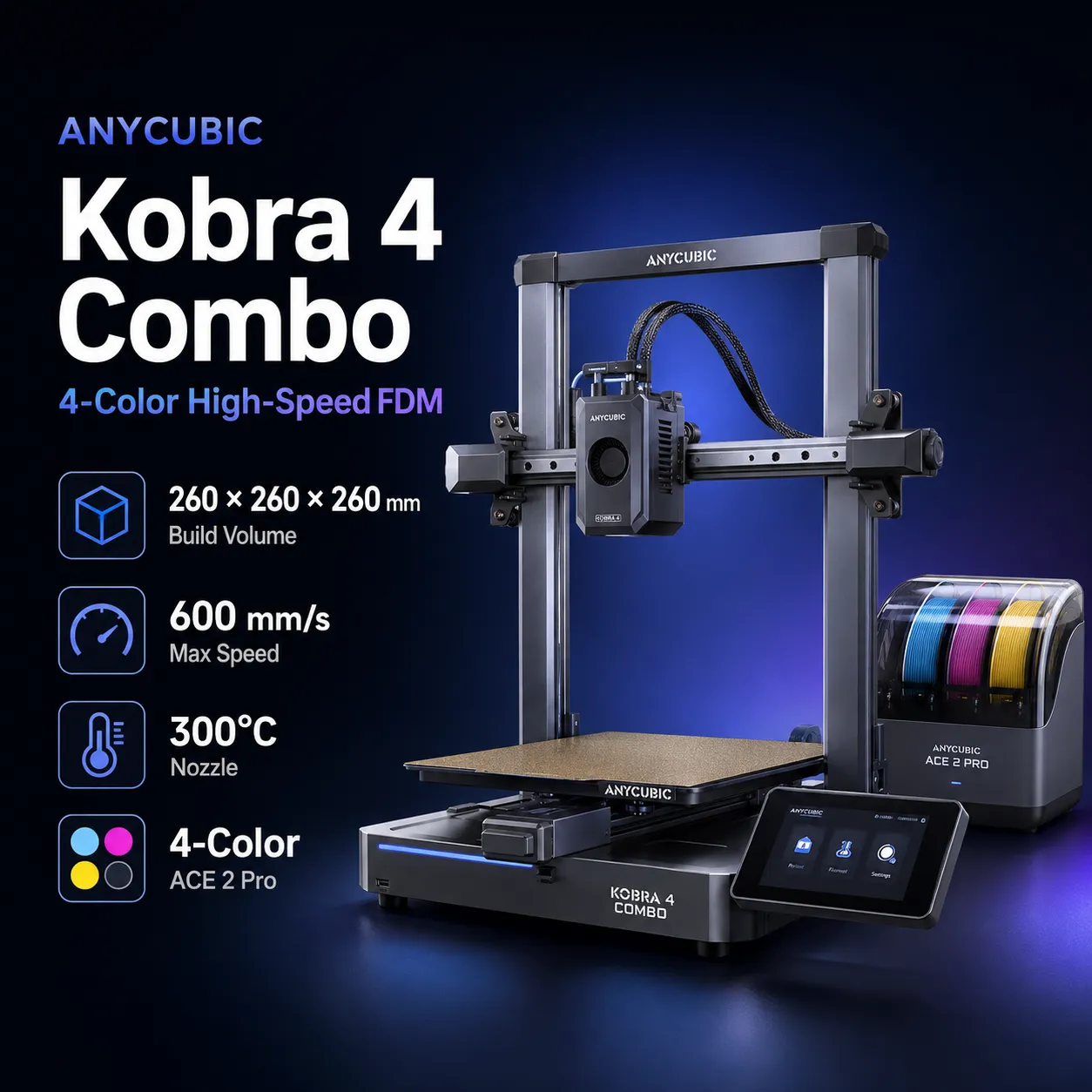
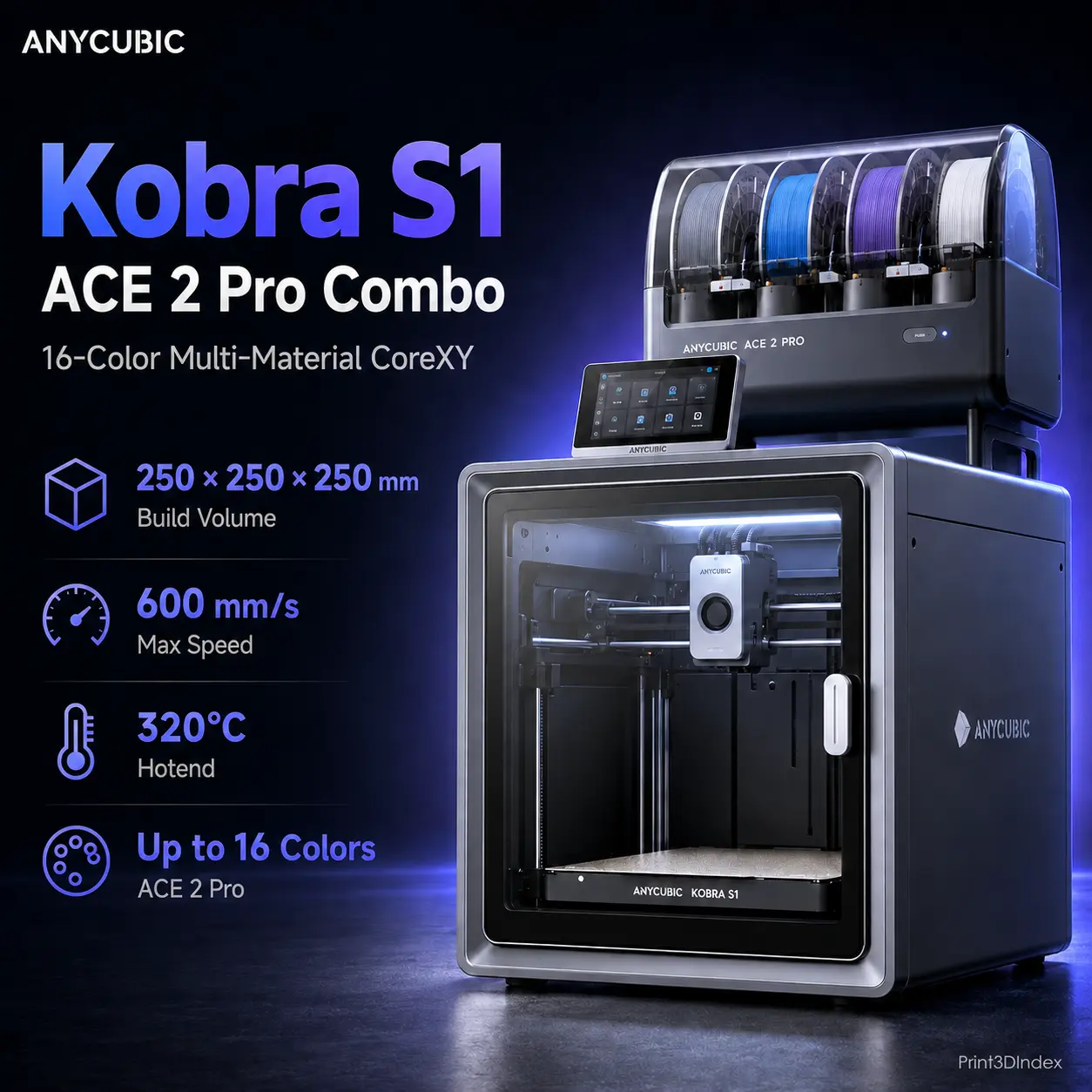
The Creality Hi Combo vs Anycubic Kobra X comparison is especially relevant in the value-focused multi-color category.
The indexed Anycubic Kobra X offers a 260 × 260 × 260 mm build volume, 600 mm/s maximum speed, 20,000 mm/s² maximum acceleration, 300°C hardened-steel nozzle, 100°C PEI bed, 720p camera, and native four-color printing.
Anycubic currently advertises expansion up to 19 colors, with active drying available through ACE 2 Pro.
Hi Combo is 40 mm taller in Z and uses Creality's CFS ecosystem. Kobra X is faster on paper and offers hardened nozzle hardware plus more aggressive color expansion.
Choose Hi Combo when height and CFS integration matter more. Choose Kobra X when speed, hardened hardware, and maximum color count are stronger priorities.
See the official Anycubic Kobra X page.
The Creality Hi Combo vs Bambu Lab P2S Combo comparison is open-frame value versus enclosed capability.
The indexed Bambu Lab P2S provides a 256 × 256 × 256 mm build volume, 600 mm/s maximum toolhead speed, 300°C hardened-steel nozzle, 110°C bed, 1080p camera, automatic flow-dynamics calibration, and AMS compatibility.
Hi Combo offers a taller 300 mm Z axis and a lower-cost path to multi-color printing. P2S is better suited to ABS, ASA, PA, PC, and reinforced materials because it is enclosed.
Choose Hi Combo for affordable PLA/PETG multi-color work and taller models. Choose P2S Combo when enclosure, reinforced-material support, camera quality, and automatic extrusion calibration justify the higher cost.
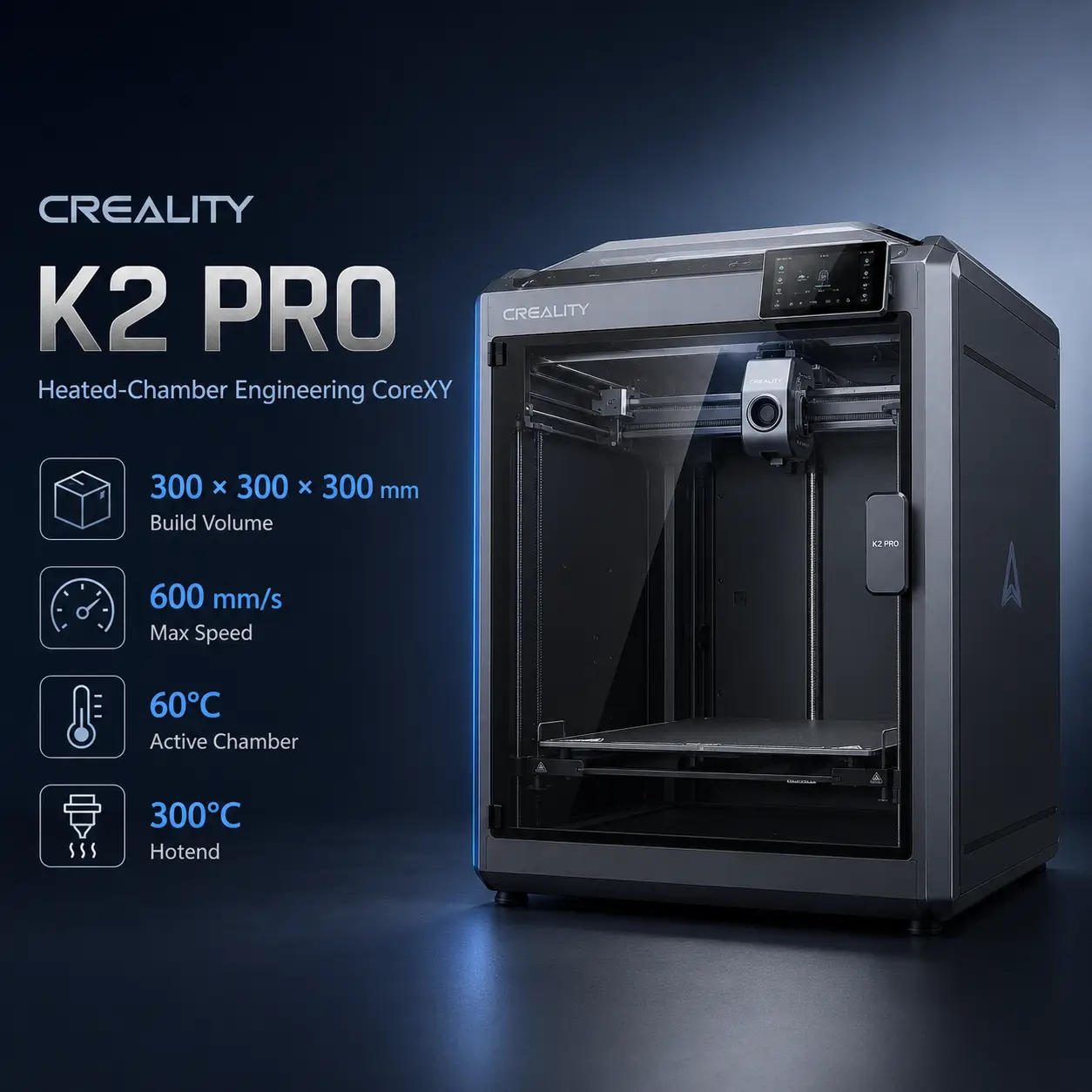
The Creality Hi Combo vs Creality K2 Plus Combo comparison shows the step from Creality's accessible multi-color printer to its large engineering platform.
The indexed Creality K2 Plus provides a 350 × 350 × 350 mm build volume, 600 mm/s maximum print speed, 350°C nozzle, 120°C bed, and 60°C actively heated chamber.
Both can scale to four CFS units and 16 filament inputs.
Choose Hi Combo for hobby, education, PLA/PETG multi-color work, and lower cost. Choose K2 Plus Combo for large parts, active chamber heating, and broader engineering-material use.
For broader beginner and home-use context, see Best 3D Printers for Home Use in 2026.
The Creality Hi Combo starts from US$399, approximately €342 in Europe, £293 in the UK, C$550 in Canada, A$561 in Australia, ₹38,202 in India, and AED 1,466 in the UAE.
Actual pricing may vary by region depending on VAT or local taxes, shipping costs, exchange rates, stock availability, plug configuration, selected bundles, filament promotions, and other regional offers.
The Creality Hi printer bundled with one four-slot CFS.
260 × 260 × 300 mm.
0.10–0.35 mm.
500 mm/s; Creality lists 300 mm/s as typical.
300°C.
Four through the included CFS.
By using four CFS units in total; three additional units are required beyond the included CFS.
No. It uses sealed storage and desiccant for moisture control.
Hyper PLA, PLA, PETG, ABS, and PLA-CF.
No. Creality specifically warns against flexible TPU and other soft materials in the CFS feed path.
Yes.
Yes, with monitoring and timelapse support.
Creality's current support specification lists it as unsupported.
No.
Hi Combo is taller and expands to 16 inputs; A1 emphasizes active flow compensation and the Bambu Studio/AMS lite ecosystem.
Kobra X is faster on paper and expands beyond 16 colors, while Hi offers a taller 300 mm Z axis and Creality's CFS workflow.
The Creality Hi Combo starts from US$399, approximately €342 in Europe, £293 in the UK, C$550 in Canada, A$561 in Australia, ₹38,202 in India, and AED 1,466 in the UAE. Actual pricing may vary by region depending on VAT or local taxes, shipping costs, exchange rates, stock availability, plug configuration, selected bundles, filament promotions, and other regional offers.