RecommendedPopularEasy to PrintTough Easy Print PLAImpact Resistant PLAEasy Print Tough PLAFunctional PLA FilamentLow Warp
EeSUN
eSUN
# eSUN PLA+
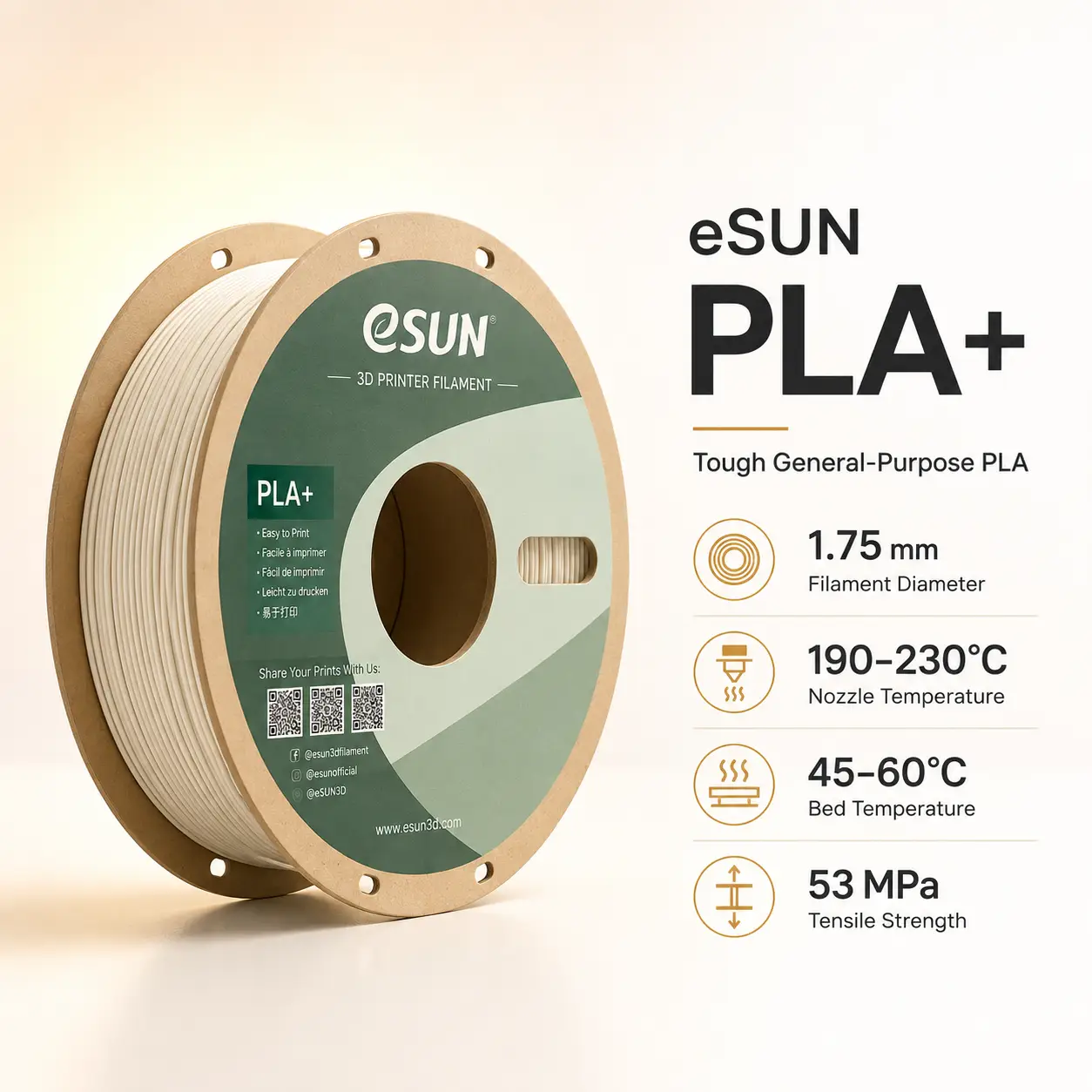
eSUN PLA+ is a modified PLA filament aimed at users who want easier printing than many engineering plastics while gaining more toughness and impact resistance than a conventional basic PLA formulation. It remains a low-warp, fan-cooled material that works on a broad range of desktop FDM printers, but its mechanical profile makes it better suited to functional prototypes, fixtures, cosplay parts, models, and everyday components that may see moderate handling or impact.
eSUN's current PLA+ technical data sheet, dated June 2026, lists 70.37 MPa XY tensile strength, 7.27 kJ/m² XY Izod impact strength, and a 53.78°C heat-deflection temperature at 0.45 MPa. Those figures come from eSUN's standardized printed test specimens and should be treated as manufacturer test results rather than guaranteed values for every printer, orientation, or part geometry.
For current product information, see the official eSUN PLA+ product page, the June 2026 PLA+ technical data sheet, and the official eSUN PLA+ store page.
| Specification | Value |
|---|---|
| Material type | Toughened PLA filament |
| Printing compatibility | FDM |
| Diameter | 1.75 mm |
| Spool size | 1 kg |
| Density | 1.24 g/cm³ |
| Melt flow index | 3.7 g/10 min at 190°C / 2.16 kg |
| Nozzle temperature | 210–230°C |
| Bed temperature | 45–60°C |
| Recommended nozzle sizes | 0.2, 0.4, 0.6, 0.8 mm |
| Build surface | Textured PEI listed in current TDS |
| Cooling fan | 100% |
| Printing speed | Below 300 mm/s |
| Drying | 50°C for 8–12 hours |
| XY tensile strength | 70.37 MPa |
| Z tensile strength | 36.36 MPa |
| XY elongation at break | 4.14% |
| Z elongation at break | 2.92% |
| XY flexural strength | 100.3 MPa |
| Z flexural strength | 56.4 MPa |
| XY flexural modulus | 3259.39 MPa |
| Z flexural modulus | 2873.94 MPa |
| XY Izod impact strength | 7.27 kJ/m² |
| Z Izod impact strength | 2.22 kJ/m² |
| HDT at 0.45 MPa | 53.78°C |
| Enclosure required | No |
| Abrasive | No |
Mechanical-data note: The mechanical values above come from eSUN's June 2026 PLA+ TDS and its printed-specimen test conditions.
The current eSUN PLA+ TDS recommends a 210–230°C nozzle temperature and 45–60°C bed temperature.
A practical starting point for many modern FDM printers is around 220°C nozzle and 50–60°C bed, followed by small adjustments for hotend calibration, print speed, layer height, cooling, and the specific color.
eSUN lists 100% part cooling in its standard profile.
Unlike ABS, ASA, or polycarbonate, PLA+ does not normally need an enclosed or actively heated chamber. That makes it easier to use on open-frame printers and compact desktop machines.
The latest TDS lists 0.2, 0.4, 0.6, and 0.8 mm nozzles, with no hardened-nozzle requirement for standard PLA+.
eSUN's June 2026 PLA+ TDS lists a recommended printing speed of below 300 mm/s.
That does not mean every printer, geometry, or profile should be run close to 300 mm/s. High-speed printing depends on:
For a typical desktop printer, slower speeds can improve dimensional consistency, overhang quality, and surface finish.
The latest manufacturer data gives eSUN PLA+ a useful combination of stiffness and toughness for a PLA-family material.
eSUN reports:
The difference between XY and Z values highlights the directional nature of FDM parts. Interlayer bonding remains a major factor in real-world strength.
The current TDS lists:
That makes PLA+ better suited to moderate handling and impact than a brittle visual-model material, but it should not be treated as a substitute for nylon, polycarbonate, or flexible engineering polymers where high impact performance is the primary requirement.
eSUN reports:
The material therefore remains relatively stiff while offering a tougher behavior than many basic PLA formulations.
The June 2026 technical data sheet lists a 53.78°C heat-deflection temperature at 0.45 MPa.
This is one of the main limitations of PLA+.
It is suitable for room-temperature prototypes, models, indoor fixtures, and many everyday functional components, but it is not a good choice for parts that may remain under load in hot cars, near heaters, or around high-temperature machinery.
For applications where higher service temperature matters, materials such as Prusament PETG or Prusament ASA can be more appropriate, although they require different printing conditions.
eSUN positions PLA+ as having improved toughness and layer adhesion compared with basic PLA.
The current mechanical data still shows a significant difference between XY and Z strength, so part orientation matters.
For functional components:
Good layer adhesion does not eliminate the anisotropy inherent to FDM printing.
PLA+ is designed for smooth extrusion and low shrinkage.
That makes it useful for:
The official eSUN store lists ±0.03 mm filament dimensional accuracy for its 1.75 mm PLA+ spool.
As with other PLA materials, sharp corners and fine detail are generally easier to preserve than with higher-shrinkage materials such as ABS.
PLA+ is easier to store than highly hygroscopic materials such as nylon, but it can still absorb enough moisture to reduce print quality.
Common moisture symptoms include:
The June 2026 TDS recommends 50°C for 8–12 hours when drying is necessary.
After drying, store the spool sealed with desiccant rather than leaving it exposed for long periods in humid environments.
eSUN PLA+ can be finished with common PLA post-processing methods.
Useful options include:
For cosplay and display models, filler primer and sanding can help hide layer lines before painting.
For functional parts, drilling or machining should be performed carefully because PLA-family materials can soften from friction-generated heat.
eSUN sells PLA+ in a broad color range, including standard, muted, bright, and specialty shades.
The material is generally intended to produce a smooth, clean surface rather than a deliberately matte or textured finish.
Color can slightly affect optimal temperature and appearance, so a small temperature tower or calibration print can be useful when changing between significantly different pigments.
| Material | Material Class | Nozzle Temperature | HDT / Heat Resistance | Main Strength | Best Fit |
|---|---|---|---|---|---|
| eSUN PLA+ | Toughened PLA | 210–230°C | 53.78°C HDT at 0.45 MPa | Easy printing with improved toughness | Prototypes, models, everyday functional parts |
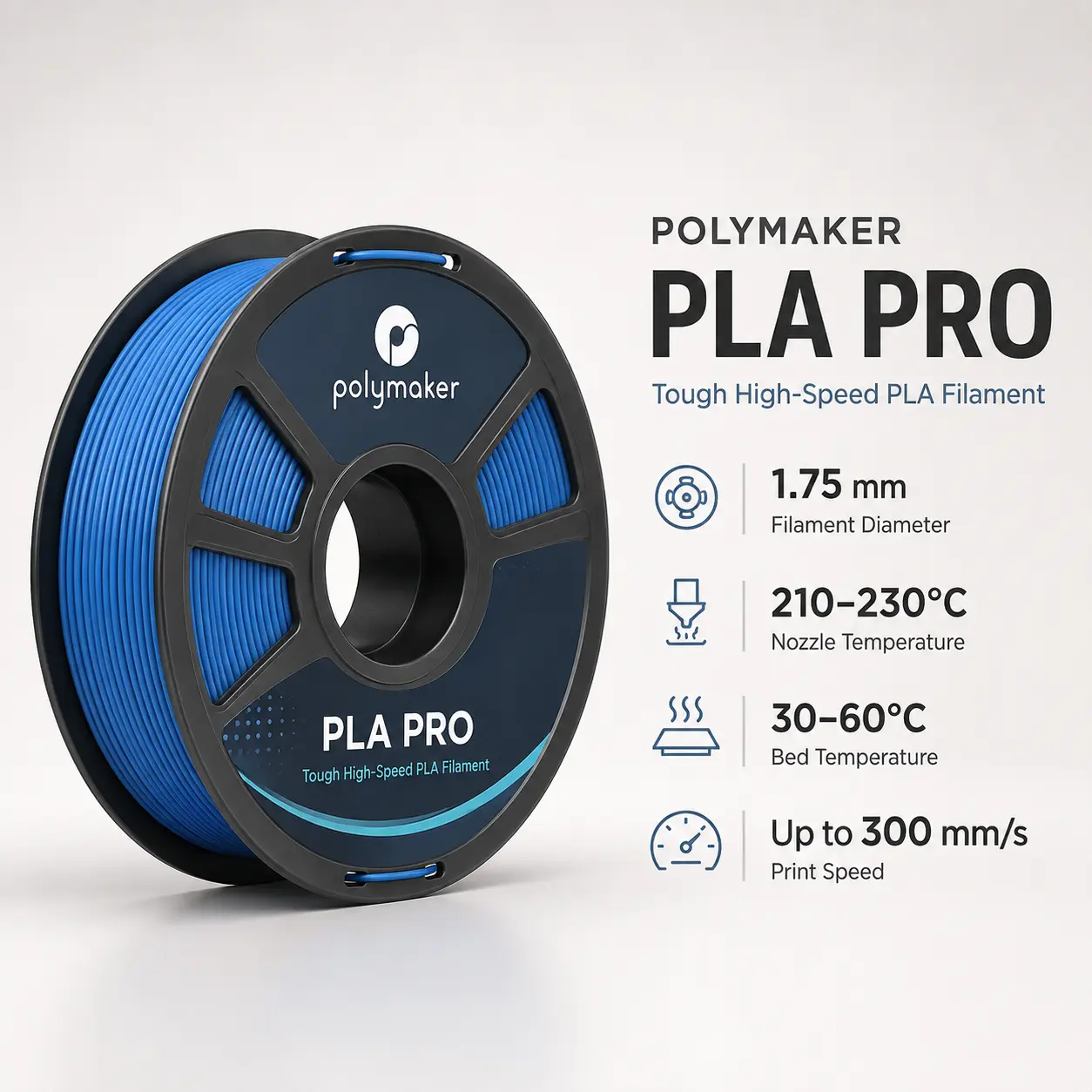
| Polymaker PLA Pro | Tough professional PLA | PLA-style temperatures | 58°C HDT at 1.8 MPa | High toughness and rigidity | Functional PLA parts and engineering prototypes |
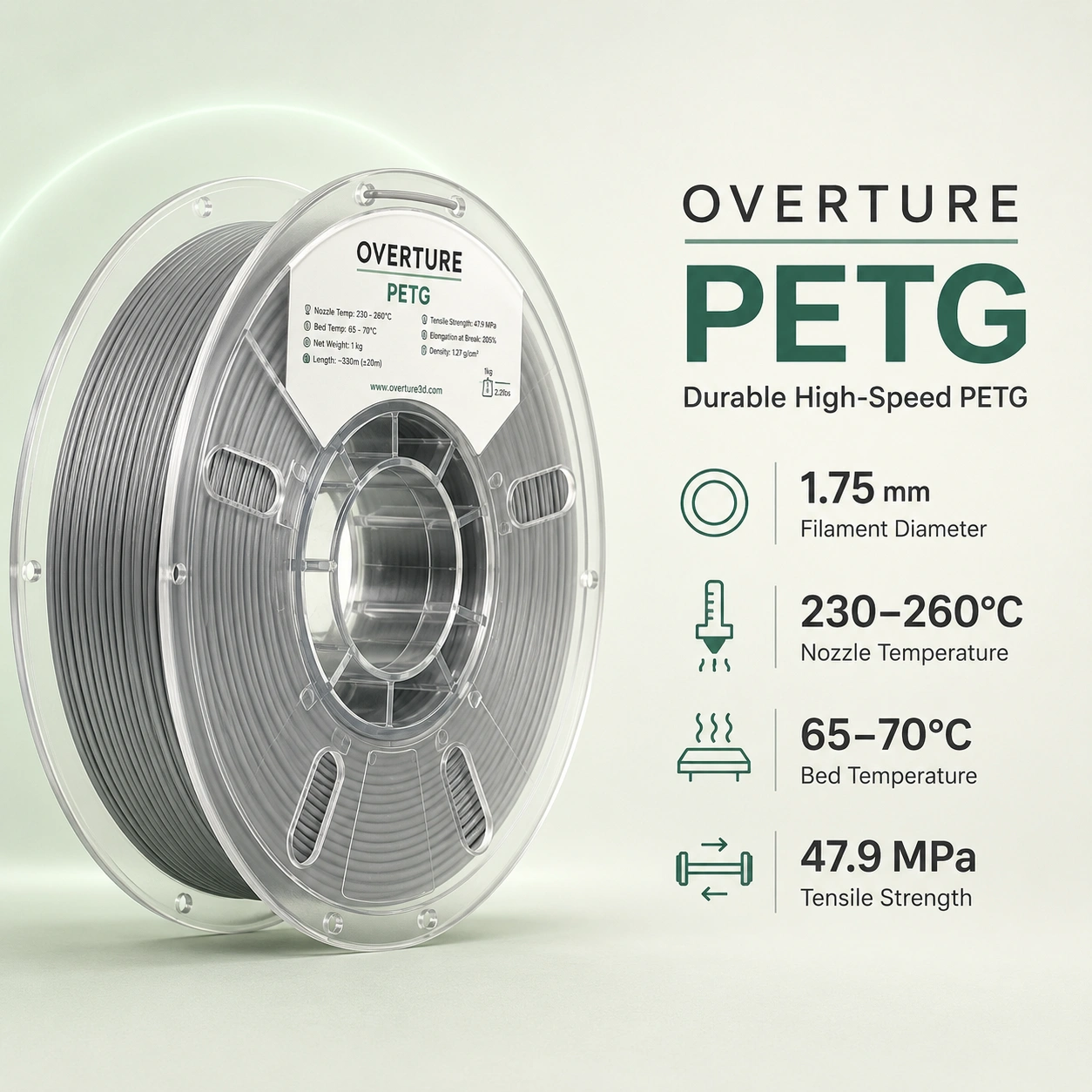
| Prusament PETG | PETG | Higher than PLA+ | 68°C HDT | Toughness, layer adhesion, heat resistance | Durable functional parts |
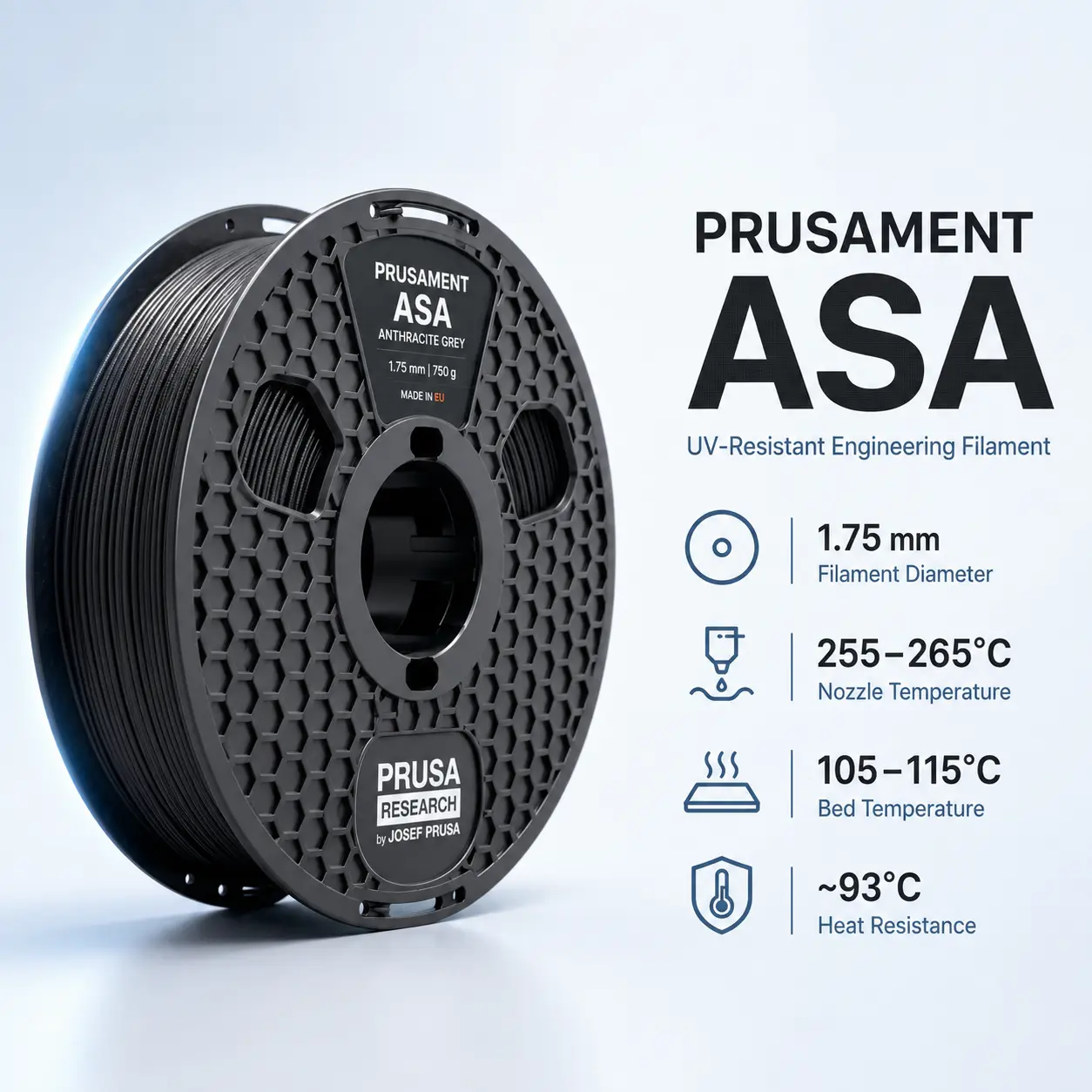
| Prusament ASA | ASA | Around 260°C | Higher-temperature material | UV and weather resistance | Outdoor and heat-exposed parts |
The table is a practical material-selection guide rather than a direct ranking. Test methods differ between manufacturers, so values from different technical data sheets should not be treated as perfectly equivalent laboratory comparisons.
The eSUN PLA+ vs Polymaker PLA Pro comparison is most relevant when the goal is a tougher PLA that still prints easily.
Polymaker PLA Pro is positioned as a high-toughness, high-rigidity PLA for engineering-style applications. Its current technical data sheet lists a 58°C heat-deflection temperature at 1.8 MPa and approximately 49.8 MPa XY tensile strength under Polymaker's own test method.
eSUN PLA+ is attractive when:
Polymaker PLA Pro is a strong alternative when a documented professional PLA profile and its particular toughness/rigidity balance are more important than the lowest spool cost.
Because the manufacturers use different test conditions, raw tensile and HDT numbers should not be compared as if they came from the same laboratory method.
The eSUN PLA+ vs Prusament PETG comparison is mainly about print simplicity versus heat resistance and ductility.
Prusament PETG has a published 68°C HDT and is known for good layer adhesion, durability, and low warping.
Choose eSUN PLA+ when you want:
Choose Prusament PETG when you need:
PETG can string more and usually runs at higher nozzle and bed temperatures, while PLA+ tends to be easier for clean visual prints.
The eSUN PLA+ vs Prusament ASA comparison becomes relevant when the part may see sunlight, weather, or substantially higher temperatures.
Prusament ASA is designed for outdoor and higher-temperature applications and is printed at much higher nozzle and bed temperatures than PLA+.
Choose eSUN PLA+ for indoor prototypes, models, fixtures, and everyday parts when easy printing and low warping matter most.
Choose Prusament ASA for outdoor housings, automotive accessories, weather-exposed components, and applications where UV stability and heat resistance justify the added printing requirements.
ASA is more demanding: larger parts benefit from an enclosure, ventilation is important, and warping control matters more than with PLA+.
The eSUN PLA+ vs standard PLA comparison is less about a universal chemistry standard and more about formulation intent.
“PLA+” is not one industry-wide specification. Each manufacturer uses its own additives and formulation.
eSUN positions PLA+ as a tougher, more impact-resistant PLA with improved layer adhesion while keeping the familiar low-warp printing behavior of PLA.
Standard PLA can still be preferable for:
eSUN PLA+ is a better default when the same easy-printing workflow is wanted but the part may be handled, flexed slightly, dropped, screwed together, or used functionally.
The best eSUN PLA+ alternative depends on the limitation you are trying to solve.
For most indoor prototypes and light-duty functional parts, PLA+ offers a useful middle ground between basic visual-model PLA and more demanding engineering filaments.
The official eSUN US store currently displays US$15.99 flash-sale pricing for the 1 kg PLA+ spool, approximately €13.94 in Europe • £11.82 in the United Kingdom • AED 58.72 in the UAE • C$22.19 in Canada • A$22.64 in Australia • ₹1,526 in India • ¥2,547 in Japan • ¥107.82 in China at current exchange rates. Pricing varies by region, color, promotions, quantity discounts, exchange rates, taxes, and shipping destination. The store also offers multiple PLA+ spool sizes and refill options beyond the 1 kg format described here.
Recommended use: Choose eSUN PLA+ for prototypes, models, cosplay, fixtures, and everyday functional FDM parts when you want PLA-style ease of printing with better toughness and impact resistance than a basic visual-model PLA.
It is a modified PLA filament designed to improve toughness, impact resistance and layer adhesion while retaining easy PLA-style printing.
The June 2026 eSUN TDS recommends 210–230°C. Around 220°C is a practical starting point for many printers.
eSUN lists 45–60°C.
The latest June 2026 TDS reports 70.37 MPa XY tensile strength and 36.36 MPa Z tensile strength under eSUN's printed-specimen test conditions.
The current TDS lists a 53.78°C heat-deflection temperature at 0.45 MPa.
The June 2026 TDS lists printing speed below 300 mm/s. Practical speed still depends on the printer, flow rate, cooling and geometry.
No. A heated enclosure is not required for normal printing.
No. Standard PLA+ is not a fiber-filled abrasive composite and normally works with a standard brass nozzle.
If moisture affects print quality, eSUN recommends drying at 50°C for 8–12 hours.
Yes, especially indoor light- to moderate-duty parts, prototypes and fixtures where easy printing and improved toughness are useful.
Neither is universally better. PLA+ is usually easier to print cleanly, while PETG generally offers better heat resistance and a tougher, more ductile material profile.
It can be used outdoors temporarily, but PLA+ is not the best choice for long-term heat and UV exposure. ASA is usually more appropriate for demanding outdoor parts.