Engineering GradeUV-Resistant Engineering ASAOutdoor Engineering FilamentHeat & UV Resistant ASADurable Outdoor ASA
PPrusa
Prusa
Compact row for standout or material-specific features only.
# Prusament ASA
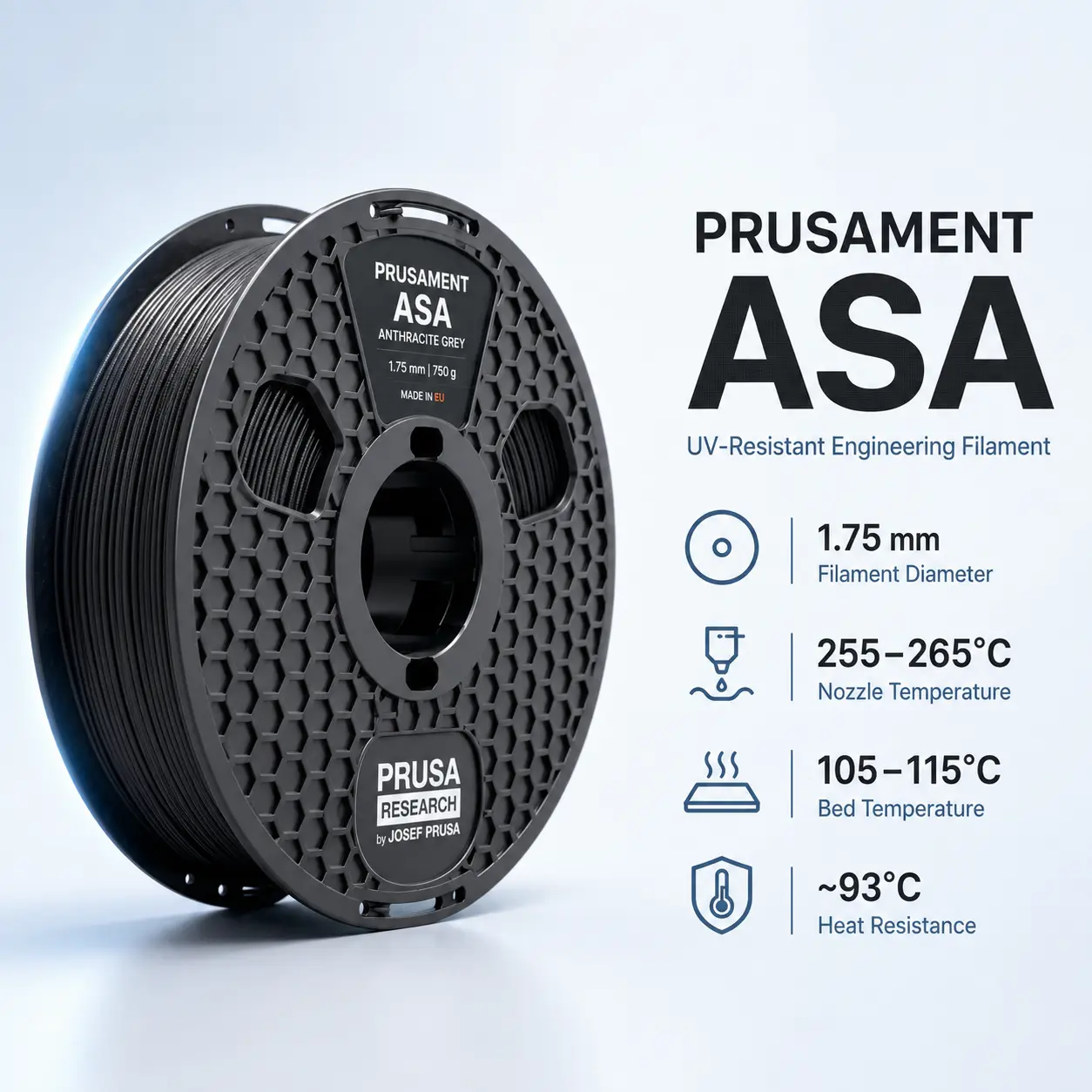
Prusament ASA is a technical FDM filament from Prusa Polymers for durable mechanical, engineering and outdoor parts. Compared with ABS, ASA offers better UV stability, reduced warping and strong temperature resistance while retaining good toughness and impact performance.
Its UV stability makes it especially suitable for outdoor components, housings, brackets, automotive prototypes and tooling. For easier rigid materials, Prusament PETG offers lower warping, while Polymaker PLA Pro focuses on easier high-speed printing.
| Specification | Value |
|---|---|
| Material Type | Filament |
| Chemistry | ASA |
| Printing Compatibility | FDM |
| Applications | Prototype, Engineering, Automotive, Tooling, Production |
| Print Temperature | 255–265°C |
| Bed Temperature | 105–115°C |
| Published Print Speed | Up to 200 mm/s |
| Format | 1.75 mm, 800 g spool |
| Diameter Tolerance | ±0.04 mm |
| Tensile Yield Strength | 42 ±1 MPa horizontal; 45 ±2 MPa vertical XZ |
| Tensile Modulus | 1.6 ±0.1 GPa horizontal; 1.7 ±0.1 GPa vertical XZ |
| Interlayer Adhesion | 11 ±1 MPa |
| Heat Deflection Temperature | 93°C at 0.45 MPa; 86°C at 1.80 MPa |
| Warping | High |
| Abrasive | No |
| Enclosure | Recommended for larger parts |
| Post-Processing | Wet/dry sanding; acetone smoothing and bonding |
| Storage / Drying | Keep dry; dry if moisture-related issues occur |
| Colour / Finish | Multiple colours; smooth finish |
| Price | Approximately US$25.92 per 800 g spool — check manufacturer’s current listing |
Note: Mechanical and thermal values are manufacturer test results and depend on orientation, geometry, processing and test conditions.
The Prusa CORE One+ is a strong match for ASA because of its enclosed engineering-material workflow.
Other relevant indexed printers include the Bambu Lab P2S, Bambu Lab H2D and Creality K2 Plus. The H2D and K2 Plus add active chamber heating, useful for larger warp-prone parts.
Important: Large ASA parts can warp. Use an enclosure, warmer ambient conditions or a tall skirt and avoid drafts.
Important: ASA contains styrene and produces fumes during printing. Use suitable ventilation or filtration.
| Property | Information |
|---|---|
| Tensile yield strength | 42 ±1 MPa horizontal; 45 ±2 MPa vertical XZ |
| Tensile modulus | 1.6 ±0.1 GPa horizontal; 1.7 ±0.1 GPa vertical XZ |
| Interlayer adhesion | 11 ±1 MPa |
| HDT | 93°C at 0.45 MPa; 86°C at 1.80 MPa |
| Toughness | High |
| Elasticity | Medium |
| Abrasivity | None |
Prusament ASA prints at approximately 260 ±5°C with a 110 ±5°C bed. The technical datasheet lists speeds up to 200 mm/s.
Warping is the main processing challenge, especially on larger parts. Enclosed printers such as the Prusa CORE One+, Bambu Lab H2D and Creality K2 Plus provide stable environments, while the Bambu Lab P2S also supports ASA in its enclosed chamber.
Use suitable ventilation or filtration because ASA emits styrene fumes during printing.
| Feature | Prusament ASA | Prusament PETG | Polymaker PLA Pro |
|---|---|---|---|
| Material family | ASA | PETG | Toughened PLA |
| UV resistance | High | General outdoor suitability | Not a dedicated UV-stable material |
| Warping | High | Low | Low |
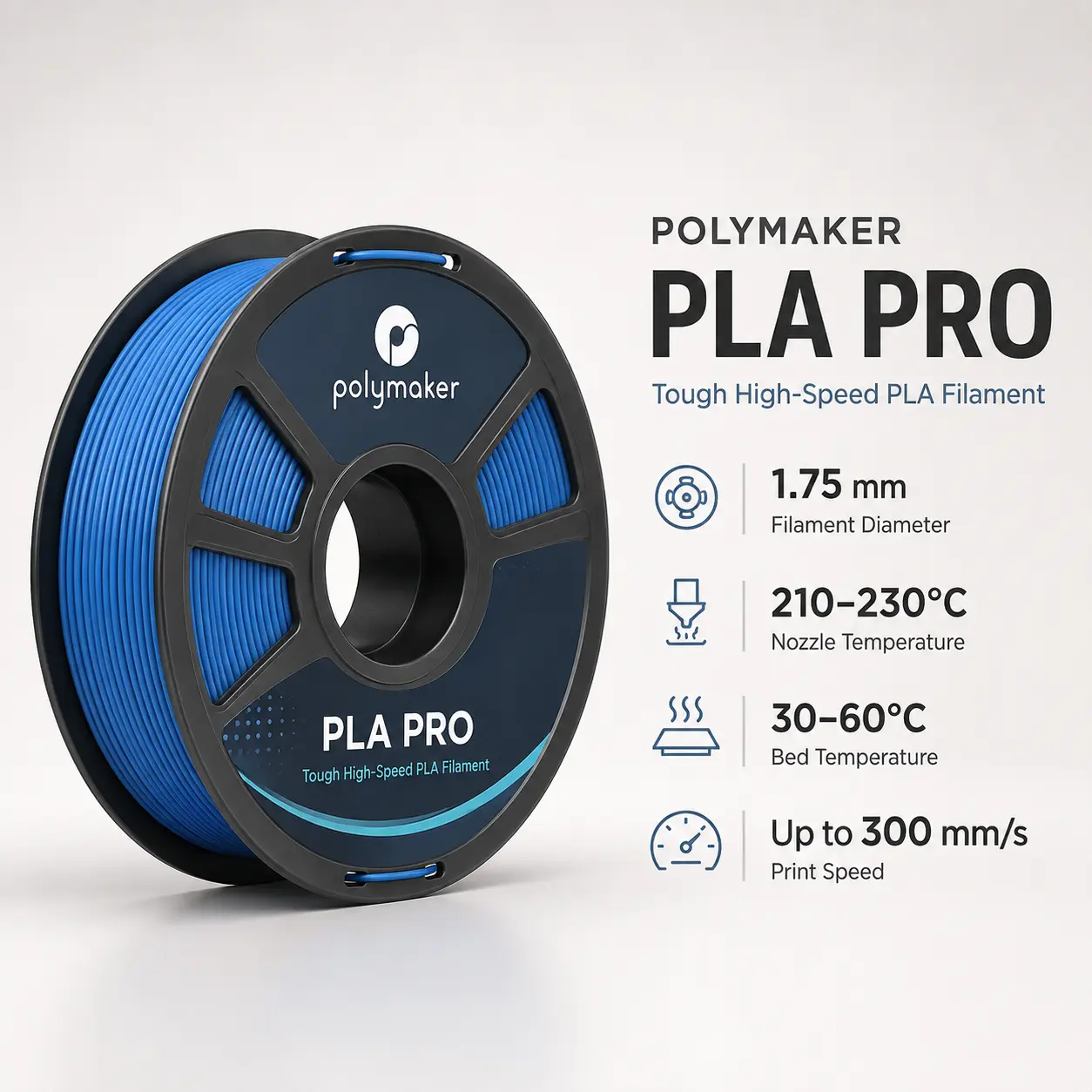
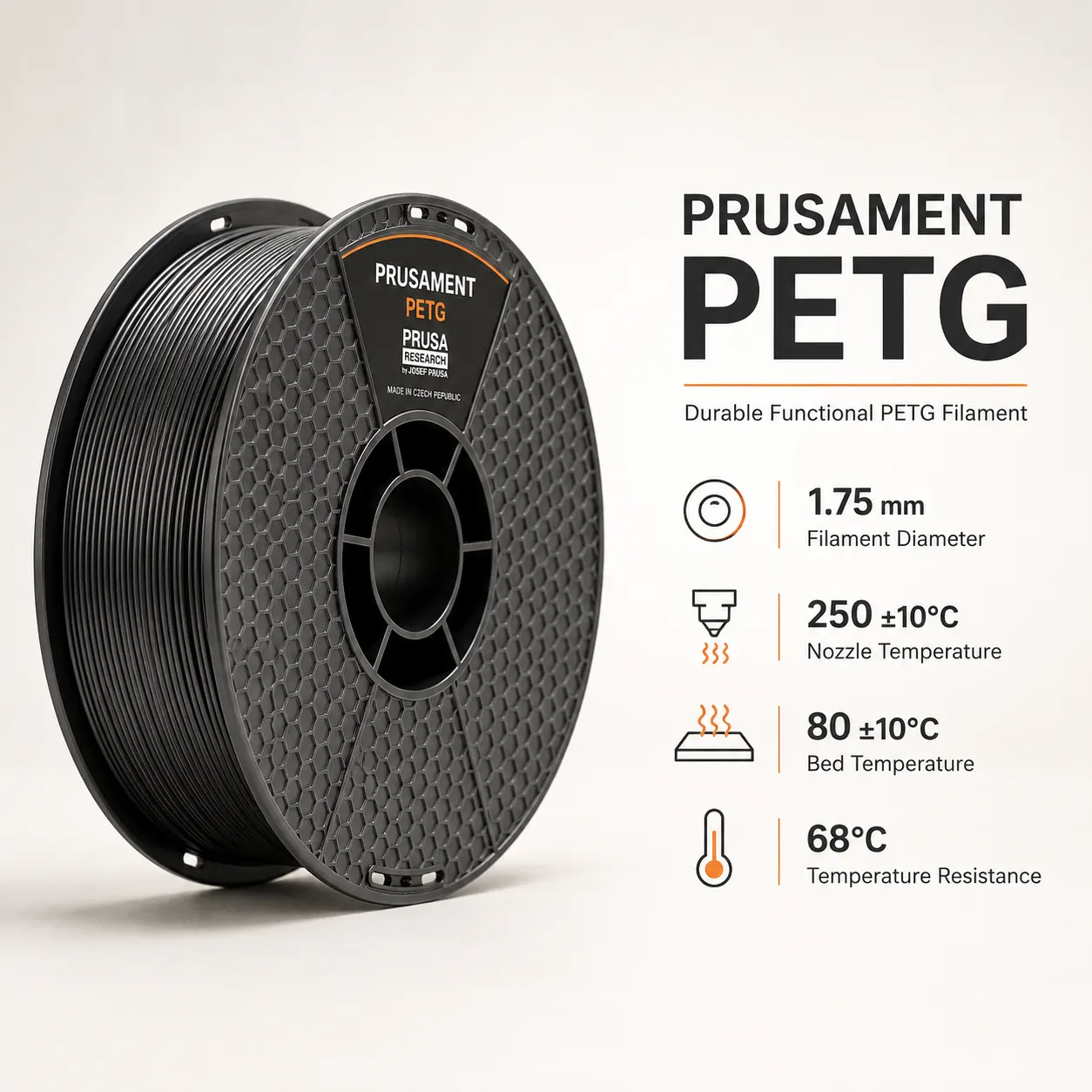
| Nozzle temperature | 255–265°C | 240–260°C | 210–230°C |
| Bed temperature | 105–115°C | 70–90°C | 30–60°C |
| Heat resistance | 93°C HDT at 0.45 MPa | ~68°C HDT | 55.6°C HDT at 1.8 MPa |
| Enclosure | Recommended for larger parts | No | No |
| Abrasive | No | No | No |
| Acetone smoothing | Yes | No | No |
| Typical use | Outdoor, automotive and heat-resistant parts | Tough engineering parts | High-speed prototypes and fixtures |
Recommended use: Choose Prusament ASA for UV-exposed, outdoor and higher-temperature engineering parts. Choose Prusament PETG for easier low-warping printing or Polymaker PLA Pro for easier high-speed prototypes and tooling.
Recommended use: Best for outdoor, automotive and engineering parts requiring UV stability, toughness and higher temperature resistance. Suitable enclosed printers include the Prusa CORE One+, Bambu Lab H2D and Creality K2 Plus.
A UV-stable 1.75 mm ASA filament for outdoor, mechanical, automotive and heat-resistant FDM parts.
Approximately 260 ±5°C nozzle and 110 ±5°C bed.
Not for every print, but an enclosure or tall skirt is strongly recommended for larger parts to reduce warping.
Yes. UV stability is one of its main advantages.
93°C HDT at 0.45 MPa and 86°C at 1.80 MPa.
42 ±1 MPa horizontally and 45 ±2 MPa vertically in documented tests.
No. A hardened nozzle is not required for abrasion resistance.
Yes. It can be sanded, acetone vapor-smoothed and acetone-bonded with appropriate safety precautions.
Relevant options include the Prusa CORE One+, Bambu Lab P2S, Bambu Lab H2D and Creality K2 Plus.
ASA offers better UV-focused outdoor performance and higher heat resi