Newly LaunchedEngineering GradeEasy to PrintTough High-Speed PLANo Hardened Nozzle Rrequired
PPolymaker
Polymaker
Compact row for standout or material-specific features only.
# Polymaker PLA Pro
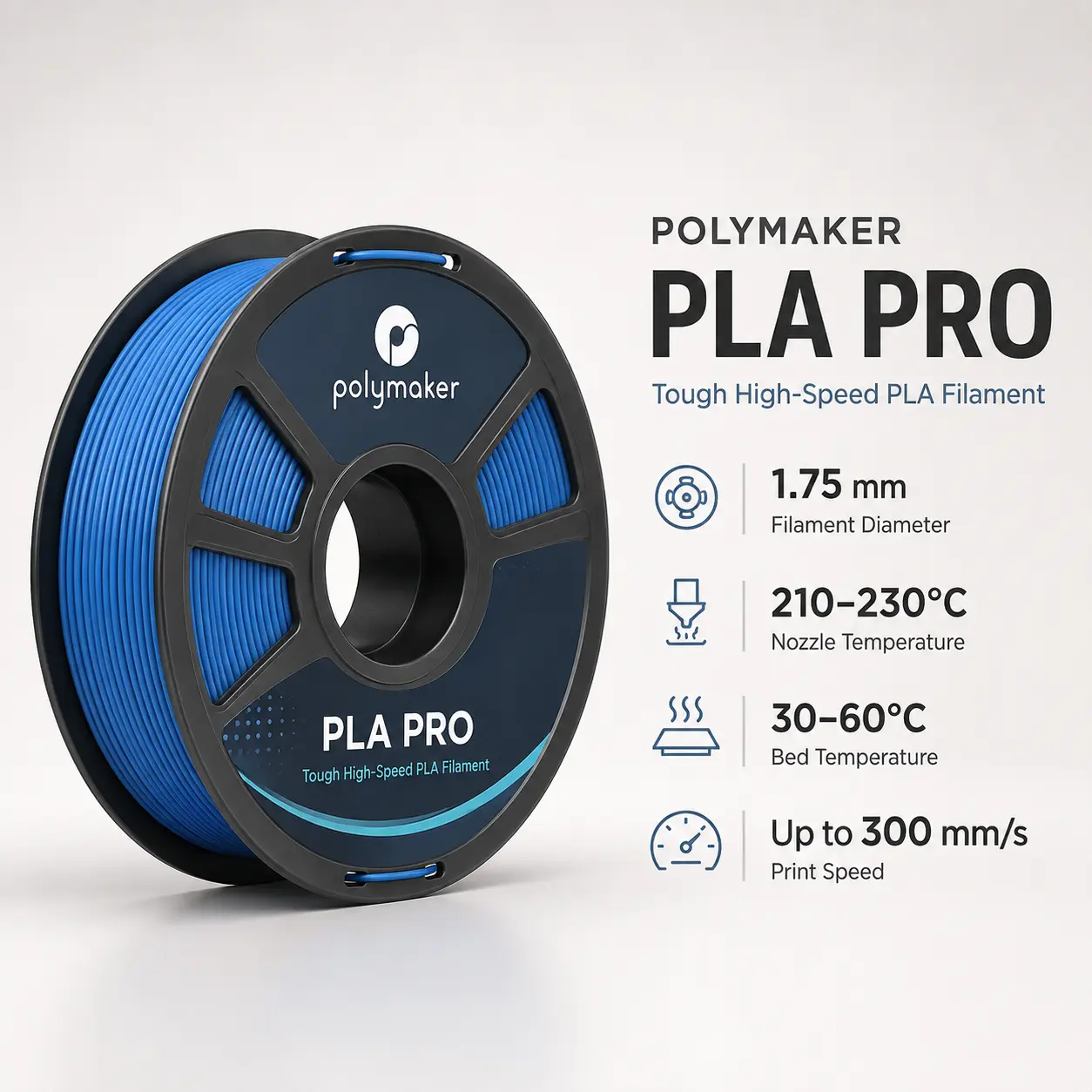
Polymaker PLA Pro is a toughened PLA filament developed for fast functional and engineering-oriented FDM printing. The current formula combines improved impact resistance, strong layer adhesion, dimensional stability, and validated print speeds up to 300 mm/s while retaining straightforward PLA-style processing.
Polymaker PLA Pro is the current formula replacing PolyLite PLA Pro, which Polymaker states will be discontinued by the end of 2026. The material does not require an enclosure or hardened nozzle and is designed to work on standard FDM printers.
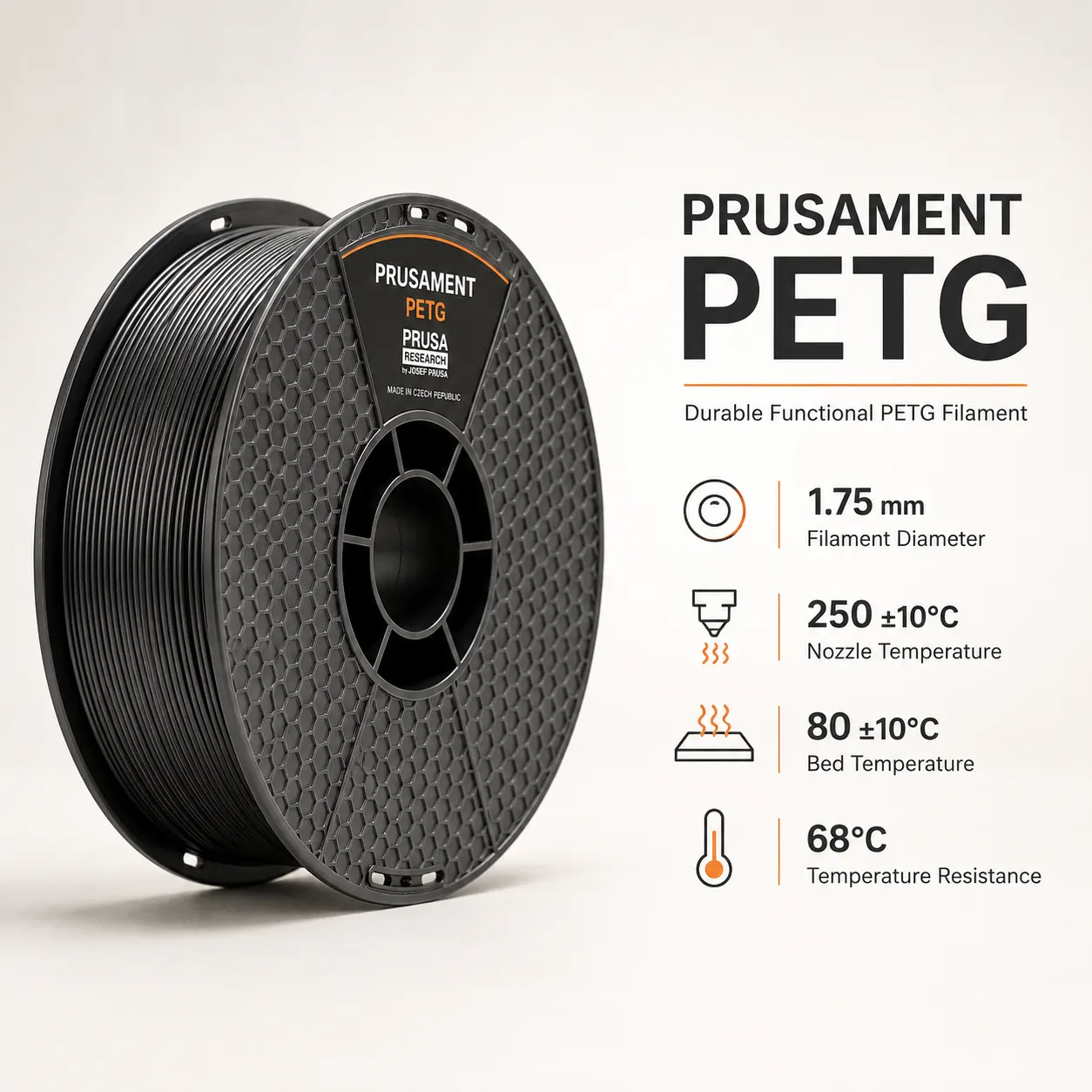
For users choosing between easy-print functional materials, Prusament PETG offers higher documented heat-deflection resistance and PETG ductility, while Polymaker PLA Pro focuses on PLA-like printability, impact resistance, rigidity, and high-speed throughput.
Compatible indexed printers include the Bambu Lab A1, Bambu Lab P2S, Prusa CORE One+, and Creality K2 Plus, using suitable PLA profiles and respecting each printer's extrusion-flow limits.
| Specification | Value |
|---|---|
| Material Type | Filament |
| Chemistry | Toughened PLA |
| Printing Compatibility | FDM |
| Applications | Prototype, Engineering, Tooling, Production |
| Key Property | High-impact tough PLA with high-speed printability |
| Print / Process Temperature | 210–230°C |
| Bed Temperature | 30–60°C |
| Print Speed | Up to 300 mm/s |
| Enclosure | Not required |
| Hardened Nozzle | Not required |
| Format | 1.75 mm, 1 kg spool |
| Mechanical Profile | High impact resistance with good rigidity |
| Tensile Strength | Approximately 39.93 MPa, X-Y |
| Young's Modulus | Approximately 2.53 GPa, X-Y |
| Notched Charpy Impact Strength | Approximately 20.76 kJ/m², X-Y |
| Heat Deflection Temperature | 55.6°C at 1.8 MPa |
| Abrasive | No |
| Storage / Drying | Dry at 55°C for 6 hours only if moisture has been absorbed |
| Colour / Finish | Broad standard and metallic colour range; smooth finish |
| Availability | Available; colour availability varies |
| Price | From US$23.99 per 1 kg spool — check manufacturer’s current listing |
Note: The mechanical and thermal figures are typical manufacturer test results from the current Polymaker PLA Pro technical data sheet. They are reference values rather than guaranteed design values and can vary with print orientation, processing conditions, part geometry, and test method.
Note: The 300 mm/s value is Polymaker's validated maximum print-speed claim for the material. Reaching it requires a printer, hotend flow rate, cooling system, and slicer profile capable of sustaining the required extrusion rate.
Polymaker PLA Pro can be used on many indexed PLA-capable printers, including the Bambu Lab A1, Bambu Lab P2S, Prusa CORE One+, and Creality K2 Plus. Actual high-speed performance depends on the printer's volumetric-flow capability and selected profile.
Recommended use: Use validated Polymaker or slicer profiles when targeting high print speeds rather than assuming every PLA-capable printer can sustain 300 mm/s for every model.
| Property | Information |
|---|---|
| Tensile strength | 39.93 ± 0.44 MPa, X-Y |
| Tensile strength | 25.39 ± 0.45 MPa, Z |
| Young's modulus | 2531.08 ± 25.16 MPa, X-Y |
| Young's modulus | 2265.58 ± 48.68 MPa, Z |
| Elongation at break | 16.57 ± 6.18%, X-Y |
| Notched Charpy impact strength | 20.76 ± 2.18 kJ/m², X-Y |
| Heat-deflection temperature | 55.6°C at 1.8 MPa |
| Behaviour | Tough, impact-resistant and relatively rigid |
Note: These are typical values from Polymaker's current technical data sheet and should not be treated as guaranteed engineering design values.
Polymaker recommends a nozzle temperature of 210–230°C, a build-plate temperature of 30–60°C, and the cooling fan on. The material is validated for printing speeds up to 300 mm/s with appropriate equipment and settings.
Drying is only recommended when the material has absorbed moisture. Polymaker specifies approximately 55°C for 6 hours in that situation and recommends dry storage.
Because no enclosure is required, the material is suitable for open-frame printers such as the Bambu Lab A1, as well as enclosed systems such as the Bambu Lab P2S and Prusa CORE One+. Avoid excessive chamber heat when printing PLA-class materials unless the printer and profile specifically call for it.
For users choosing between easy-print functional filaments, Prusament PETG is a useful alternative when greater temperature resistance and PETG-type ductility matter more than the PLA-like processing and high-speed focus of Polymaker PLA Pro.
| Feature | Polymaker PLA Pro | Prusament PETG |
|---|---|---|
| Material family | Toughened PLA | PETG |
| Recommended nozzle temperature | 210–230°C | 240–260°C |
| Recommended bed temperature | 30–60°C | 70–90°C |
| Published material speed | Up to 300 mm/s | Fast; profile-dependent |
| Heat deflection / resistance | 55.6°C HDT at 1.8 MPa | Approximately 68°C HDT |
| Toughness profile | High impact resistance with good rigidity | High toughness with greater ductility than typical PLA |
| Warping | Low | Low |
| Enclosure required | No | No |
| Abrasive | No | No |
| Typical use | Rapid prototypes, jigs, fixtures, functional parts and light production | Durable engineering parts, functional prototypes and tooling |
Note: Mechanical and thermal figures from different manufacturers may use different specimen preparation and test conditions, so they should not be treated as directly equivalent design limits.
Recommended use: Choose Polymaker PLA Pro when impact resistance, easy PLA-style processing, rigidity, and high printing speed are priorities. Consider Prusament PETG when higher temperature resistance and a more ductile material response are more important.
Recommended use: Polymaker PLA Pro is a strong choice for rapid functional prototypes, jigs, fixtures, brackets, and light-production parts that need more impact resistance than standard PLA without requiri