PopularEasy to PrintDurable High Speed PETGWeather Resistant PETGImpact Resistant PETGFunctional PETG FilamentLow Shrink PETG
OOverture
Overture
# Overture PETG
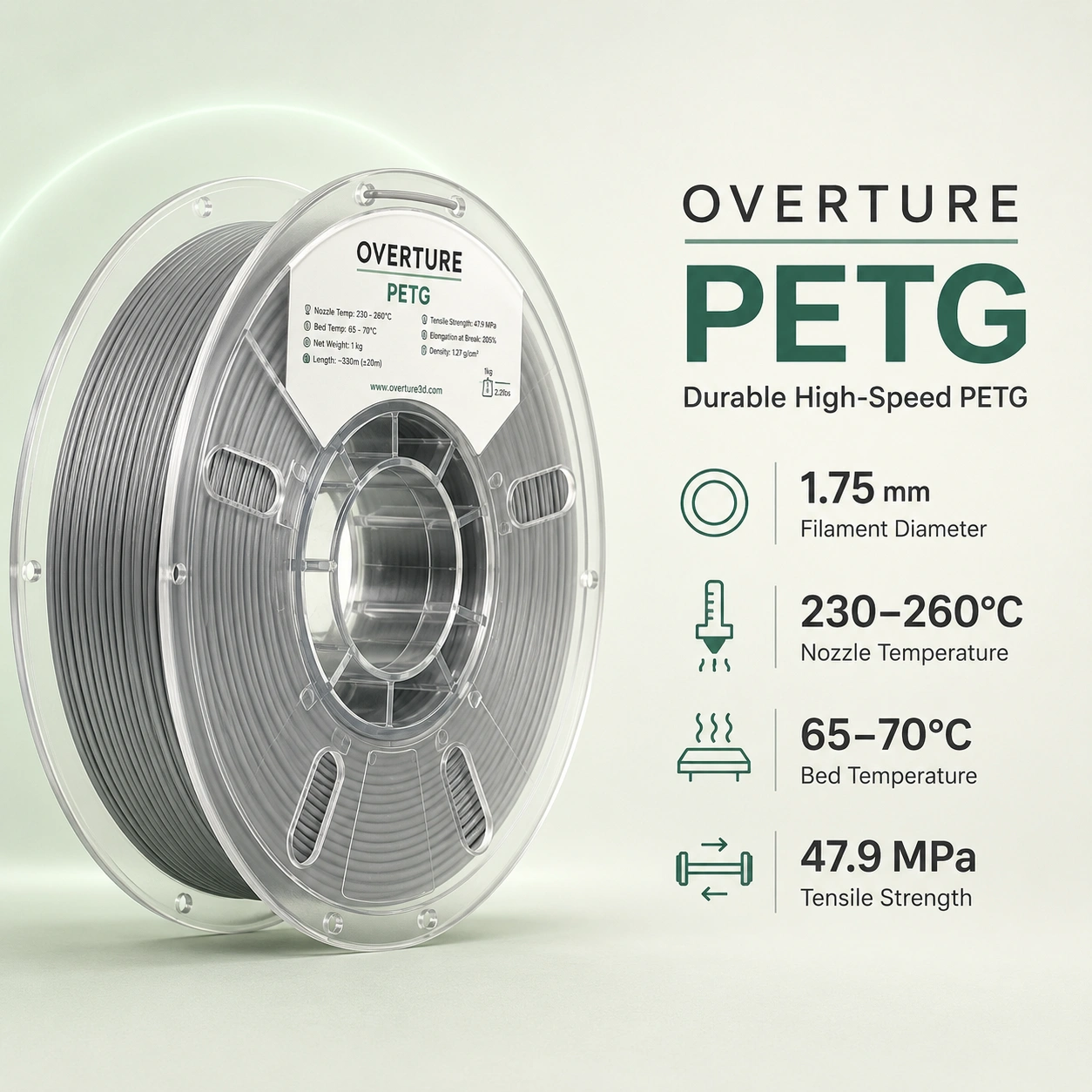
Overture PETG is a general-purpose 1.75 mm PETG filament aimed at functional parts that need more toughness, layer adhesion and environmental resistance than a typical PLA print without moving to a high-temperature engineering polymer. Overture positions it for prototypes, mechanical components, outdoor projects, automotive accessories, fixtures and everyday durable parts.
The current Overture PETG technical data sheet lists 47.9 ± 4.8 MPa XY tensile strength, 45.7 ± 1.7 MPa Z tensile strength, 20.2 ± 3.4 kJ/m² XY Charpy impact strength, and a 75°C Vicat softening temperature. Those results come from printed test specimens and should be treated as manufacturer reference data rather than guaranteed values for every printer, orientation or geometry.
Printing remains relatively approachable for PETG. Overture specifies 230–260°C nozzle temperature, 65–70°C bed temperature, cooling enabled, printing below 300 mm/s, and drying at 60°C for 5 hours when needed.
For current specifications, downloads and pricing, see the official Overture PETG product page, the official Overture PETG technical data sheet, and the Overture TDS and SDS library.
| Specification | Value |
|---|---|
| Material type | PETG filament |
| Printing compatibility | FDM |
| Filament diameter | 1.75 mm |
| Spool size | 1 kg |
| Density | 1.3 g/cm³ at 20.7°C |
| Melt index | 8.8 g/10 min at 240°C / 2.16 kg |
| Nozzle temperature | 230–260°C |
| Bed temperature | 65–70°C |
| Printing speed | Below 300 mm/s |
| Cooling fan | On |
| Drying | 60°C for 5 hours |
| Build surfaces | Overture build surface, textured PEI |
| XY tensile strength | 47.9 ± 4.8 MPa |
| Z tensile strength | 45.7 ± 1.7 MPa |
| XY Young's modulus | 2311.1 ± 92.4 MPa |
| Z Young's modulus | 2200.1 ± 52.4 MPa |
| XY elongation at break | 9.3 ± 6.5% |
| Z elongation at break | 3.5 ± 2.2% |
| XY flexural strength | 80.1 ± 3.5 MPa |
| Z flexural strength | 57.6 ± 5.6 MPa |
| XY Charpy impact strength | 20.2 ± 3.4 kJ/m² |
| Z Charpy impact strength | 15.7 ± 3.9 kJ/m² |
| XY notched Charpy impact strength | 4.85 ± 0.35 kJ/m² |
| Vicat softening temperature | 75°C |
| Heated enclosure required | No |
| Abrasive | No |
Thermal-property note: Overture's current PETG TDS publishes a 75°C Vicat softening temperature. Vicat softening temperature is not the same test as heat-deflection temperature, so no HDT value is assigned from that number.
Overture recommends a 230–260°C nozzle temperature and 65–70°C bed temperature.
A practical starting point for many modern printers is around 245°C nozzle and 65–70°C bed, followed by adjustments for print speed, hotend calibration, cooling, color and desired surface finish.
PETG generally needs more heat than PLA and benefits from a controlled first layer. Too little nozzle temperature can reduce interlayer bonding, while excessive temperature can increase stringing and surface blobs.
Overture specifies the cooling fan as on. Its FAQ notes that lower fan can improve layer adhesion, while stronger cooling can improve surface quality and reduce stringing. Minimal first-layer cooling can help bed adhesion.
Overture now markets this PETG for printing speeds below 300 mm/s.
That figure should be read as a material-profile ceiling rather than a promise that every printer can maintain 300 mm/s while preserving the same mechanical and visual quality.
Actual usable speed depends on:
The TDS mechanical specimens were printed at 45 mm/s, so those strength values should not be assumed to remain identical at maximum-speed settings. For structural parts, layer bonding matters more than chasing the highest possible speed.
The current Overture TDS provides separate XY and Z results from 100% infill printed specimens.
The relatively close XY and Z tensile values are notable for an FDM material and support Overture's emphasis on layer adhesion.
Real parts can still be weaker between layers because geometry, wall count, temperature, cooling and print orientation all influence failure behavior.
Overture reports:
These results make PETG useful for parts that may see bumps, handling and moderate impact where a brittle visual-model material would be less suitable.
The current TDS lists:
This gives Overture PETG a useful combination of stiffness and toughness for brackets, housings, fixtures and general mechanical parts.
Overture's current PETG TDS lists a 75°C Vicat softening temperature.
That gives PETG better thermal margin than many basic PLA-family materials, but it is still not a high-temperature engineering filament.
Avoid using PETG near engines, heaters, hot tooling, or other environments where the part may remain mechanically loaded close to its softening range.
For more demanding heat exposure, Prusament ASA publishes a substantially higher heat-deflection temperature and is designed for outdoor and higher-temperature use.
Strong interlayer bonding is one of PETG's main practical advantages.
Overture's TDS reports 45.7 ± 1.7 MPa Z tensile strength, compared with 47.9 ± 4.8 MPa in XY under its printed-specimen conditions.
Part orientation still matters, especially around:
For functional printing, use enough wall thickness and avoid excessive cooling when maximum layer adhesion is more important than surface finish.
Overture markets PETG as weather-resistant and water-resistant and specifically recommends it for garden fixtures, automotive components and outdoor functional prototypes.
PETG is generally a stronger outdoor candidate than basic PLA because it resists moisture and moderate heat more effectively.
However, long-term outdoor life still depends on:
Overture does not publish a guaranteed outdoor service-life period, so weather resistance should not be treated as permanent UV-aging certification. For sustained UV exposure, ASA is more purpose-built.
PETG is moisture-sensitive and often prints worse after prolonged exposure to humid air.
Common moisture symptoms include:
Overture specifies 60°C for 5 hours when drying PETG and cautions against excessive drying time because over-drying may make the filament brittle.
After drying, keep the spool sealed with fresh desiccant.
A dry box can be useful in humid workshops or for long prints where the spool remains exposed for many hours.
Overture lists its own build surface and textured PEI in the PETG TDS.
PETG can bond very strongly to some smooth PEI surfaces. A suitable release layer or manufacturer-recommended preparation can make removal easier and reduce the risk of damaging the build surface.
Overture's TDS also lists PVA glue as an optional build-surface treatment.
Bed cleanliness, first-layer height and temperature are more important than adding excessive adhesive.
Standard Overture PETG is not fiber-filled or abrasive.
A normal brass nozzle is suitable unless the printer manufacturer has a different hardware recommendation.
The filament does not require a hardened steel nozzle or heated chamber. A heated bed is strongly recommended, and the hotend should reliably cover the normal PETG temperature range.
The hotend should reliably reach the upper end of the 230–260°C temperature range if high-speed or high-flow profiles are used.
PETG can be post-processed with conventional mechanical methods.
Common options include:
PETG can soften from friction heat during aggressive sanding or machining, so slower tool speeds and light passes are preferable.
Its toughness can also make support removal slightly more stubborn than PLA when interfaces are printed too tightly.
Overture PETG is offered in a broad range of opaque, transparent and specialty colors.
Current options include black, white, gray, red, orange, green, blue, purple and transparent variants, with availability varying by region.
PETG generally produces a glossier surface than matte PLA.
Transparent colors can transmit light, but normal FDM layer lines and internal reflections prevent most prints from becoming optically clear without specialized processing.
| Material | Material Class | Nozzle Range | Thermal Reference | Print Speed | Main Advantage | Best Fit |
|---|---|---|---|---|---|---|
| Overture PETG | PETG | 230–260°C | 75°C Vicat | 300 mm/s | Toughness, layer adhesion, low shrinkage | Functional and outdoor-use parts |
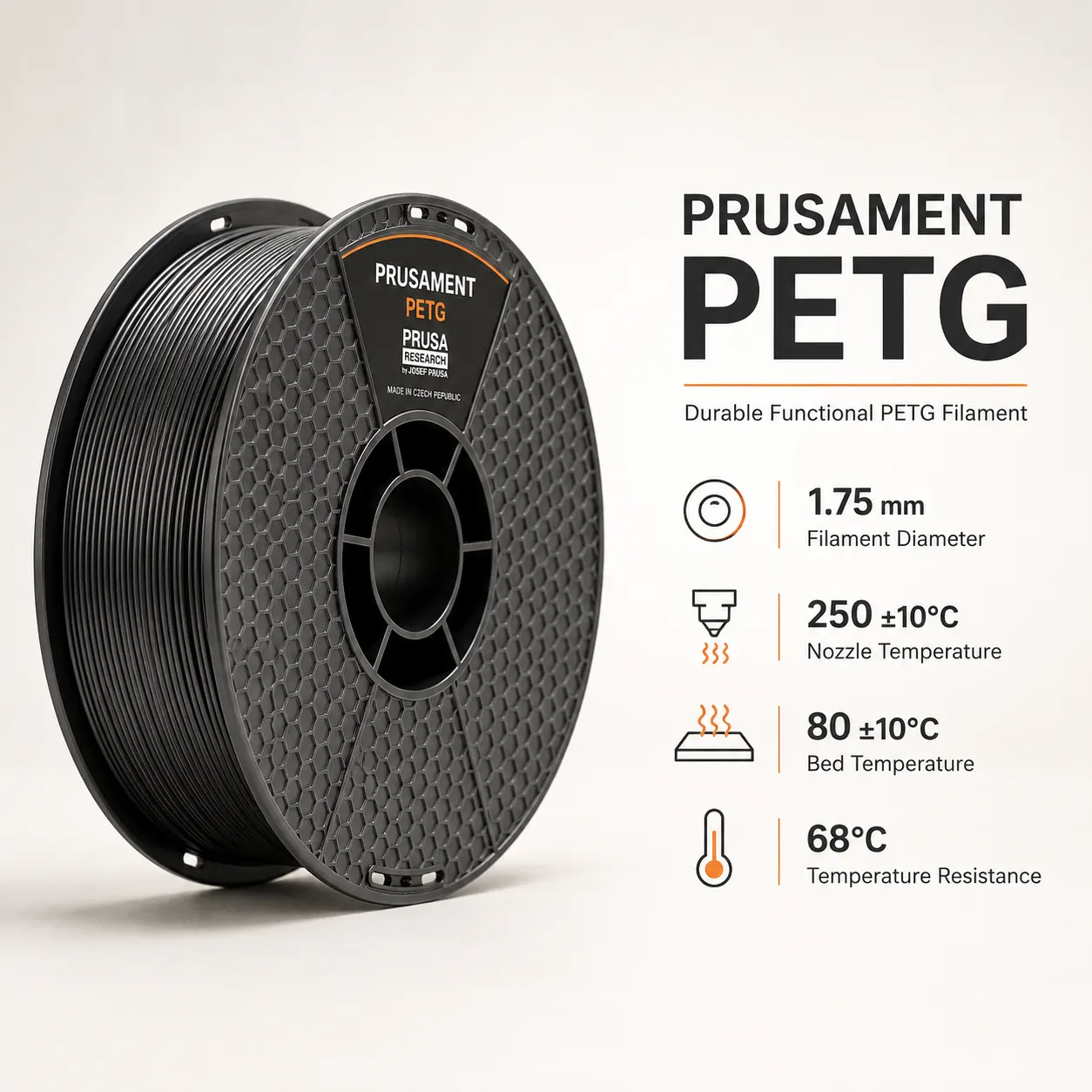
| Prusament PETG | PETG | 240–260°C | 68°C HDT | Up to 200 mm/s | Documented material consistency and layer adhesion | Engineering and general functional parts |
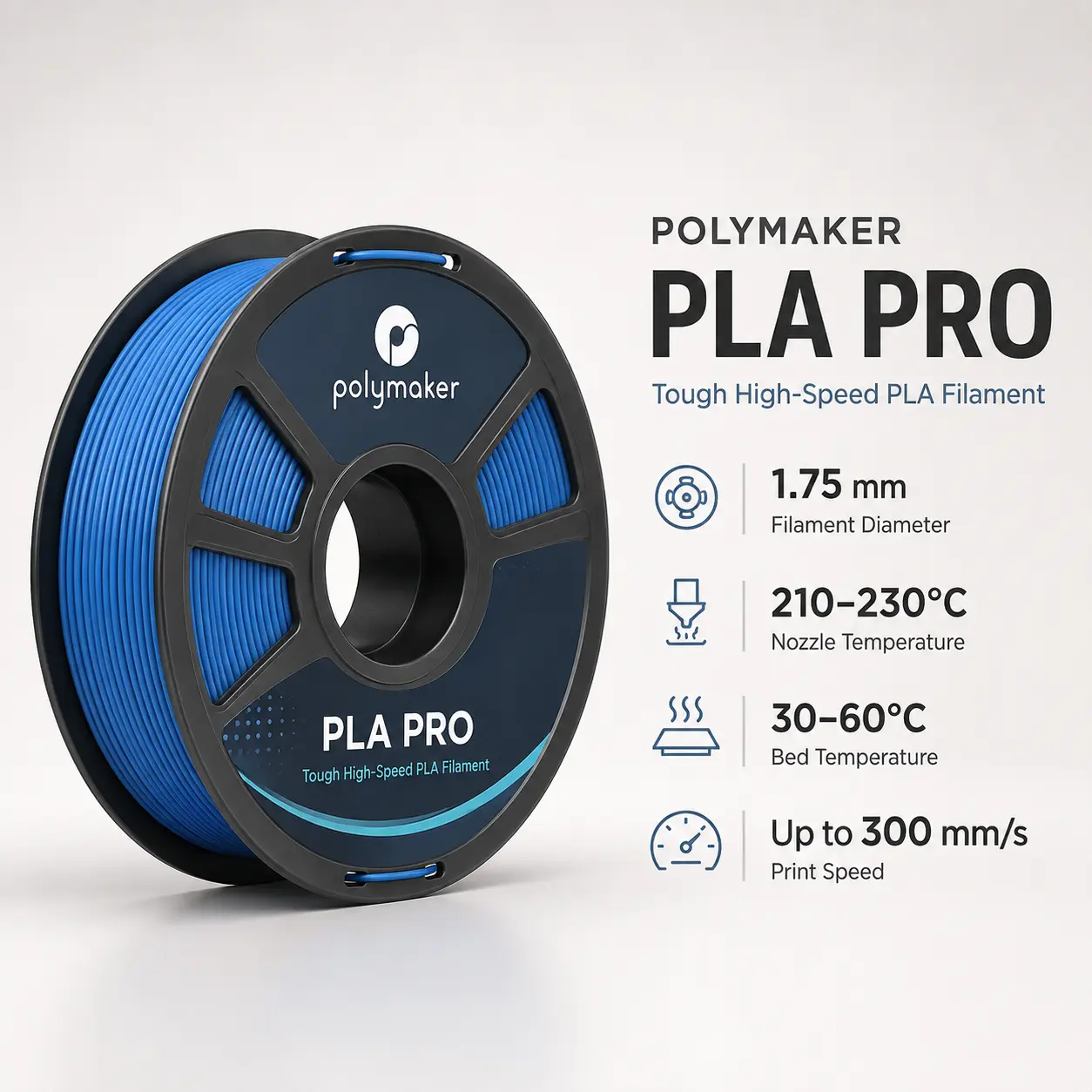
| Polymaker PLA Pro | Tough PLA | 210–230°C | 58.1°C HDT at 0.45 MPa | Up to 300 mm/s | PLA-easy printing with high impact resistance | Fast prototypes and functional PLA parts |
| Prusament ASA | ASA | 250–270°C | 93°C HDT at 0.45 MPa | Up to 200 mm/s | UV and heat resistance | Outdoor and higher-temperature parts |
The values above come from different manufacturer test methods and should be used as material-selection references, not as a single controlled laboratory ranking.
The Overture PETG vs Prusament PETG comparison is the most direct like-for-like choice.
Prusament PETG specifies 250 ± 10°C nozzle temperature, 80 ± 10°C bed temperature, printing up to 200 mm/s, and 68°C HDT in its official technical data sheet.
Choose Overture PETG when you want:
Choose Prusament PETG when tightly documented Prusa profiles, manufacturer-controlled filament production and a well-established Prusa ecosystem matter more than maximizing advertised print speed.
Both are strong general-purpose PETG choices, but differing test methods make direct mechanical-number rankings unreliable.
The Overture PETG vs Polymaker PLA Pro comparison is useful for users deciding between durable PETG behavior and easier PLA-family printing.
Polymaker PLA Pro uses a 210–230°C nozzle range, does not require an enclosure and supports printing up to 300 mm/s in its current 2026 technical data sheet.
Choose Overture PETG when you need:
Choose Polymaker PLA Pro when:
PETG and tough PLA overlap in prototyping, but the service environment should drive the choice.
The Overture PETG vs Prusament ASA comparison becomes important for parts exposed to sun and heat.
Prusament ASA publishes a 93°C HDT at 0.45 MPa, substantially above Overture PETG's 75°C Vicat softening reference, although the two values come from different thermal tests.
Choose Overture PETG for:
Choose Prusament ASA for:
ASA is more demanding to print and benefits from enclosure control, while PETG is considerably easier for open desktop printers.
The Overture PETG vs PLA+ decision usually comes down to environmental durability versus PLA-style print simplicity.
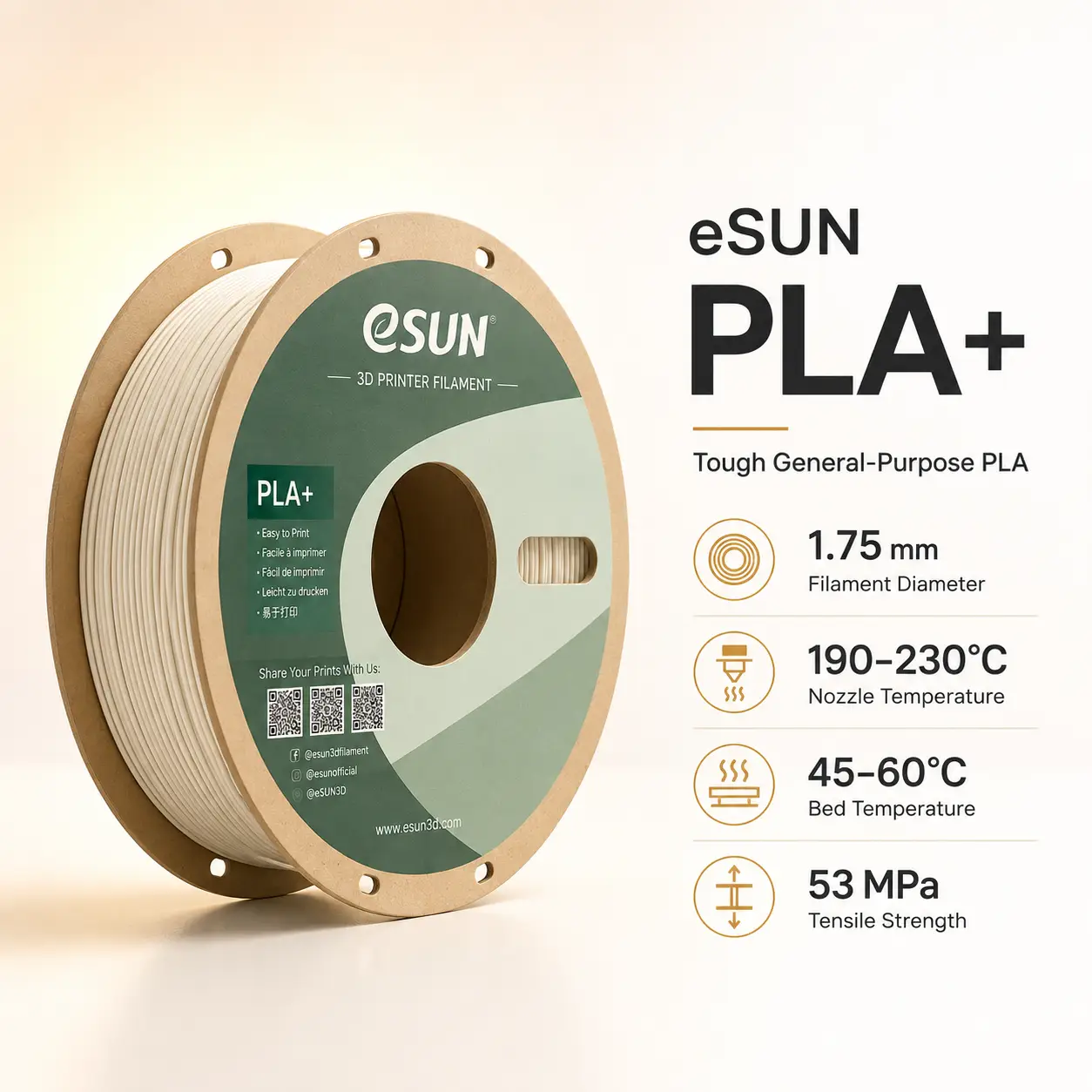
A current tough PLA such as eSUN PLA+ can offer easy printing, high stiffness and strong prototype performance at lower nozzle and bed temperatures.
Overture PETG is generally the better fit when the part needs:
PLA+ is often preferable for:
Neither category is automatically stronger in every test. Formulation, print orientation and the specific manufacturer data sheet matter.
The best Overture PETG alternative depends on the application.
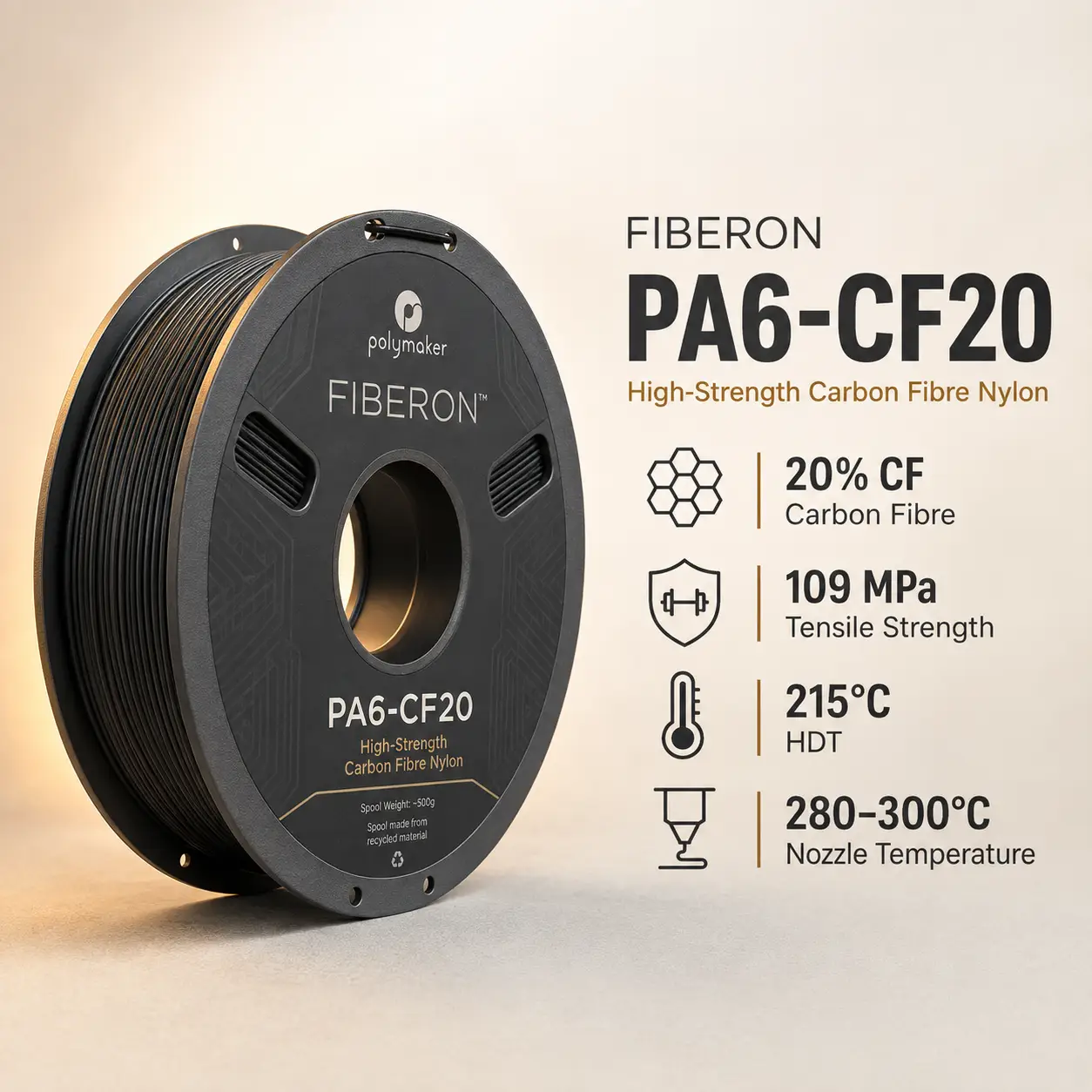
For many workshop parts, PETG occupies a useful middle ground between easy-print PLA-family materials and more demanding ASA, nylon or polycarbonate.
Overture's current product page lists the 1 kg PETG spool at US$14.99 in the United States, approximately €13.07 in Europe, £11.08 in the United Kingdom, AED 55.05 in the UAE, C$20.81 in Canada, A$21.22 in Australia, ₹1,431 in India.
Price and stock vary by region, color, local taxes, exchange rates, shipping costs, and promotions, so the current regional product page is the best source for live purchase information.
Recommended use: Choose Overture PETG for functional prototypes, brackets, fixtures, outdoor-use parts and everyday mechanical prints when strong layer adhesion, impact resistance, low shrinkage and easier printing matter more than the higher heat resistance of ASA or other engineering polymers.
It is a general-purpose 1.75 mm PETG filament designed for durable functional parts with strong layer adhesion, good impact resistance and low shrinkage.
Overture recommends 230–260°C. Around 245°C is a practical starting point for many printers.
The current TDS specifies 65–70°C.
Overture reports 47.9 ± 4.8 MPa XY tensile strength and 45.7 ± 1.7 MPa Z tensile strength in its printed test specimens.
The current Overture PETG TDS lists a 75°C Vicat softening temperature. That is not the same measurement as HDT.
Overture specifies printing below 300 mm/s. Real usable speed depends on hotend flow, layer height, cooling and geometry.
No. A heated enclosure is not required for normal printing.
No. Standard Overture PETG is not a fiber-filled abrasive composite and normally works with a brass nozzle.
PETG is moisture-sensitive. Overture recommends drying at 60°C for 5 hours when needed.
Overture markets it as weather- and water-resistant and recommends it for outdoor applications, but long-term life still depends on UV exposure, color, temperature and load.