Engineering GradeIndustrial GradeHigh-Heat Carbon Fibre PCRigid Carbon Fibre CompositeHeat-Resistant PC-CF
PPrusa
Prusa
Compact row for standout or material-specific features only.
# Prusament PC Blend Carbon Fiber
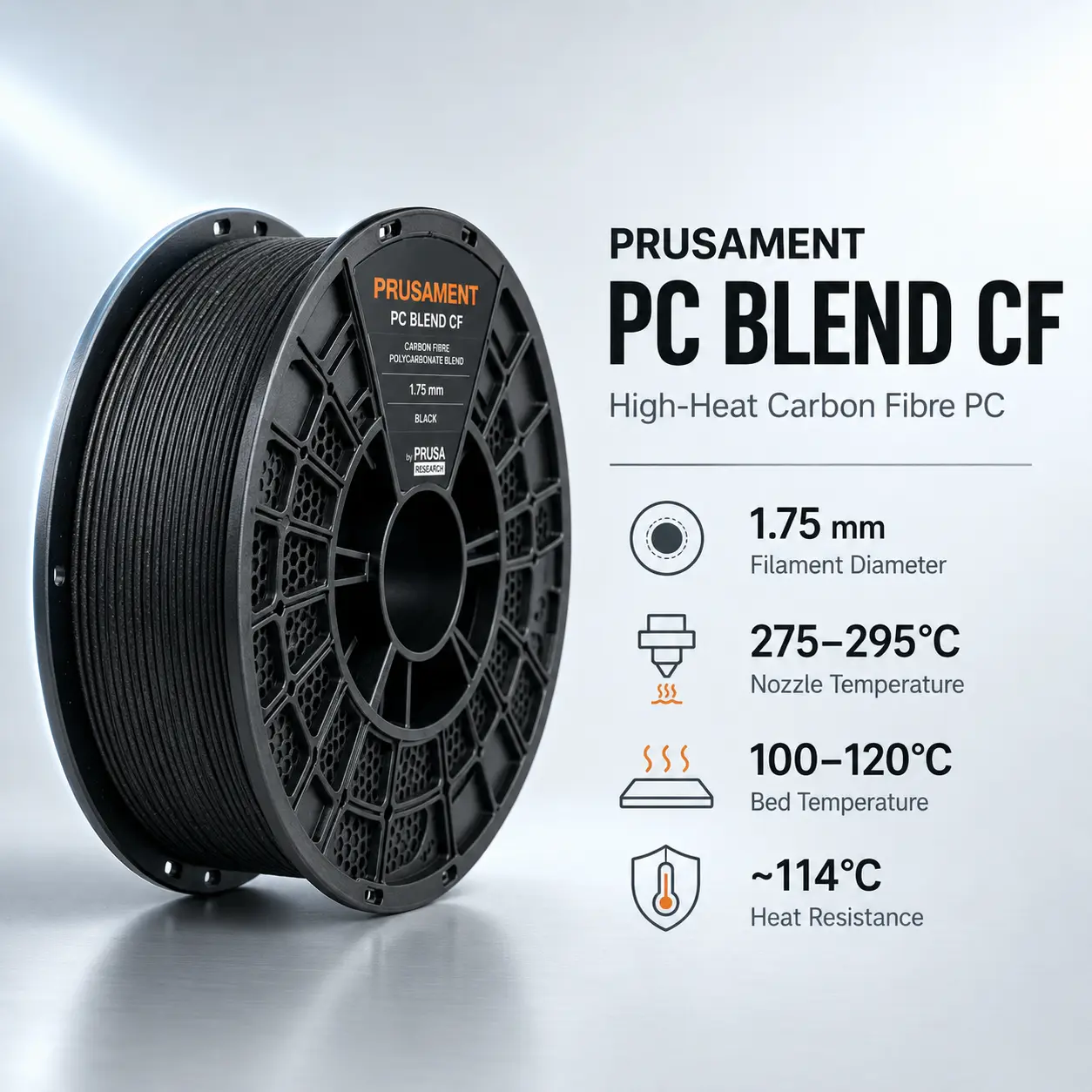
Prusament PC Blend Carbon Fiber is a carbon-fibre-filled polycarbonate blend from Prusa Polymers for demanding engineering, industrial, tooling and production parts. Carbon-fibre reinforcement improves stiffness, dimensional stability, heat resistance and printability while reducing warping.
Prusament reports 114°C HDT at 0.45 MPa and 106°C at 1.80 MPa. Controlled annealing can increase manufacturer-stated temperature resistance to approximately 130°C. The material is also UV stable, chemically resistant and has a matte-black finish.
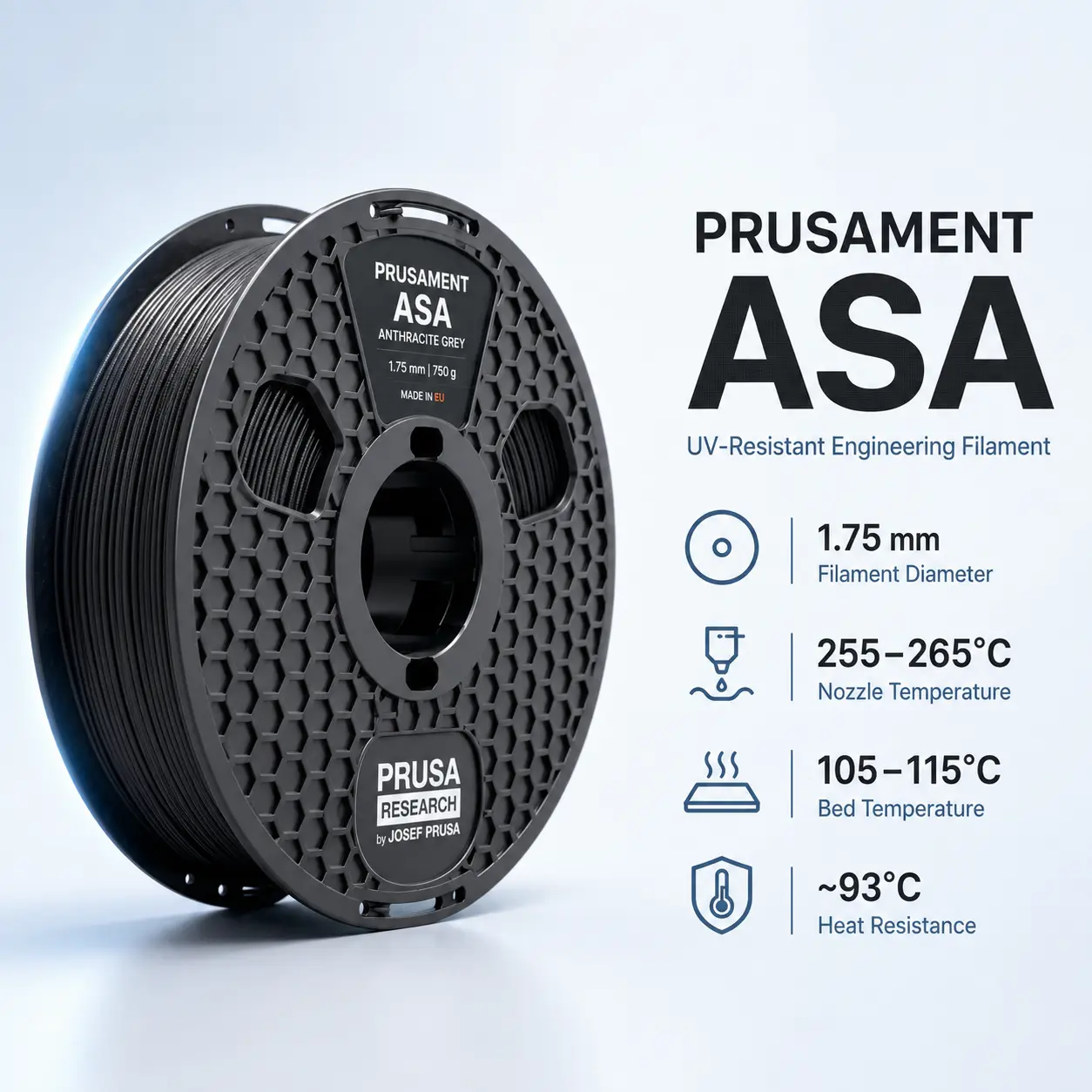
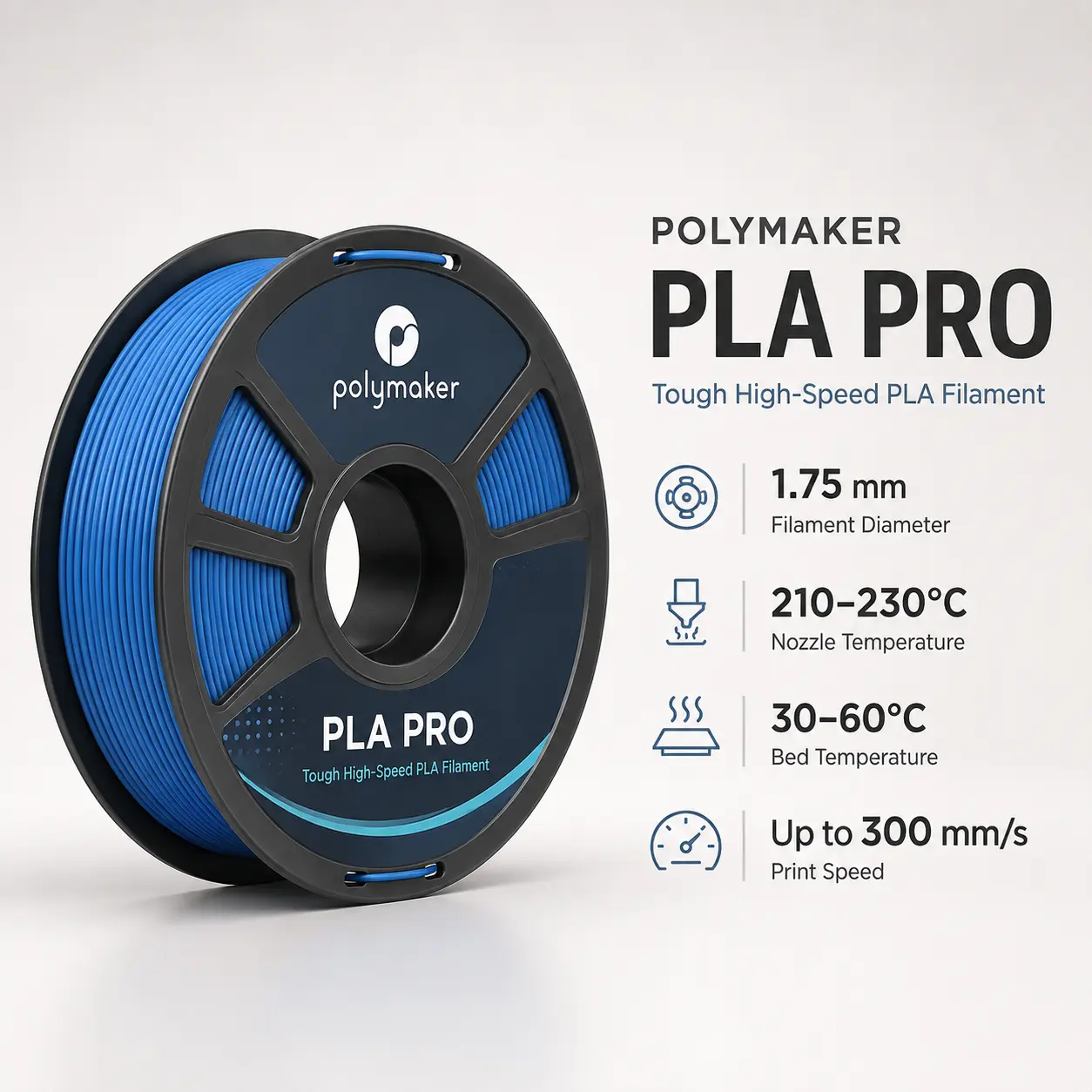
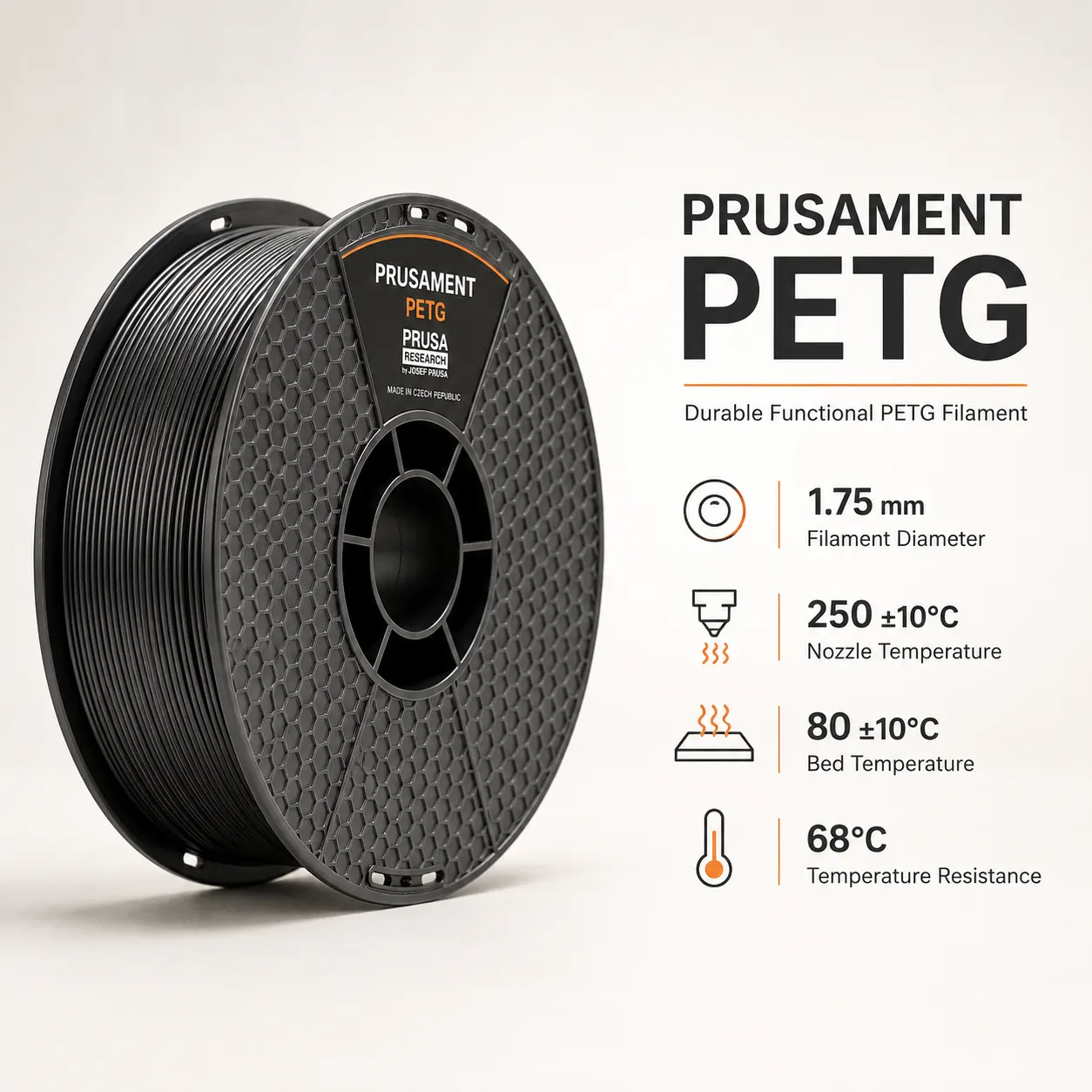
For easier rigid materials, compare Prusament ASA, Prusament PETG and Polymaker PLA Pro.
| Specification | Value |
|---|---|
| Material Type | Composite |
| Chemistry | Polycarbonate Blend filled with Carbon Fiber |
| Printing Compatibility | FDM |
| Applications | Engineering, Industrial, Tooling, Production |
| Print Temperature | 275–295°C |
| Bed Temperature | 100–120°C |
| Print Speed | Up to 200 mm/s |
| Format | 1.75 mm, 800 g spool |
| Diameter Tolerance | ±0.04 mm |
| Tensile Yield Strength | 64 ± 3 MPa horizontal; 70 ± 3 MPa vertical XZ |
| Tensile Modulus | 2.6 ± 0.1 GPa horizontal; 3.2 ± 0.1 GPa vertical XZ |
| Interlayer Adhesion | 23 ± 2 MPa |
| Heat Deflection Temperature | 114°C at 0.45 MPa; 106°C at 1.80 MPa |
| Enclosure | Not required |
| Abrasive | Yes |
| Cooling | Normally off; up to 20% for bridges |
| Post-Processing | Wet or dry sanding; annealing supported |
| Storage / Drying | 90°C for 4 h if needed |
| Colour / Finish | Black; matte carbon-fibre finish |
| Price | US$59.99 per 800 g spool — check manufacturer’s current listing |
Note: Mechanical and thermal values are manufacturer test results and depend on orientation, geometry, processing and test conditions.
Important: Carbon fibres are highly abrasive. Use a hardened steel or equivalent wear-resistant nozzle.
The Prusa CORE One+ is suitable after replacing its standard brass nozzle with a hardened abrasion-resistant nozzle.
The Bambu Lab H2D and Creality K2 Plus are also suitable high-temperature platforms when configured for abrasive filament. The Bambu Lab P2S can use the central 285°C / 110°C settings but must remain within its bed-temperature limit.
Important: Prusament states that an enclosure is not required because carbon fibres substantially reduce warping.
Important: Avoid direct printing on smooth PEI unless a suitable separation layer is used.
| Property | Information |
|---|---|
| Tensile yield strength | 64 ± 3 MPa horizontal; 70 ± 3 MPa vertical XZ |
| Tensile modulus | 2.6 ± 0.1 GPa horizontal; 3.2 ± 0.1 GPa vertical XZ |
| Flexural strength | 94 ± 3 MPa horizontal; 130 ± 2 MPa vertical XZ |
| Interlayer adhesion | 23 ± 2 MPa |
| Charpy impact strength | 32 ± 5 kJ/m² horizontal; 35 ± 4 kJ/m² vertical XZ |
| HDT | 114°C at 0.45 MPa; 106°C at 1.80 MPa |
| Rigidity | High |
| Dimensional stability | Excellent |
| Warping | Low |
| Abrasivity | High |
Print at approximately 285 ±10°C with a 110 ±10°C bed. The technical datasheet lists speeds up to 200 mm/s, normally with cooling off except limited bridge cooling.
Use a hardened nozzle and Satin or textured powder-coated sheet. Smooth PEI requires a separation layer. Drying is normally unnecessary; if needed, dry at 90°C for 4 hours.
Prusa specifies 140°C for 120 minutes. Properly annealed parts can reach approximately 130°C manufacturer-stated temperature resistance with less than approximately 1% shrinkage.
| Feature | Prusament PC Blend Carbon Fiber | Prusament ASA | Prusament PETG | Polymaker PLA Pro |
|---|---|---|---|---|
| Material family | Carbon-fibre PC | ASA | PETG | Toughened PLA |
| Nozzle temperature | 275–295°C | 255–265°C | 240–260°C | 210–230°C |
| HDT / heat resistance | 114°C at 0.45 MPa | 93°C at 0.45 MPa | ~68°C HDT | 55.6°C at 1.8 MPa |
| Warping | Low | High | Low | Low |
| Abrasive | Yes | No | No | No |
| Hardened nozzle | Required | No | No | No |
| Enclosure | No | Recommended for larger parts | No | No |
| Typical use | High-temperature engineering and tooling | Outdoor / automotive | General engineering | High-speed prototypes and fixtures |
Recommended use: Choose Prusament PC Blend Carbon Fiber for high stiffness, dimensional stability and elevated-temperature performance. Choose Prusament ASA, Prusament PETG or Polymaker PLA Pro when easier processing is preferred.
Recommended use: Best for high-temperature, mechanically stressed and dimensionally critical parts. Suitable indexed printers include the Prusa CORE One+, Bambu Lab H2D and Creality K2 Plus when equipped for abrasive filament.
A 1.75 mm carbon-fibre-filled polycarbonate blend for rigid, dimensionally stable and high-temperature FDM parts.
Approximately 285 ±10°C nozzle and 110 ±10°C bed.
Yes. Carbon fibres are highly abrasive.
114°C at 0.45 MPa and 106°C at 1.80 MPa.
64 ±3 MPa horizontally and 70 ±3 MPa vertically in documented tests.
Yes. Prusa specifies 140°C for 120 minutes, with temperature resistance reaching approximately 130°C.
Normally no. If needed, dry at 90°C for 4 hours.
Relevant options include the Prusa CORE One+, Bambu Lab H2D, Bambu Lab P2S