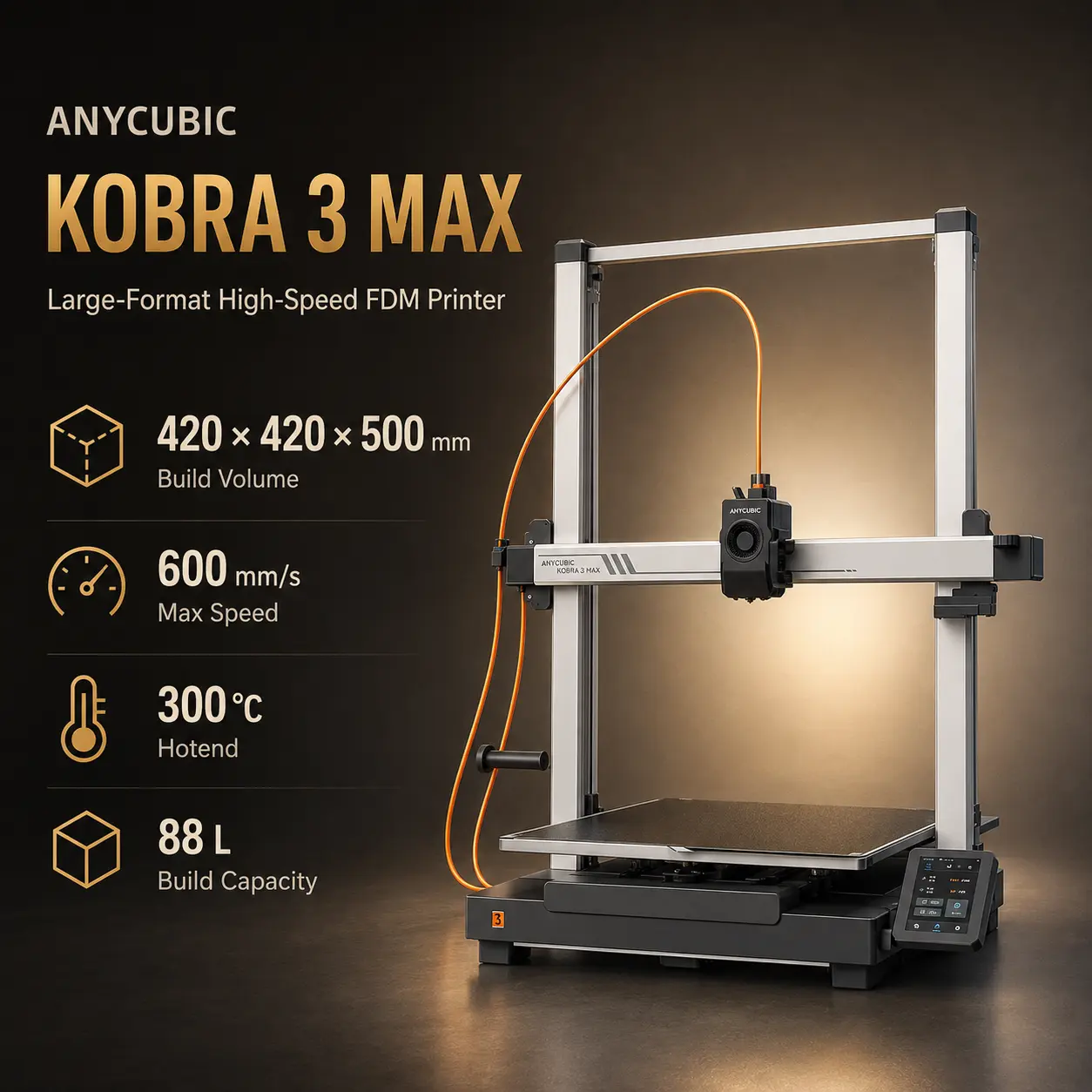
Ultra Large Build Volume and PlatformTall Part PrintingHigh Speed PrintingQuick Release HotendLeviQ 3 Auto LevelingACE Pro Multi Color Ready
AAnycubic
Anycubic
# Anycubic Kobra 3 Max
The Anycubic Kobra 3 Max is a large-format open-frame FDM/FFF printer with a 420 × 420 × 500 mm build volume, equal to roughly 88 liters of printable space. It is aimed at cosplay props, large prototypes, architectural models, functional assemblies, display pieces, and batch printing where a conventional 250–350 mm desktop platform would require more part splitting.
Anycubic rates the machine for 300 mm/s recommended printing speed, 600 mm/s maximum print speed, and 10,000 mm/s² maximum acceleration. Its large moving bed is supported by dual Y-axis motors, semi-automatic belt tensioning, resonance compensation, pressure advance, flow calibration, LeviQ 3.0 automatic leveling, and automatic Z-offset.
The standard printer is single-filament. A compatible ACE Pro adds four-color printing, while eight-color printing requires two ACE Pro units plus the 8-color filament hub. ACE Pro also adds active filament drying up to 55°C, filament backup, and automatic feeding.
The Kobra 3 Max uses a 300°C quick-release hotend, a standard 0.4 mm nozzle, and a 90°C PEI spring-steel bed. Anycubic officially lists 1.75 mm PLA, PETG, ABS, and TPU for the printer. TPU should be printed through the direct feed path rather than ACE Pro.
For current specifications and pricing, see the official Anycubic Kobra 3 Max page. Multi-color details are available on the official Anycubic ACE Pro page.
| Specification | Value |
|---|---|
| Technology | FDM / FFF |
| Construction | Open-frame moving-bed gantry |
| Build volume | 420 × 420 × 500 mm |
| Build capacity | Approx. 88 L |
| Spring-steel platform size | 430 × 429 mm |
| Current published layer range | 0.05–0.30 mm |
| Standard nozzle | 0.4 mm |
| Optional nozzles | 0.6 / 0.8 mm |
| Maximum nozzle temperature | 300°C |
| Maximum bed temperature | 90°C |
| Build surface | PEI spring steel |
| Recommended speed | 300 mm/s |
| Maximum print speed | 600 mm/s |
| Maximum acceleration | 10,000 mm/s² |
| Extruder | Short-distance extrusion |
| Leveling | LeviQ 3.0 + automatic Z-offset |
| Pressure advance | Supported |
| Flow calibration | Supported |
| Filament diameter | 1.75 mm |
| Official materials | PLA, PETG, ABS, TPU |
| Display | 4.3-inch capacitive touchscreen |
| Firmware | Kobra OS |
| Wireless | 2.4 GHz |
| Local transfer | USB / U-Disk |
| Machine dimensions | 706 × 640 × 753 mm |
| Approx. depth with full bed travel | 940 mm |
| Machine weight | Approx. 19 kg |
| Standard-mode noise | ≤60 dB |
| Power input | 110 / 220 V AC |
| Rated power | 1,100 W |
Anycubic's current product page gives a 0.05–0.30 mm layer range, while a current manual revision lists 0.08–0.28 mm. The current product-page figure is used here.
The Kobra 3 Max is primarily about printable space. A 420 × 420 mm XY area and 500 mm height can reduce seams on helmets, props, sculptures, prototype shells, architectural components, and other oversized parts.
The removable Kobra 3 Max spring-steel platform measures 430 × 429 mm, slightly larger than the 420 × 420 mm printable XY area. This distinction is useful when comparing physical build-plate dimensions with build volume.
The large bed also works well for batch production of smaller parts, although one adhesion problem can put a long multi-object job at risk.
The Kobra 3 Max is a large bed-slinger, not a CoreXY machine. The bed and printed part move along the Y axis, so moving mass increases as tall prints grow.
Anycubic uses dual Y-axis motors, dual-shaft guidance, semi-automatic belt tensioning, and resonance compensation to control the platform.
The chassis is approximately 706 × 640 × 753 mm, but Anycubic's manual lists about 940 mm of required depth once full bed travel is included. Buyers should plan workspace around the operating footprint rather than cabinet dimensions alone.
Very tall or narrow parts may benefit from lower acceleration and speed to reduce oscillation.
Anycubic publishes a 600 mm/s maximum and 300 mm/s recommended print speed.
The 600 mm/s figure is a machine limit, not an expectation for every model. Real throughput depends on hotend flow, nozzle diameter, layer height, filament, cooling, geometry, acceleration, and moving-bed mass.
For very large props, a 0.6 or 0.8 mm nozzle can often reduce total print time more effectively than simply increasing movement speed with a 0.4 mm nozzle.
The Kobra 3 Max uses a quick-release hotend rated to 300°C with a ceramic-composite throat design.
A 0.4 mm nozzle is standard, with 0.6 and 0.8 mm options officially supported.
The higher-temperature hotend provides useful headroom, but printability is also limited by the 90°C bed, open frame, nozzle material, and cooling environment. A high nozzle-temperature number alone does not make the machine equivalent to an enclosed engineering printer.
The removable PEI spring-steel platform is easier to flex for part removal than a fixed glass bed.
Anycubic's current replacement-platform specification lists 430 × 429 × 0.6 mm for the Kobra 3 Max sheet.
The heated bed reaches 90°C, and Anycubic states that heating from 25°C to 60°C takes about 125 seconds.
For multi-day large prints, surface cleaning and first-layer setup remain important even with automatic leveling.
LeviQ 3.0 provides automatic bed leveling and Z-offset calibration.
The printer also supports area leveling, allowing calibration to focus on the portion of the plate used by a job.
Other calibration and motion features include:
Automatic compensation helps with surface variation but does not replace correct mechanical setup or a clean build surface.
The Kobra 3 Max supports:
Object skipping is useful during batch jobs because a failed object can be excluded while the rest of the plate continues.
Anycubic also advertises AI spaghetti detection, but the base printer does not include standard video monitoring. Anycubic notes that the detection feature requires the optional camera.
The base Kobra 3 Max does not include ACE Pro.
One compatible ACE Pro provides four filament channels.
Eight-color printing requires:
Anycubic currently sells an 8-color filament hub compatible with the Kobra 3 Max Combo platform.
ACE Pro provides active drying up to 55°C, automated feeding, filament backup, tangle management, and identification for compatible tagged filaments.
TPU is not supported through the ACE Pro feed path.
Anycubic's Kobra 3 Max FAQ and current manual list:
PLA and PETG are the easiest match for the open-frame design.
ABS is officially supported, but large ABS parts can still warp because the printer lacks an enclosure and the bed reaches only 90°C.
TPU is supported for direct printing but should not be routed through ACE Pro.
The printer works with Anycubic Slicer Next, which Anycubic says is based on the open-source OrcaSlicer platform.
The Anycubic App supports remote-control and print-management functions, while USB / U-Disk provides local file transfer.
A 4.3-inch capacitive touchscreen provides local control.
| Printer | Build Volume | Published Speed Figure | Nozzle / Bed | Enclosure | Multi-Material Approach |
|---|---|---|---|---|---|
| Anycubic Kobra 3 Max | 420 × 420 × 500 mm | 600 mm/s max print | 300°C / 90°C | Open | ACE Pro, 4 or 8 colors |
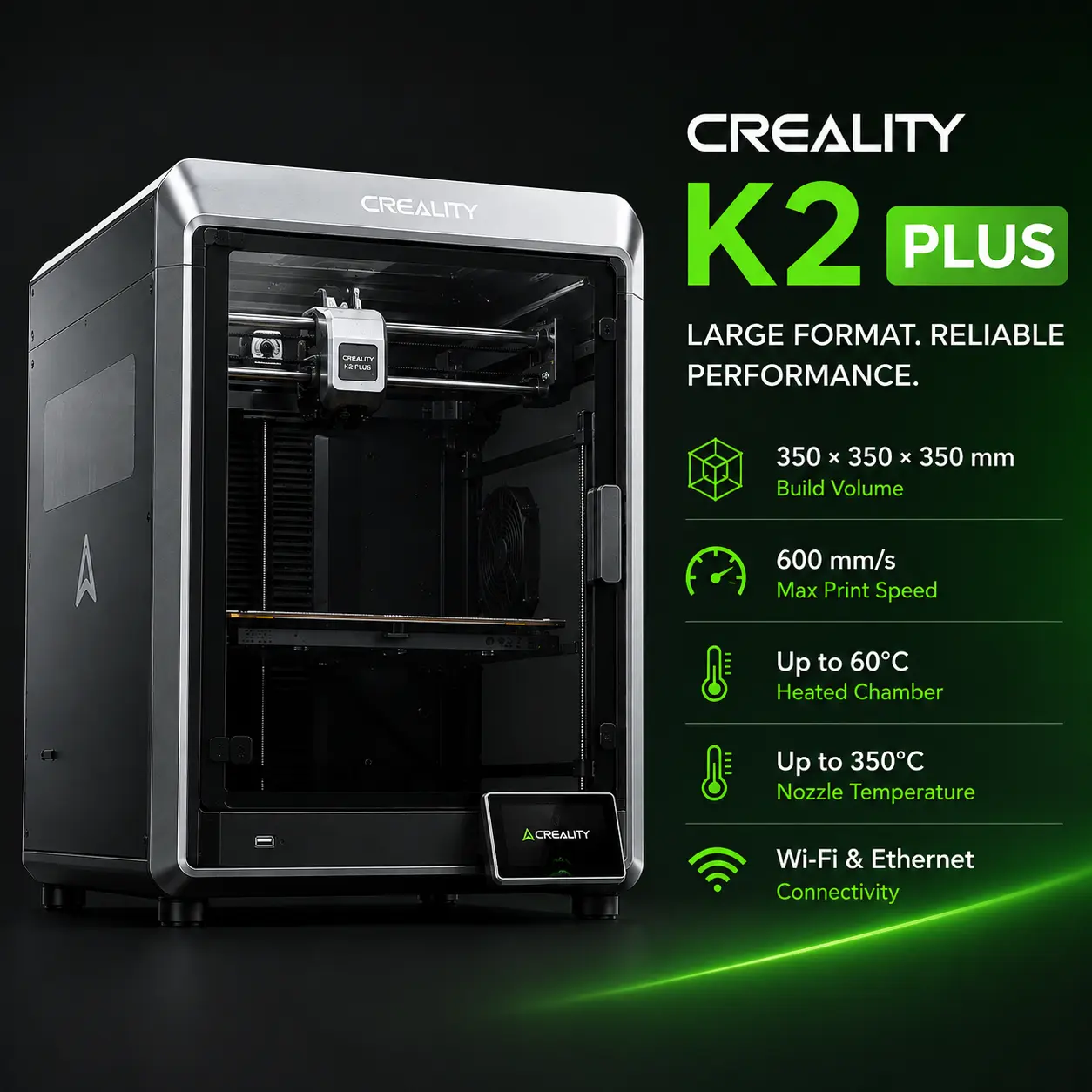
| Creality K2 Plus | 350 × 350 × 350 mm | 600 mm/s max print | 350°C / 120°C | 60°C active chamber | CFS, up to 16 colors |
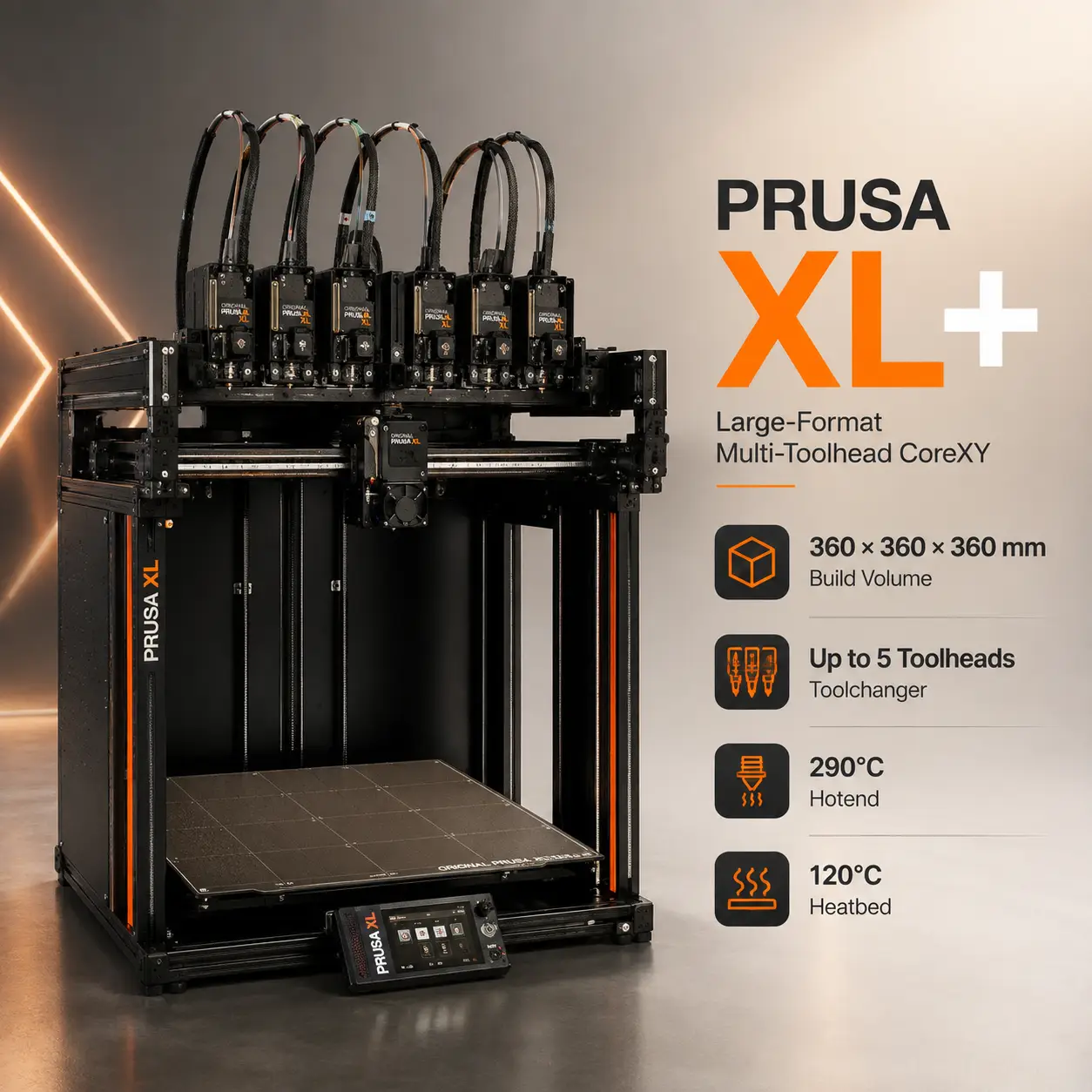
| Prusa XL+ | 360 × 360 × 360 mm | Prusa states ~10–15% faster than prior XL | 290°C / 120°C | Optional enclosure | Up to 5 independent tools |
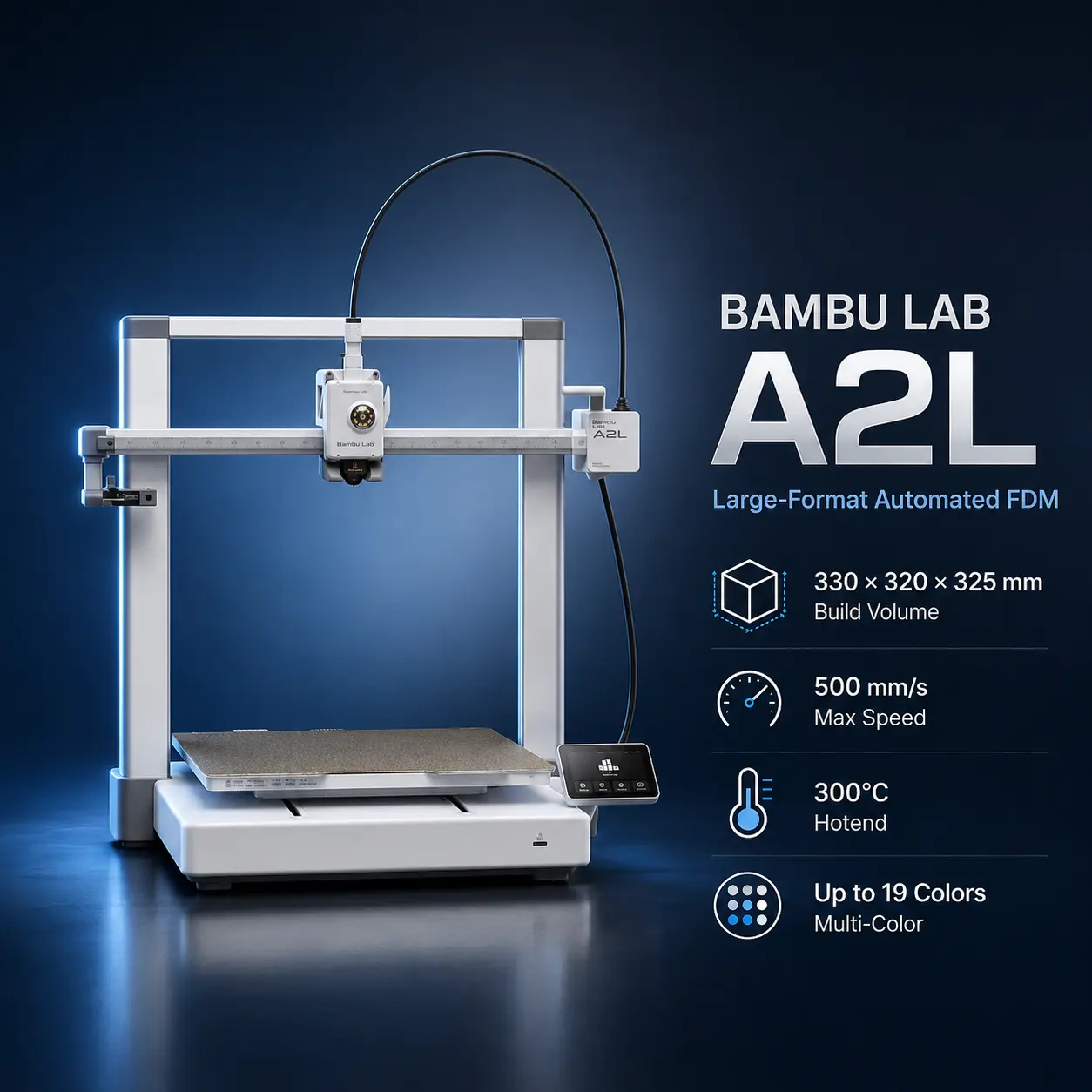
| Bambu Lab A2L | 330 × 320 × 325 mm | 500 mm/s max toolhead speed | 300°C / 80°C | Open | AMS ecosystem |
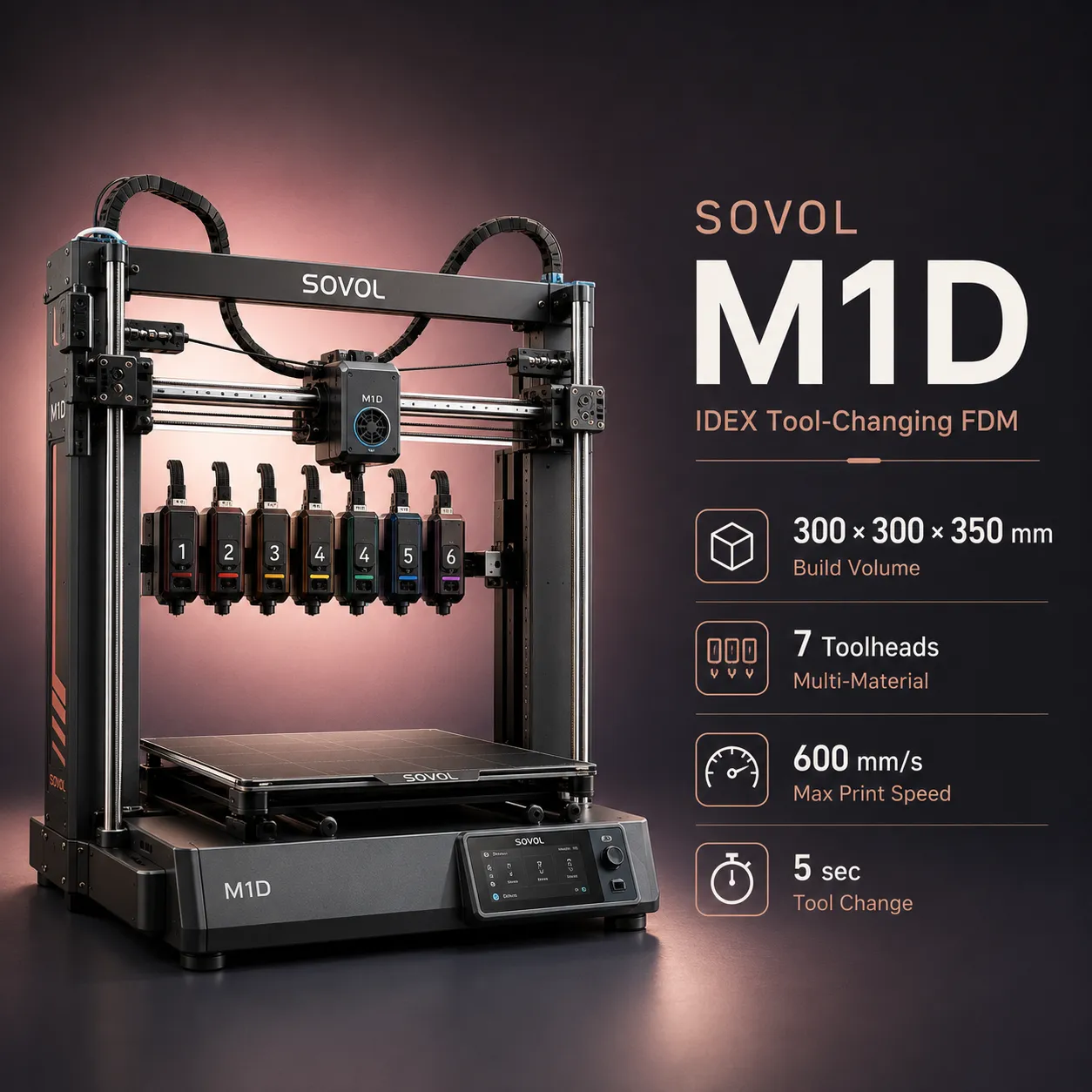
| Sovol M1D | Up to 300 × 300 × 350 mm | 600 mm/s max print | 300°C / 100°C | Open | IDEX + tool changing |
The Kobra 3 Max prioritizes raw build volume. K2 Plus prioritizes enclosed engineering-material capability, XL+ prioritizes independent-tool multi-material printing, A2L emphasizes automation, and M1D focuses on IDEX and tool changing.
The Creality K2 Plus has a smaller 350 × 350 × 350 mm build volume but adds a 350°C nozzle, 120°C bed, and 60°C actively heated chamber.
Both publish maximum print speeds of 600 mm/s.
Choose Kobra 3 Max when maximum printable size and lower purchase cost are more important. Choose K2 Plus when enclosure control and engineering-material compatibility are priorities.
The Prusa XL+ has a 360 × 360 × 360 mm build volume and supports up to five independent toolheads.
Independent tools are especially useful for soluble supports, mixed rigid/flexible materials, and low-purge multi-material printing.
Kobra 3 Max provides a much larger 420 × 420 × 500 mm volume and lower entry price. XL+ is the stronger choice when independent material paths justify its premium cost.
Prusa currently describes XL+ as roughly 10–15% faster than the previous XL rather than publishing one universal maximum print speed in mm/s.
The Bambu Lab A2L is another open-frame large-format bed-slinger, but its build volume is smaller at 330 × 320 × 325 mm.
Bambu publishes a 300°C nozzle, 80°C bed, and 500 mm/s maximum toolhead speed. A2L emphasizes automated flow calibration, adaptive vibration control, failure monitoring, and AMS integration.
Choose Kobra 3 Max for much larger parts. Choose A2L when automation and Bambu's software/material ecosystem matter more than maximum build space.
The Sovol M1D uses a hybrid IDEX and tool-changing architecture with one fixed tool plus six swappable secondary tools.
Its maximum Single Mode build volume is 300 × 300 × 350 mm, and some multi-tool operating modes use smaller overlapping areas.
Both publish maximum speeds up to 600 mm/s.
Choose Kobra 3 Max for raw volume. Choose M1D when Copy/Mirror modes, dedicated toolheads, and lower-purge multi-material workflows matter more.
Anycubic's US store currently lists the Kobra 3 Max at US$495. The estimated equivalent prices are approximately €428 in the Eurozone, £365 in the UK, C$687 in Canada, A$697 in Australia, AED 1,818 in the UAE, and ₹47,372 in India.
Regional pricing may vary due to VAT, taxes, import duties, shipping, exchange rates, and local Anycubic promotions.
420 × 420 × 500 mm, approximately 88 liters.
Anycubic lists the replacement platform at approximately 430 × 429 mm.
Anycubic specifies 300 mm/s recommended and 600 mm/s maximum.
300°C.
0.4 mm standard, with 0.6 and 0.8 mm options.
The current product page states 0.05–0.30 mm.
Up to 90°C.
No. It is open-frame.
PLA, PETG, ABS, and TPU.
Yes, with one compatible ACE Pro.
Yes, using two ACE Pro units plus the compatible 8-color filament hub and connection hardware.
No. TPU should use the direct feed path.
The base printer does not list standard video monitoring.
Yes.
Anycubic Slicer Next and the Anycubic App.
The current manual lists 1,100 W.