Intelligent DesignNext-GenLarge-format Creative PrintingAdaptive Vibration ControlExpandable Multi-color Printing
BBambu Lab
Bambu Lab
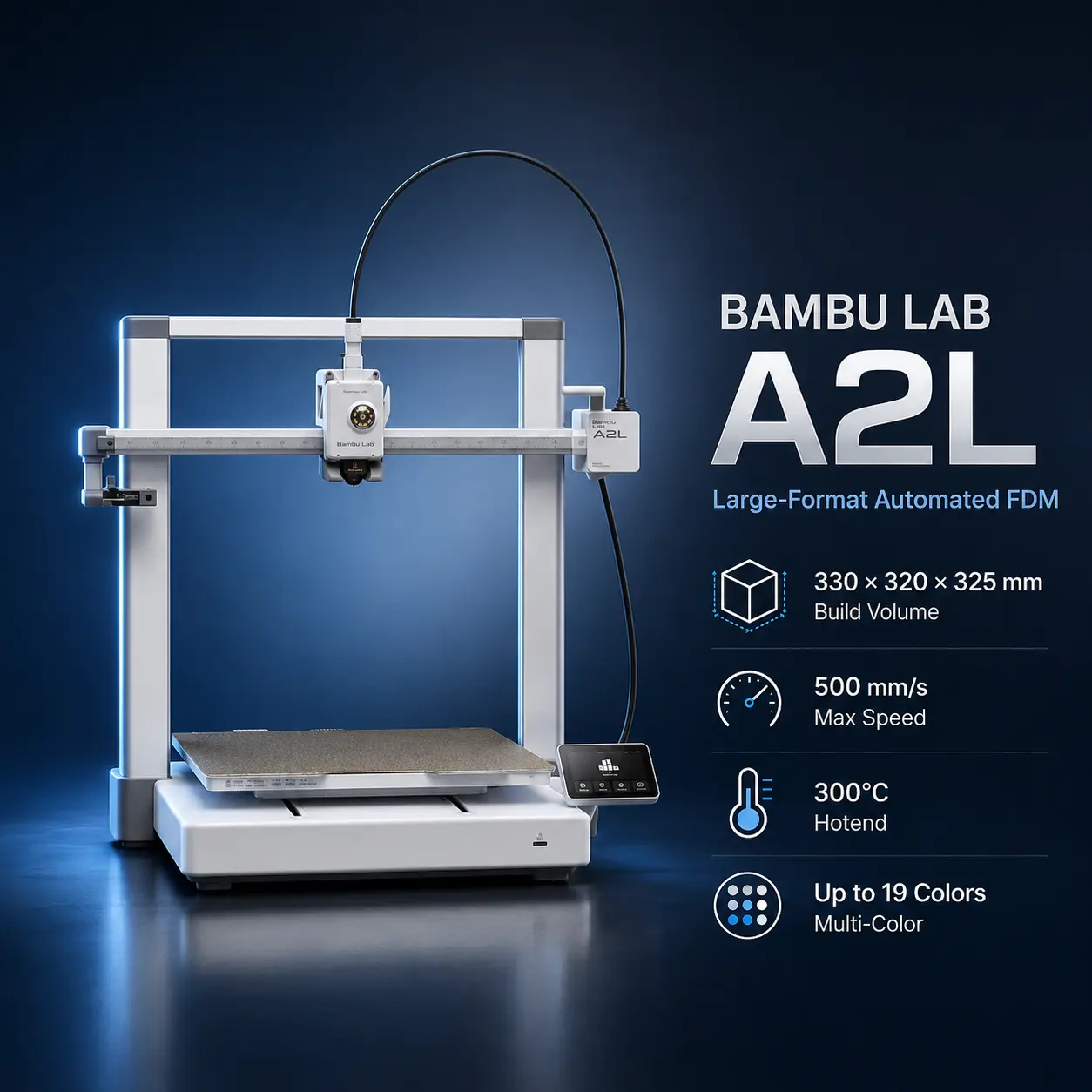
# Bambu Lab A2L
The Bambu Lab A2L is a large-format open-frame FDM 3D printer for users who need substantially more build space than a typical desktop bedslinger without moving to an enclosed engineering-material platform. Its 330 × 320 × 325 mm build volume suits full-size cosplay pieces, large models, classroom projects, batches of smaller parts, home décor, and many functional prototypes that would otherwise need to be split.
Bambu Lab launched the A2L on June 1, 2026. It keeps the approachable A-series workflow while adding hardware intended to control the extra moving mass of a much larger bed. Important systems include a closed-loop PMSM servo extruder, adaptive vibration compensation, two granular dampers, automatic flow-dynamics calibration, and multiple print-monitoring functions.
The A2L is best understood as a large creative and general-purpose printer, not a low-cost high-temperature engineering machine. Its hotend reaches 300°C, but the printer is open-frame and its bed is limited to 80°C. Bambu Lab officially lists PLA, PETG, TPU, and PVA as supported, with PLA-CF and PETG-CF suitable when an appropriate hardened-steel nozzle is installed.
For current regional pricing, bundles, and accessory availability, check the official Bambu Lab A2L page.
| Specification | Value |
|---|---|
| Printing technology | FDM / FFF |
| Motion architecture | Open-frame Cartesian bedslinger |
| Build volume | 330 × 320 × 325 mm |
| Physical dimensions | 544 × 529 × 505 mm |
| Net weight | 12.8 kg |
| Included nozzle | 0.4 mm stainless steel |
| Supported nozzle diameters | 0.2, 0.4, 0.6, and 0.8 mm |
| Extruder gear | Hardened steel |
| Maximum nozzle temperature | 300°C |
| Maximum bed temperature | 80°C |
| Maximum toolhead speed | 500 mm/s |
| Maximum toolhead acceleration | 10 m/s² |
| Published hotend-flow test | Up to 28 mm³/s under Bambu Lab's stated PLA test |
| Included build plate | Textured PEI flexible steel plate |
| Camera | Low-frame-rate, up to 1080p, timelapse supported |
| Touchscreen | 3.5-inch, 240 × 320 |
| Storage | 32 GB microSD card |
| Wireless network | 2.4 GHz Wi-Fi |
| Ethernet | Not available |
| Rated maximum power | 1000 W |
| Input voltage | 100–120 VAC or 200–240 VAC, 50/60 Hz, region-dependent |
| Cutting area with optional module | 300 × 300 mm |
| Drawing area with optional module | 300 × 255 mm |
Note: Bambu Lab publishes 500 mm/s as maximum toolhead speed. It is not a guaranteed print speed for every model or material. Real throughput depends on acceleration, hotend flow, geometry, layer height, filament, cooling, and the selected profile.
The A2L's strongest reason to exist is its build area.
At 330 × 320 × 325 mm, it is substantially larger than the Bambu Lab A1 and Bambu Lab A1 mini. That extra space can remove seams from cosplay parts, fit larger housings in one piece, or increase batch capacity for smaller parts.
Large bedslingers face a particular mechanical problem: the print becomes part of the moving mass. A tall model can therefore change the machine's vibration behavior as the job progresses.
Bambu Lab addresses this with two complementary systems:
Important: The published physical dimensions describe the printer body. Because the A2L is a bedslinger, the build plate moves forward and backward during printing, so the installation needs additional front and rear clearance.
The A2L uses a PMSM closed-loop servo extruder. The system monitors extrusion behavior and supports feeding-fault detection rather than relying only on open-loop motor commands.
The extruder gear is hardened steel. The standard installed nozzle is 0.4 mm stainless steel.
Supported nozzle diameters are:
This range gives users a choice between smaller-feature work and higher-flow large-format printing.
The stock stainless-steel nozzle should not be treated as a long-term abrasive-material nozzle.
Bambu Lab specifically lists PLA-CF and PETG-CF as suitable when a hardened-steel nozzle is installed. Carbon-fiber, glass-fiber, glow, and other abrasive filled filaments should use appropriate wear-resistant hardware and the nozzle size recommended for the exact material.
This does not turn the A2L into a general high-temperature composite printer. Materials such as Prusament PC Blend Carbon Fiber and Prusament PA11 Carbon Fiber require thermal conditions beyond the A2L's intended open-frame workflow.
Bambu Lab's official A2L specification lists:
It additionally identifies:
PLA is one of the A2L's natural materials for large props, models, educational projects, décor, display parts, and batches of smaller items.
For an indexed tougher PLA example, see Polymaker PLA Pro.
PETG is useful when a project needs more toughness or temperature resistance than ordinary PLA while remaining compatible with an open-frame workflow.
See Prusament PETG for an indexed PETG reference.
TPU is supported, but flexible-filament handling depends on the exact material and feeding method. Generic TPU is not automatically compatible with every AMS path.
For a flexible-material example, see Prusament TPU 95A.
PVA can be used for support workflows where the filament-management and drying setup is appropriate. Because PVA is moisture-sensitive, dry storage is important.
The A2L should not be marketed as a general ABS, ASA, PC, PA, PPA, PPS, or other chamber-sensitive engineering-filament platform.
The main limitations are:
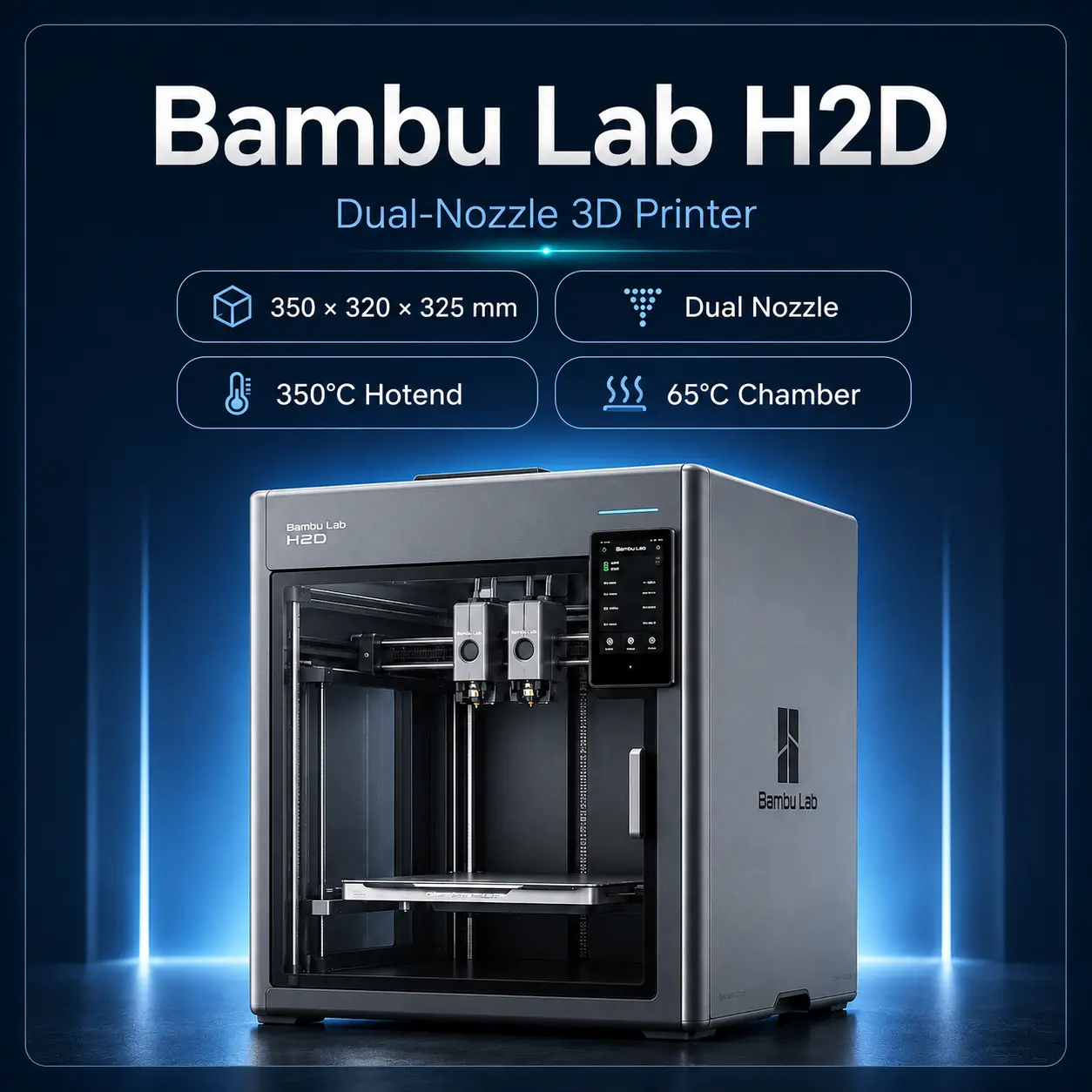
Users who need a broader enclosed engineering-material platform should compare the Bambu Lab P2S. For larger, dual-nozzle, and higher-temperature work, the Bambu Lab H2D is the more appropriate step up.
The A2L combines several automation systems intended to reduce setup and detect common print problems.
The printer can calibrate flow behavior for the current nozzle and filament condition. On a large-format machine, this is useful because an extrusion problem discovered late in a long job can waste substantial time and material.
The A2L includes support for:
These systems reduce routine supervision, but they do not replace correct slicing, filament conditioning, or part design.
The A2L works with Bambu Lab's automatic material ecosystem.
Bambu Lab documents compatibility with AMS lite and AMS 2 Pro, including mixed configurations of up to four AMS 2 Pro units plus one AMS lite, enabling up to 19 colors.
The standalone A2L does not include an AMS.
Users buying specifically for multi-color work should compare the standalone package with the A2L Combo and current AMS bundles before purchase.
Important: Printer material compatibility and AMS feed compatibility are not identical. Generic TPU and some abrasive or brittle filaments can require external feeding or may be unsuitable for a particular AMS model. Check Bambu Lab's current filament/AMS compatibility table before loading specialty filament.
Multi-color printing also increases purge waste and print time. It is most valuable when color is genuinely part of the design.
The A2L can be expanded beyond FDM printing with optional 2D tool modules.
Supported add-ons include:
Bambu Lab publishes a cutting area of 300 × 300 mm and a drawing area of 300 × 255 mm.
The cutting workflow supports thin craft materials such as paper, vinyl, PVC, and leather within the manufacturer's limits.
Important: Cutting and pen modules are optional accessories and are not standard equipment with the standalone printer unless a bundle says otherwise.
Warning: The A2L does not support a laser module. Its open-frame design is one reason the platform is limited to cutting and drawing rather than laser processing.
The A2L uses 2.4 GHz Wi-Fi and Bambu-Bus for supported accessories. Ethernet is not available.
It can operate through Bambu Cloud or use LAN-only mode for local-network control.
Primary software includes:
Bambu Lab also states that third-party slicers capable of exporting standard G-code can be used, although advanced Bambu-specific functions may not be fully supported.
The built-in camera is a low-frame-rate unit with up to 1080p output for monitoring and timelapse recording.
Bambu Lab rates the A2L at about 49 dB in Silent Mode under its stated test conditions.
The printer also carries UL 2904 / GREENGUARD certification for indoor-air-quality performance when used with qualifying official filaments under the manufacturer's stated conditions.
That should not be expanded into a blanket claim that every filament is emission-free or appropriate for an unventilated room. Filament chemistry still matters.
| Printer | Main Difference | Better Fit |
|---|---|---|
| Bambu Lab A1 mini | Much smaller open-frame platform | Compact entry-level printing |
| Bambu Lab A1 | Smaller 256 mm-class open-frame platform | General desktop use when A2L size is unnecessary |
| Bambu Lab A2L | 330 × 320 × 325 mm open-frame large format | Large PLA/PETG projects, cosplay, creative production, batch work |
| Bambu Lab P2S | Enclosed 256 mm-class platform | Functional and reinforced-material workflows |
| Bambu Lab H2D | Larger enclosed dual-nozzle platform with active chamber heating | Advanced engineering and multi-material prototyping |
The A2L's value comes from large build volume at a much lower entry price than Bambu's enclosed large-format systems, while accepting the thermal limitations of an open frame and 80°C bed.
The standalone A2L launched in the United States at US$469, while the A2L Combo costs more because it includes an AMS lite.
Pricing and promotions can change by region. Treat the catalog price as a checked reference rather than permanent MSRP and confirm the current offer on the official Bambu Lab US store.
Recommended use: Choose the A2L when build volume is the main limitation of a smaller desktop printer and your normal materials are PLA, PETG, TPU, PVA, or compatible low-warping filled variants. If your projects depend on ABS, ASA, nylon, polycarbonate, or higher-temperature composites, prioritize an enclosed printer with the thermal hardware those materials require.
The A2L has a 330 × 320 × 325 mm build volume.
No. Bambu Lab publishes 500 mm/s as maximum toolhead speed. Actual print speed depends on acceleration, hotend flow, material, geometry, cooling, layer height, and the selected profile.
The standard printer uses a 0.4 mm stainless-steel nozzle. Supported diameters are 0.2, 0.4, 0.6, and 0.8 mm.
The extruder gear is hardened steel, but the standard nozzle is stainless steel. Abrasive PLA-CF and PETG-CF should be printed with an appropriate hardened-steel nozzle.
Bambu Lab lists PLA, PETG, TPU, and PVA. PLA-CF and PETG-CF are also listed as suitable with a hardened-steel nozzle.
The A2L is not positioned as a general platform for those chamber-sensitive engineering materials. Its open frame and 80°C bed make an enclosed printer a better starting point.
No. It is an open-frame bedslinger and does not have an actively heated chamber.
Yes. It supports AMS lite and AMS 2 Pro configurations, with Bambu Lab documenting setups of up to 19 colors. The standalone printer does not include an AMS unless a bundle specifically says so.
Yes, with optional cutting and pen-drawing modules. They are sold separately unless included in a specific bundle.
No. Bambu Lab explicitly does not support a laser module on the open-frame A2L.
Bambu LabA2L lists 544 × 529 × 505 mm and 12.8 kg. Extra front and rear operating clearance is required because the bed moves.
The standalone US model launched at US$469. Current promotions and regional pricing can change, so check Bambu Lab's current store listing before purchase.