High-Heat Performance ABSHeated-Chamber ABSHigh-Creep-Resistance ABSIndustrial High-Heat ABSand Advanced Engineering ABS.
PPolymaker
Polymaker
# Polymaker ABS Max
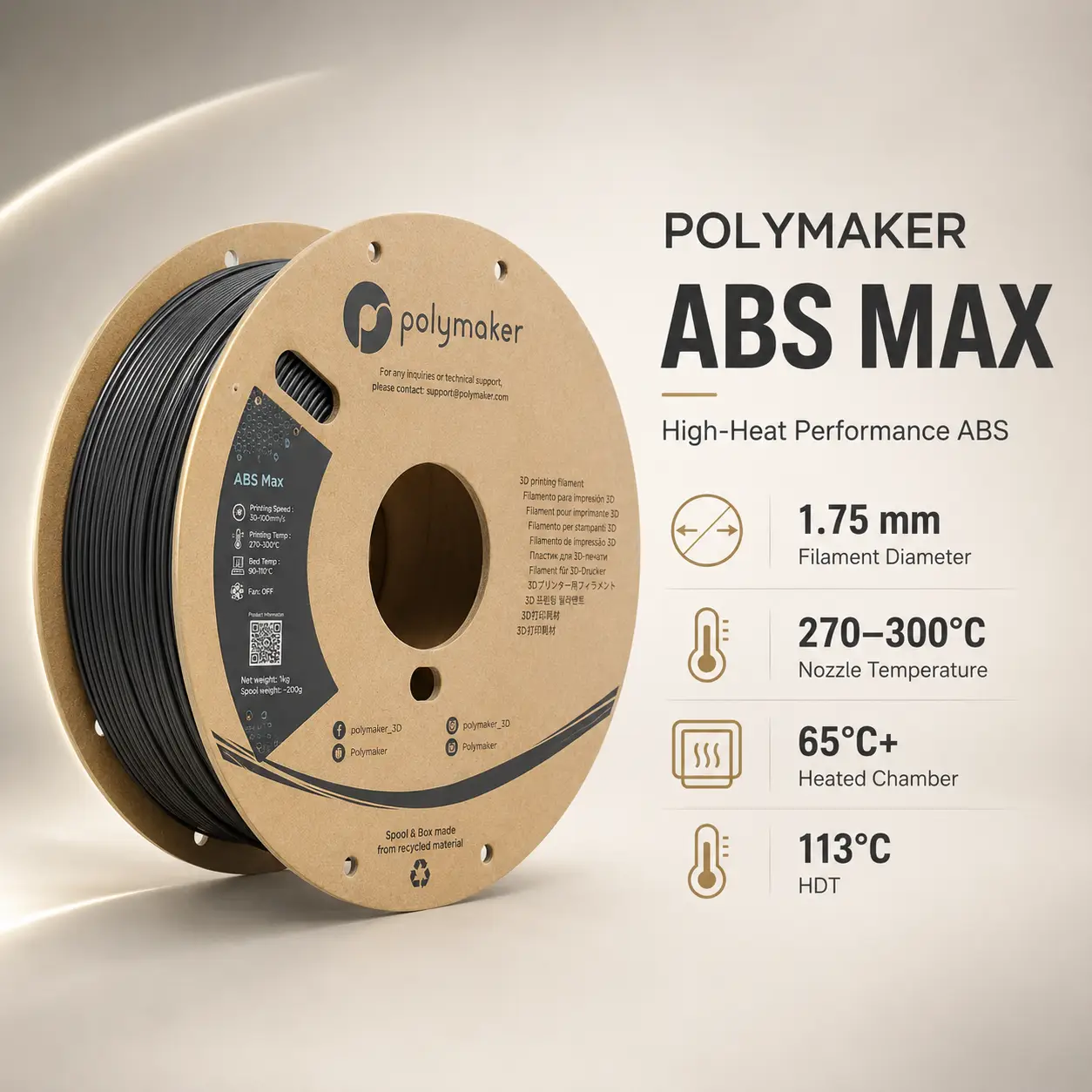
Polymaker ABS Max is a high-performance 1.75 mm ABS filament developed for advanced FDM printers with actively heated chambers. It is aimed at functional parts that need more thermal stability and long-term load resistance than conventional consumer ABS or ASA, while retaining a non-fiber-filled formulation that does not require a hardened nozzle.
Polymaker specifies a heat deflection temperature (HDT) of 113.1°C at 1.8 MPa and 118.1°C at 0.45 MPa, plus a Vicat softening temperature of 127.4°C. The material is also designed for print speeds up to 200 mm/s when used with suitable hardware and process settings.
The tradeoff is printer requirement. ABS Max is not intended for ordinary open-frame machines or passive enclosures. Polymaker calls for an all-metal hotend, 270–300°C nozzle temperature, 120°C build plate, and actively heated chamber at 65°C or higher.
For current product information and regional ordering, see the official Polymaker ABS Max product page.
| Specification | Value |
|---|---|
| Material type | Filament |
| Polymer family | High-performance ABS |
| Printing technology | FDM |
| Diameter | 1.75 mm |
| Spool weight | 1 kg |
| Nozzle temperature | 270–300°C |
| Build plate temperature | 120°C |
| Chamber temperature | 65°C+ actively heated |
| Build surface | PEI |
| Cooling fan | 0–30% |
| Printing speed | Up to 200 mm/s |
| Drying | 70°C for 6 hours when needed |
| Density | 1.06 g/cm³ at 23°C |
| Glass transition temperature | 126.3°C |
| Vicat softening temperature | 127.4°C |
| HDT at 1.8 MPa | 113.1°C |
| HDT at 0.45 MPa | 118.1°C |
| XY tensile strength | 35.66 ± 0.58 MPa |
| Z tensile strength | 25.41 ± 0.36 MPa |
| XY Young's modulus | 2.32 ± 0.03 GPa |
| Z Young's modulus | 2.10 ± 0.01 GPa |
| XY elongation at break | 6.72 ± 0.34% |
| Z elongation at break | 1.81 ± 0.15% |
| XY flexural strength | 63.29 ± 1.19 MPa |
| Z flexural strength | 45.12 ± 0.89 MPa |
| XY unnotched impact strength | 29.37 ± 2.40 kJ/m² |
| Abrasive reinforcement | No |
| Standard colors | Black, White, Grey, Blue, Red, Green |
ABS Max demands a substantially hotter environment than mainstream ABS.
Polymaker's recommended starting conditions are:
The active chamber requirement is the main compatibility filter. A passive enclosure that merely traps some bed heat should not be assumed to maintain the 65°C+ environment Polymaker specifies.
Printers with controlled chamber heating are therefore the natural fit for ABS Max. Large parts, long prints, and mechanically demanding components benefit most from keeping the chamber temperature stable throughout the build.
ABS shrinks as it cools. Large temperature gradients between newly deposited material and the rest of the part increase the risk of warping, corner lift, internal stress, and layer separation.
ABS Max is formulated around an actively heated process environment. Maintaining the chamber at 65°C or above reduces those temperature gradients and helps the part remain dimensionally stable while printing.
The chamber requirement is also one reason ABS Max should not be treated as a drop-in replacement for ordinary desktop ABS. A printer may technically reach 285°C at the nozzle and 120°C on the bed while still lacking the chamber control needed to run the material as intended.
Thermal performance is one of ABS Max's main advantages.
Polymaker reports:
| Thermal Property | Typical Value |
|---|---|
| Glass transition temperature | 126.3°C |
| Vicat softening temperature | 127.4°C |
| HDT at 1.8 MPa | 113.1°C |
| HDT at 0.45 MPa | 118.1°C |
The two HDT values use different applied loads, so they should not be mixed into a single generic "118°C heat resistance" claim.
For parts carrying meaningful load at elevated temperature, the 113.1°C HDT at 1.8 MPa is the more conservative reference. The 118.1°C value is measured at the lower 0.45 MPa load.
Real-world temperature capability also depends on part geometry, print orientation, stress, exposure time, airflow, chemicals, and safety margin.
Polymaker's TDS reports the following printed-specimen values:
| Mechanical Property | XY | Z |
|---|---|---|
| Young's modulus | 2.32 ± 0.03 GPa | 2.10 ± 0.01 GPa |
| Tensile strength | 35.66 ± 0.58 MPa | 25.41 ± 0.36 MPa |
| Elongation at break | 6.72 ± 0.34% | 1.81 ± 0.15% |
| Flexural strength | 63.29 ± 1.19 MPa | 45.12 ± 0.89 MPa |
The directional difference is important. Like other FDM materials, ABS Max is anisotropic: properties measured along printed roads are not identical to properties through layer interfaces.
For fixtures, brackets, tooling, and mechanically loaded production parts, orientation should therefore be chosen around the main load path rather than appearance alone.
Polymaker specifically positions ABS Max around improved creep resistance.
Creep is gradual deformation under a sustained load, and it becomes more important as temperature rises. A material can have adequate short-term tensile strength yet slowly lose dimensional accuracy when a constant force is applied for hours, days, or months.
That makes ABS Max especially relevant to loaded brackets, fixtures that must hold alignment, clamps, equipment mounts, tooling, production aids, and parts exposed to heat while mechanically constrained.
Published creep positioning is useful for material selection, but long-duration parts should still be validated under the actual temperature, stress, orientation, and service time expected in the application.
Polymaker rates ABS Max for printing speeds up to 200 mm/s.
That is a material capability under suitable conditions, not a guarantee that every printer, extrusion rate, layer height, or geometry can sustain 200 mm/s.
Actual speed is limited by hotend melt capacity, nozzle diameter, layer height, line width, volumetric flow, chamber stability, cooling, part geometry, and acceleration settings.
Polymaker recommendations are based on a 0.4 mm nozzle and that conditions can vary with nozzle diameter.
ABS Max does not use carbon fiber, glass fiber, or another abrasive reinforcement.
That means a hardened nozzle is not required solely because of the filament composition. A standard compatible metal nozzle can be used as long as the hotend is all-metal and safely supports the required temperature range.
This is an important distinction from engineering composites such as Prusament PC Blend Carbon Fiber and Prusament PA11 Carbon Fiber, both of which contain abrasive carbon fibers and require wear-resistant nozzles.
Polymaker specifies 70°C for 6 hours when drying is needed.
The filament should be stored cool and dry, away from moisture and UV exposure. Polymaker recommends dry storage systems such as PolyBox or PolyDryer for maintaining consistent print quality.
Drying is not a substitute for fixing poor chamber control or bed adhesion. If a print warps despite dry filament, the chamber temperature, bed preparation, first layer, and geometry should be checked before assuming moisture is the cause.
The ABS Max TDS also provides qualitative chemical-resistance guidance at ambient temperature:
These ratings are useful screening information, but they are not a substitute for application-specific compatibility testing. Concentration, temperature, exposure time, mechanical stress, and additives can all change the outcome.
ABS Max can be approached with many familiar ABS finishing methods.
Depending on the part and finish requirements, post-processing can include sanding, filing, drilling, tapping, machining, priming, and painting.
Solvent-based finishing should be tested on sample parts first and carried out only with appropriate chemical handling, ventilation, and fire-safety controls.
| Material | Heat-Performance Reference | Typical Printing Setup | Heated Chamber | Abrasive | Key Strength |
|---|---|---|---|---|---|
| Polymaker ABS Max | 113.1°C HDT at 1.8 MPa; 118.1°C at 0.45 MPa | 270–300°C nozzle, 120°C bed | 65°C+ active heat required | No | High heat + creep resistance without fiber reinforcement |
| Prusament ASA | Resists deformation near 93°C | 260±5°C nozzle, 110±5°C bed | Enclosure recommended/required for reliable large prints | No | UV/weather resistance and easier outdoor use |
| Prusament PC Blend Carbon Fiber | 114°C HDT as printed; up to 130°C after annealing | 285±10°C nozzle, 110±10°C bed | Not normally required | Yes | Rigid, dimensionally stable engineering composite |
| Prusament PA11 Carbon Fiber | Temperature resistance up to 190°C depending on load | 285±10°C nozzle, 110±10°C bed | Not normally required | Yes | High heat, chemical resistance, wear resistance |
The table highlights the central tradeoff. ABS Max combines high thermal performance and creep resistance with a non-abrasive ABS formulation, but it requires a demanding 65°C+ actively heated chamber.
Detailed test methods and material-property values are available in Polymaker's ABS Max technical data sheet.
The Polymaker ABS Max vs Prusament ASA comparison is primarily about high-temperature structural use versus outdoor durability and easier printer compatibility.
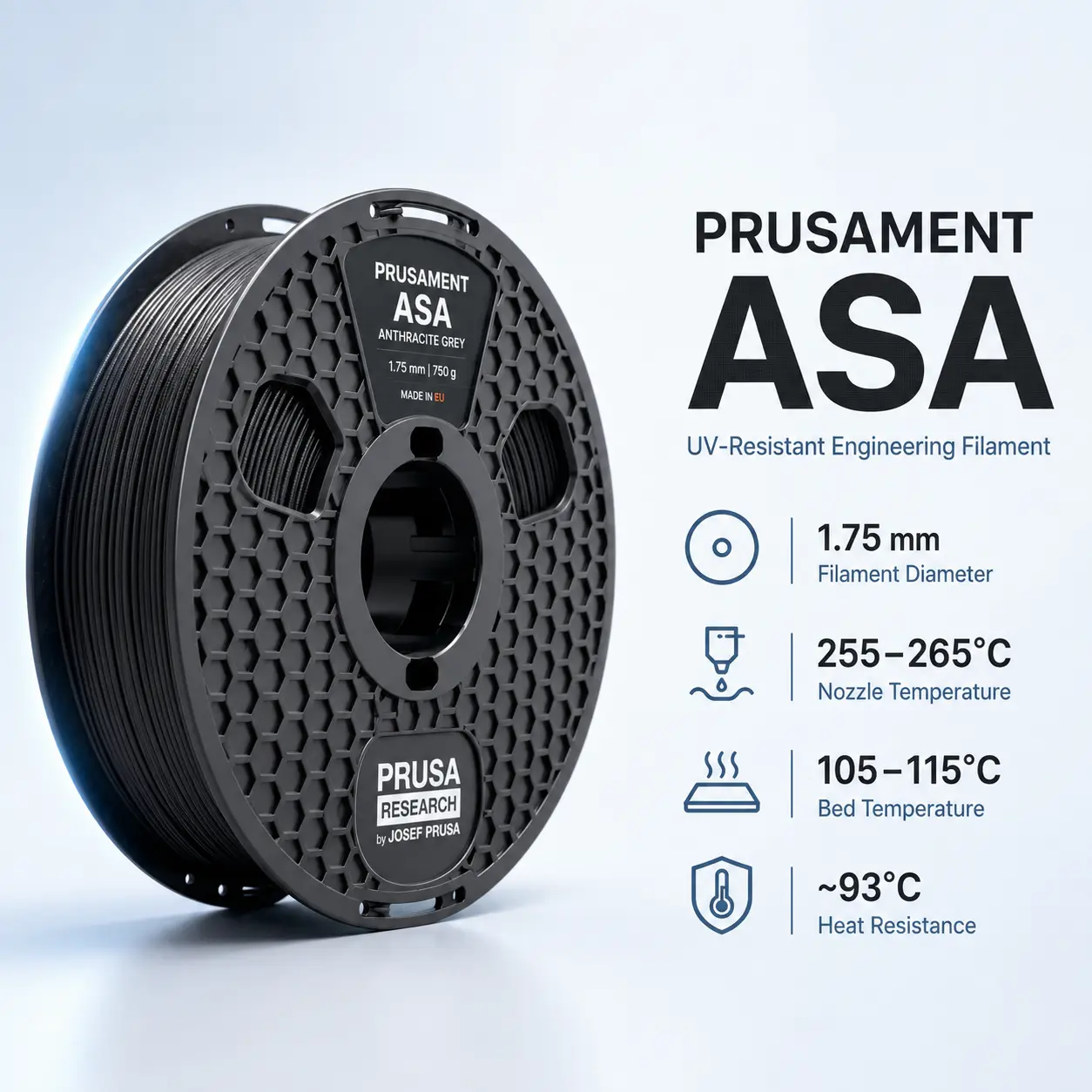
Prusament ASA is UV stable, weather resistant, acetone-smoothable, and specified for a 260±5°C nozzle with a 110±5°C bed. Prusa describes it as resisting deformation up to temperatures near 93°C.
ABS Max raises the thermal ceiling substantially, with 113.1°C HDT at 1.8 MPa and 118.1°C at 0.45 MPa, while Polymaker also emphasizes creep resistance under sustained heat and load.
Choose ABS Max when high service temperature and long-term dimensional stability are more important than ease of printing.
Choose Prusament ASA when outdoor UV exposure, weather resistance, and compatibility with more conventional enclosed FDM printers matter more than the higher thermal figures.
The Polymaker ABS Max vs Prusament PC Blend Carbon Fiber comparison is unusually close on as-printed heat performance.
Prusament PC Blend Carbon Fiber publishes an HDT of about 114°C as printed, with annealing capable of raising temperature resistance to about 130°C. It also offers high rigidity, dimensional stability, wear resistance, and a matte carbon-fiber finish.
ABS Max reaches 113.1°C HDT at 1.8 MPa without abrasive fiber reinforcement.
The practical differences are significant:
Choose ABS Max when you have a capable heated-chamber printer and want high-heat ABS behavior without carbon-fiber abrasion.
Choose PC Blend CF when rigidity, dimensional stability, carbon-fiber reinforcement, and easier chamber requirements are more valuable than using a non-filled polymer.
The Polymaker ABS Max vs Prusament PA11 Carbon Fiber comparison moves into a more demanding engineering-material class.
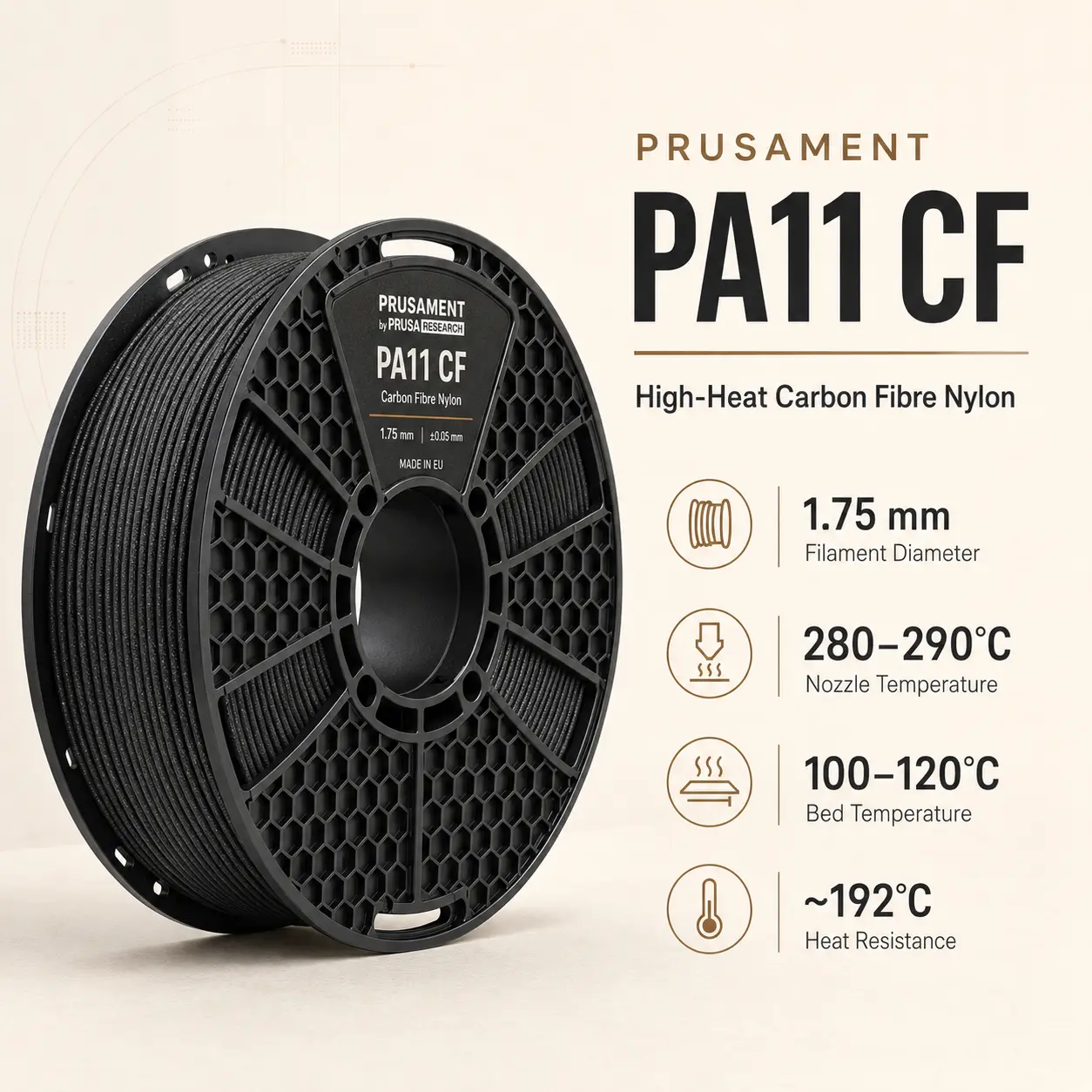
Prusament PA11 Carbon Fiber is a carbon-fiber-reinforced nylon with strong chemical, wear, and temperature resistance. Prusa states that printed parts can withstand temperatures up to about 190°C depending on load.
PA11-CF is therefore the stronger candidate for environments where high heat, solvents, low friction, and wear dominate the requirement.
ABS Max is easier in several other respects: it is non-abrasive, uses a conventional ABS-family processing approach, and does not require a special wear-resistant nozzle.
Choose PA11-CF for higher-end thermal, chemical, and tribological requirements when moisture handling and abrasive filament processing are acceptable.
Choose ABS Max for industrial fixtures, automotive components, tooling, and production parts that fit inside its thermal envelope and benefit from a non-fiber-filled material.
For buyers comparing ABS Max vs ASA, ABS Max vs PC-CF, or looking for a high-heat ABS alternative, the printer and environment often decide the answer before nominal strength does.
Choose Polymaker ABS Max when:
Choose Prusament ASA when:
Choose Prusament PC Blend Carbon Fiber when:
Choose Prusament PA11 Carbon Fiber when:
Polymaker lists ABS Max at US$29.99 per 1 kg spool in the United States, approximately €25.89 in Europe, £22.13 in the United Kingdom, AED 110.14 in the UAE, C$41.59 in Canada, A$42.26 in Australia, ₹2,867 in India.
Availability may vary by color and region. The standard color range includes Black, White, Grey, Blue, Red, and Green. Regional pricing, taxes, shipping charges, exchange rates, promotions, and stock status may differ
Recommended use: Choose Polymaker ABS Max for high-temperature fixtures, tooling, automotive components, and production parts when a 65°C+ actively heated chamber is available and you want strong creep resistance and 113°C-class HDT without using an abrasive fiber-filled filament.
It is Polymaker's highest-performance ABS filament, designed for actively heated FDM printers and functional parts requiring high heat and creep resistance.
Polymaker recommends 270–300°C.
120°C.
Yes. Polymaker specifies 65°C or higher.
Polymaker reports 113.1°C at 1.8 MPa and 118.1°C at 0.45 MPa.
127.4°C.
The TDS reports 35.66 ± 0.58 MPa in XY and 25.41 ± 0.36 MPa in Z under its test conditions.
No. It does not contain carbon or glass fiber reinforcement, so a hardened nozzle is not required solely because of the filament.
Polymaker rates it for up to 200 mm/s with suitable equipment and settings.
Polymaker specifies 70°C for 6 hours when drying is needed.
It offers substantially higher published heat resistance and is designed for strong creep resistance, while ASA is generally the better choice for UV-exposed outdoor parts and is easier to run on more conventional enclosed printers.
Their as-printed heat resistance is similar, but ABS Max is non-abrasive and requires an actively heated 65°C+ chamber. PC Blend Carbon Fiber is abrasive, much stiffer, and normally does not require an enclosure.
PA11-CF offers substantially higher temperature and chemical resistance, while ABS Max avoids abrasive reinforcement and is aimed at high-heat ABS-style engineering applications.
Black, White, Grey, Blue, Red, and Green.