Large-Format Multi-Toolhead PrintingLow-Waste Multi-MaterialIndependent Toolhead SystemSoluble Support WorkflowMixed-Material EngineeringFive-Toolhead Printing
PPrusa
Prusa
# Prusa XL+
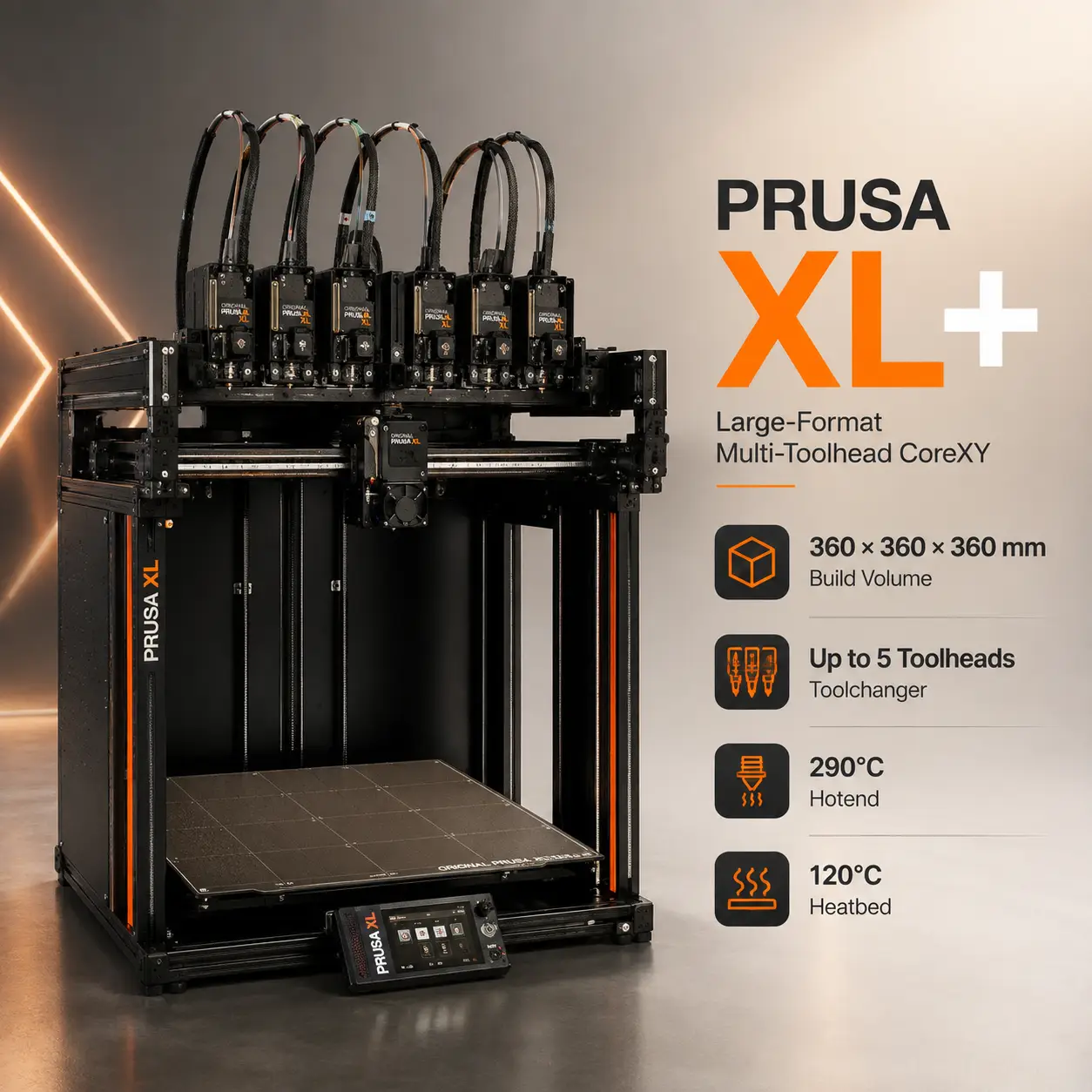
The Prusa XL+ is a large-format CoreXY 3D printer built around an expandable active toolchanger. Its 360 × 360 × 360 mm build volume provides approximately 46.7 liters of printing space, while one-, two-, and five-tool configurations support large single-material parts, soluble-support workflows, mixed rigid and flexible materials, multi-color production, and different nozzle sizes within the same job.
The XL+ is the August 2026 refresh of Prusa's established XL platform. The updated machine adds GT1.5 motion belts, 360-degree part cooling, a permanently mounted electronic tool-offset sensor, high-flow nozzles, improved cooling, and an integrated nozzle wiper. Prusa states that the refreshed platform prints roughly 10–15% faster than the previous XL, but it does not publish one universal maximum print-speed figure in mm/s.
Each toolhead keeps its own extruder, hotend, nozzle, and filament. That reduces the loading, unloading, and purging required by single-nozzle filament-changing systems and makes the XL+ particularly useful for mixed materials and soluble supports.
The XL+ is open-frame as standard. The optional Enclosure for Prusa XL+ can reach approximately 50°C using heat from the printer, while a separate external heater is planned to raise chamber temperature to 60°C.
Official configurations and launch information are available on the Prusa XL+ product page.
| Specification | Value |
|---|---|
| Printing technology | FDM / FFF |
| Motion system | CoreXY |
| Build volume | 360 × 360 × 360 mm |
| Build capacity | Approximately 46.7 L |
| Filament diameter | 1.75 mm |
| Toolhead configurations | 1, 2, or 5 |
| Tool changing | Automatic active toolchanger |
| Extruder | Nextruder direct drive |
| Standard nozzle family | High-flow Prusa nozzles |
| Maximum nozzle temperature | 290°C |
| Maximum heatbed temperature | 120°C |
| Heatbed | 16 individually controlled segments |
| Standard chamber | Open-frame |
| Optional enclosure temperature | Up to approximately 50°C |
| Planned enclosure heater | Up to 60°C |
| First-layer calibration | Automatic LoadCell |
| Tool-offset calibration | Automatic dedicated electronic sensor |
| Motion features | GT1.5 belts, Input Shaper, Phase Stepping |
| Part cooling | 360-degree cooling system |
| Connectivity | Ethernet, optional Wi-Fi |
| Offline operation | Supported |
| Print surface | Removable double-sided Satin Print Sheet |
| Software | PrusaSlicer, Prusa Connect, EasyPrint, Prusa App |
| Printer dimensions | Approximately 700 × 900 × 720 mm |
| Printer weight | Approximately 30 kg |
Print-speed note: Prusa describes XL+ as approximately 10–15% faster than the previous XL.
The defining feature of the XL+ is its independent-tool architecture.
Each toolhead contains its own Nextruder, hotend, nozzle, and filament path. When the printer changes tools, it parks one complete toolhead and picks up another rather than retracting a filament through a shared nozzle.
This is useful for:
A dedicated toolhead for each material can sharply reduce purge waste. Some jobs may still use a small priming structure or wiping strategy for pressure stabilization, so the system is better described as very low waste rather than universally zero waste.
The single-tool configuration provides the full 360 mm build volume at the lowest platform price. Two tools are especially useful for model-plus-support workflows or two nozzle sizes. Five tools provide the full multi-material capability for color, production, and long unattended jobs.
Toolheads can be added later.
The XL+ keeps the core XL architecture while upgrading the areas most relevant to print quality and daily operation.
The new 1.5 mm-pitch belts are intended to make fine repeating motion artifacts less noticeable on broad, smooth surfaces.
The refreshed printer replaces the older, slower alignment process with a permanently mounted electronic sensor for automatic toolhead offset calibration.
The redesigned cooling system distributes air more evenly around the nozzle, improving bridges, overhangs, and smaller details.
Every nozzle is cleaned before printing begins, reducing the chance that an ooze strand or small blob interferes with calibration or the first layer.
Improved toolhead and electronics cooling also prepares the XL+ for the warmer environment created by the new enclosure system.
The XL+ uses 16 individually controlled heatbed tiles rather than one large heater.
This allows the printer to heat the active region instead of powering the entire 360 × 360 mm surface for every small job. The maximum heatbed temperature is 120°C.
The segmented system is especially useful on a large-format printer because many jobs occupy only part of the available bed.
For large ABS, ASA, PC, or nylon parts, bed temperature should still be considered together with chamber conditions, material drying, build-surface preparation, and part geometry.
The base XL+ is not enclosed, so `hasHeatedChamber` remains `false`.
PLA, PETG, TPU, PVA, and many general-purpose materials can be used in the open configuration. Larger warp-sensitive engineering parts benefit from the optional enclosure.
This distinction matters because the material list describes what the platform can process with suitable hardware and conditions, not what every material will print equally well in the stock open-frame configuration.
The Enclosure for Prusa XL+ can hold approximately 50°C using heat generated by the printer.
It also adds HEPA filtration, reduced noise, chamber-temperature monitoring, lighting, and a foldable opening for cooler PLA/PETG operation.
Prusa has separately announced an external heater intended to raise the enclosed chamber to 60°C. That heater is a planned add-on, not part of the standard printer.
For an indexed material example, Prusament ASA benefits from a warmer, draft-controlled environment on larger parts.
Every toolhead uses Prusa's direct-drive Nextruder.
Prusa ships XL+ toolheads with high-flow nozzles and supports a range of Nextruder nozzle types and diameters. The manufacturer highlights fine-detail nozzles, larger 0.6 and 0.8 mm options, hardened nozzles for abrasives, and high-flow CHT nozzles for throughput.
Because the current XL+ specification does not explicitly state one universal default nozzle diameter for every configuration, the structured `nozzleDiameterMm` field is left empty.
Prusa lists carbon-fiber composites among the supported XL+ material families.
Abrasive composites should be paired with a hardened or wear-resistant nozzle rather than an ordinary brass nozzle.
Relevant indexed materials include:
Prusa currently lists these material families for XL+:
The open filament policy allows third-party 1.75 mm filament without proprietary spool chips or mandatory material subscriptions.
A dual- or five-tool XL+ can dedicate one toolhead to a soluble or breakaway support material while the main tool prints the part.
This is especially useful for:
The toolchanger can also keep a rigid polymer and TPU loaded separately for parts that combine hard and flexible regions.
Possible applications include protective bumpers, flexible hinges, soft grips, seals, and vibration-isolating features.
Material-to-material adhesion still depends on the specific polymers; being printable in one machine does not guarantee a strong bond between them.
XL+ supports:
Cloud connectivity is not mandatory. The printer can operate fully offline, and the Wi-Fi module can be physically removed for stricter local-only environments.
This makes the XL+ relevant to workshops, laboratories, education, and organizations that cannot send design files through a mandatory cloud service.
PrusaSlicer is the primary local slicing environment.
Prusa also provides Prusa Connect for remote monitoring and fleet management, EasyPrint for web-oriented preparation, and the Prusa App for mobile monitoring and control.
The printer's open filament policy allows profiles for third-party 1.75 mm materials as well as Prusament.
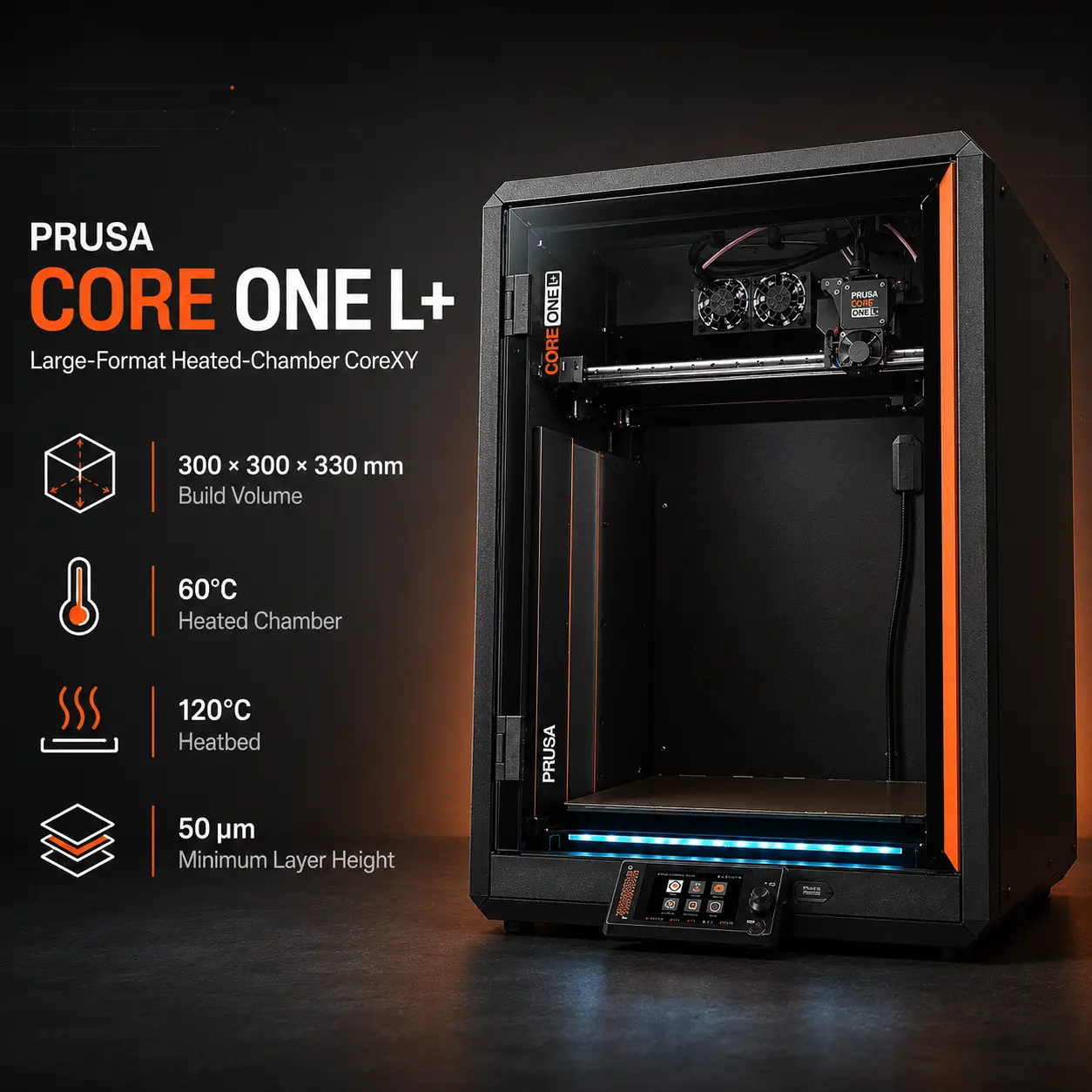
The Prusa CORE One+ is a more compact enclosed CoreXY printer.
Choose CORE One+ when a built-in enclosed workflow, smaller footprint, and single-nozzle printing are more important.
Choose XL+ when you need:
The Creality K2 Plus and Bambu Lab H2D are relevant alternatives for users comparing large enclosed engineering platforms.
The XL+ differs by prioritizing independent active toolheads rather than a conventional filament-changing architecture.
Its main strengths are:
Its main tradeoff is that enclosure and higher chamber temperatures are optional rather than standard.
Prusa launched the refreshed XL+ lineup in August 2026.
The current US single-tool listing is approximately US$2,299 and Based on current exchange rates, the estimated equivalent prices are approximately €1,987 in the Eurozone, £1,699 in the UK, C$3,190 in Canada, A$3,248 in Australia, AED 8,443 in the UAE, and ₹219,441 in India..
One-, two-, and five-tool configurations have different prices, and regional pricing varies by destination and configuration.
Recommended use: Choose the Prusa XL+ when a 360 mm build volume and true independent toolchanging are more valuable than a built-in enclosure. It is particularly well suited to large prototypes, soluble-support engineering parts, mixed rigid and flexible materials, and low-waste jobs that benefit from several nozzles remaining loaded at once.
360 × 360 × 360 mm, approximately 46.7 liters.
Prusa offers one-, two-, and five-tool configurations, with support for up to five independent toolheads.
XL+ adds GT1.5 belts, 360-degree part cooling, a dedicated electronic tool-offset sensor, high-flow nozzles, improved cooling, and an integrated nozzle wiper.
290°C.
120°C.
No. The base printer is open-frame. The optional Prusa XL+ Enclosure can reach approximately 50°C.
Not as standard. Prusa has announced an external heater for the Prusa XL+ Enclosure intended to raise the chamber temperature to 60°C.
Yes. Prusa lists carbon-fiber composites as supported, but abrasive formulations require a suitable wear-resistant nozzle.
Yes. Independent toolheads can keep flexible and rigid filaments loaded separately, although inter-material adhesion depends on the polymers.
The independent-tool system can reduce purge waste dramatically. Some jobs may still use a small priming or wiping structure.
Yes. It is fully offline-capable, and its Wi-Fi module can be removed.
Prusa says XL+ is 10–15% faster than the previous XL but does not publish one universal maximum print-speed value in mm/s.
The current single-tool listing is approximately US$2,299. Based on current exchange rates, the estimated equivalent prices are approximately €1,987 in the Eurozone, £1,699 in the UK, C$3,190 in Canada, A$3,248 in Australia, AED 8,443 in the UAE, and ₹219,441 in India.
Prusa currently lists August 28, 2026.