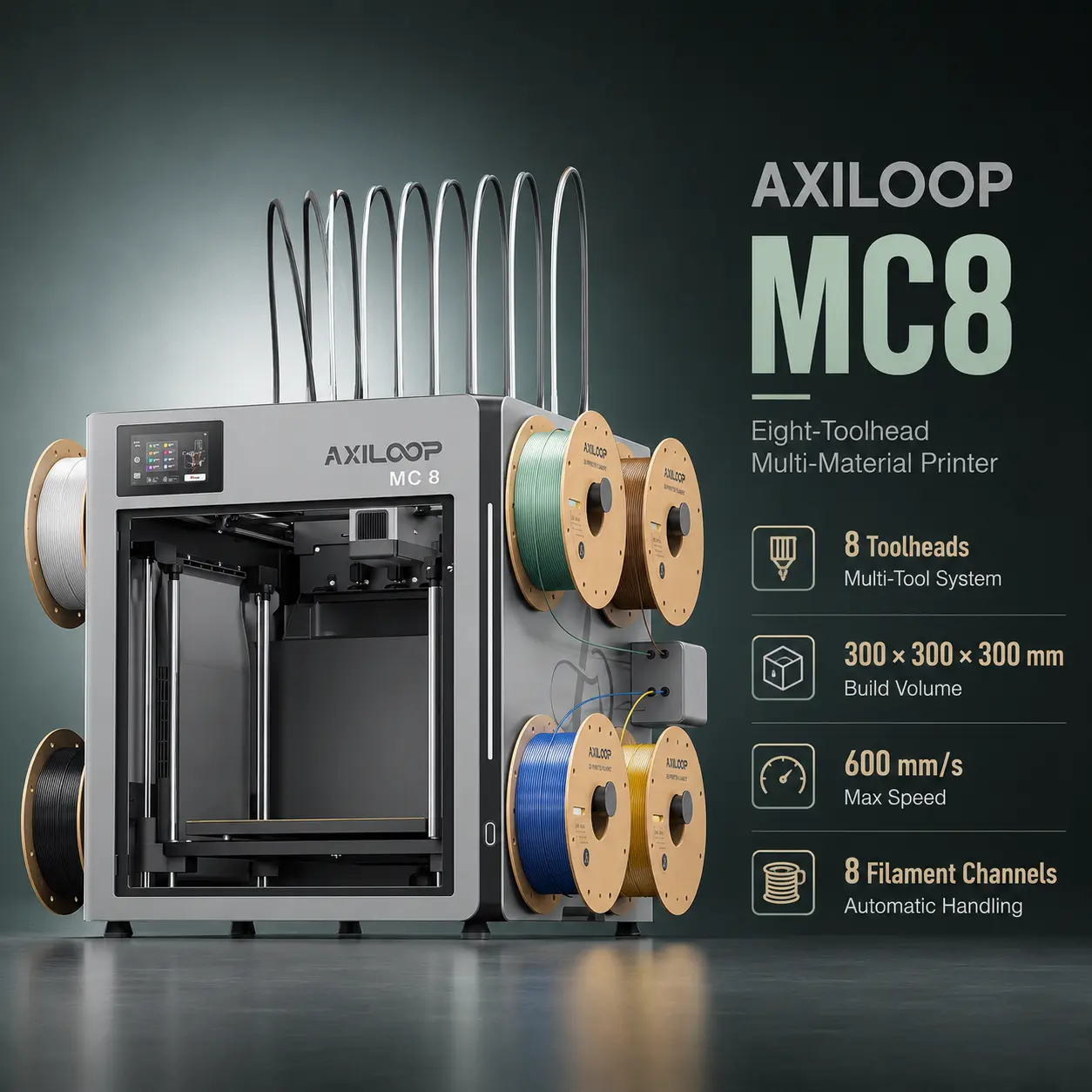
Eight-Toolhead Multi-Material PrintingAutomatic Spool ChangingLow Waste Multicolor PrintingHigh Speed PrintingAutomated Filament LoadingEight Channel Filament Workflow
AAxiLoop
AxiLoop
# AxiLoop MC8
The AxiLoop MC8 is an upcoming FDM/FFF 3D printer built around a manufacturer-announced eight-toolhead, eight-spool architecture for multi-color and multi-material printing. Its core idea is to keep several materials available through separate printing tools instead of relying entirely on repeated unloading, reloading, and flushing through one shared nozzle.
AxiLoop has announced a 300 × 300 × 300 mm build volume, maximum print speed of up to 600 mm/s, automatic filament loading and unloading, a 2,500-point automatic bed-leveling system, touchscreen control, and an app-based control ecosystem.
The MC8 is still a pre-release product. AxiLoop has not yet published final nozzle, bed, chamber, material, slicer, acceleration, flow-rate, electrical, physical-size, tool-change-time, price, or shipping specifications. Those missing details matter because an eight-tool system is only as useful as its calibration, thermal hardware, software, and switching reliability.
AxiLoop publishes product updates through its official Instagram account. The MC8 is scheduled for its first live public demonstration at Formnext Asia Shenzhen 2026, held August 26–28, 2026.
If the production model delivers the announced capabilities, the MC8 could suit multi-color models, multi-material prototypes, dedicated support-material workflows, product-development models, education, design studios, and small-batch production where several materials need to remain ready during one job.
| Specification | Announced Value |
|---|---|
| Technology | FDM / FFF |
| Tool system | Eight-toolhead architecture |
| Filament channels / spools | 8 |
| Build volume | 300 × 300 × 300 mm |
| Maximum print speed | Up to 600 mm/s |
| Automatic bed leveling | 2,500 measurement points |
| Bed measurement time | Under 1 minute |
| Filament handling | Automatic loading and unloading |
| Multi-color printing | Manufacturer-announced |
| Multi-material printing | Manufacturer-announced |
| Local control | Touchscreen |
| Remote control | AxiLoop app ecosystem |
| Nozzle specification | Not yet announced |
| Maximum nozzle temperature | Not yet announced |
| Maximum bed temperature | Not yet announced |
| Chamber configuration | Not yet announced |
| Supported materials | Not yet announced |
| Slicer | Not yet published |
| Tool-change time | Not yet announced |
| Acceleration / flow rate | Not yet announced |
| Retail price | Not yet announced |
| Commercial availability | Not yet announced |
These are pre-release manufacturer specifications rather than independently validated production figures.
The MC8's defining feature is the announced eight-toolhead system.
Separate printing tools can reduce the need to flush large amounts of filament through a shared melt chamber during color or material changes. They can also keep different nozzle roles or compatible materials ready at the same time.
AxiLoop has not yet released a complete engineering explanation of the eight-tool mechanism. Important unanswered questions include how the tools are parked, how XY and Z offsets are calibrated, how inactive nozzles are kept from oozing onto the print, and how long a complete transition takes.
That means the headline number of eight tools is interesting, but not enough by itself to predict real multi-material productivity.
AxiLoop has shown the MC8 with eight filament spools and says loading and unloading are automated.
This could simplify jobs that require several colors or materials, especially if each tool can remain assigned to a dedicated filament.
Potential workflows include multi-color PLA, dedicated breakaway or soluble support, several surface finishes, and mixed-material prototypes. Final compatibility will depend on the production hotend temperature, bed temperature, chamber design, nozzle hardware, and slicer profiles.
Two materials being printable on the same machine does not automatically mean they will bond correctly or share compatible bed and chamber requirements.
AxiLoop is positioning the MC8 as a lower-waste alternative to single-nozzle filament-changing systems.
That design goal is credible because dedicated hotends can avoid much of the flushing required to clean one shared melt zone between colors.
Even so, independent-tool systems can still consume filament for priming, wiping, pressure stabilization, ooze management, calibration, and prime structures. Until production hardware is tested, designed to reduce purge waste is a more defensible description than a universal waste-savings claim.
The announced 300 mm cube provides 27 liters of printable volume.
That is useful for larger prototypes, visual models, tooling, fixtures, assemblies, and batches of smaller components while remaining in a desktop-oriented size class.
AxiLoop has not separately published the physical build-plate dimensions, so the confirmed measurement is the announced printable area and height rather than the removable plate's outside dimensions.
AxiLoop specifies up to 600 mm/s.
This should be read as a maximum manufacturer rating, not expected speed for every model. Actual throughput will depend on acceleration, hotend flow, material, layer height, line width, cooling, geometry, tool changes, and priming behavior.
For a multi-tool machine, transition time can have a large effect on total job duration. A slower machine with quick tool changes can beat a faster one on a model containing hundreds of switches.
AxiLoop has not yet published acceleration, flow rate, or tool-change time, so sustained production performance remains unknown.
AxiLoop says the MC8 maps the build surface at 2,500 points in under one minute.
A dense map could help first-layer consistency across the 300 × 300 mm area. However, bed mapping and multi-tool offset calibration are different tasks. An eight-tool printer also needs accurate nozzle-to-nozzle XY and Z alignment.
AxiLoop has not yet explained how those eight tool offsets are measured or maintained, making calibration one of the most important areas to watch during live demonstrations.
The printer includes a touchscreen and an announced app-based control ecosystem.
AxiLoop has not yet specified whether remote operation uses Wi-Fi, Ethernet, cloud access, local-network control, or another method. It has also not identified the production slicer.
Software quality will be especially important because an eight-tool machine needs clear control over material assignment, tool assignment, temperatures, offsets, prime/wipe behavior, and error recovery.
Final material compatibility cannot be confirmed yet because AxiLoop has not published the production machine's nozzle material, nozzle diameter, hotend temperature, bed temperature, chamber design, or active chamber capability.
Those specifications will determine whether the MC8 is primarily a PLA/PETG multi-color platform or can reliably handle more demanding ABS, ASA, PC, nylon, TPU, soluble-support, or fiber-filled workflows.
Until those details are public, specific engineering-material compatibility should remain unclaimed.
| Printer | Tool / Material Architecture | Build Volume | Published Speed Figure | Main Difference |
|---|---|---|---|---|
| AxiLoop MC8 | Announced 8-toolhead / 8-spool system | 300 × 300 × 300 mm | Up to 600 mm/s | Eight announced tools; pre-release |
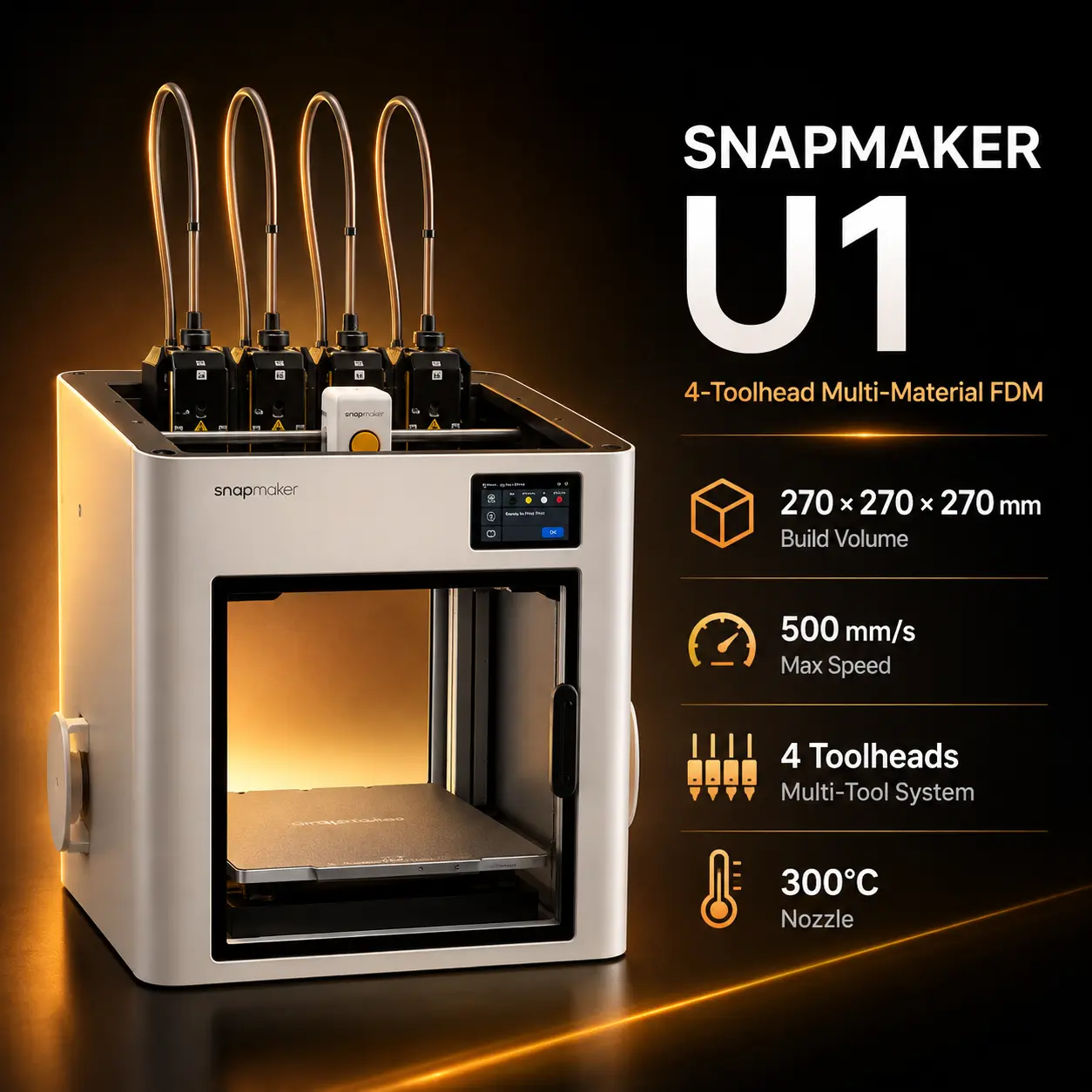
| Snapmaker U1 | 4 independent SnapSwap tools | 270 × 270 × 270 mm | 500 mm/s max toolhead speed | Available four-tool desktop workflow |
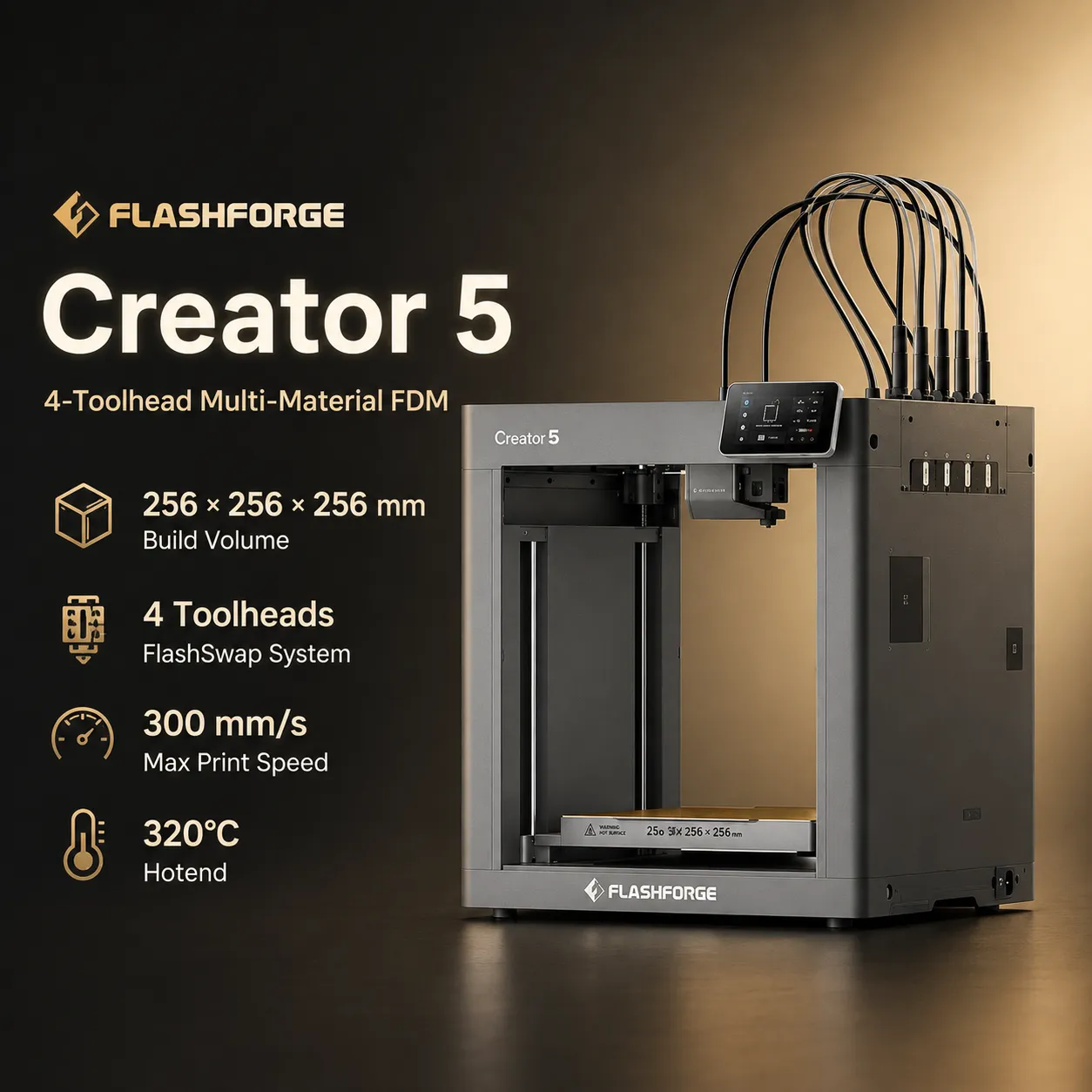
| Flashforge Creator 5 | 4 independent FlashSwap tools | 256 × 256 × 256 mm | 300 mm/s print; 600 mm/s travel | 320°C four-tool platform |
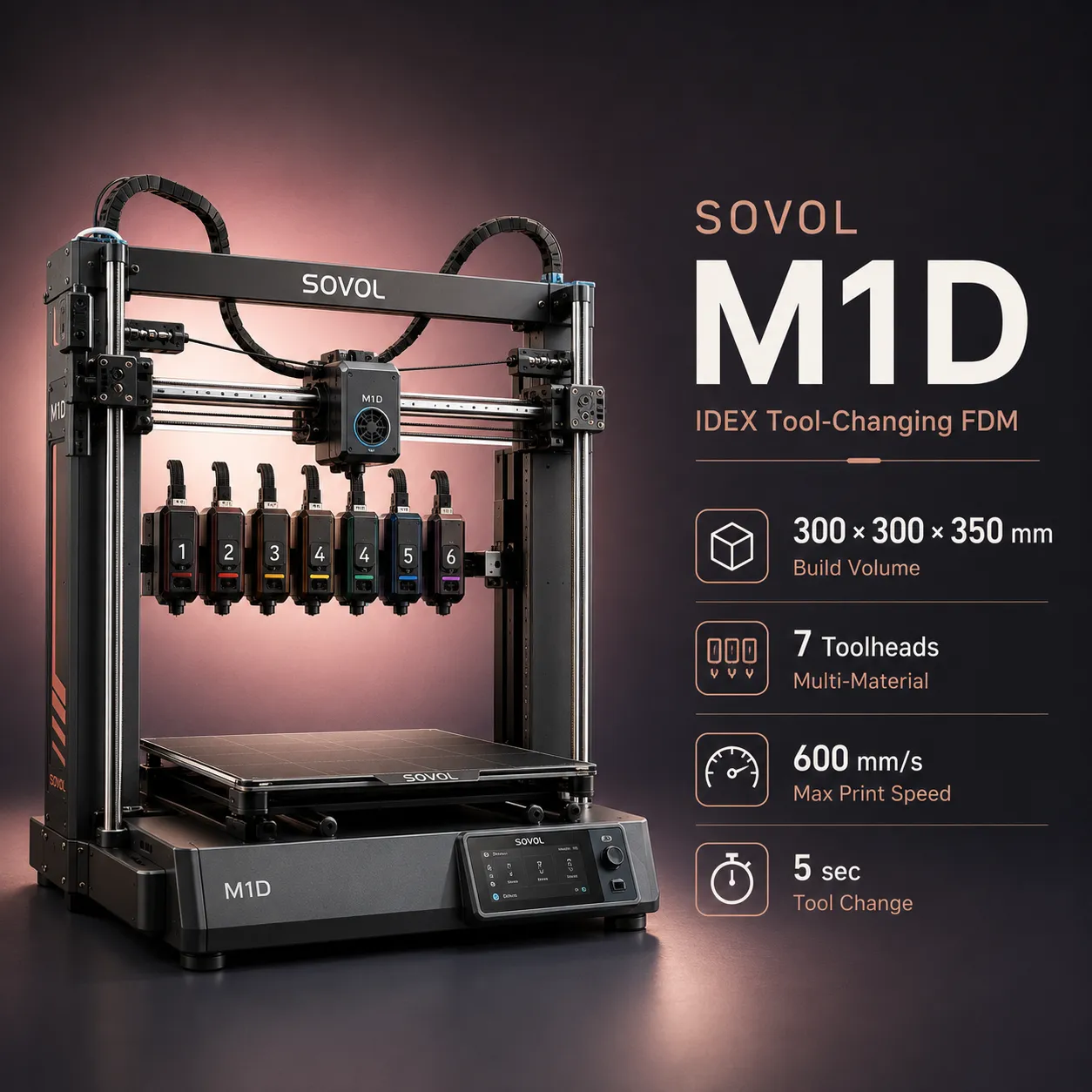
| Sovol M1D | IDEX + 1 fixed and 6 swappable tools | 300 × 300 × 350 mm Single Mode | Up to 600 mm/s | Seven-material IDEX/tool-changing concept |
| Prusa XL+ | Up to 5 independent Nextruder tools | 360 × 360 × 360 mm | No universal max mm/s published | Larger established active toolchanger |
For manufacturer specifications, see the Snapmaker U1 specifications, Flashforge Creator 5 Pro specifications, Sovol M1D tool-changing guide, and Prusa XL+ Five-Toolhead page.
The AxiLoop MC8 vs Snapmaker U1 comparison is an eight-tool pre-release concept against an available four-tool desktop system.
The Snapmaker U1 has four independent SnapSwap toolheads, a 270 × 270 × 270 mm build volume, 500 mm/s maximum toolhead speed, automatic tool-offset calibration, 300°C hotends, a 100°C bed, camera monitoring, Wi-Fi, and documented slicer support.
The MC8 announces twice as many tools, a larger 300 mm cube, and a 600 mm/s maximum print-speed figure. The U1 currently has the stronger case for buyers who need documented calibration, thermal specifications, software, and material support.
The AxiLoop MC8 vs Sovol M1D comparison is especially relevant because both move beyond four-tool printing.
The Sovol M1D uses one fixed tool plus six swappable secondary tools for up to seven colors or materials. Sovol publishes 300 × 300 × 350 mm in Single Mode and up to 600 mm/s.
Its full seven-head dual-overlap area is smaller at 240 × 300 × 350 mm, an important detail missing from simple headline comparisons.
The MC8 announces an eighth tool and 300 × 300 × 300 mm build volume, but AxiLoop has not yet confirmed whether all eight tools can use the full area simultaneously or whether multi-tool modes impose restrictions.
The AxiLoop MC8 vs Prusa XL+ comparison is more about maturity and build size than raw tool count.
The Prusa XL+ supports up to five independent toolheads and provides a larger 360 × 360 × 360 mm build volume. Prusa documents automatic tool-offset calibration, LoadCell first-layer calibration, a 290°C nozzle limit, 120°C segmented heatbed, and established PrusaSlicer support.
Prusa does not publish one universal XL+ maximum print speed in mm/s; it says the refreshed XL+ is about 10–15% faster than the previous XL.
The MC8 announces more tools and a 600 mm/s maximum, while the XL+ offers a documented toolchanger and mature multi-material workflow.
The AxiLoop MC8 vs Flashforge Creator 5 comparison pits maximum tool count against a documented four-tool platform.
The Flashforge Creator 5 has four independent FlashSwap tools, a 256 × 256 × 256 mm build volume, 300 mm/s maximum print speed, and 600 mm/s maximum travel speed. It also documents 320°C hotends, a 120°C bed, bed leveling, and automatic tool-offset calibration.
The MC8 is larger and announces twice as many tools, but Creator 5 currently provides far more production-level detail about calibration, thermal hardware, materials, and software.
For buyers searching for an AxiLoop MC8 alternative:
The MC8 is compelling as an eight-toolhead concept, but it is too early to rank it above proven alternatives on print quality, waste, reliability, or total job time.
The MC8 is scheduled for its first live public appearance at Formnext Asia Shenzhen 2026, running August 26–28, 2026.
Key details to watch at the show include actual tool-change sequence and time, tool-offset calibration, full eight-tool build-area access, priming and wiping behavior, slicer workflow, material assignments, thermal specifications, and long multi-material print quality.
Independent long-duration prints will be more informative than a short motion-speed demonstration.
AxiLoop has not announced final retail pricing.
Commercial release timing, preorders, regional distribution, warranty, and production shipping dates are also unconfirmed.
The MC8 should therefore be treated as a coming-soon pre-release product, not a normally available retail printer.
AxiLoop has announced an eight-toolhead architecture.
300 × 300 × 300 mm.
AxiLoop states up to 600 mm/s, although sustained throughput will depend on hardware, material, geometry, and tool-change overhead.
AxiLoop has announced an eight-spool setup with automatic loading and unloading.
The architecture is designed to reduce flushing compared with shared-nozzle systems, but real prints can still require priming, wiping, and calibration material.
AxiLoop has announced a 2,500-point bed-mapping system with measurement in under one minute.
Chamber specifications have not yet been published.
A final material-compatibility list has not yet been published.
Production slicer details have not yet been announced.
AxiLoop has announced app-based control, but detailed networking specifications are not public yet.
MC8 announces eight tools and a 300 mm cube; U1 has four documented independent tools, a 270 mm cube, and a mature published specification set.
MC8 announces eight tools; M1D supports up to seven materials through an IDEX plus tool-changing system and has more published detail about modes and calibration.
MC8 announces more tools, while XL+ provides a larger 360 mm cube and a documented five-tool active toolchanger.
AxiLoop has not announced a retail price.
Normal retail availability has not yet been announced.