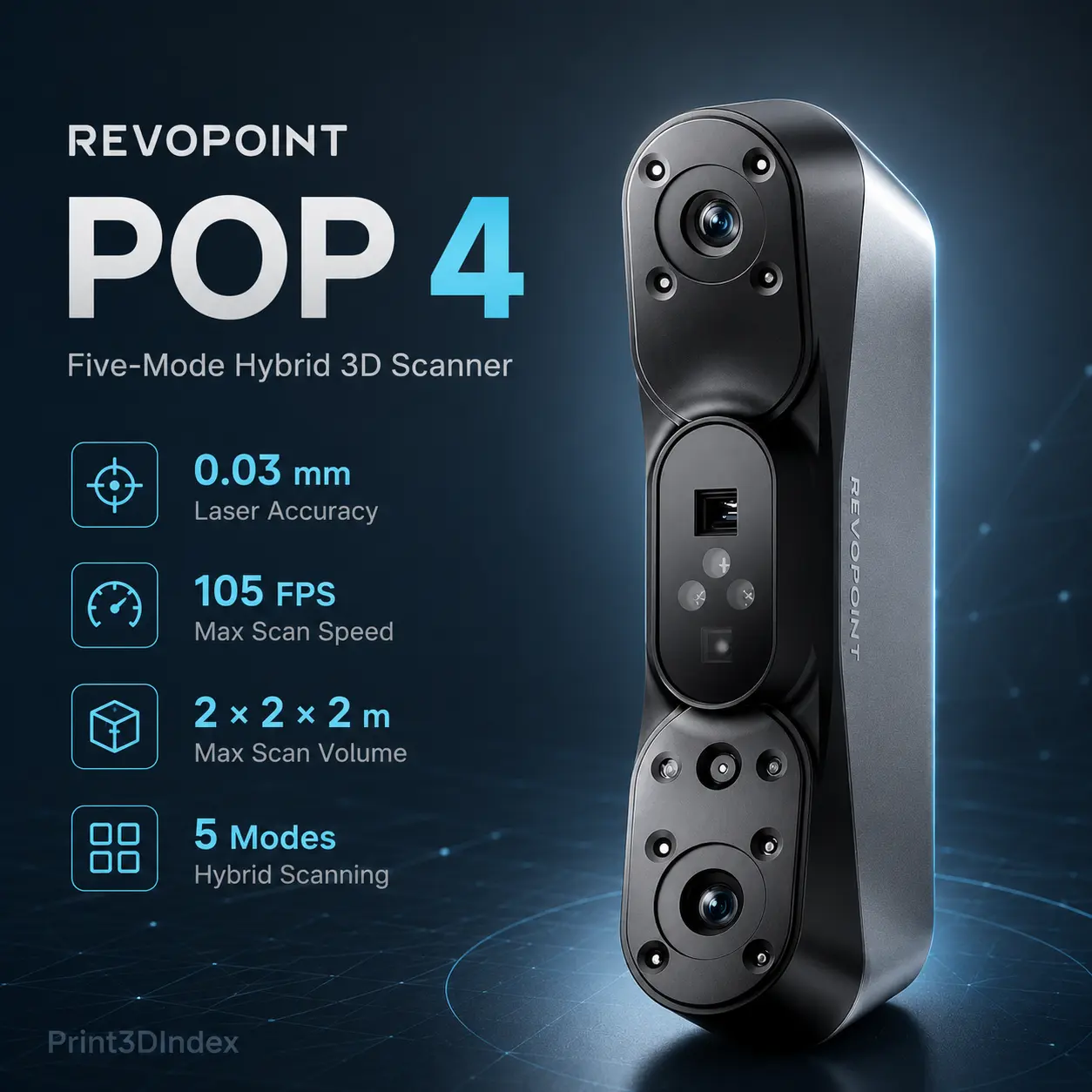
Five Mode Hybrid ScanningAI Assisted Object TrackingPrecision Blue Laser CaptureOutdoor Hybrid 3D ScanningDeep Hole Detail ScanningFull Color Surface Capture
RRevopoint
Revopoint
# Revopoint POP 4
The Revopoint POP 4 is a hybrid 3D scanner that combines blue multi-line laser, near-infrared full-field structured light, and VCSEL structured light in one handheld platform. It is designed for small-to-medium objects, reverse engineering, scan-to-print work, full-color capture, outdoor scanning, and creative 3D workflows.
POP 4 provides five scanning modes: 30 crossed blue laser lines, a single blue line for deep holes and grooves, Full-Field HD, Hybrid HD, and VCSEL Rapid. The blue-laser workflow reaches up to 0.03 mm single-frame accuracy and 0.03 mm + 0.05 mm × L volumetric accuracy in marker tracking, while the full-field and VCSEL modes trade some local accuracy for marker-free coverage, larger working distance, and easier body or wide-area scanning.
In multi-line laser mode, Revopoint publishes up to 105 FPS with supported NVIDIA GPU acceleration and up to 2,000,000 points/s. Full-field structured light returns up to 5,000,000 points/s at up to 20 FPS, while VCSEL Rapid reaches up to 30 FPS.
The scanner covers working distances from 200 mm to 800 mm depending on mode, with a maximum stated scan volume of 2 × 2 × 2 m. Outdoor capability reaches 100,000 lux in VCSEL mode and can reach the same lighting level in blue-laser mode when the compatible Outdoor Blue Filter is used.
For current specifications and ordering, see the official Revopoint POP 4 product page and official POP 4 support page. For broader buying guidance, see Best 3D Scanners for Reverse Engineering in 2026.
| Specification | Value |
|---|---|
| Scanner type | Handheld and desktop |
| Main technology | Blue multi-line laser + NIR full-field structured light + NIR VCSEL |
| Scannable object class | Small to medium |
| Blue-laser single-frame accuracy | Up to 0.03 mm |
| Full-field single-frame accuracy | Up to 0.08 mm |
| VCSEL single-frame accuracy | 0.10 mm at 300–500 mm; 0.20 mm at 500–800 mm |
| Volumetric accuracy | 0.03 mm + 0.05 mm × L in multi-line laser marker mode |
| Fused point distance | Up to 0.05 mm |
| Multi-line laser working distance | 200–400 mm |
| Full-Field / Hybrid working distance | 250–500 mm |
| VCSEL working distance | 300–800 mm |
| Nearest capture area | 131 × 134 mm at 200 mm |
| Multi-line / full-field far capture | 312 × 269 mm at 400 mm |
| VCSEL far capture | 505 × 538 mm at 800 mm |
| Angular field of view | 46 × 37° |
| Minimum scan volume | 10 × 10 × 10 mm |
| Maximum scan volume | 2 × 2 × 2 m |
| Multi-line laser speed | Up to 105 FPS GPU / 60 FPS CPU |
| Full-field speed | Up to 20 FPS |
| VCSEL speed | Up to 30 FPS |
| Multi-line laser point return | Up to 2,000,000 points/s |
| Full-field point return | Up to 5,000,000 points/s |
| RGB camera | 1.3 MP |
| Color capture | Yes |
| Tracking | Feature, Marker, Global Marker, Color |
| Outdoor scanning | Yes, mode/accessory dependent |
| Wireless | Wi-Fi 6 |
| Additional wireless hardware | Bluetooth 4.1 |
| Wired connection | USB 3.0 Type-C |
| Power | DC 5 V, 2 A |
| Scanner weight | 286 g |
| Dimensions | 160 × 30 × 72 mm |
| User recalibration | Yes |
| Main software | Revo Scan 6 |
For terminology, see 3D Scanner Accuracy vs Resolution.
The 30-line crossed-laser mode is the fastest precision-oriented workflow.
Revopoint publishes:
It is the best POP 4 mode for mechanical parts, castings, housings, brackets, dark surfaces, many shiny surfaces, and reverse-engineering targets where dimensional fidelity matters.
The single-line mode is designed for narrow recesses that broad laser patterns may not reach cleanly. Typical uses include deep holes, grooves, narrow channels, grilles, recessed mechanical features, and tight internal edges.
Full-Field HD uses near-infrared structured light for marker-free scanning of suitable feature-rich objects. Its published single-frame accuracy is up to 0.08 mm, with working distance from 250–500 mm and point return up to 5 million points/s.
It is better suited to sculptures, people, artwork, consumer products, and naturally featured objects than high-precision marker-based engineering work.
Hybrid HD combines full-field and VCSEL data to balance tracking stability, surface coverage, and detail. It is useful when an object has mixed geometry or when a pure fine-detail workflow would be unnecessarily slow.
VCSEL Rapid extends working distance to 300–800 mm and reaches up to 30 FPS. At 800 mm, the capture area reaches 505 × 538 mm, making this the natural POP 4 mode for larger objects, body scanning, sculptures, outdoor work, and fast marker-free capture.
For multi-frame engineering scans, the most useful POP 4 specification is often the published volumetric accuracy:
0.03 mm + 0.05 mm × L
where L is the object length in meters.
That value applies to multi-line laser mode using marker tracking. It should not be applied to every structured-light or VCSEL workflow.
For reverse engineering, markers remain the better choice when dimensional stability matters more than setup speed. Smooth, repetitive, or low-feature mechanical surfaces can also benefit from marker placement even when another tracking option is technically available.
Revopoint specifically promotes multi-line blue-laser scanning for many dark, black, or reflective objects without scanning spray.
The limitation is important: transparent and strongly specular or mirror-like surfaces can still require scanning spray or other surface preparation.
"No scanning spray needed" should therefore be understood as a strength on many difficult dark or reflective surfaces, not a universal claim for every optical surface.
Published ambient-light limits include:
The Outdoor Blue Filter is included with the Premium Edition rather than the Standard Edition. Outdoor performance still depends on direct sun angle, reflections, surface color, scan distance, and tracking quality.
The scanner includes a 1.3 MP RGB camera for color capture.
Revo Scan 6 can generate conventional textured meshes as well as physically scaled 3D Gaussian Splatting (3DGS) models using point-cloud and RGB data.
Meshes are better suited to 3D printing, CAD reference, measurement, and conventional modeling. Gaussian Splatting is more useful for photorealistic visualization, heritage capture, digital environments, people, and media workflows.
A visually realistic 3DGS model should not be confused with a metrology-grade CAD reconstruction.
POP 4 uses Revo Scan 6 for acquisition, fusion, meshing, alignment, texturing, AI segmentation, calibration, and export.
Revopoint also offers Revo Design for scan-to-CAD and reverse-engineering workflows, Revo Measure for dimensional comparison and inspection, and Revo Mirror for PC-to-mobile scan monitoring.
Revo Design and Revo Measure are separate products or licenses; Revo Scan 6 is the included scanning software.
A typical reverse-engineering workflow is to capture and fuse the object, clean the scan, create a mesh, export it, reconstruct editable CAD geometry, validate critical dimensions, and prepare the final model for manufacturing. A scan mesh is not automatically an editable parametric CAD model.
POP 4 supports Wi-Fi 6 and wired USB 3.0 Type-C connection.
Full-field and VCSEL capture can operate through compatible mobile devices, while multi-line laser scanning requires desktop-class processing for the full workflow. Revo Mirror can stream the PC scanning interface to a mobile device for remote viewing and control.
This distinction matters because "wireless scanner" does not mean every POP 4 mode performs all processing independently on a phone.
The scanner has no built-in battery. Premium Edition includes a 5,500 mAh Battery Grip, which Revopoint rates for up to about four hours under average power consumption; actual runtime varies with mode and wireless use.
| Scanner | Main Technology | Published Accuracy | Max Scan Range / Volume | Peak Capture | Best Fit |
|---|---|---|---|---|---|
| Revopoint POP 4 | 30-line blue laser + NIR full-field + VCSEL | 0.03 mm blue laser | Up to 2 × 2 × 2 m | 105 FPS / 2M points/s laser | Versatile hybrid reverse engineering |
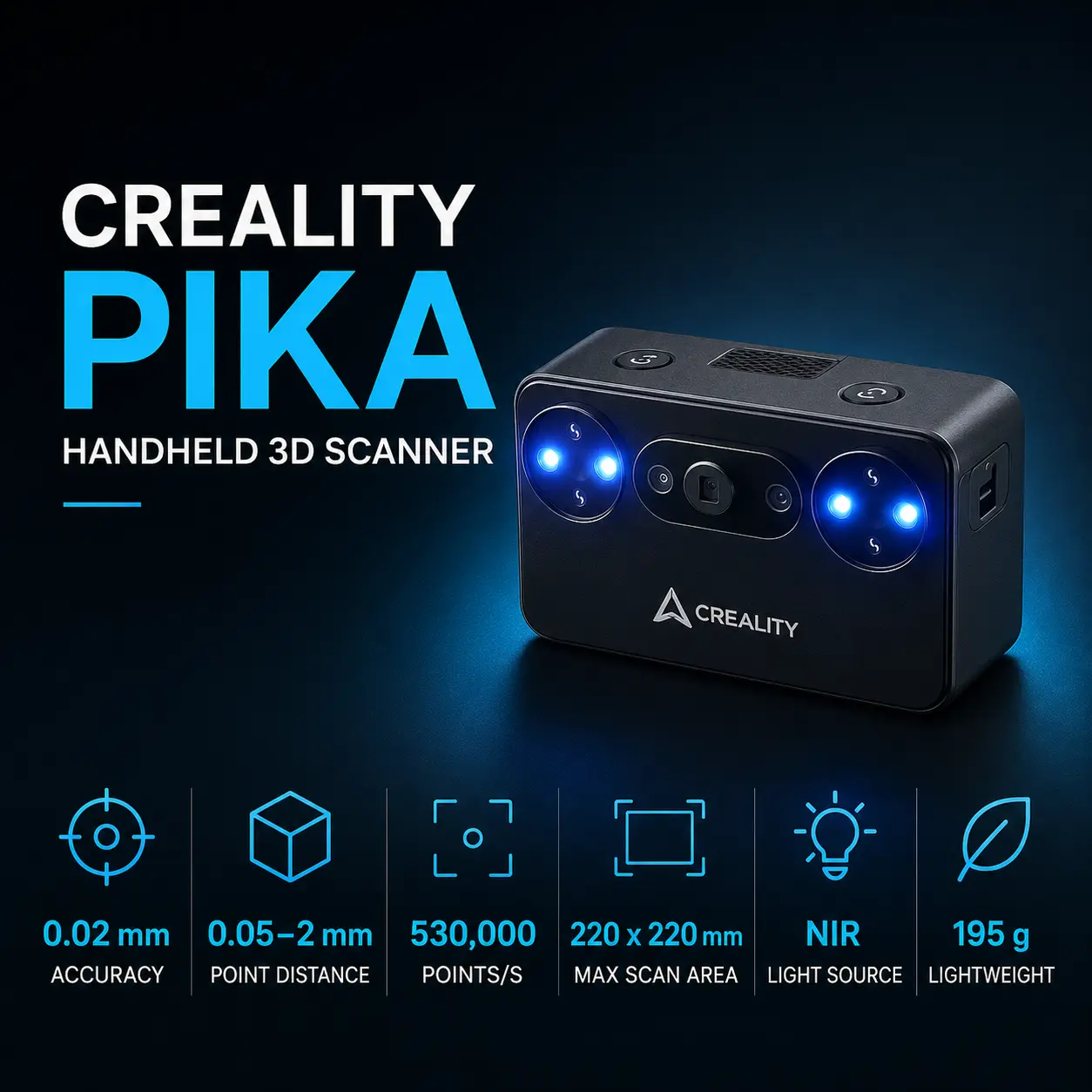
| Creality Pika | 7-line blue laser + NIR | 0.03 mm blue laser | Up to 2 × 2 × 2 m | 110 FPS blue laser PC | Smaller battery-powered creative scanner |
| Revopoint INSPIRE 2 | 11-line infrared laser + IR structured light | 0.05 mm | Up to 2 × 2 × 2 m | 90 FPS laser | Lower-cost Revopoint hybrid |
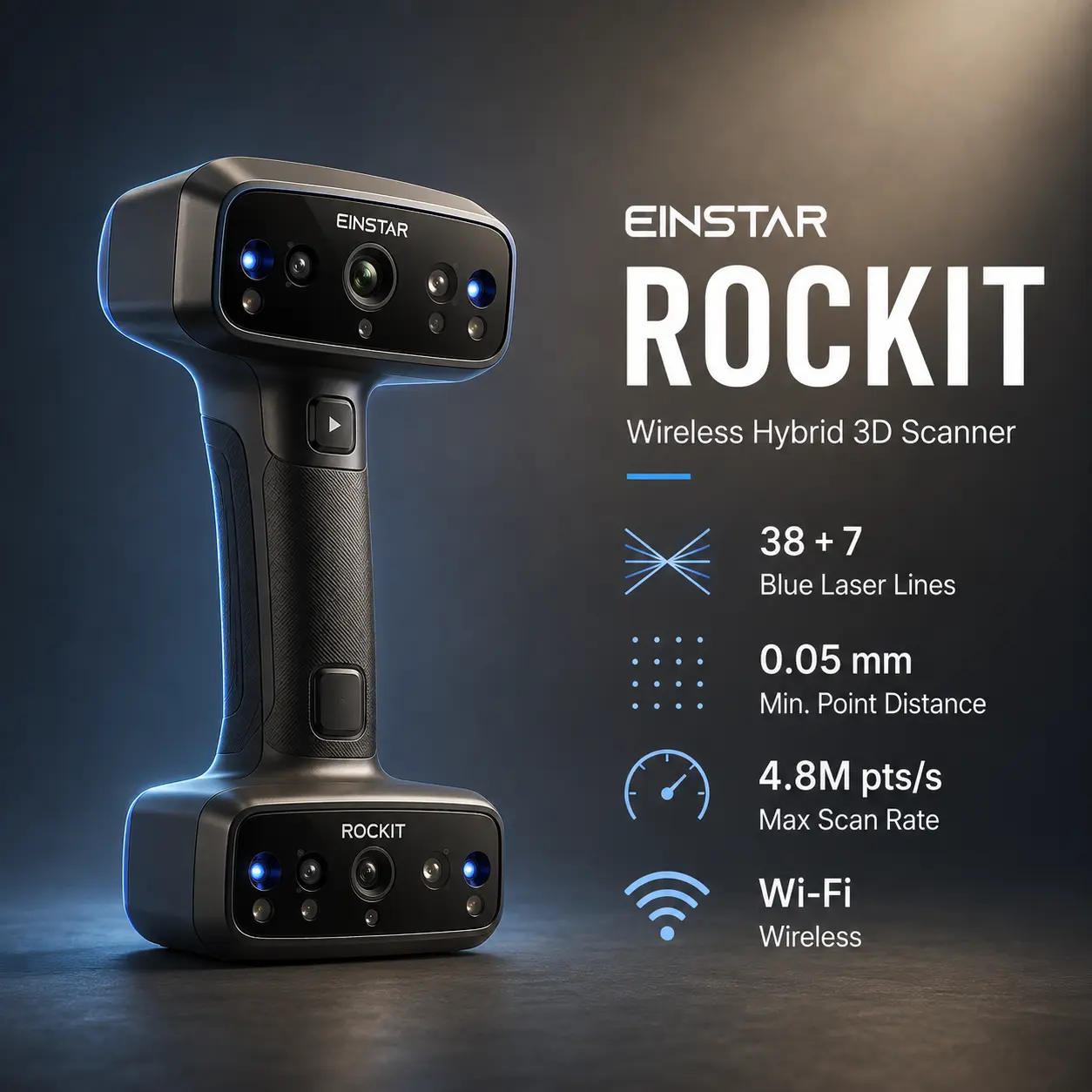
| SHINING 3D EINSTAR 2 | 17-line blue laser + IR VCSEL | No universal accuracy value published | IR working distance to 1,400 mm | 4.8M points/s IR | Wireless large-area and body scanning |
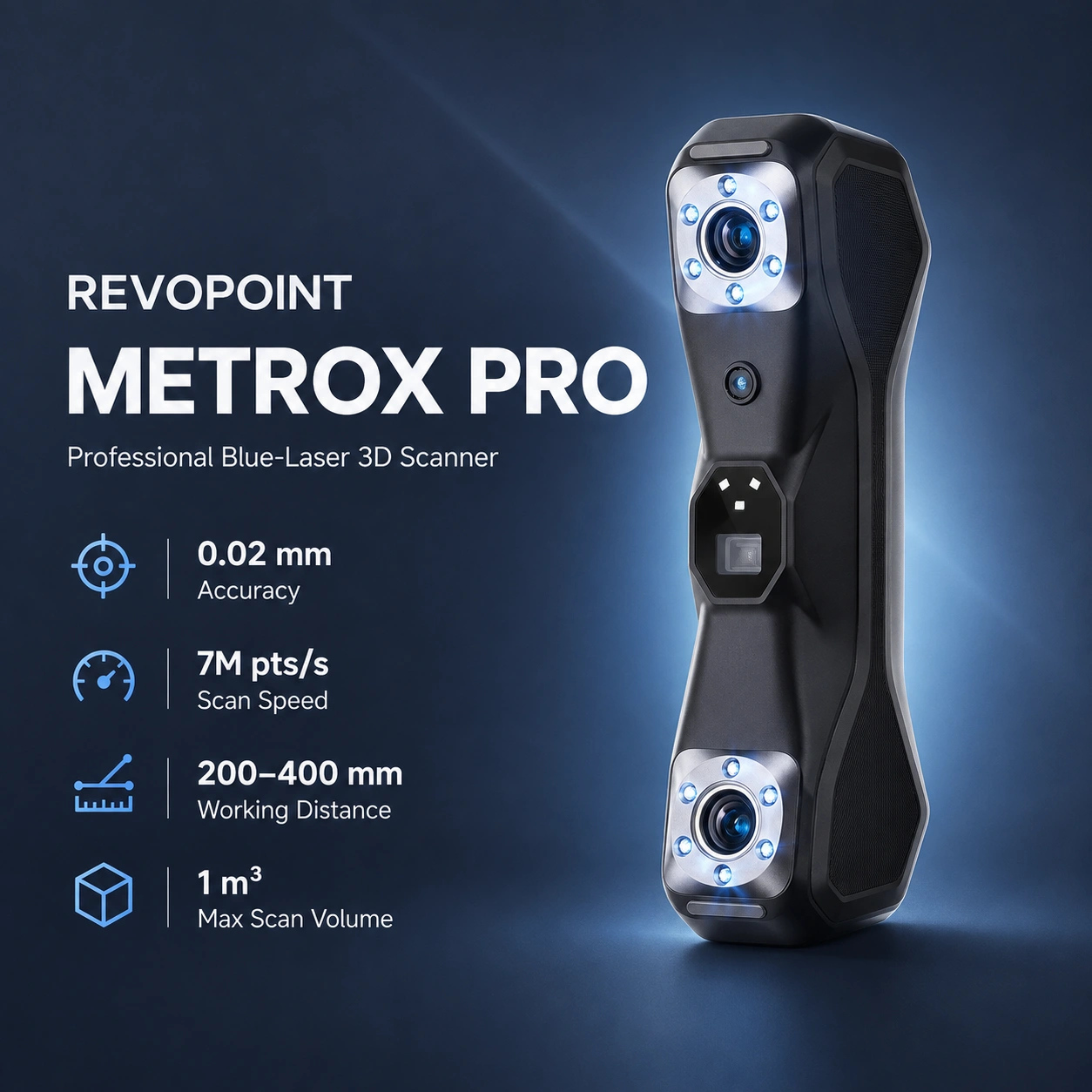
| Revopoint MetroX Pro | Multi-line blue laser + full-field blue light | 0.02 mm | Up to 1 × 1 × 1 m | 2M points/s laser; 7M full-field | Precision reverse engineering |
Higher scan rate does not automatically mean higher dimensional accuracy.
The Revopoint POP 4 vs Creality Pika comparison is especially close for portable hybrid scanning.
The Creality Pika uses seven parallel blue laser lines plus NIR structured light. Creality publishes up to 0.03 mm blue-laser accuracy, up to 110 FPS on PC, and a 2 × 2 × 2 m overall scan range.
Pika is smaller at about 260 g including its removable battery and has a built-in touchscreen plus two removable 3,350 mAh batteries. It can also perform marker-free blue-laser scanning in Creality's supported wired-PC workflow.
POP 4 offers a denser 30-cross-line laser pattern, a dedicated deep-hole line, five scanning modes, published volumetric accuracy, full-field HD, VCSEL Rapid, and Revopoint's integrated Revo Design / Revo Measure ecosystem.
Choose Pika when compact size, integrated batteries, touchscreen operation, and creative portability are the priority. Choose POP 4 when reverse engineering, recessed geometry, multiple optical modes, and a broader scan-to-CAD workflow matter more.
The Revopoint INSPIRE 2 uses 11 parallel infrared laser lines plus infrared structured light. Revopoint publishes 0.05 mm single-frame accuracy, 0.05 mm + 0.1 mm × L volumetric accuracy, up to 90 FPS laser scanning, and a 2 × 2 × 2 m maximum scan volume.
POP 4 improves the engineering side with 0.03 mm blue-laser accuracy, 30 crossed laser lines, a dedicated deep-hole line, faster 105 FPS laser capture, outdoor VCSEL scanning to 100,000 lux, and a 0.05 mm fused point-distance specification.
INSPIRE 2 is lighter and typically less expensive. Choose it for lower-cost general hybrid scanning; choose POP 4 when finer reverse-engineering data, difficult surfaces, deep features, and higher-performance laser scanning justify the step up.
The SHINING 3D EINSTAR 2 combines 17 parallel blue laser lines with IR VCSEL. Laser HD reaches up to 2.5 million points/s and IR Rapid up to 4.8 million points/s. Working distance extends to 1,400 mm in IR Rapid, while built-in Wi-Fi and a removable 5,500 mAh battery support cable-free scanning.
SHINING 3D does not publish one universal numerical accuracy value for EINSTAR 2; its often-quoted 0.05 mm figure is Laser HD point distance, not measurement accuracy.
POP 4 publishes explicit 0.03 mm blue-laser single-frame accuracy and volumetric accuracy while also adding deep-hole scanning and full-field HD.
Choose EINSTAR 2 when built-in wireless operation, large field of view, body scanning, and longer working distance are the priority. Choose POP 4 when a published dimensional accuracy framework, lower weight, and small-to-medium reverse-engineering work matter more.
The Revopoint MetroX Pro is the more specialized reverse-engineering scanner.
It reaches 0.02 mm single-frame accuracy, 0.02 mm + 0.04 mm × L volumetric accuracy, and combines 30 crossed blue laser lines, 15 parallel lines, and full-field blue structured light. Full-field acquisition reaches up to 7 million points/s.
POP 4 is lighter, wireless-capable, outdoor-ready, full-color, body-friendly in infrared modes, and supports a larger 2 m scan volume.
Choose MetroX Pro when controlled small-to-medium engineering work, precision, inspection, and scan-to-CAD tasks dominate. Choose POP 4 when one scanner must move between engineering parts, creative color capture, people, outdoor work, and mobile scanning.
The Revopoint POP 4 price starts from US$839, making it a mid-range option for users looking for a versatile hybrid 3D scanner for reverse engineering, 3D printing, product scanning, and full-color capture. Approximate regional pricing is Canada: C$1,156 · Europe: €718 / £615 · Middle East: AED 3,081 · Australia: A$1,180 · India: ₹80,343.
The Revopoint POP 4 is available through Revopoint and selected regional resellers. Final pricing, availability, shipping costs, taxes, and promotional discounts can vary by country and seller.
It combines 30 crossed blue laser lines, a single deep-hole laser line, NIR full-field structured light, and NIR VCSEL structured light.
Up to 0.03 mm in blue-laser mode, 0.08 mm in full-field mode, and 0.10–0.20 mm in VCSEL mode depending on distance.
0.03 mm + 0.05 mm × L in multi-line laser mode using marker tracking.
Multi-line laser reaches up to 105 FPS with supported GPU acceleration; full-field reaches 20 FPS and VCSEL 30 FPS.
Up to 2 × 2 × 2 m.
200–400 mm laser, 250–500 mm Full-Field/Hybrid, and 300–800 mm VCSEL.
The precision blue-laser workflow uses markers. Infrared modes can use feature or color tracking on suitable objects.
Many dark or reflective surfaces can be captured directly in blue-laser modes, but transparent or strongly specular surfaces may still need preparation.
Yes. VCSEL supports up to 100,000 lux, and blue laser can reach the same level with the Outdoor Blue Filter.
Yes. It has a 1.3 MP RGB camera and Revo Scan 6 supports physically scaled 3D Gaussian Splatting.
No. Portable use requires external power or the optional 5,500 mAh Battery Grip.
Revo Scan 6 is included; Revo Design, Revo Measure and Revo Mirror extend the workflow. Export formats include PLY, OBJ, STL, ASC, 3MF, GLTF, FBX and Splat.
Yes. Its 0.03 mm blue-laser accuracy, volumetric accuracy, deep-hole line and scan-to-CAD ecosystem suit many small-to-medium engineering parts.
Both publish 0.03 mm blue-laser accuracy. Pika is smaller and battery-powered; POP 4 offers 30 crossed lines, five modes, deep-hole scanning an