Intelligent DesignTrue Wireless 3D ScanningHybrid Laser IR ScanningPortable Full-Color ScanningOutdoor ReadySwappable Battery
SSHINING 3D
SHINING 3D
Compact row for standout or scanner-specific features only.
# SHINING 3D EINSTAR 2
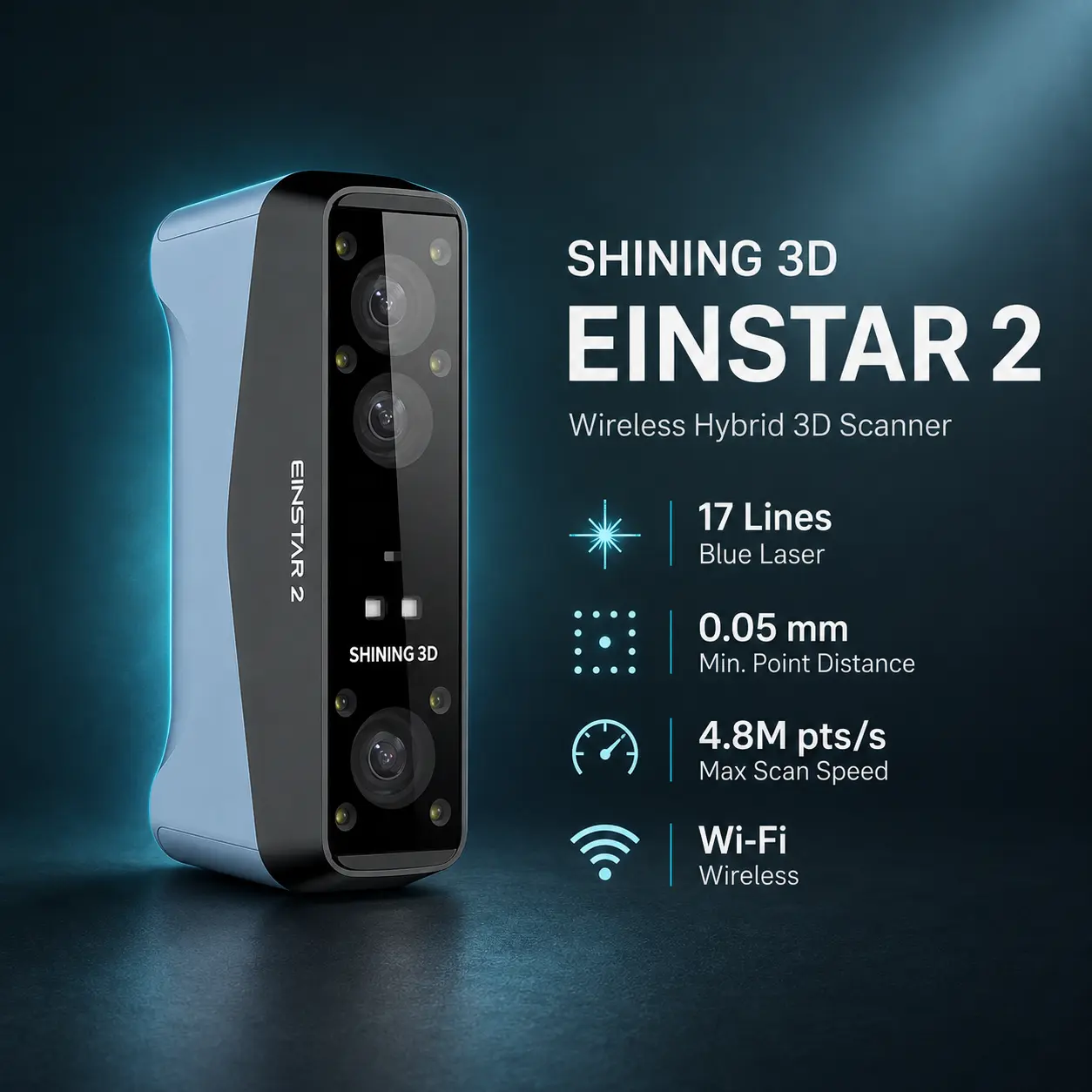
The SHINING 3D EINSTAR 2 is a wireless handheld 3D scanner for 3D printing, reverse engineering, automotive scanning, digital creation, full-color capture, and outdoor 3D scanning. It combines 17 parallel blue laser lines in Laser HD mode with IR VCSEL scanning in IR Rapid mode, covering detailed small-to-medium parts as well as larger marker-free subjects.
Built-in Wi-Fi and a swappable battery enable cable-free scanning without a separate wireless bridge. At approximately 420 g with battery, EINSTAR 2 is designed for portable workshop, studio, vehicle, museum, and outdoor use.
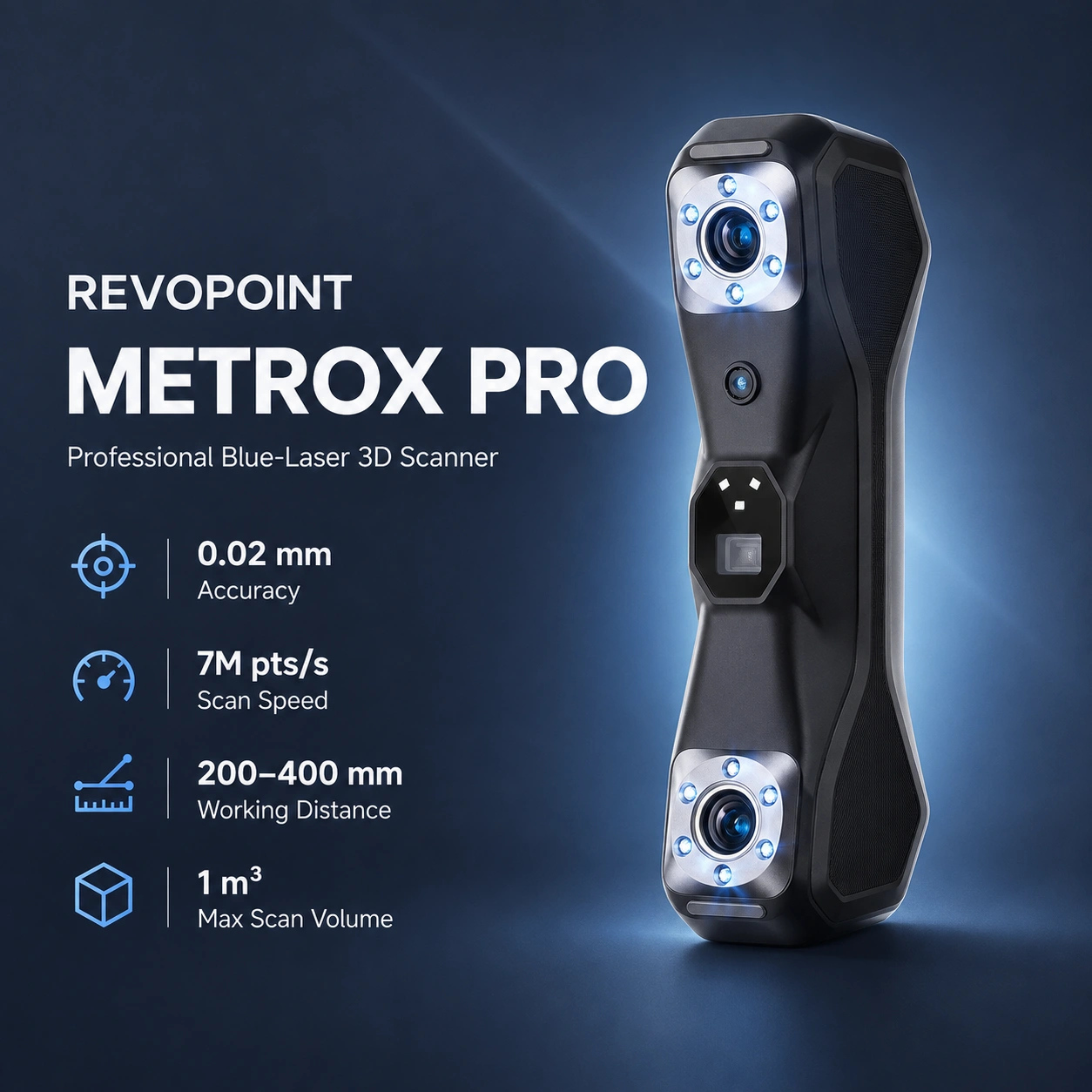
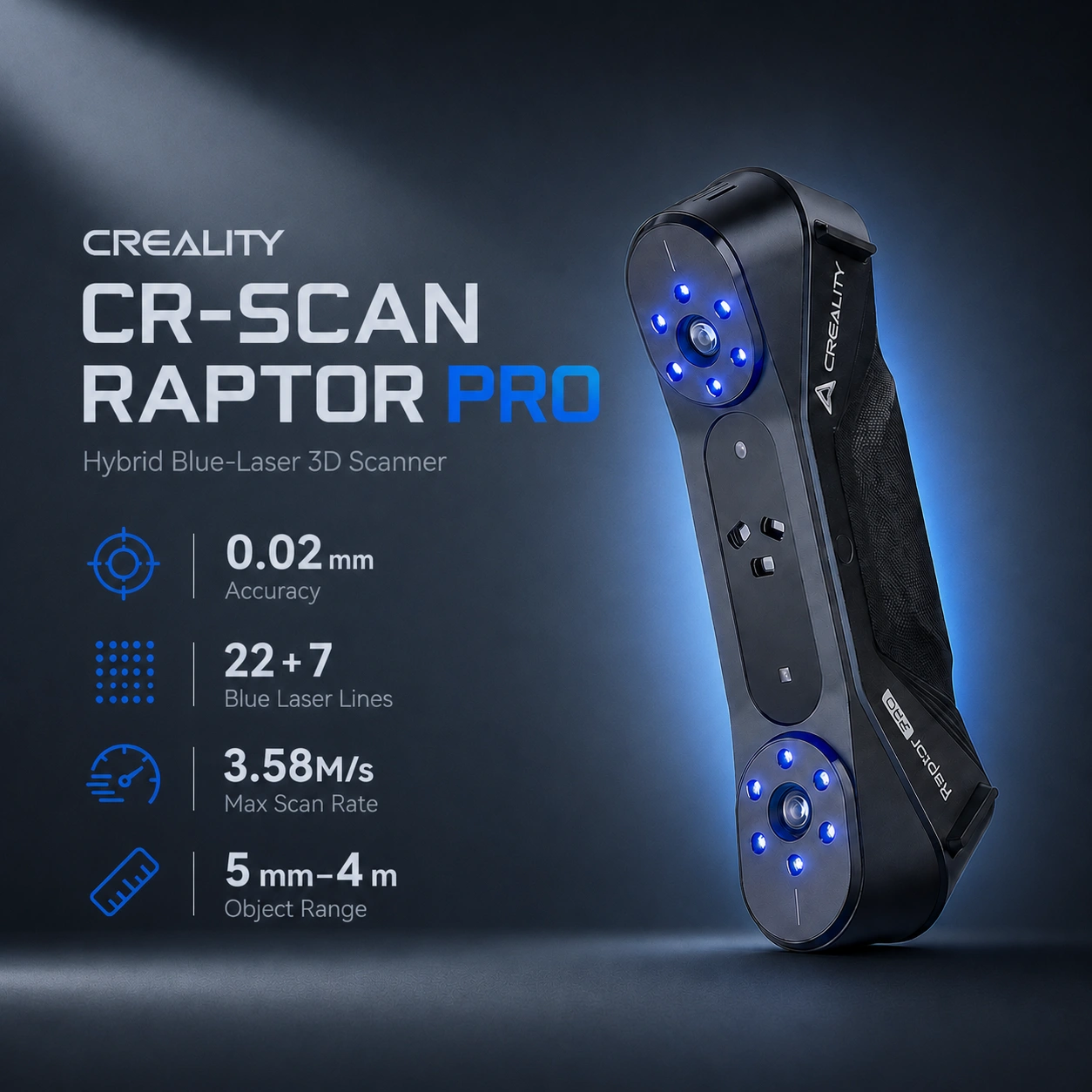
Compared with the original EINSTAR, it adds blue-laser scanning, improves IR tracking, introduces true wireless operation, and uses the newer EXStar Hub platform. Buyers comparing hybrid scanners can also consider the Creality CR-Scan Raptor Pro for a broader 22+7-line blue-laser/NIR workflow or the Revopoint MetroX Pro for precision-focused small-to-medium engineering capture.
Important: Current official specifications list only Marker / Global Marker alignment for Laser HD. Marker-free feature or texture alignment belongs to IR Rapid.
SHINING 3D states that EINSTAR 2 can handle targets from approximately 5 mm details to scenes around 10 m, but this is a broad application range rather than a fixed scan-volume or uniform-accuracy specification.
Note: SHINING 3D does not publish one universal accuracy value for EINSTAR 2. The 0.05 mm figure is minimum Laser HD point distance, not measurement accuracy.
| Specification | Value |
|---|---|
| Scanner Type | Handheld |
| Technology | Blue laser + IR VCSEL |
| Laser Configuration | 17 parallel blue laser lines |
| Laser HD Point Distance | 0.05–10 mm |
| IR Rapid Point Distance | 0.2–10 mm |
| Laser HD Speed | Up to 2,500,000 points/s |
| IR Rapid Speed | Up to 4,800,000 points/s |
| Laser HD Working Distance | 100–600 mm |
| IR Rapid Working Distance | 160–1,400 mm |
| Laser HD Max FOV | 490 × 580 mm |
| IR Rapid Max FOV | 1,170 × 1,385 mm |
| Minimum Scan Volume | 10 mm cube Laser HD; 50 mm cube IR Rapid |
| 3D Cameras | 2 MP × 2 |
| Texture Camera | 2.3 MP |
| Color Capture | Full color |
| Connectivity | Wi-Fi; USB Type-C |
| Battery | 5,500 mAh swappable battery |
| Charging | Supports 60 W USB-PD 3.0 |
| Runtime | Up to approximately 3 hours |
| Weight | 420 g with battery; 348 g without |
| Dimensions | 130 × 37 × 61 mm |
| Laser Class | Class 2 |
| Operating Temperature | -10°C to 40°C |
| Output Formats | STL, OBJ, PLY, 3MF, ASC |
Note: The 4.8 million points/s maximum applies to IR Rapid; Laser HD reaches up to 2.5 million points/s.
Built-in Wi-Fi allows wireless computer connection without an additional bridge. USB Type-C remains available when Wi-Fi interference or workflow requirements make a wired connection preferable.
The replaceable 5,500 mAh battery provides up to approximately three hours of stated scanning runtime.
Note: Official pages conflict on base-package battery count: the FAQ references two batteries and a charger, while the current specification and packing-list presentation show a single battery entry. Confirm regional box contents before purchase.
Laser HD uses Marker or Global Marker alignment. IR Rapid adds Feature, Texture, Hybrid, Marker, and Global Marker tracking, making marker-free capture practical for bodies, sculptures, furniture, vehicle interiors, artwork, and other naturally featured subjects.
Important: EINSTAR 2 is not universally marker-free. Laser HD is marker-based; marker-free Feature/Texture/Hybrid tracking belongs to IR Rapid.
SHINING 3D promotes EINSTAR 2 for black, metallic, and reflective objects, with many surfaces scannable directly without spray. Transparent, mirror-like, extremely glossy, or otherwise difficult surfaces may still require preparation.
Outdoor limits are:
A 2.3 MP texture camera supports full-color scanning for artwork, cultural objects, AR/VR assets, digital replicas, and product visualization.
IR Rapid is the appropriate mode for human scanning. SHINING 3D states that a full-body scan can be captured in approximately 60 seconds under suitable conditions.
Important: Laser HD uses a Class 2 blue-laser system. Use the intended IR workflow for people and portraits.
EINSTAR 2 uses EXStar Hub for scanning, alignment, point-cloud processing, meshing, measurement, and export.
EXModel Personal integrates with EXStar Hub for scan-to-design workflows, including mesh cleanup, primitive extraction, CAD-style sketching, and comparison between reconstructed geometry and the original scan.
Laser HD is useful for detailed mechanical components, automotive parts, and objects that need to become editable digital geometry. Scan data generally requires mesh cleanup or CAD reconstruction before production use.
For additive manufacturing, detailed resin reproductions may suit the Formlabs Form 4. Functional FDM parts may suit the Prusa CORE One+, Bambu Lab H2D, or Creality K2 Plus, depending on material, geometry, size, and required accuracy. Simpler personal-manufacturing projects can also move to an accessible desktop printer such as the Bambu Lab A1.
Current official specifications also list Apple-silicon macOS support with at least 16 GB RAM, while higher-end M3-class systems and 24 GB or more are recommended for heavier work.
Recommended use: Dense point clouds, high-resolution meshing, vehicle scans, and multi-scan projects benefit from hardware above the minimum requirements.
Wireless operation is particularly useful around vehicle interiors, engine bays, bodywork, and other spaces where cables can restrict movement.
| Feature | SHINING 3D EINSTAR 2 | Creality CR-Scan Raptor Pro | Revopoint MetroX Pro |
|---|---|---|---|
| Hybrid Technology | 17-line blue laser + IR VCSEL | 22+7-line blue laser + NIR | Multi-line blue laser + full-field blue structured light |
| Published Universal Accuracy | Not specified | Up to 0.02 mm blue laser | Up to 0.02 mm single-frame |
| Minimum Point Distance | 0.05 mm Laser HD | High-detail blue-laser workflow | Up to 0.05 mm fused point distance |
| Maximum Laser-Mode Rate | 2,500,000 points/s | 660,000 measurements/s crossed laser | 2,000,000 points/s |
| Secondary-Mode Rate | 4,800,000 points/s IR Rapid | 3,580,000 measurements/s NIR | 7,000,000 points/s full-field |
| Wireless Scanning | Built in | Optional Scan Bridge | Computer-tethered workflow |
| Outdoor Scanning | Up to 110,000 lux Laser HD | Mode-dependent | Not officially supported |
| Human Scanning | Yes, IR Rapid | Yes, NIR | Not a primary workflow |
| Main Strength | Wireless versatility and broad creative/engineering use | Automotive and broad hybrid scanning | Precision-focused small/medium engineering work |
Note: Manufacturers use different scan-rate units, methods, and accuracy definitions, so headline figures are not always directly comparable.
Recommended use: Choose EINSTAR 2 when true wireless operation, outdoor scanning, full-color capture, human scanning, and flexible scan-to-print workflows matter most. Consider the Creality CR-Scan Raptor Pro or Revopoint MetroX Pro when more explicitly specified engineering-accuracy workflows are the priority.
Recommended use: EINSTAR 2 is a strong fit for makers, automotive users, designers, artists, and engineering teams seeking one wireless handheld 3D scanner for detailed laser parts, larger IR scans, outdoor work, full-color capture, reverse engineering, and 3D-printing workflows.
It combines 17 parallel blue laser lines in Laser HD mode with IR VCSEL scanning in IR Rapid mode.
SHINING 3D does not currently publish one universal accuracy specification. The 0.05 mm figure is minimum Laser HD point distance, not universal accuracy.
Up to 2,500,000 points/s in Laser HD and up to 4,800,000 points/s in IR Rapid.
Laser HD operates at approximately 100–600 mm and IR Rapid at approximately 160–1,400 mm.
Yes. Current specifications list Marker and Global Marker alignment for Laser HD.
Yes. IR Rapid supports Feature, Texture, and Hybrid alignment for suitable objects.
Yes. Built-in Wi-Fi provides wireless computer connection, with USB Type-C available as a wired option.
SHINING 3D states up to approximately three hours under its test conditions.
Yes. Many black or reflective objects can be scanned directly, although especially difficult surfaces may still need preparation.
Yes. Laser HD is specified below approximately 110,000 lux and IR Rapid below approximately 70,000 lux.
Yes. It has a 2.3 MP texture camera, while IR Rapid supports portrait and full-body scanning; SHINING 3D states full-body data can be captured in about 60 seconds under suitable conditions.
It uses EXStar Hub and exports STL, OBJ, PLY, 3MF, and ASC. EXModel Personal supports additional scan-to-design workflows.
Yes. Laser HD can capture mechanical geometry, while cleaned or reconstructed scans can move into CAD and additive-manufacturing workflows.
EINSTAR 2 prioritizes built-in wireless scanning, outdoor performance, human capture, and broad scan-to-print versatility. The Creality CR-Scan Raptor Pro and Revopoint MetroX Pro provide more explicitly specified high-accuracy engineering workflows.
Refer to the current EINSTAR 2 and EXStar Hub documentation from SHINING 3D.