AI-PoweredNewaddedPocket-Sized Dual-Light ScannerMarker-Free ScanningWireless Creative ScanningCompact Laser NIR Scanner
CCreality
Creality
# Creality Pika
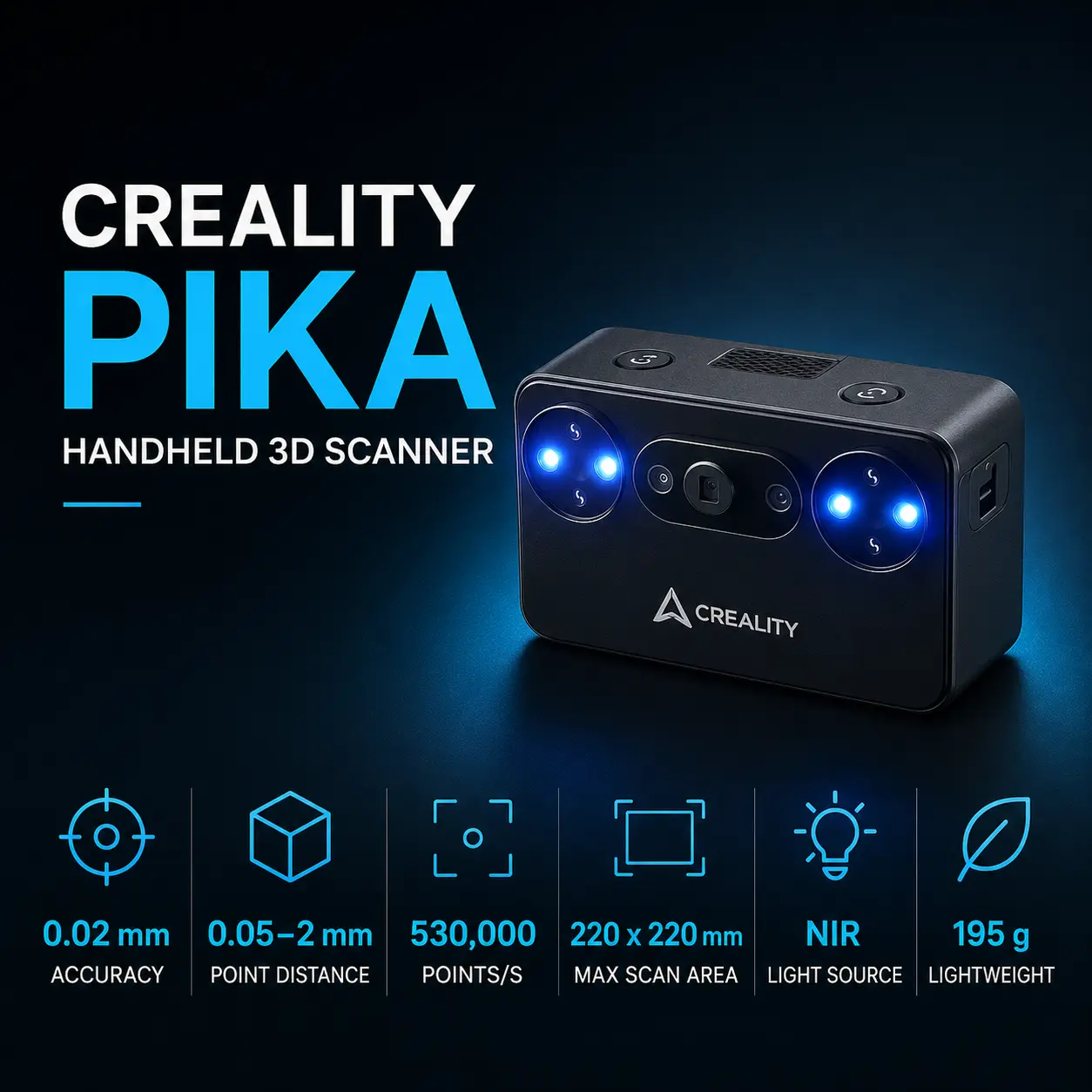
The Creality Pika is a compact hybrid handheld 3D scanner that combines 7 parallel blue laser lines with NIR structured light. It is aimed at makers, 3D-printing users, product designers, digital creators, educators, and users who need a small scanner for everyday object capture and light reverse-engineering work.
At approximately 260 g including the battery, Pika measures about 100 × 60 × 35 mm and includes a 3-inch touchscreen, Wi-Fi 6, USB 3.0 Type-C, and two removable 3,350 mAh batteries.
Its two optical modes serve different jobs. Blue laser is the higher-precision mode, with Creality publishing up to 0.03 mm accuracy, 0.10–2.0 mm point resolution, and scanning up to 110 FPS on a compatible PC. NIR structured light provides a larger capture area, full-color capture, geometry or texture tracking, and body scanning, with published accuracy up to 0.10 mm.
Pika is portable, but it is not a fully standalone scanner. Creality states that it must remain connected to a compatible phone, tablet, or computer while scanning so the host device can provide the processing power needed for live capture and model generation.
For current product specifications, see the official Creality Pika page. Setup and operating guidance are available in the official Pika user documentation. Current ordering status should be checked on the official Creality store.
| Specification | Blue Laser | NIR Structured Light |
|---|---|---|
| Light source | 7 parallel blue laser lines | NIR structured light |
| Published accuracy | Up to 0.03 mm | Up to 0.10 mm |
| 3D resolution / point distance | 0.10–2.0 mm | 0.15–2.0 mm |
| PC scanning speed | Up to 110 FPS | Up to 30 FPS |
| Mobile scanning speed | Up to 40 FPS | Up to 20 FPS |
| Minimum scan volume | 10 × 10 × 10 mm | 150 × 150 × 150 mm on current product page |
| Working distance | 160–400 mm | 200–1,200 mm |
| Single capture area | 101 × 107 mm at 160 mm to 344 × 268 mm at 400 mm | 144 × 134 mm at 200 mm to 764 × 670 mm at 1,000 mm |
| Alignment | Marker / Global Marker / Marker-free | Marker / Global Marker / Geometry / Texture |
| Outdoor-light rating | Up to 110,000 lux | Up to 80,000 lux with filter |
| Color mapping | Supported | Supported |
| Specification | Value |
|---|---|
| Overall advertised object range | Approximately 5 mm to 2,000 mm |
| Published scan range | 10 × 10 × 10 mm to 2,000 × 2,000 × 2,000 mm |
| Processor | 8-core CPU, 2.0 GHz |
| Display | 3-inch touchscreen |
| Battery | 3,350 mAh removable |
| Included batteries | 2 |
| Stated battery life | Up to approximately 70 min per battery |
| Wired interface | USB 3.0 Type-C |
| Wireless | Wi-Fi 6 |
| Input power | 5 V DC, 2 A |
| Dimensions | 100 × 60 × 35 mm |
| Weight | 260 g including battery |
| Laser safety | Class I |
| Export formats | STL, OBJ, PLY, ASC |
Important: Accuracy and point resolution are different metrics. The 0.10 mm and 0.15 mm values describe point resolution, while Creality separately publishes up to 0.03 mm blue-laser accuracy and up to 0.10 mm NIR accuracy.
Note: Creality states that accuracy is measured under laboratory conditions. Vibration, temperature, surface properties, exposure, tracking quality, and operator technique can affect real results.
The 7-line blue-laser mode is the better choice when detail and dimensional fidelity matter more than wide-area capture.
Creality publishes:
The blue-laser workflow can scan many dark and metallic objects without scanning spray under suitable conditions.
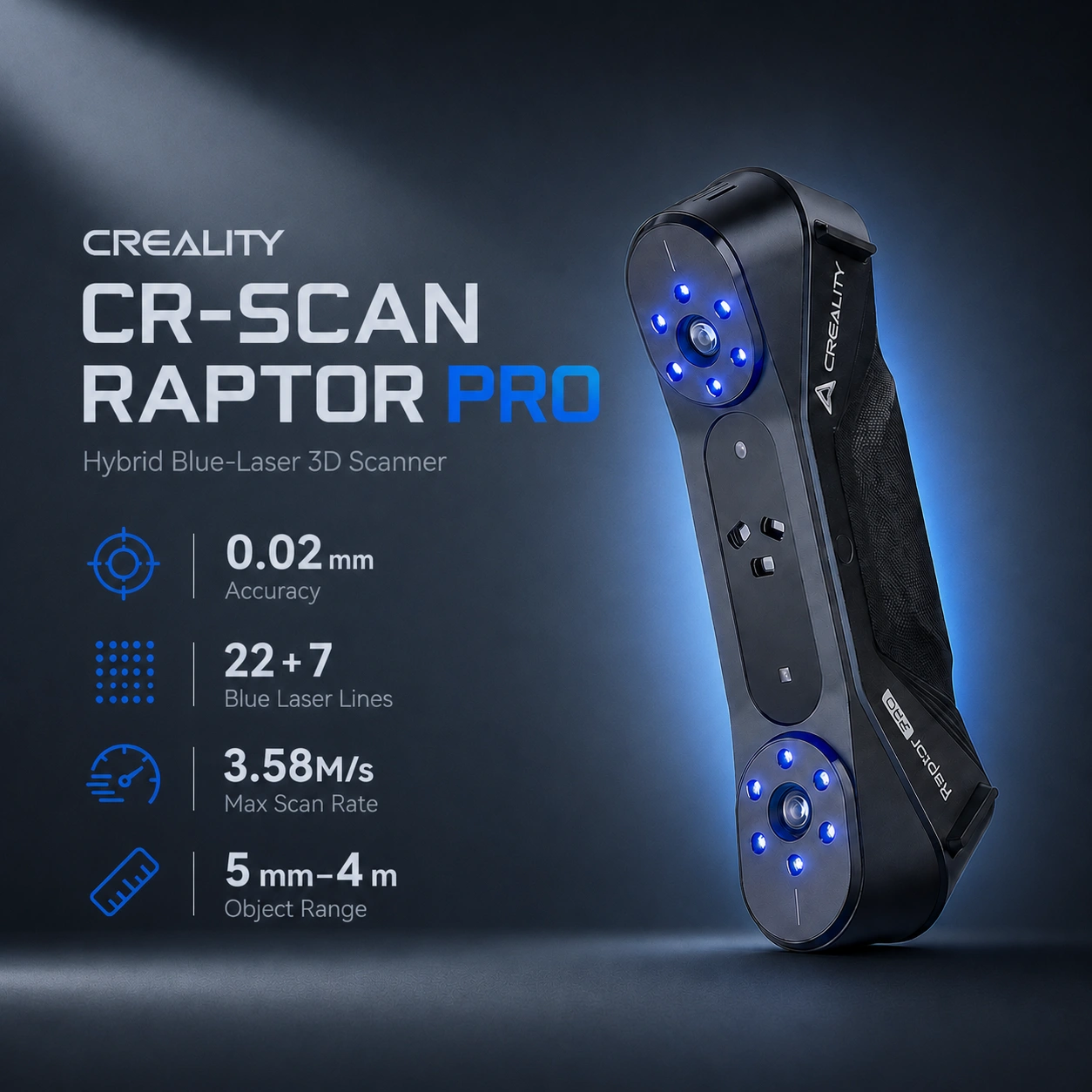
For a more professional hybrid scanner with stronger inspection and reverse-engineering positioning, compare the Creality CR-Scan Raptor Pro.
Pika supports marker-free blue-laser scanning, but Creality currently limits that function to the wired PC workflow.
That limitation is important because the scanner also supports Wi-Fi and mobile operation, and it would be misleading to imply that marker-free laser tracking is available identically across every connection mode.
Markers remain useful for:
Blue laser also supports Marker and Global Marker alignment.
NIR is the more flexible mode for larger objects, people, sculptures, and visually distinctive subjects.
Current Creality product specifications list:
NIR is the appropriate mode for human-body scanning and wider-area color capture.
Pika supports color mapping, while the NIR workflow is specifically promoted for 24-bit full-color capture.
CrealityScan can also use AI Re-Texturing. This allows high-resolution photographs from a phone or camera to be mapped onto the scanned geometry for improved visual detail.
That is useful for:
For reverse engineering, texture quality does not improve the dimensional accuracy of the geometry.
Creality currently documents several AI-assisted processing features for Pika through the PC version of CrealityScan.
Additional high-resolution photographs can be used to improve texture detail and color appearance.
The software can automatically repair missing mesh regions.
A scanned face/head can be combined with a body photograph to generate a complete digital body model.
Important: AI-completed or hole-filled regions can include synthesized geometry. They should not be treated as directly measured surface data for dimensional inspection or reverse engineering.
CrealityScan now documents Gaussian Rendering / Gaussian Splatting workflows.
Current official software documentation lists:
The current Gaussian workflow is Windows-only and requires an NVIDIA GeForce RTX 2060 or better with at least 8 GB VRAM.
See the official Creality Gaussian Rendering guide.
Gaussian Splatting is intended for visual realism and digital presentation. It should not be confused with a metrology mesh or a parametric CAD model.
Pika's strongest hardware advantage is portability.
At 260 g, it is light enough for a camera bag or mobile scanning kit. Two removable 3,350 mAh batteries are included.
Creality states up to approximately 70 minutes per battery under its test conditions.
Because the batteries are removable, a depleted pack can be replaced instead of waiting for the scanner body to recharge.
Actual runtime depends on Wi-Fi use, scan mode, screen use, ambient conditions, and battery age.
The built-in screen and processor make Pika easier to operate, but they do not replace the host device.
Creality explicitly states that Pika must connect to a:
The connected device handles the heavier scan-processing and model-generation workload.
For a scanner with integrated onboard processing and storage, compare the Revopoint MIRACO Plus.
Pika supports:
CrealityScan supports Windows, macOS, Android, and iOS workflows.
The scanner's exact feature set can vary by platform and connection type. Marker-free blue-laser scanning, for example, is currently documented for wired PC use rather than every wireless/mobile configuration.
Pika uses CrealityScan for capture, fusion, meshing, color mapping, alignment, basic editing, and export.
Supported output formats include:
Creality's software documentation specifies:
These formats are suitable for downstream 3D printing, mesh editing, visualization, and reverse engineering.
Pika can be useful for light reverse engineering and scan-to-print work.
Typical workflow:
A scan mesh is not automatically a parametric CAD model.
For more demanding workflows, compare the Revopoint MetroX Pro or Creality CR-Scan Raptor Pro.
For broader buying guidance, see Best 3D Scanners for Reverse Engineering in 2026.
Pika is a useful example of why these scanner specifications should not be merged.
For more detail, see 3D Scanner Accuracy vs Resolution: What Actually Matters in 2026?.
| Scanner | Main Strength | Published Accuracy | Portability |
|---|---|---|---|
| Creality Pika | Pocket-size hybrid blue laser + NIR | Up to 0.03 mm blue laser | 260 g, removable batteries |
| CR-Scan Raptor Pro | Professional laser/NIR reverse engineering | Up to 0.02 mm blue laser | Larger professional workflow |
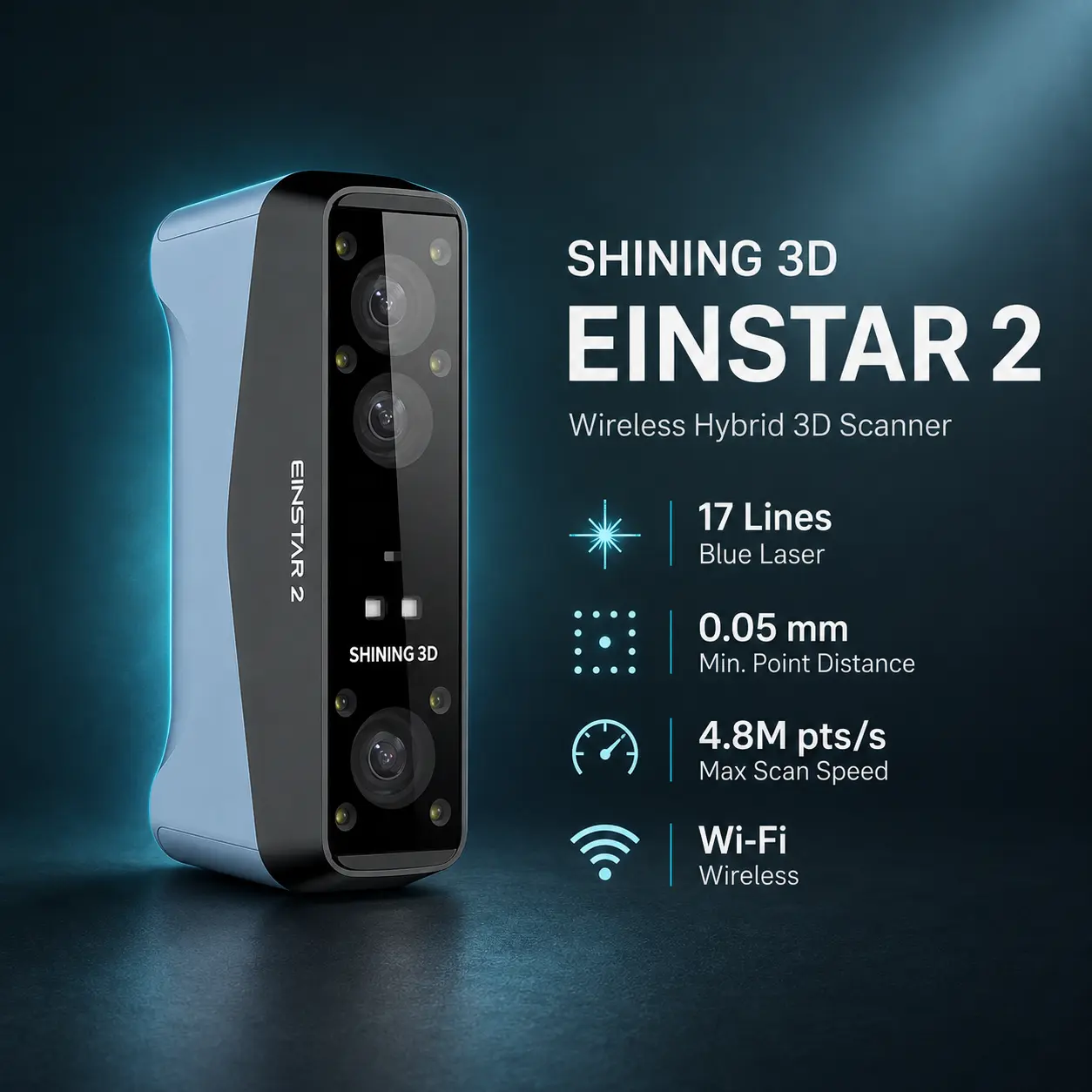
| EINSTAR 2 | Wireless hybrid laser + IR | No universal numerical accuracy published | Replaceable battery |
| MetroX Pro | Precision blue-light reverse engineering | Up to 0.02 mm | Tethered professional workflow |
| MIRACO Plus | Standalone all-in-one scanning | Up to 0.04 mm | Integrated processing and storage |
Pika is strongest when small size, mobile use, creative workflows, and useful blue-laser detail matter more than a full professional metrology workflow.
Recommended use: Choose Creality Pika when portability, scan-to-print work, creative capture, education, product digitization, and light reverse engineering matter more than full professional metrology capability. Use a blue laser when dimensional detail is the priority and NIR when body scanning, color, or wider-area capture is more important.
It combines seven parallel blue laser lines with NIR structured light.
Creality publishes up to 0.03 mm in blue-laser mode and up to 0.10 mm in NIR mode.
Blue laser uses 0.10–2.0 mm point resolution, while NIR uses 0.15–2.0 mm.
Blue laser reaches up to 110 FPS on PC and 40 FPS on mobile. NIR reaches up to 30 FPS on PC and 20 FPS on mobile.
Yes, but Creality currently specifies marker-free laser scanning for the wired PC workflow.
Yes. Color mapping is supported, and NIR is specifically promoted for 24-bit full-color capture.
No. It must remain connected to a compatible phone, tablet, or computer during scanning.
Creality states up to approximately 70 minutes per battery, and two removable batteries are included.
STL, OBJ, PLY, and ASC.
Yes. Creality lists blue laser up to 110,000 lux and NIR up to 80,000 lux with the supplied filter.
Yes through supported current CrealityScan workflows. Creality's current Gaussian Rendering documentation requires Windows and a compatible NVIDIA RTX GPU.
Creality's official US store currently labels Pika as a pre-order product, so this listing treats it as coming soon rather than normal in-stock retail availability.