Marker-Free Laser ScanningWireless Automotive Scanning. Hybrid Laser IR ScanningPortable Reverse EngineeringOutdoor Ready ScanningFull Color 3D Capture
SSHINING 3D
SHINING 3D
# EINSTAR Rockit
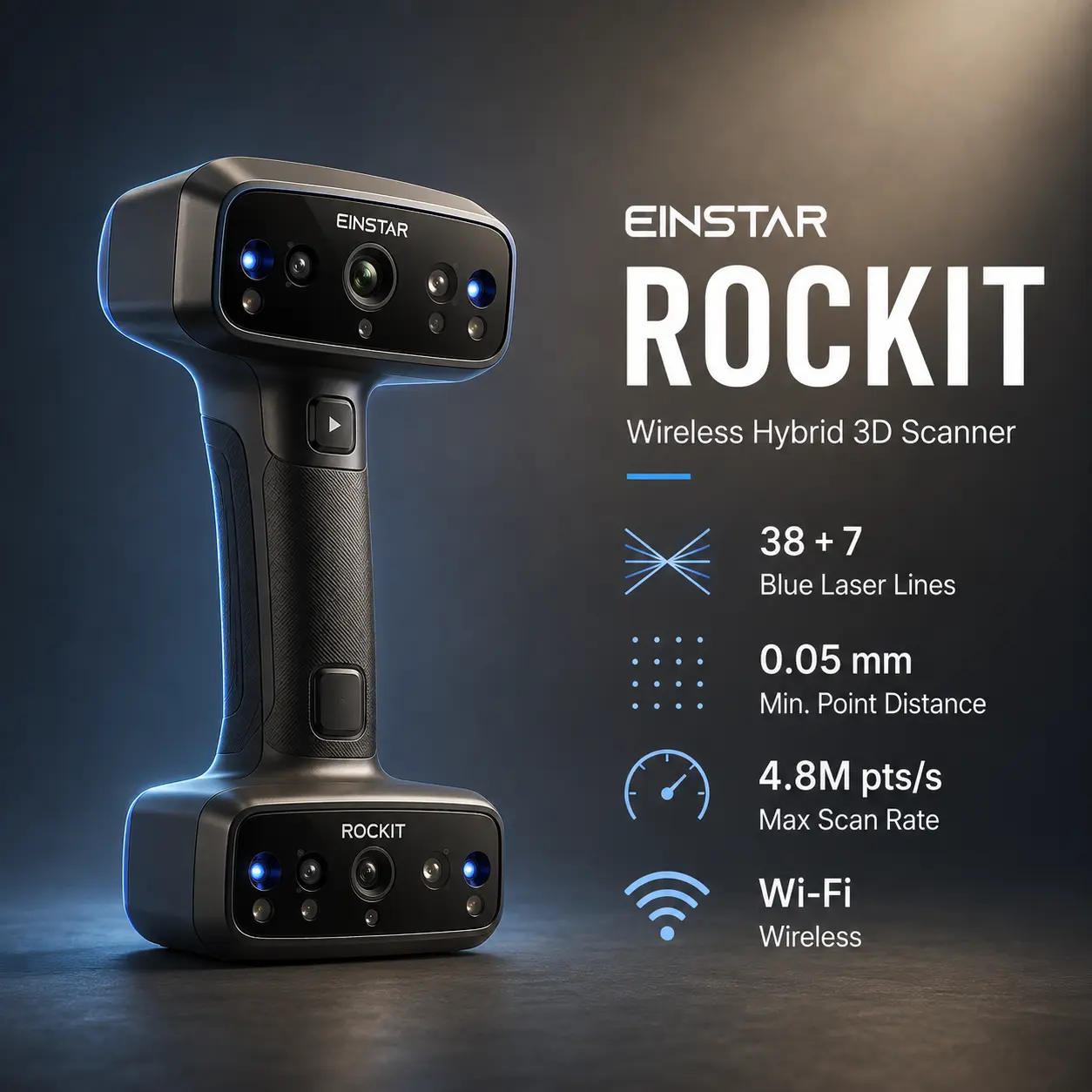
The EINSTAR Rockit is a compact wireless handheld 3D scanner aimed at automotive work, reverse engineering, product development, 3D printing, digital content creation, and portable outdoor capture.
It combines two optical systems:
The two modes serve different jobs. Laser HD prioritizes local detail, difficult engineering surfaces, and smaller mechanical geometry. IR Rapid provides a much larger field of view and longer working distance for people, interiors, vehicle sections, sculptures, and other medium-to-large subjects.
Rockit's other major advantage is mobility. The scanner has built-in Wi-Fi, so wireless scanning to a computer does not require a separate bridge or hub. A removable 5500 mAh battery supplies power, while USB Type-C remains available when a wired connection is preferred.
EINSTAR does not publish one universal numerical accuracy value for Rockit on its current specification page. The frequently advertised 0.05 mm figure is the minimum published Laser HD point distance / resolution, not scanner accuracy. Keeping that distinction clear is essential when comparing Rockit with measurement-oriented scanners.
For current specifications and support information, use the official EINSTAR Rockit product page and official Rockit specifications. For US pricing and stock, use the official EINSTAR US store.
| Specification | Value |
|---|---|
| Scanning technology | Blue laser + IR VCSEL |
| Laser HD light pattern | 38 crossed laser lines + 7 parallel laser lines |
| IR Rapid light source | IR VCSEL |
| Laser HD point distance / resolution | 0.05-10 mm |
| IR Rapid point distance / resolution | 0.2-10 mm |
| Laser HD scan rate | Up to 2,800,000 points/s |
| IR Rapid scan rate | Up to 4,800,000 points/s |
| Maximum published frame rate | Up to 90 FPS with marker alignment |
| Crossed-laser working distance | 100-600 mm |
| Parallel-laser working distance | 100-400 mm |
| IR Rapid working distance | 160-1400 mm |
| Crossed-laser maximum FOV | 545 x 620 mm |
| Parallel-laser maximum FOV | 355 x 425 mm |
| IR Rapid maximum FOV | 1170 x 1385 mm |
| Laser HD minimum scan volume | 5 x 5 x 5 mm |
| IR Rapid minimum scan volume | 50 x 50 x 50 mm |
| 3D cameras | 2 MP x 2 |
| Texture camera | 5 MP |
| Output formats | STL, OBJ, PLY, 3MF, ASC |
| Outdoor Laser HD limit | Below 110,000 lux |
| Outdoor IR Rapid limit | Below 70,000 lux |
| Operating temperature | -10C to 40C |
| Connection | Built-in Wi-Fi, USB Type-C |
| Battery | 5500 mAh removable battery |
| Charger support | 60 W USB PD 3.0 |
| Dimensions | 130 x 37 x 61 mm |
| Weight | About 420 g with battery on the current US product page |
| Laser class | Class 2 |
| Ingress / enclosure rating | IP50 |
Important: EINSTAR's 0.05 mm value is a Laser HD point-distance / resolution figure. It must not be entered or described as 0.05 mm scanner accuracy.
Note: The manufacturer's scan rates, field of view, working distance, alignment options, and outdoor-light limits are mode-specific. Do not combine the best value from Laser HD with the best value from IR Rapid as though they occur simultaneously.
Laser HD is the engineering-oriented side of Rockit.
It uses two blue-laser patterns:
The crossed mode is intended for faster coverage, while the parallel mode is better suited to fine geometry and smaller details.
The crossed pattern is formed by 19 + 19 laser lines.
Published specifications include:
This mode is particularly useful for automotive body and mechanical parts, castings, brackets, housings, medium-size components, and broad engineering surfaces.
The parallel-line workflow is intended for finer geometry.
Published working distance:
Published maximum FOV:
Typical uses include small machined features, detailed brackets, edges and grooves, compact mechanical components, and reverse-engineering reference geometry.
EINSTAR states that both crossed and parallel laser workflows can scan suitable feature-rich objects without markers by using feature recognition.
Rockit's marker-free blue-laser capability is one of its main practical differentiators.
EINSTAR states that crossed and parallel laser modes can align scan data through recognizable geometric features. That can reduce setup time on vehicle panels with sufficient geometry, castings, sculpted parts, complex housings, and detailed mechanical components.
However, marker-free does not mean markers are obsolete.
Reflective markers remain valuable for smooth surfaces, repetitive geometry, large low-feature panels, and parts where tracking stability is more important than setup speed.
Laser HD supports Feature, Marker, and Global Marker alignment.
Recommended use: Use feature tracking when the object has enough distinctive geometry. Use markers for smooth, repetitive, or measurement-critical surfaces where stable registration matters more than preparation time.
IR Rapid uses infrared VCSEL structured light rather than blue laser lines.
Its main advantages are wider field of view, longer working distance, fast coverage, geometry and texture tracking, human scanning, and larger-object scanning.
Published specifications include:
Alignment options include Global Marker, Marker, Feature, Texture, and Hybrid.
IR Rapid is therefore the more natural mode for vehicle interiors, seats and dashboards, human bodies, sculptures, furniture, large visual models, and broad surfaces where texture or feature tracking is available.
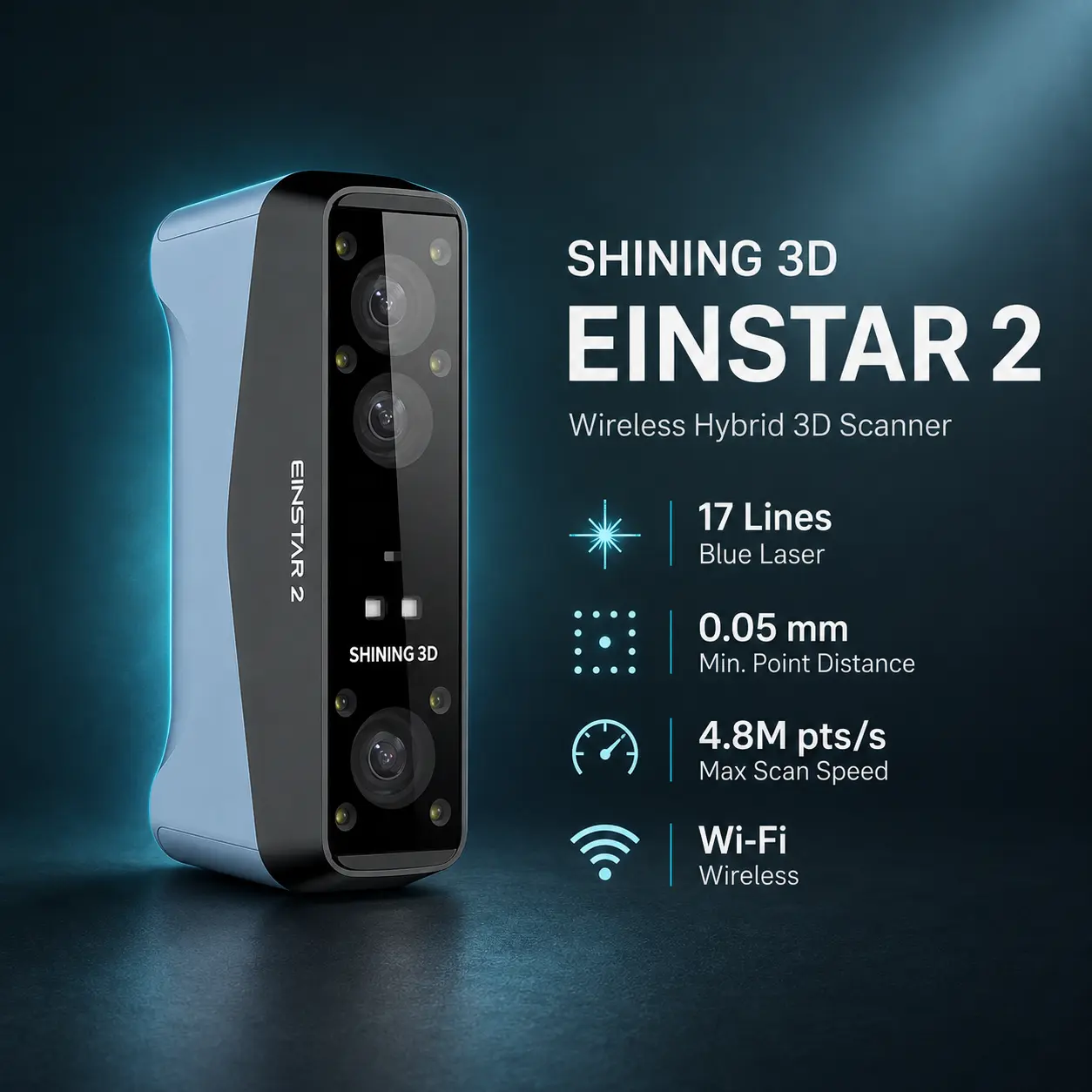
For another indexed hybrid scanner with blue laser and IR structured light, compare the SHINING 3D EINSTAR 2.
Rockit and EINSTAR 2 share the same broad concept of blue-laser plus IR scanning, but their laser systems emphasize different jobs.
| Feature | EINSTAR Rockit | EINSTAR 2 |
|---|---|---|
| Crossed blue laser | 38 lines | No crossed-line mode |
| Parallel blue laser | 7 lines | 17 lines |
| IR VCSEL | Yes | Yes |
| Laser scan rate | Up to 2.8M points/s | Up to 2.5M points/s |
| IR scan rate | Up to 4.8M points/s | Up to 4.8M points/s |
| Minimum laser point distance | 0.05 mm | 0.05 mm |
| Laser minimum scan volume | 5 mm cube | 10 mm cube |
| Built-in Wi-Fi | Yes | Yes |
| Main positioning | Automotive and portable fast laser scanning | General-purpose hybrid scanning |
Rockit is the stronger choice when crossed-laser coverage and marker-free automotive scanning are central to the workflow. EINSTAR 2's 17 parallel lines are attractive when the priority is a wider parallel-laser pattern rather than crossed-line speed.
Rockit's official product specification does not publish a universal numerical accuracy figure.
That means the catalog should leave accuracyMicrons as `null`.
The official figures are:
Resolution and point distance describe sampling density and model detail. They do not independently tell you how close the final scan is to a true dimensional reference.
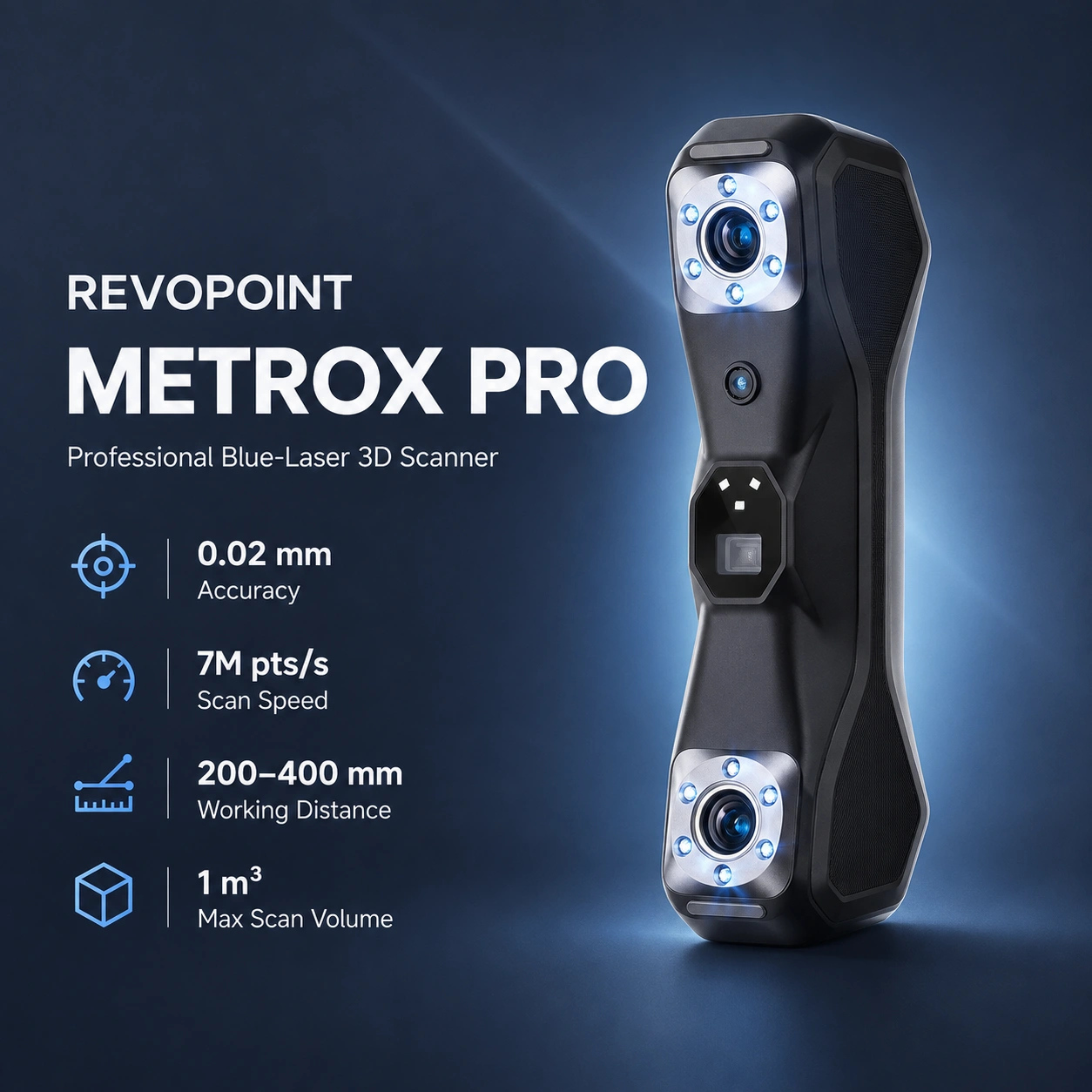
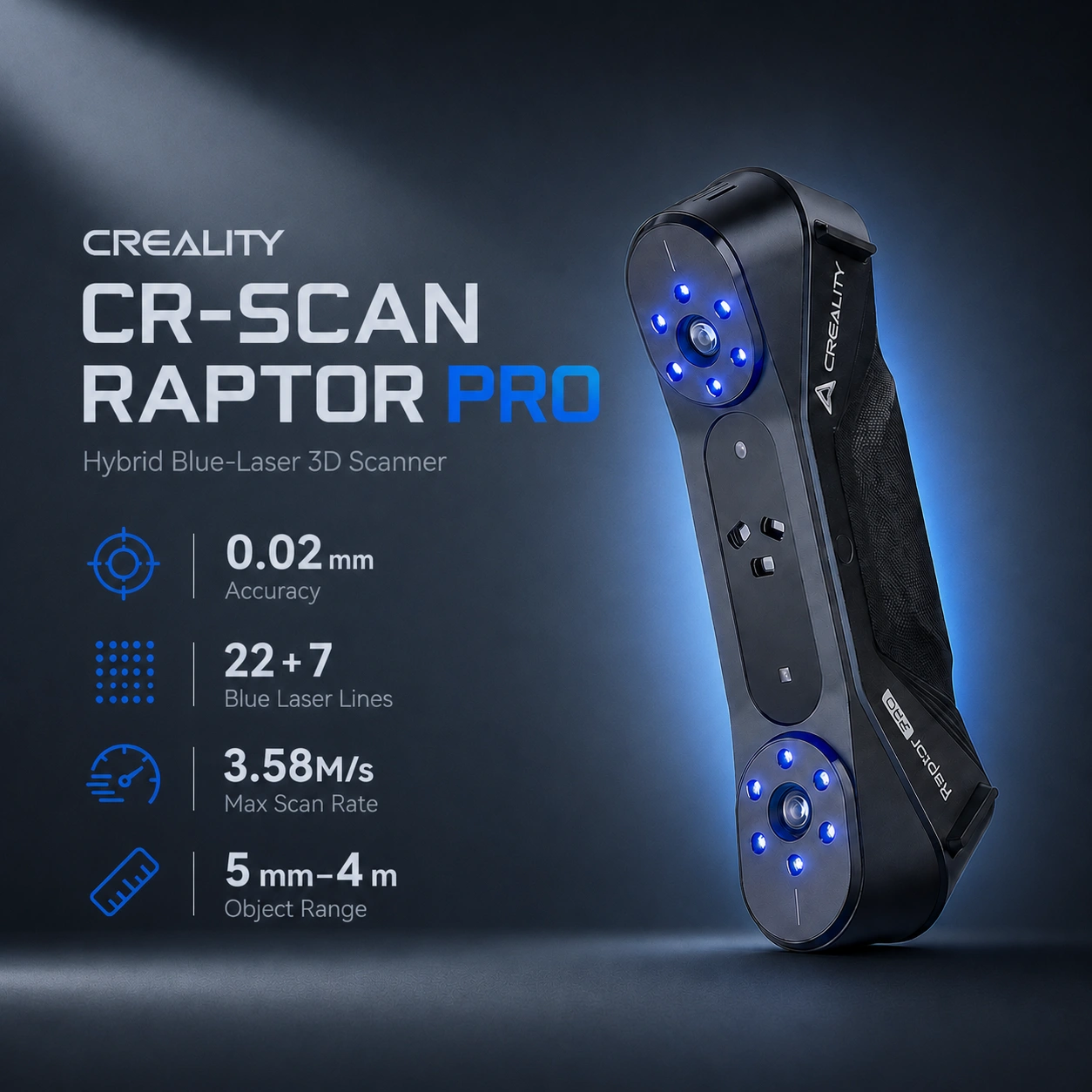
For users who specifically need a published dimensional-accuracy specification, compare the Revopoint MetroX Pro or Creality CR-Scan Raptor Pro, both of which publish mode-specific accuracy figures.
For a deeper explanation, see 3D Scanner Accuracy vs Resolution: What Actually Matters in 2026?.
Rockit includes a built-in Wi-Fi module.
Unlike scanners that need a separate wireless bridge, Rockit connects wirelessly to a compatible computer without an additional hub.
USB Type-C remains available when wireless interference is present, maximum connection stability is preferred, battery operation is unnecessary, or the workstation is close to the scanning area.
The wireless design is especially useful around vehicles, engine bays, interiors, large sculptures, workshop fixtures, and awkward mechanical assemblies.
Rockit uses a removable 5500 mAh battery.
EINSTAR's current FAQ states up to 3 hours of runtime under its test conditions.
The scanner supports 60 W USB PD 3.0 charging.
Actual runtime can vary with wireless activity, scan mode, processing workflow, battery age, and ambient temperature.
Rockit is designed for bright-light and outdoor work.
EINSTAR publishes:
That makes Laser HD the stronger mode in very bright environments.
Outdoor performance still depends on direct sunlight angle, surface reflectivity, scan distance, exposure, tracking quality, and the selected optical mode.
EINSTAR positions Rockit's Laser HD system for direct scanning of many black and reflective engineering surfaces without scanning spray.
That can be useful for black automotive plastics, painted body components, metal housings, cast parts, and machined surfaces.
Important: Transparent, mirror-like, exceptionally glossy, or highly specular surfaces may still require scanning spray, exposure changes, a different angle, or another preparation method.
For another internally indexed scanner aimed at dark and metallic engineering parts, compare the Creality CR-Scan Raptor Pro.
Rockit includes two 2 MP 3D cameras and one dedicated 5 MP texture camera.
The texture camera supports full-color model capture for AR/VR assets, digital art, human scanning, product visualization, and heritage or sculpture capture.
For dimensional reverse engineering, texture is usually secondary to clean geometry and stable tracking.
IR Rapid is the appropriate workflow for scanning people.
EINSTAR markets Rockit for body scanning and states that its IR mode supports large-area capture and hybrid alignment. The product page also advertises fast face-to-feet capture.
Blue laser should still be treated as the engineering workflow rather than the default mode for direct eye-area scanning.
Rockit uses EXStar Hub as its primary scanning and post-processing software.
The software provides scanner connection and calibration, live scanning, alignment, point-cloud processing, mesh generation, editing and cleanup, texture processing, and export.
Supported output formats are:
EINSTAR also offers EXModel Personal for additional mesh-editing and reverse-engineering work.
For advanced scan-to-CAD work, exported mesh data can be transferred into third-party reverse-engineering or CAD tools. A scanner produces point-cloud and mesh data rather than a finished parametric CAD model, so accurate reverse engineering still requires reference planes, feature reconstruction, dimensional checks, and design validation.
Rockit is especially well matched to automotive aftermarket and fabrication work.
Laser HD is useful for brackets, suspension components, engine-bay parts, custom trim, bumper geometry, grilles, and mechanical interfaces.
IR Rapid is useful for vehicle interiors, seats, dashboards, large body regions, and larger visual reference models.
A typical reverse-engineering workflow is:
For a broader buyer guide, see Best 3D Scanners for Reverse Engineering in 2026.
Rockit can generate dense point clouds, particularly during marker-free laser scanning. EINSTAR recommends Windows 11 with a Core i7-13700H-class processor, RTX 3060 Laptop GPU or better, at least 32 GB DDR5 RAM, and 64 GB RAM for smoother marker-free laser work. Apple Silicon Macs are also supported, with 16 GB RAM as a practical minimum and 24 GB or more recommended for heavier projects.
Rockit measures approximately 130 x 37 x 61 mm.
The current US product page lists 420 g with battery and 348 g without battery. A separate current official specifications page has shown a slightly different 425 g battery-included figure, so the catalog uses the current US product-page value while recording the discrepancy in admin notes.
Rockit is also listed with an IP50 enclosure rating.
IP50 should not be described as waterproof. Avoid exposing the scanner to rain or liquid contamination.
| Scanner | Main Strength | Published Accuracy | Wireless |
|---|---|---|---|
| EINSTAR Rockit | Portable marker-free laser + IR automotive scanning | No universal numerical value published | Built-in Wi-Fi |
| EINSTAR 2 | General-purpose hybrid laser + IR | No universal numerical value published | Built-in Wi-Fi |
| CR-Scan Raptor Pro | Hybrid laser/NIR with published mode-specific accuracy | Up to 0.02 mm in blue-laser modes | Optional accessory |
| MetroX Pro | Compact precision blue-light reverse engineering | Up to 0.02 mm | Accessory/workflow dependent |
| MIRACO Plus | Standalone all-in-one structured-light scanning | Up to 0.04 mm | Standalone device |
Rockit's strongest combination is built-in wireless operation, crossed blue-laser coverage, marker-free feature tracking, IR large-object capture, and a compact removable-battery design.
Recommended use: Choose EINSTAR Rockit when automotive and reverse-engineering work benefits from a compact wireless scanner, fast crossed blue-laser coverage, marker-free feature tracking, and IR capture for larger objects. If a published dimensional-accuracy figure is mandatory for your inspection workflow, compare a scanner with an explicit manufacturer accuracy specification rather than treating Rockit's 0.05 mm point distance as accuracy.
It combines 38 crossed and 7 parallel blue-laser lines in Laser HD mode with IR VCSEL structured light in IR Rapid mode.
EINSTAR does not publish one universal numerical accuracy specification on the current Rockit specifications page. The 0.05 mm value is the minimum Laser HD point distance / resolution, not accuracy.
Laser HD supports 0.05-10 mm point distance / resolution. IR Rapid supports 0.2-10 mm.
EINSTAR publishes up to 2.8 million points/s in Laser HD and 4.8 million points/s in IR Rapid. The product page also advertises up to 90 FPS with marker alignment under supported conditions.
Crossed laser works from 100-600 mm, parallel laser from 100-400 mm, and IR Rapid from 160-1400 mm.
IR Rapid reaches up to 1170 x 1385 mm. Crossed laser reaches up to 545 x 620 mm, while parallel laser reaches up to 355 x 425 mm.
Not always. EINSTAR supports marker-free feature tracking in both crossed and parallel laser modes on suitable feature-rich objects. Markers remain useful for smooth or low-feature surfaces.
Yes. It has built-in Wi-Fi and does not require an external wireless bridge. USB Type-C is also available.
EINSTAR states up to approximately three hours of runtime under its test conditions. The battery is removable.
Yes. Laser HD is specified below 110,000 lux and IR Rapid below 70,000 lux.
Many black and reflective automotive or engineering surfaces can be scanned directly in Laser HD, but transparent, mirror-like, or highly specular surfaces may still require preparation.
Yes. It includes a dedicated 5 MP texture camera.
EXStar Hub is the primary scanning and processing software. EXModel Personal is available for additional mesh and reverse-engineering work.
EINSTAR lists STL, OBJ, PLY, 3MF, and ASC.
No. EINSTAR lists an IP50 rating, which should not be interpreted as waterproof protection.
The official US store currently shows Rockit at US$1,899, reduced from US$1,999, but the base listing is sold out. Check the current manufacturer page because pricing and inventory can change.