12 Nozzle Tool ChangingMulti material PrintingHigh Speed CoreXYHeated Chamber PrintingCarbon Fiber ReadyLow-Waste Color Printing
AAtomForm
AtomForm
# AtomForm Palette 300
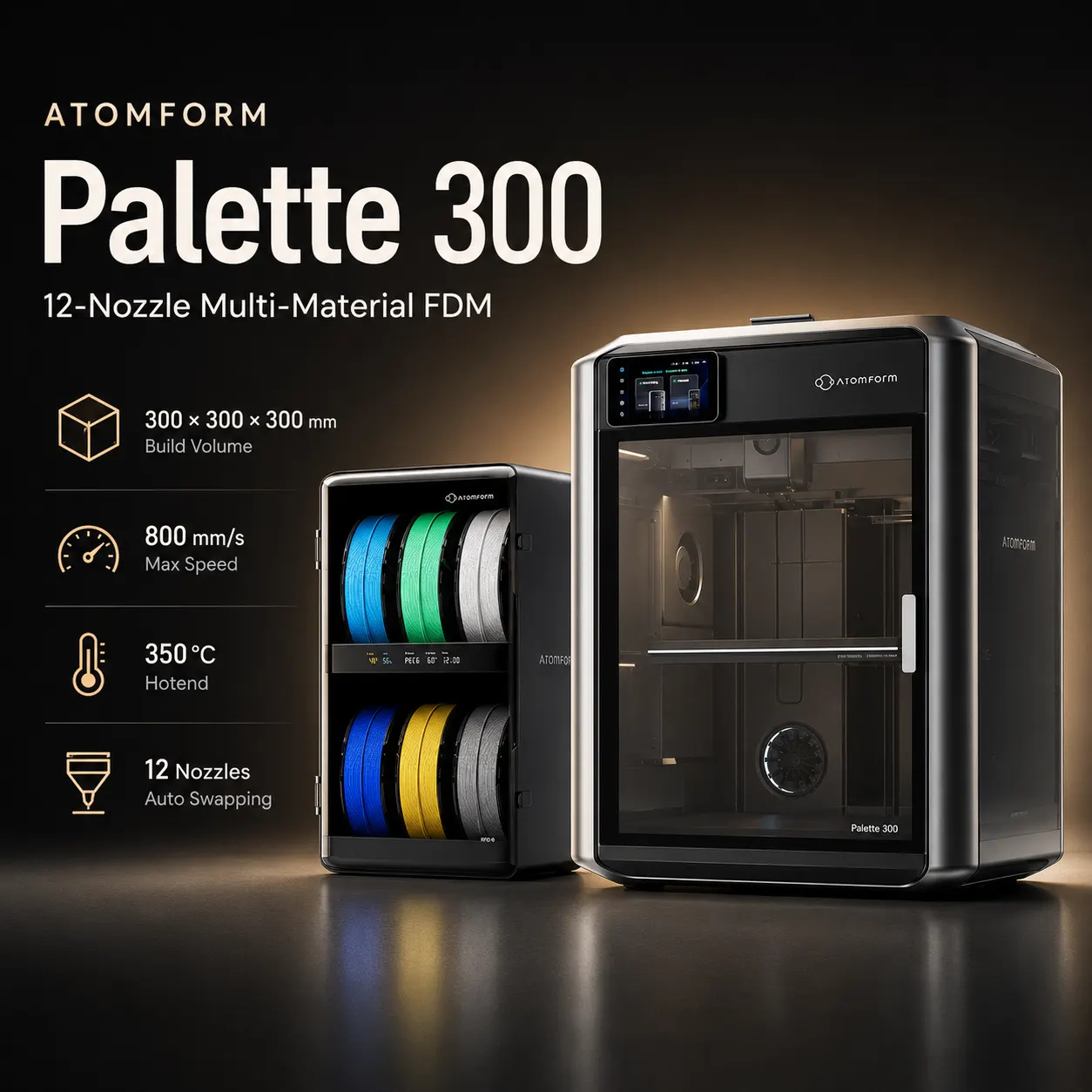
The AtomForm Palette 300 is a fully enclosed multi-color and multi-material FDM/FFF printer built around the OmniElement automatic nozzle-swapping system. Instead of forcing every color or material through one shared melt path, the machine can keep as many as 12 dedicated nozzles ready for different filaments and nozzle diameters.
AtomForm and parent brand MOVA currently publish a 300 × 300 × 300 mm build volume, 800 mm/s maximum print speed, 350°C hotend, 110°C heated bed, and 65°C actively heated chamber. The current detailed MOVA specification table lists 20,000 mm/s² maximum acceleration.
The nozzle system supports 0.2, 0.4, 0.6, and 0.8 mm diameters with automatic identification, visual installation checks, and position calibration rated up to ±0.02 mm under specified conditions.
The six-slot RFD-6 adds drying up to 85°C, temperature/humidity monitoring, automated venting, and supported print-while-drying workflows. MOVA currently states that up to six RFD-6 units can manage 36 colors.
For current information, see the official AtomForm Palette 300 site and the current MOVA Palette 300 product page.
| Specification | Value |
|---|---|
| Printing technology | FDM / FFF |
| Enclosure | Fully enclosed |
| Build volume | 300 × 300 × 300 mm |
| Automatic nozzle capacity | Up to 12 |
| Supported nozzle diameters | 0.2 / 0.4 / 0.6 / 0.8 mm |
| Maximum print speed | 800 mm/s |
| Maximum acceleration | 20,000 mm/s² on current MOVA product page |
| Maximum nozzle temperature | 350°C |
| Maximum bed temperature | 110°C |
| Maximum chamber temperature | 65°C |
| Included build surface | Textured PEI |
| Nozzle positioning accuracy | Up to ±0.02 mm under stated test conditions |
| Printer dimensions | 462 × 479 × 579 mm |
| RFD-6 dimensions | 316 × 278 × 507 mm |
| Air filtration | HEPA + activated carbon |
| Bed leveling | Triple independent Z-axis with probe-assisted calibration |
| Motion calibration | Automatic belt tensioning, flow calibration, input shaping |
| Monitoring | Chamber, printhead, calibration and nozzle cameras |
| Failure detection | First-layer, buildup, spaghetti and build-plate recognition |
| Filament system | RFD-6, six slots per unit |
| RFD-6 drying | Up to 85°C |
| Maximum RFD-6 expansion | Up to 6 units on current MOVA page |
| Managed color capacity | Up to 36 colors |
| Software | AtomForm Slicer |
| Current commercial status | Coming Soon |
The speed, waste, swap-time, positioning, and noise figures are manufacturer measurements. Independent production testing remains limited because normal retail availability has not yet been established.
The Palette 300's main differentiator is its OmniElement nozzle carousel.
Each nozzle can remain associated with a particular material, color, or diameter. When the print requires another tool, the machine swaps the nozzle rather than relying only on a long purge through one shared hotend.
AtomForm combines this with automatic nozzle identification and visual calibration. The system checks nozzle installation and compensates for small XY deviations before printing.
This approach has several potential advantages:
The tradeoff is greater mechanical complexity, so long-term carousel reliability and calibration repeatability remain important unknowns.
The 12-nozzle and 36-color specifications describe different parts of the system.
The printer can keep up to 12 nozzles available through OmniElement.
The current MOVA page states that Palette 300 can connect up to six RFD-6 units, each with six filament positions, for management of up to 36 colors.
Thirty-six colors do not mean 36 dedicated nozzles. Beyond 12 nozzle assignments, some sharing, cleaning, or purging is required; MOVA states that AtomForm Slicer automates cleaning and purging during changes.
AtomForm advertises:
These are manufacturer benchmark claims for a single color or material change, not guaranteed whole-print savings. Actual waste and transition time depend on nozzle assignment, purge behavior, geometry, and slicer settings.
The ReadyPrint system preloads an upcoming filament before the replacement nozzle is engaged.
MOVA describes this as a way to reduce idle time during material transitions.
MOVA notes that this zero-wait behavior applies when the replacement filament is on a different feeding layer inside RFD-6; materials on the same layer require additional loading time.
Each RFD-6 provides six filament slots.
Published functions include:
MOVA also warns that simultaneous feeding of PLA and PETG is not recommended while RFD-6 drying is active because of their different thermal stability.
The current MOVA specification table lists a broad filament range:
The 350°C hotend, 65°C chamber, hardened-steel components, and 85°C filament drying support this engineering-material positioning, although real compatibility still depends on grade, nozzle, drying, chamber profile, and inter-material adhesion.
For broader guidance, see Best 3D Printers for Carbon Fiber Materials.
The current MOVA product page rates Palette 300 at:
The machine also uses FOC step-servo motors, a steel X-axis rail, input shaping, automatic belt tensioning, and a rigid enclosed frame.
These are maximum hardware figures; nozzle changes, feeding, cleaning, thermal transitions, and material-specific limits can dominate actual multi-material job time.
The enclosed chamber is actively heated to 65°C.
This is a significant advantage for ABS, ASA, PC, PA, PPA, and other materials that benefit from reduced temperature gradients and lower warping risk.
The printer also combines a HEPA filter and activated-carbon filtration.
Filtration reduces particles and some VOCs but does not replace appropriate room ventilation.
The current MOVA page lists 53 sensors and four cameras.
Documented automation includes:
AI monitoring can improve failure awareness but cannot guarantee every failure will be detected.
Palette 300 uses AtomForm Slicer for material assignment, nozzle management, purge behavior, and printer control.
The current product page also promotes:
Local operation is useful where cloud-independent workflows are preferred.
| Printer | Build Volume | Tool / Nozzle Approach | Speed Figure | Thermal Hardware | Best Fit |
|---|---|---|---|---|---|
| AtomForm Palette 300 | 300 × 300 × 300 mm | Up to 12 auto-swapped nozzles | 800 mm/s max print | 350°C / 110°C / 65°C chamber | High nozzle count, low-purge multi-material concept |
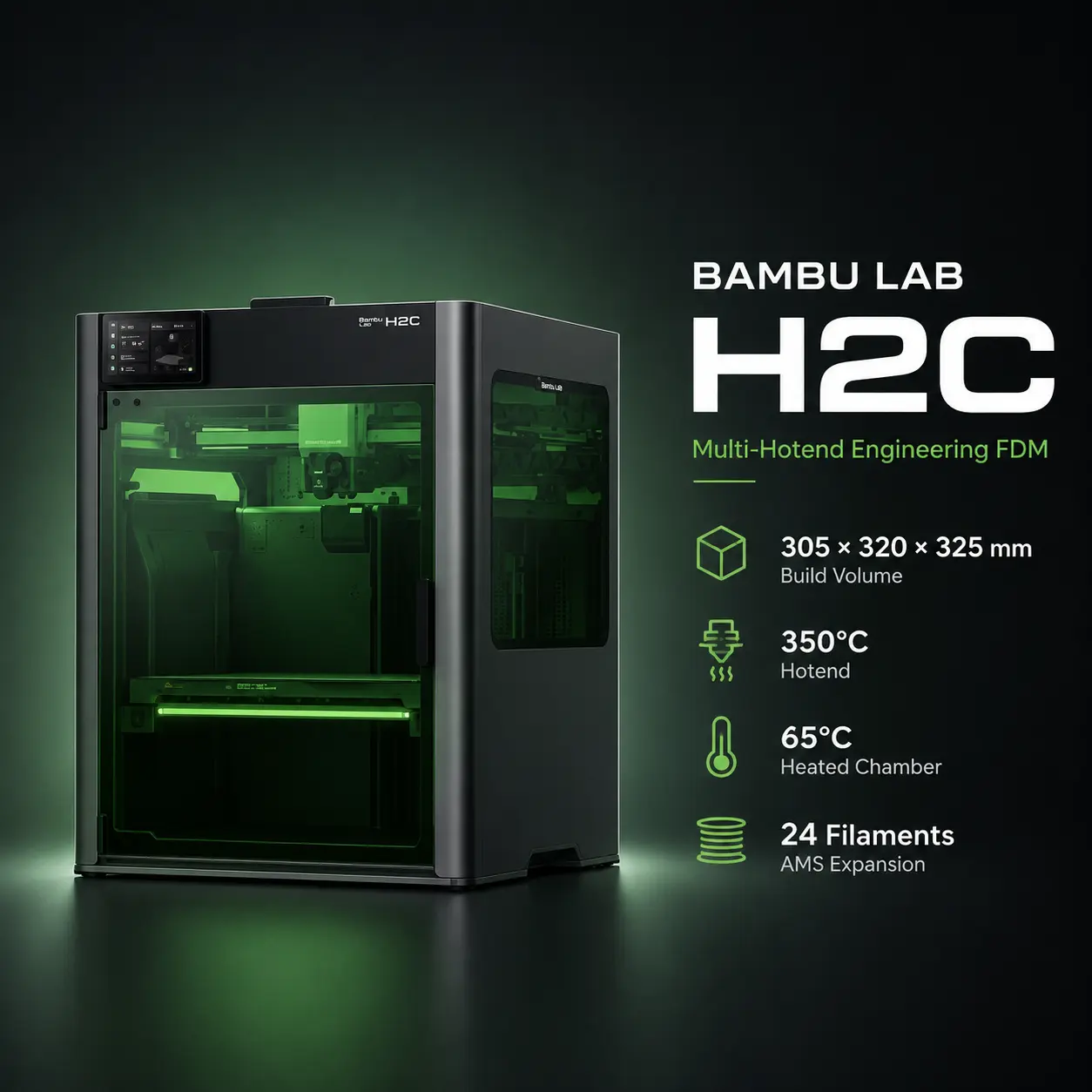
| Bambu Lab H2C | Up to 330 × 320 × 320 mm total dual-nozzle volume | Dual nozzle + Vortek induction-hotend swapping | 1000 mm/s max toolhead | 350°C / 120°C / 65°C chamber | Mature Vortek + AMS ecosystem |
| Bambu Lab H2D | Up to 350 × 320 × 320 mm total two-nozzle volume | Dual independent nozzles + AMS | 1000 mm/s max toolhead | 350°C / 120°C / 65°C chamber | Established dual-nozzle engineering platform |
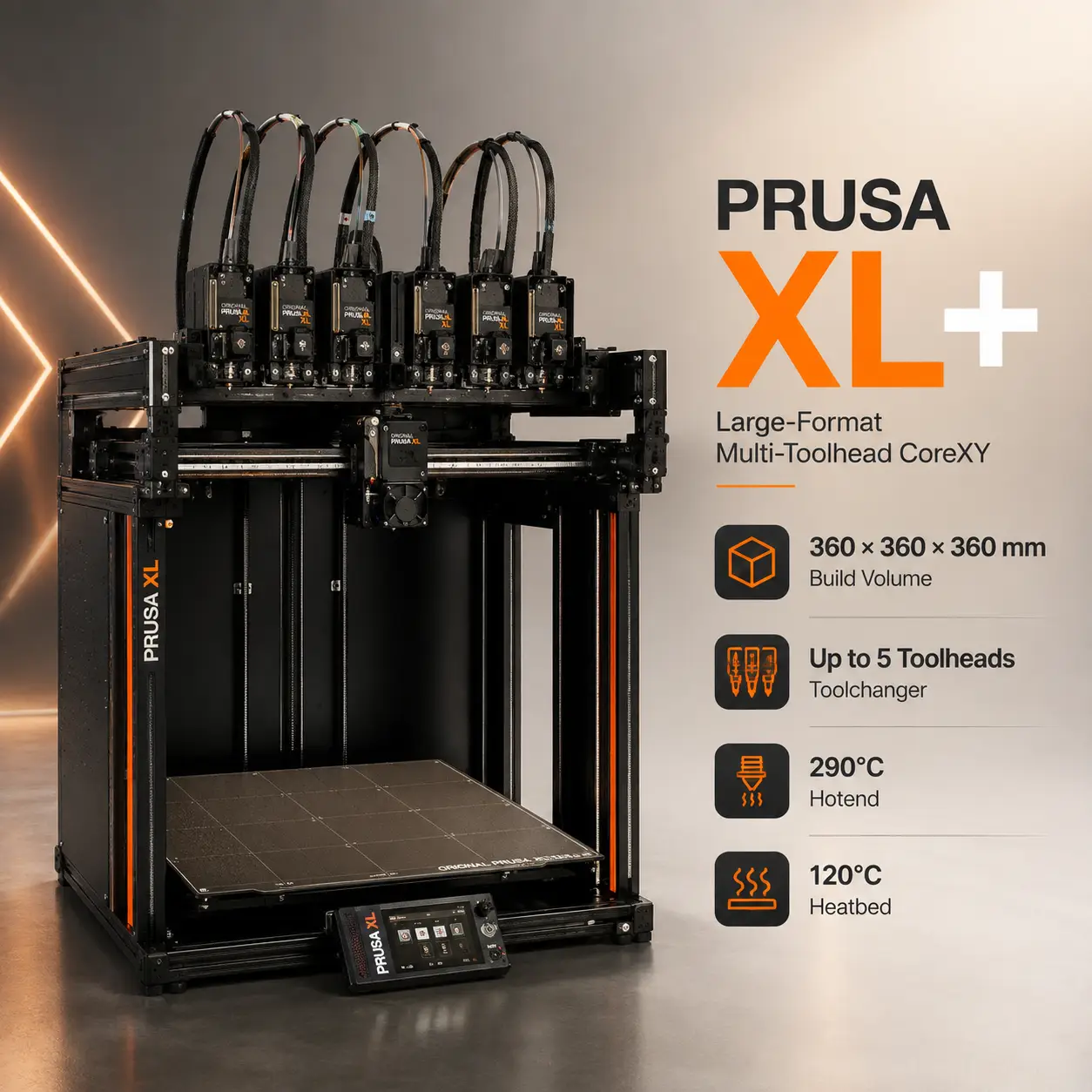
| Prusa XL+ | 360 × 360 × 360 mm | Up to 5 independent toolheads | No universal max mm/s published | 290°C / 120°C; optional heated enclosure | Large-format low-waste toolchanging |
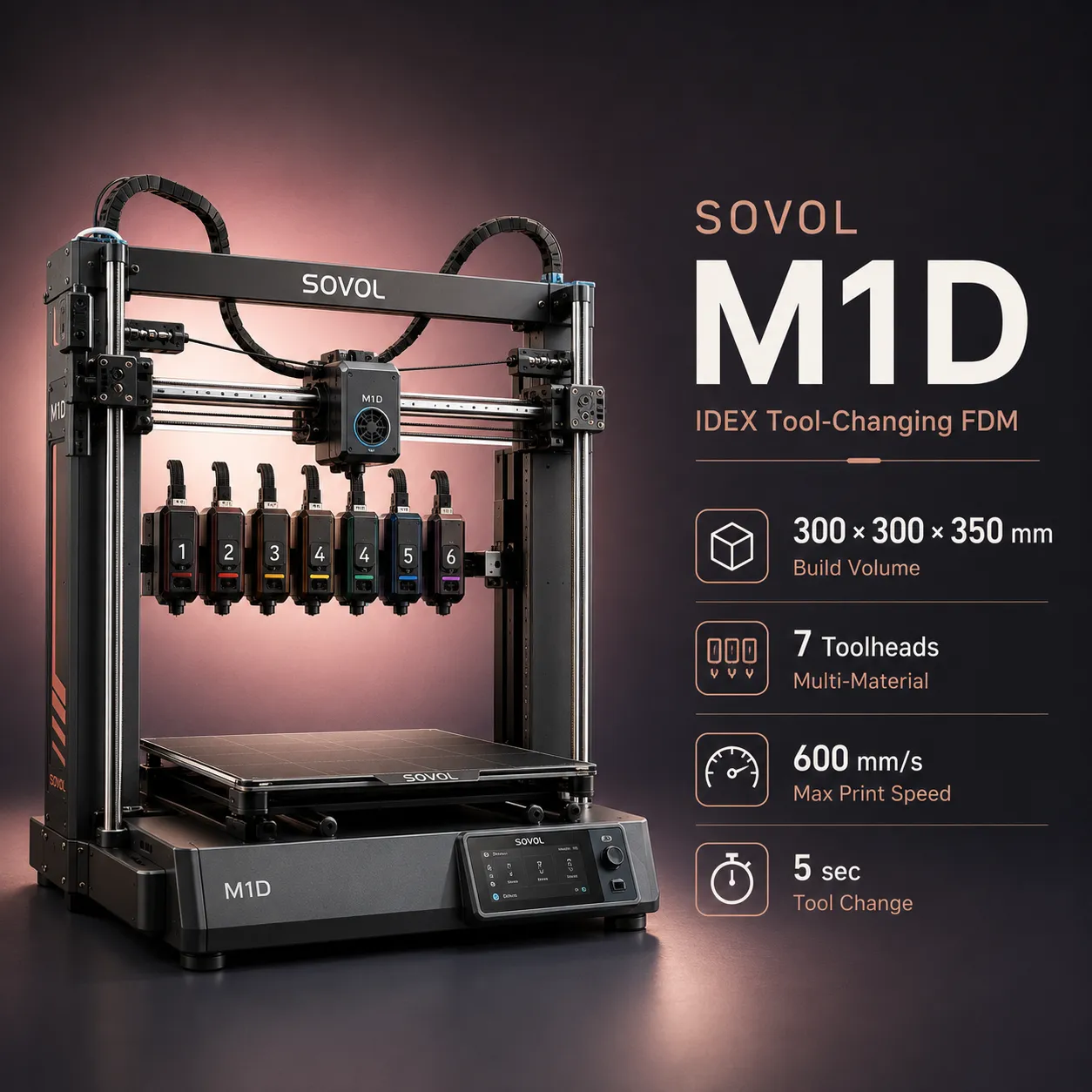
| Sovol M1D | Up to 300 × 300 × 350 mm | IDEX + 1 fixed and 6 swappable tools | 600 mm/s max print | 300°C / 100°C | Seven-material IDEX and tool changing |
Palette 300 stands out for nozzle count; the alternatives differentiate through maturity, independent tools, dual nozzles, or IDEX operation.
The AtomForm Palette 300 vs Bambu Lab H2C comparison is one of the most relevant because both systems reduce shared-hotend purging by physically changing hotend/nozzle hardware.
The Bambu Lab H2C combines dual-nozzle printing with the Vortek induction-hotend system. Bambu supports up to six alternate right-side induction hotends, while the left hotend remains a conventional active tool.
H2C publishes a 350°C nozzle, 120°C bed, 65°C active chamber, 1000 mm/s maximum toolhead speed, and 20,000 mm/s² acceleration.
Palette 300 offers more dedicated nozzle positions; H2C has the stronger advantage in current product maturity, documentation, AMS integration, and established software. Choose Palette 300 for maximum automated nozzle count, or H2C for a currently established Vortek workflow.
The Bambu Lab H2D uses two independent nozzles rather than a 12-position carousel.
Its combined two-nozzle working envelope reaches 350 × 320 × 320 mm, with a 350°C hotend, 120°C bed, 65°C chamber, and 1000 mm/s maximum toolhead speed.
H2D is the more mature dual-nozzle engineering platform. Palette 300 is more ambitious when a job needs many dedicated materials or nozzle diameters, but that advantage still needs production validation.
The AtomForm Palette 300 vs Prusa XL+ comparison contrasts nozzle swapping with complete independent toolheads.
The Prusa XL+ supports up to five independent Nextruder toolheads and provides a larger 360 × 360 × 360 mm build volume.
Each XL+ tool keeps its own filament path, hotend, and nozzle, making it strong for soluble supports and mixed materials.
Palette 300 offers more nozzle positions, a standard 65°C heated chamber, and higher published nozzle temperature. XL+ has the advantage in established production history and known toolchanger behavior.
The Sovol M1D combines IDEX with one fixed primary tool and six swappable secondary tools. Sovol publishes 300 × 300 × 350 mm in Single Mode, 240 × 300 × 350 mm in seven-head overlap mode, and up to 600 mm/s.
Palette 300 offers more nozzle positions plus a 65°C heated chamber and 350°C hotend. M1D instead adds Copy and Mirror modes. Choose Palette 300 for enclosed high-temperature multi-material work or M1D for IDEX production workflows.
Not Announced Yet
It is a fully enclosed multi-material FDM printer built around an automatic nozzle-swapping system with up to 12 dedicated nozzle positions.
300 × 300 × 300 mm.
Up to 12 automatically swapped nozzles.
0.2, 0.4, 0.6, and 0.8 mm.
AtomForm and MOVA publish up to 800 mm/s.
MOVA's current detailed product page lists 20,000 mm/s² maximum acceleration.
Up to 350°C.
Up to 65°C with active heating.
It is a six-slot filament-management and drying system with drying temperatures up to 85°C.
The current MOVA page says up to six RFD-6 units can manage 36 colors, but the printer still has 12 dedicated nozzle positions.
No. MOVA states that AtomForm Slicer performs nozzle cleaning and purging during changes, and more filament assignments than dedicated nozzles can require nozzle sharing.
The current official material list includes multiple carbon- and glass-fiber-reinforced polymers, including PPA-CF/GF and PPS-CF/GF.
Yes. The published system combines HEPA and activated-carbon filtration.
No current official live retail price is displayed.