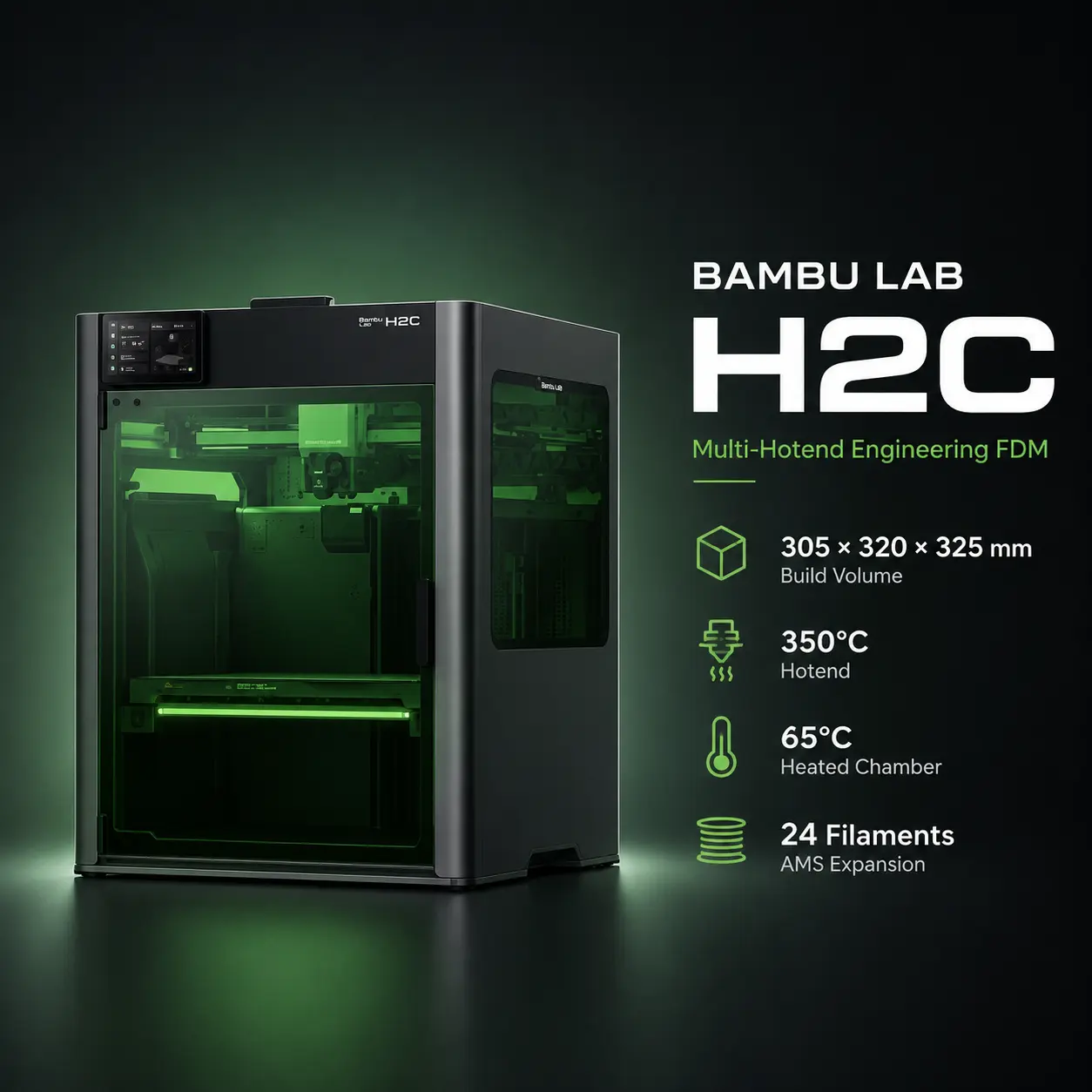
Intelligent DesignIndustrialVortek Multi Hotend PrintingPurge Saving Multi-material24-Filament Workflow
BBambu Lab
Bambu Lab
# Bambu Lab H2C
The Bambu Lab H2C is Bambu Lab's flagship multi-material CoreXY printer built around the Vortek Hotend Change System. Instead of routing every filament through one shared nozzle, the printer can keep several materials assigned to dedicated hotends and exchange them automatically during a print.
The Vortek station supports six interchangeable induction hotends, while the toolhead also has a separate left lifting hotend. That gives the H2C access to up to seven hotends in one multi-material workflow. The distinction matters: the machine does not simply have six total nozzles.
With compatible AMS hardware, the H2C can manage far more filaments than the seven hotends physically available at one time. Bambu Lab markets the system for up to 24 AMS-fed materials, while its current FAQ describes an extreme configuration reaching 25 colors when an external spool is included on the second feed path. For practical catalog use, 24 AMS-fed materials is the cleaner headline figure.
The printer combines that material-handling system with a 350°C hardened-steel nozzle platform, 120°C heated bed, 65°C actively heated chamber, hardened-steel extruder gears, a PMSM servo extruder, three-stage air filtration, and a 59-sensor platform.
For current pricing, bundles, and regional availability, see the official Bambu Lab H2C product page and the Bambu Lab US store.
| Specification | Value |
|---|---|
| Printing technology | FDM / FFF |
| Motion architecture | CoreXY |
| Multi-hotend system | Vortek Hotend Change System |
| Interchangeable induction hotends | 6 |
| Additional left lifting hotend | 1 |
| Maximum hotends available in one workflow | 7 |
| Single-nozzle build volume, left | 325 × 320 × 320 mm |
| Single-nozzle build volume, right | 305 × 320 × 325 mm |
| Dual-nozzle common build volume | 300 × 320 × 320 mm |
| Total two-nozzle accessible volume | 330 × 320 × 320 mm |
| Physical dimensions | 492 × 514 × 626 mm |
| Net weight | 32.5 kg |
| Nozzle material | Hardened steel |
| Standard nozzle size | 0.4 mm |
| Supported nozzle diameters | 0.2, 0.4, 0.6, and 0.8 mm |
| Maximum nozzle temperature | 350°C |
| Maximum bed temperature | 120°C |
| Maximum chamber temperature | 65°C |
| Chamber heating | Active |
| Maximum toolhead movement speed | 1000 mm/s |
| Maximum toolhead acceleration | 20,000 mm/s² |
| Published maximum hotend flow | 40 mm³/s under Bambu Lab's stated ABS test |
| Filament diameter | 1.75 mm |
| Included build plate type | Textured PEI flexible steel plate |
| Air filtration | G3 pre-filter + H12 HEPA + granulated coconut-shell activated carbon |
| Live-view camera | 1920 × 1080 |
| Nozzle camera | 1920 × 1080 |
| Toolhead camera | 1600 × 1200 |
| BirdsEye camera | 3264 × 2448 on Laser Edition |
| Touchscreen | 5-inch 720 × 1280 |
| Storage | 8 GB eMMC + USB |
| Network | Dual-band Wi-Fi |
| Ethernet | Not available |
| Maximum power | 1250 W at 110 V / 1800 W at 220 V |
Note: Bambu Lab publishes 1000 mm/s as maximum toolhead movement speed. It is not a universal print-speed rating for every material, hotend, or multi-material job.
Important: Build volume changes with the active hotend configuration. The right hotend provides 305 × 320 × 325 mm in single-nozzle use, while the left hotend reaches 325 × 320 × 320 mm. Dual-hotend prints share a 300 × 320 × 320 mm common area.
The H2C's defining feature is its Vortek hotend-changing system.
Six induction hotends can be stored and exchanged automatically on the right side of the toolhead. A separate conventional lifting hotend remains on the left.
Each induction hotend can retain filament-related identification data so the printer can match a hotend to a material and reduce unnecessary purging.
The Vortek station itself holds six interchangeable induction hotends.
The complete H2C printing system, however, can use:
That means up to seven hotends can participate in a multi-color or multi-material workflow.
This is more accurate than describing the H2C simply as a six-nozzle printer.
Bambu Lab uses induction to heat the Vortek hotends and a contactless communication system rather than exposed electrical contacts on each swappable hotend.
The manufacturer states that hotend heating can reach operating temperature in about eight seconds under its test conditions.
The practical goal is to make hotend swaps faster while reducing contact wear and oxidation over repeated changes.
The H2C is designed to reduce one of the biggest costs of single-nozzle multi-color printing: repeatedly flushing old material from the nozzle.
When a filament stays assigned to its own hotend, the printer can return to that hotend without re-purging the entire melt zone.
This can significantly reduce waste for:
The system should still be described as minimal-purge or low-purge, not magically waste-free in every situation.
Loading a new filament into a hotend, priming, nozzle cleaning, calibration, and certain material changes can still consume material.
Bambu Lab markets the H2C for up to 24 materials through parallel-connected AMS units.
Its current H2C FAQ goes one step further and documents:
For a normal catalog listing, up to 24 AMS-fed materials is the clearest headline because it reflects the automated material-system capacity without relying on the extra external-spool edge case.
Important: More filament slots do not mean every material can be routed through every AMS or hotend. Flexible, abrasive, brittle, and moisture-sensitive filaments still have compatibility limits.
The H2C is designed around a much broader engineering-material range than an open-frame desktop printer.
Bambu Lab lists support for:
It also lists carbon- and glass-fiber-reinforced families based on:
The combination of a 350°C nozzle, 120°C bed, and 65°C active chamber makes the H2C suitable for many warp-prone or higher-temperature polymers when the exact nozzle and material profile are appropriate.
For examples of reinforced materials with different thermal and drying requirements, compare Prusament PC Blend Carbon Fiber and Prusament PA11 Carbon Fiber.
The H2C uses hardened-steel nozzle hardware, but nozzle diameter and hotend type still matter.
Bambu Lab's current Vortek compatibility guidance shows that some carbon-fiber materials are not recommended with certain high-flow hotends even when the nozzle itself is wear resistant.
Use the exact Bambu Lab hotend/material compatibility table rather than assuming every reinforced filament works with every Vortek hotend.
The chamber can be actively heated to 65°C.
That is a major advantage for engineering polymers that benefit from a stable elevated ambient temperature.
The H2C also uses adaptive airflow and closed-loop fan control for:
A 65°C chamber is not a guarantee that every high-temperature polymer will print successfully. Material drying, build-surface preparation, nozzle choice, geometry, and slicer settings remain important.
The H2C uses Bambu Lab's high-precision permanent-magnet synchronous extruder motor.
Bambu Lab states that the servo system monitors extrusion at 20 kHz.
That feedback supports:
The benefit is process monitoring and control, not simply higher raw motor speed.
The H2C supports Bambu Lab's Vision Encoder system for motion calibration.
Bambu Lab describes the system as providing distance-independent motion accuracy below 50 µm after calibration.
That should not be interpreted as a universal ±0.05 mm finished-part tolerance.
Finished-part accuracy also depends on:
The Vision Encoder is best understood as a motion-system calibration tool.
Bambu Lab's H2 Series comparison lists the H2C with 59 sensors, making it the most sensor-dense model in the H2 family.
The printer also uses multiple cameras:
Monitoring functions include:
Important: Camera- and AI-assisted monitoring reduces supervision but does not guarantee that every failure will be detected.
The H2C uses a three-stage filtration system:
This helps reduce airborne particles and VOCs inside the enclosure.
Filtration should not be treated as a replacement for room ventilation when printing ABS, ASA, PA, PC, PPS, or other higher-emission engineering materials.
The H2C belongs to the wider H2 manufacturing platform.
Depending on the purchased configuration or upgrade path, it can support:
These functions are not standard on every H2C.
A standard non-laser H2C supports the printing workflow and can support blade cutting, while laser functionality requires the appropriate Laser Edition hardware or upgrade kit.
Warning: Do not present laser cutting or engraving as included with every H2C package.
The H2C supports:
Bambu Lab does not list native Ethernet.
The platform also supports full offline operation for users who do not want normal cloud connectivity.
| Printer | Main Difference | Better Fit |
|---|---|---|
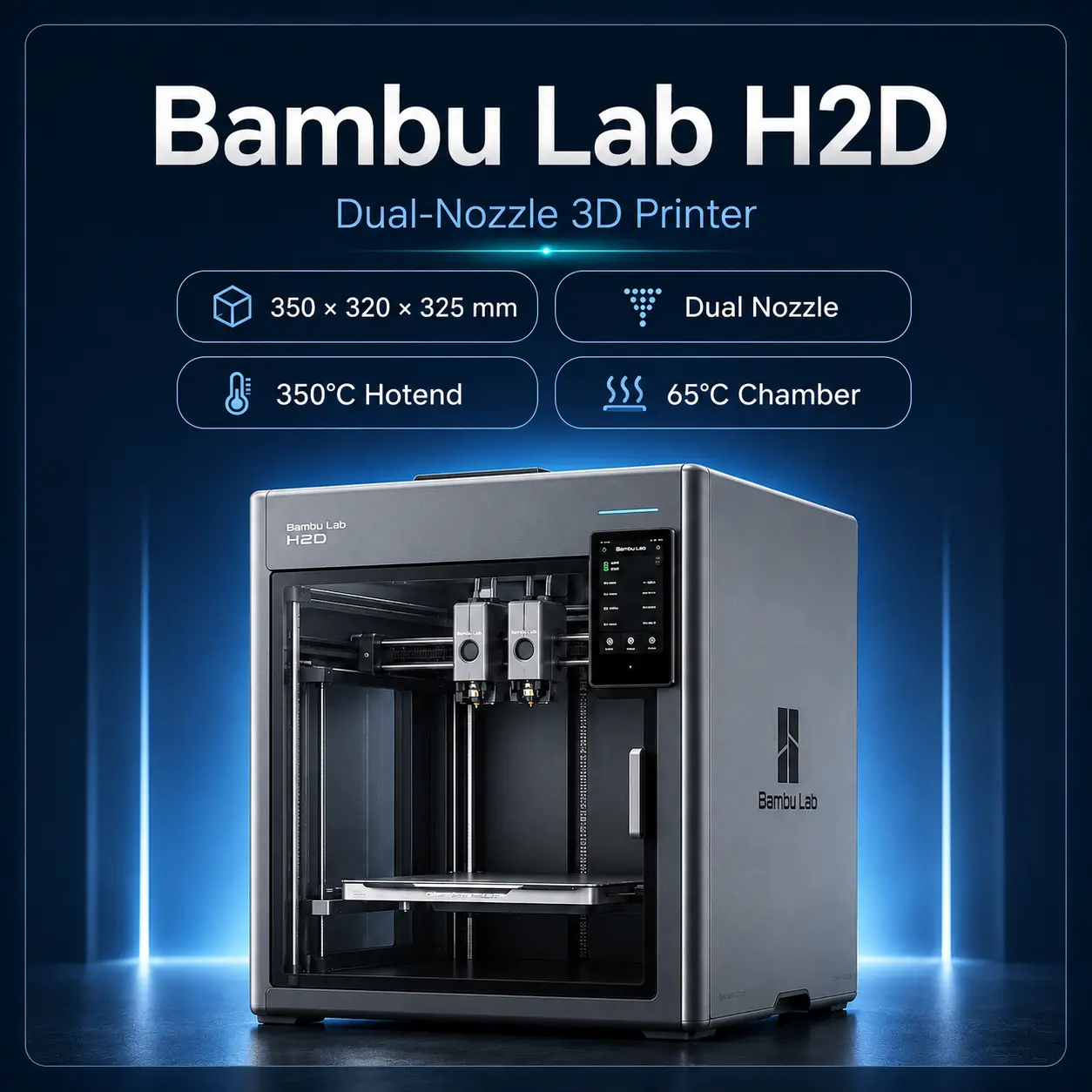
| Bambu Lab H2D | Dual-nozzle H2 platform without the six-position Vortek rack | Large dual-material and general H2 workflows |
| Bambu Lab H2C | Seven-hotend-capable Vortek system with up to 24 AMS-fed materials | Complex low-purge multi-material production |
| Bambu Lab P2S | Smaller single-nozzle enclosed platform | General engineering printing at lower cost |
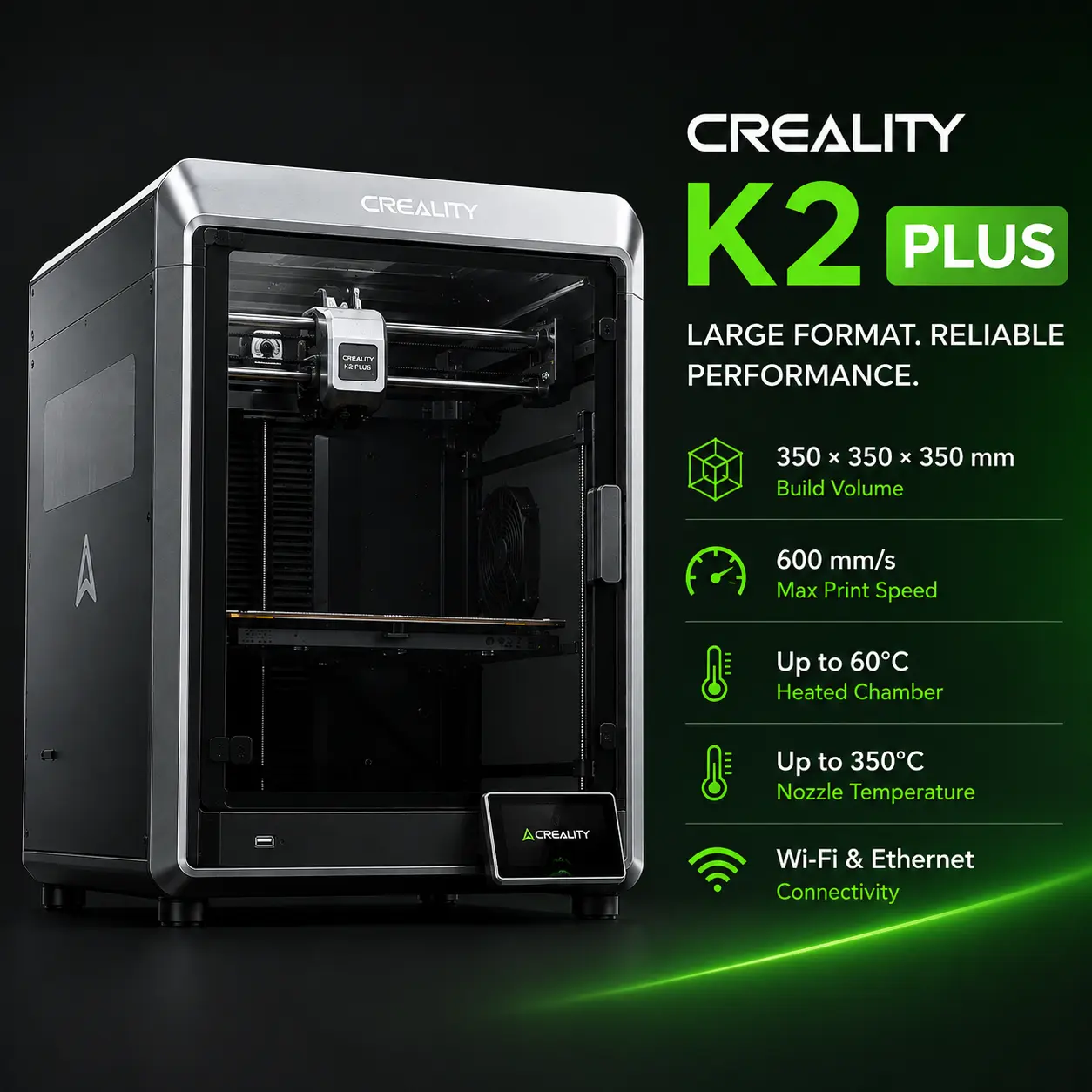
| Creality K2 Plus | 350 mm-class single-nozzle platform with active chamber | Large engineering parts where build volume matters more than hotend changing |
The H2C makes the most sense when material switching itself is a major part of the workflow. If most prints use one or two materials, a simpler enclosed printer can be easier and less expensive to operate.
Bambu Lab launched the H2C on November 18, 2025.
The current US store lists the H2C from US$2,199, with the selected standard AMS Combo shown at US$2,199 during the August 12, 2026 check.
Bambu Lab sells several H2C configurations, including higher-priced laser bundles and a Vortek Ultimate Bundle.
Because the available package rather than a bare standalone chassis often determines the price, the catalog should use a dynamic reference such as:
From US$2,199 — check manufacturer’s current listing
The US store currently shows the H2C as available to purchase.
Recommended use: Choose the H2C when complex multi-color or multi-material printing is a core production requirement and the cost of purge waste, long filament changes, or manually managing dedicated support materials is significant. If you only need one or two materials, the H2D, P2S, or another simpler enclosed platform may offer a more economical workflow.
The Vortek station supports six interchangeable induction hotends, and the printer also has one left lifting hotend. That gives the H2C access to up to seven hotends in a multi-material workflow.
Bambu Lab publishes 325 × 320 × 320 mm for the left hotend alone, 305 × 320 × 325 mm for the right hotend alone, 300 × 320 × 320 mm for dual-hotend printing, and 330 × 320 × 320 mm as the total two-nozzle accessible volume.
Bambu Lab markets the H2C for up to 24 AMS-fed materials. Its current FAQ describes a maximum 25-color edge case when 24 AMS slots are combined with an external spool on the second hotend path.
Dedicated hotends can eliminate most purge flushing when returning to an already assigned material, but new filament loading, priming, cleaning, and some material changes can still consume filament. Low-purge or minimal-purge is the more accurate description.
350°C.
120°C.
Yes. The chamber can be actively heated to 65°C.
Bambu Lab lists 0.2, 0.4, 0.6, and 0.8 mm nozzle diameters.
No. Bambu Lab publishes 1000 mm/s as maximum toolhead movement speed. Actual print speed depends on filament, flow, geometry, hotend, cooling, and multi-material switching.
Yes. Bambu Lab lists multiple carbon- and glass-fiber-reinforced filament families, but hotend and nozzle compatibility varies by material. Check the current Vortek hotend compatibility table before printing abrasive composites.
It is a motion-calibration system that Bambu Lab describes as providing motion accuracy below 50 µm. That is not the same as guaranteeing every finished part to ±0.05 mm.
Laser capability is available on the appropriate Laser Edition or through the correct upgrade path. It is not included with every H2C configuration.
No. Bambu Lab lists dual-band Wi-Fi and USB but no native Ethernet connection.
Bambu Lab's US store lists the H2C from US$2,199 at the time of this review. Bundle pricing changes, so check the current manufacturer listing before purchase.