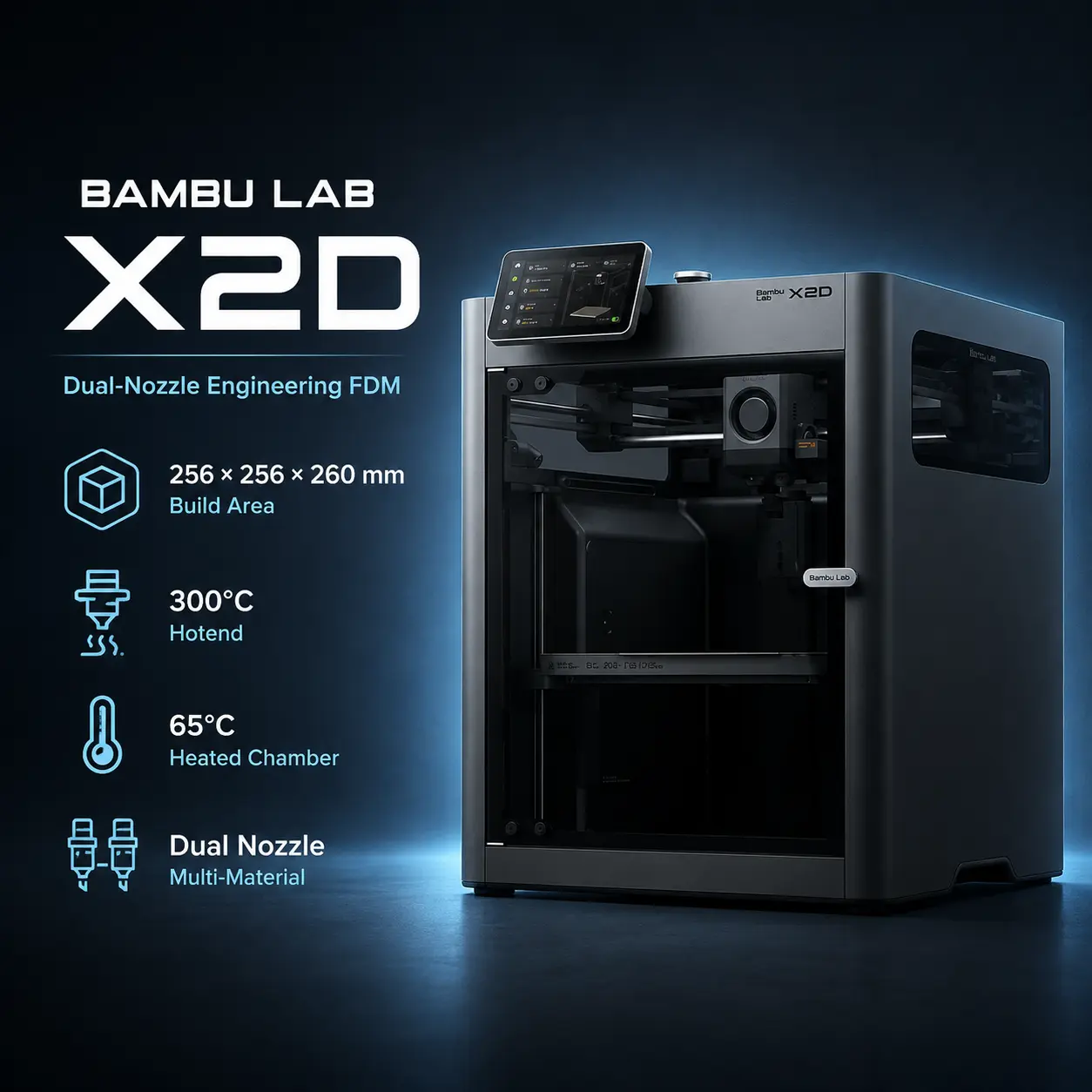
Intelligent DesignIndustrialLow-waste Dual-nozzleActively Heated ChamberMulti-material Printing
BBambu Lab
Bambu Lab
# Bambu Lab X2D
The Bambu Lab X2D is the second generation of Bambu Lab's X Series. Its defining feature is a mechanically switched dual-nozzle system that gives the main and auxiliary material paths separate hotends instead of forcing every material change through one shared nozzle.
That architecture is particularly useful for support interfaces, two-material parts, and faster low-waste color changes. The main nozzle can use a 256 × 256 × 260 mm print area, while the auxiliary nozzle and the common dual-nozzle overlap area are 235.5 × 256 × 256 mm.
The X2D combines a 300°C hardened-steel hotend, 120°C heated bed, and 65°C actively heated chamber with hardened-steel extrusion hardware, three-stage filtration, two cameras, and 31 integrated sensors. It is therefore much better suited to ABS, ASA, PA, PET, PC, and compatible reinforced engineering filaments than an open-frame desktop printer.
The standalone X2D launched in the US at US$649. Pricing and promotions can change, so check the official Bambu Lab X2D store listing before purchase.
| Specification | Value |
|---|---|
| Printing technology | FDM / FFF |
| Extrusion system | Mechanically switched dual-nozzle system |
| Main extruder | Direct drive, PMSM servo motor |
| Auxiliary extruder | Remote extruder through PTFE |
| Main-nozzle print area | 256 × 256 × 260 mm |
| Auxiliary-nozzle print area | 235.5 × 256 × 256 mm |
| Common dual-nozzle print area | 235.5 × 256 × 256 mm |
| Total union of nozzle workspaces | 256 × 256 × 260 mm |
| Physical dimensions | 392 × 406 × 478 mm |
| Net weight | 16.25 kg |
| Included nozzle | 0.4 mm hardened steel |
| Supported nozzle diameters | 0.2, 0.4, 0.6, and 0.8 mm |
| Maximum nozzle temperature | 300°C |
| Maximum bed temperature | 120°C |
| Maximum chamber temperature | 65°C |
| Chamber heating | Active |
| Maximum main toolhead movement speed | 1000 mm/s |
| Maximum toolhead acceleration | 20,000 mm/s² |
| Auxiliary-nozzle print-speed limit | 200 mm/s |
| Standard-hotend flow test | Up to 40 mm³/s under Bambu Lab's stated ABS test |
| Optional high-flow hotend | Up to 65 mm³/s under Bambu Lab's stated ABS test |
| Filtration | G3 pre-filter + H12 HEPA + coconut-shell activated carbon |
| Live-view camera | 1920 × 1080 |
| Toolhead camera | 1600 × 1200 |
| Touchscreen | 5-inch, 1280 × 720 |
| Storage | 8 GB eMMC plus USB |
| Wireless network | Dual-band Wi-Fi |
| Ethernet | Not available |
Note: Bambu Lab publishes 1000 mm/s as maximum toolhead movement speed for the main-nozzle workflow. It is not a guaranteed print speed for every model or filament.
Important: The auxiliary nozzle has different material and speed limits from the main nozzle. Do not assume every main-hotend specification applies equally to both paths.
The main nozzle uses a direct-drive extruder with Bambu Lab's PMSM servo motor. The auxiliary nozzle is fed by a remote extruder mounted at the rear of the printer.
Mechanical switching lets the toolhead alternate between the two hotends without carrying two direct-drive extruder motors.
This is useful for:
The two hotends are physically interchangeable, but their operating roles differ. The main path provides the broadest performance and material support. The auxiliary path is more restricted and has a published 200 mm/s print-speed limit.
The X2D has several workspace figures because the two nozzles do not reach exactly the same area.
For a part that requires both nozzles to reach the same geometry, design around the smaller common area.
The X2D ships with a 0.4 mm hardened-steel nozzle and supports 0.2, 0.4, 0.6, and 0.8 mm diameters.
Bambu Lab publishes up to 40 mm³/s for the standard-flow hotend and up to 65 mm³/s for the optional high-flow hotend under its stated ABS test conditions.
Those numbers should not be treated as universal material flow rates. Real flow depends on the polymer, temperature, nozzle size, layer geometry, and cooling.
The chamber can be actively heated to 65°C.
The printer can also use a cooling-oriented airflow mode for lower-temperature materials such as PLA.
This thermal control, together with the 120°C bed, makes the X2D much more appropriate for engineering polymers than open-frame machines.
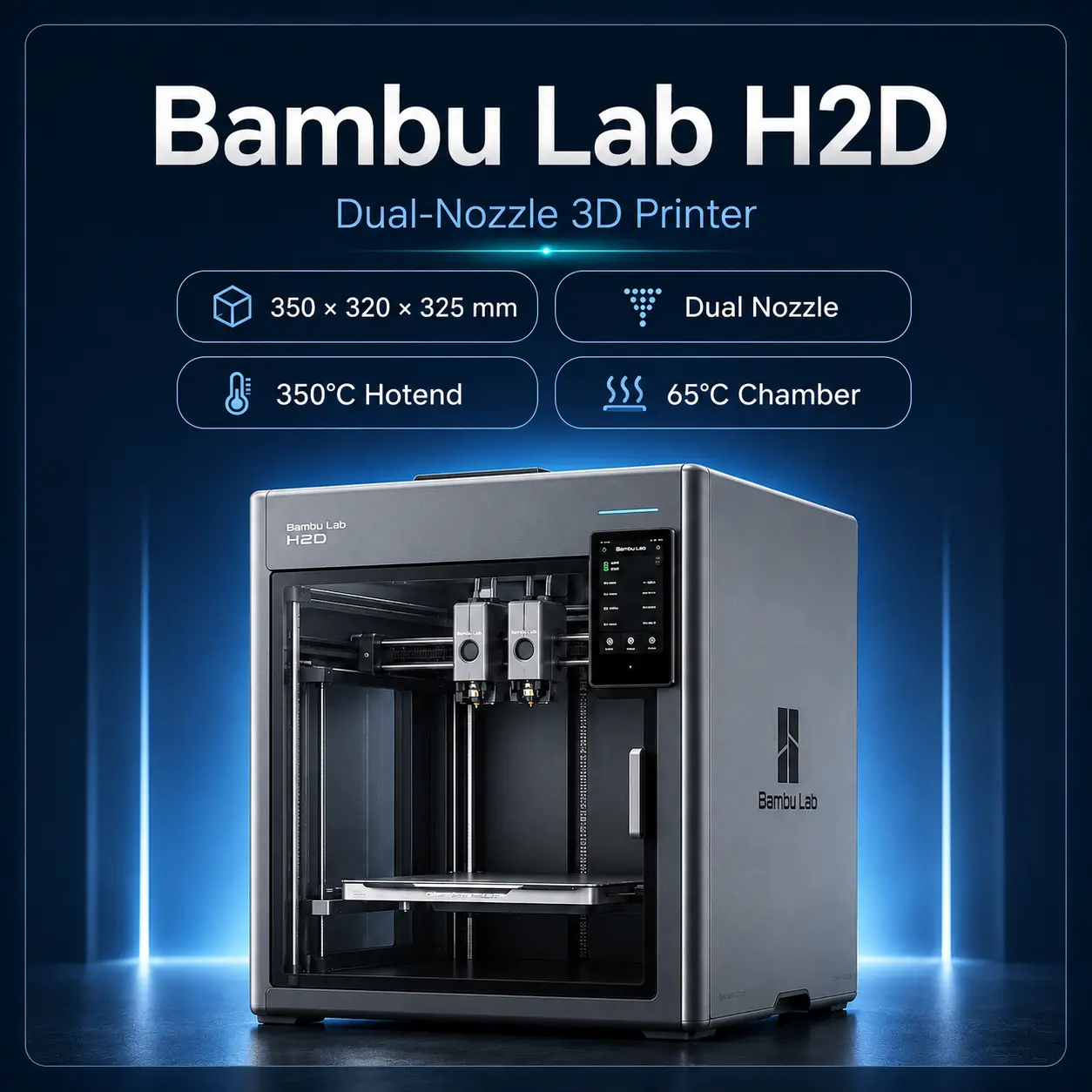
For a larger dual-nozzle platform with a 65°C chamber, see the Bambu Lab H2D. If dual nozzles are unnecessary, the smaller enclosed Bambu Lab P2S is also worth comparing.
Bambu Lab publishes separate material guidance for the two hotends.
Supported standard families include:
Bambu Lab also lists fiber-reinforced families based on:
The auxiliary path supports many of the same general families but has additional restrictions.
Bambu Lab specifically marks some materials as print with caution on the auxiliary hotend, including:
Use the main hotend where Bambu Lab recommends it for best print quality.
An actively heated chamber does not replace filament drying. PA, PAHT, PPA, PET, PVA, and many reinforced materials can be moisture-sensitive.
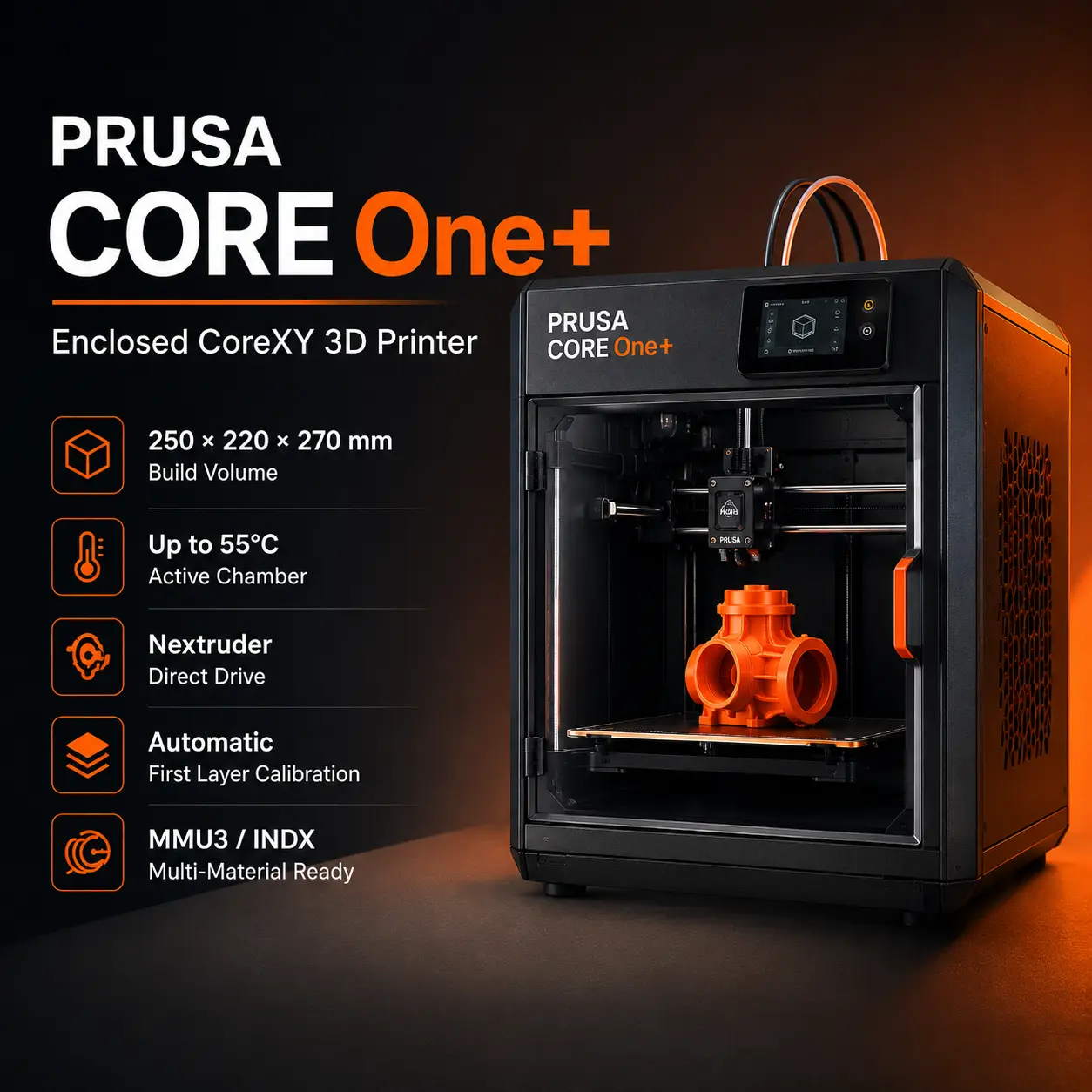
For examples of reinforced polymers with very different processing requirements, compare Prusament PC Blend Carbon Fiber and Prusament PA11 Carbon Fiber.
The X2D can be expanded through Bambu Lab's current AMS ecosystem.
Bambu Lab states that the maximum dual-hotend configuration can reach up to 25 colors.
A large number of AMS slots does not mean every filament is suitable for every feed path. Flexible, abrasive, or moisture-sensitive materials still need the correct AMS and hotend configuration.
The main extruder uses Bambu Lab's high-precision permanent-magnet synchronous motor.
Bambu Lab states that the system samples torque and position at 20 kHz, allowing the printer to monitor extrusion behavior and identify abnormal feeding conditions.
Dynamic Flow Calibration is associated with the main model-printing path and is designed to compensate for changes in extrusion behavior over time.
Bambu Lab states that the X2D integrates 31 sensors across feeding, printing, thermal control, and safety systems.
The printer includes:
Important: AI monitoring is a detection aid, not a guarantee that every print failure or obstruction will be caught.
The X2D uses:
The chamber exhaust system can also remove air after higher-temperature jobs and supports routing exhaust through a ventilation pipe.
Filtration should not be treated as a substitute for appropriate ventilation when printing materials such as ABS, ASA, PA, or PC.
The X2D supports Bambu Lab's optional Vision Encoder motion-calibration accessory.
Bambu Lab describes it as enabling 50-micron-class motion accuracy.
This is a motion-system specification, not a guarantee that every finished part will hold ±0.05 mm dimensional tolerance. Material shrinkage, extrusion, geometry, slicer compensation, and temperature still affect the final part.
The Vision Encoder is optional and is not standard equipment with the standalone X2D.
The X2D supports:
Bambu Lab does not list native Ethernet.
The printer includes 8 GB eMMC storage and a 5-inch 1280 × 720 touchscreen.
| Printer | Main Difference | Better Fit |
|---|---|---|
| Bambu Lab P2S | Single-nozzle enclosed 256 mm-class platform | General engineering printing without dual-nozzle requirements |
| Bambu Lab X2D | Dual-nozzle 256 mm-class platform with 65°C active chamber | Compact engineering multi-material and support workflows |
| Bambu Lab H2D | Much larger dual-nozzle platform | Larger engineering and advanced multi-material projects |
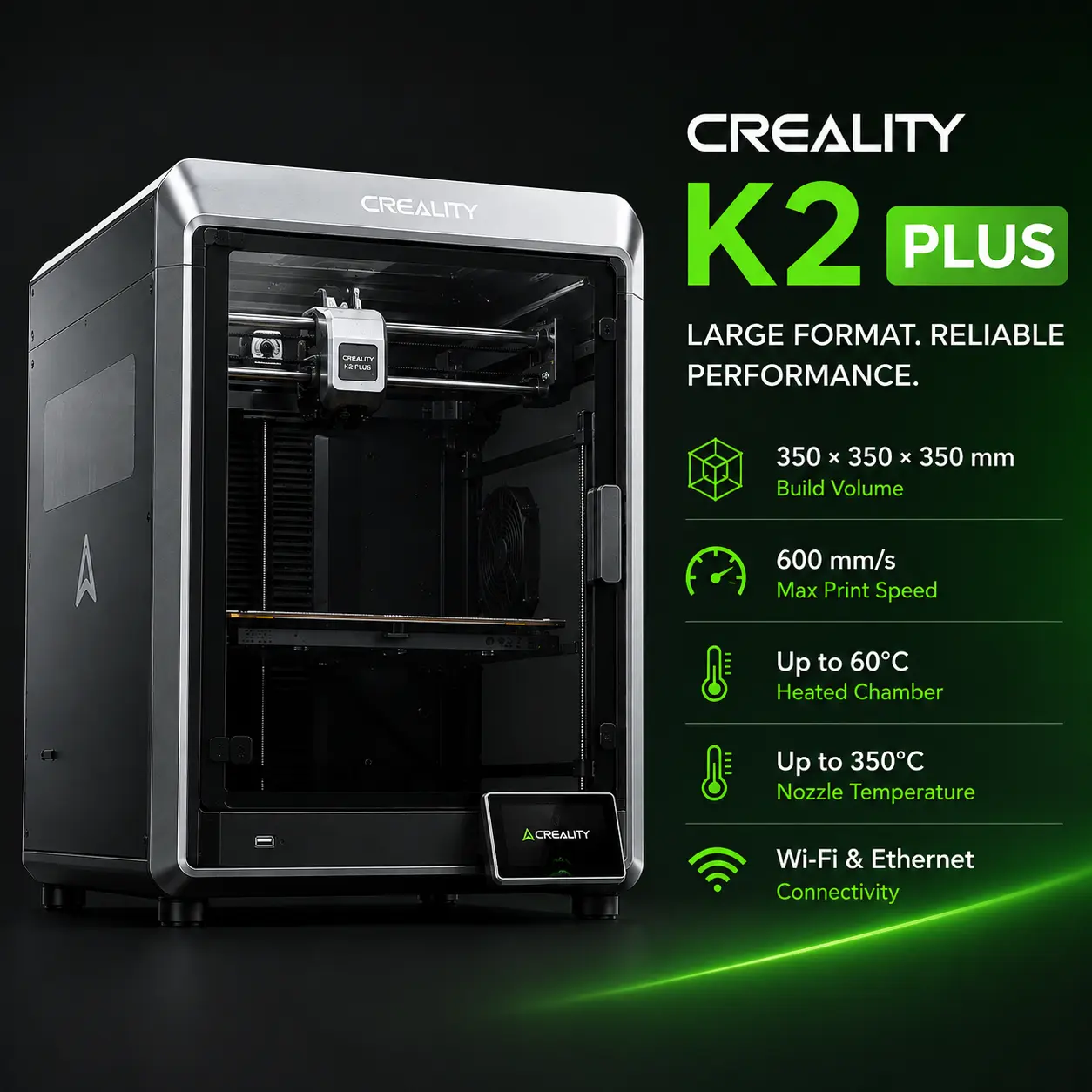
| Creality K2 Plus | 350 mm large-format platform with active chamber | Large engineering parts where build volume matters more than dual nozzles |
The X2D is most compelling when support removal, dual-material printing, and engineering-material capability matter more than maximum build volume.
Bambu Lab launched the standalone X2D in the United States at US$649 before tax.
The X2D Combo launched at a higher price and includes additional material-management hardware.
Pricing and bundles can change by region, so verify the current offer on the official Bambu Lab US store.
Recommended use: Choose the X2D when you need a compact enclosed printer for engineering materials and regularly benefit from a second nozzle for support interfaces, secondary materials, or faster low-waste color changes. If larger build volume matters more than dual-nozzle flexibility, compare the H2D or K2 Plus.
The main nozzle can use 256 × 256 × 260 mm. The auxiliary nozzle and common dual-nozzle area are 235.5 × 256 × 256 mm.
Yes. It uses a mechanically switched dual-nozzle system with separate main and auxiliary filament paths.
Bambu Lab lists a 0.4 mm hardened-steel nozzle as standard. Supported diameters are 0.2, 0.4, 0.6, and 0.8 mm.
300°C.
120°C.
Yes. The chamber can be actively heated to 65°C.
No. Bambu Lab publishes 1000 mm/s as maximum toolhead movement speed on the main-nozzle workflow.
Bambu Lab states that auxiliary-nozzle print speed must not exceed 200 mm/s.
Yes. Bambu Lab lists ABS, ASA, PET, PA, PC, PVA, and multiple reinforced filament families among supported main-hotend materials.
Some reinforced materials are supported, but Bambu Lab flags PETG-CF, ASA-CF, and PA6-CF as print-with-caution on the auxiliary hotend.
Yes. Bambu Lab states that the maximum dual-hotend AMS configuration can reach up to 25 colors.
Yes. It uses a G3 pre-filter, H12 HEPA filter, and granulated coconut-shell activated carbon.
No. Bambu Lab lists dual-band Wi-Fi and USB but no native Ethernet.
It calibrates motion-system error. Bambu Lab describes it as enabling 50-micron-class motion accuracy, which is not the same as guaranteeing every finished part to ±0.05 mm.
The standalone X2D launched in the US at US$649. Current promotions and regional pricing can change, so check Bambu Lab's current store listing.