Heated Chamber EngineeringCoreXY and Active Chamber HeatingCarbon-Fiber-Ready PlatformHigh Speed Enclosed MultiColor PrintingDual AI Camera MonitoringReinforced Filament PrintingProduction GradeAdvanced Material 3D Printing
CCreality
Creality
# Creality K2 Pro
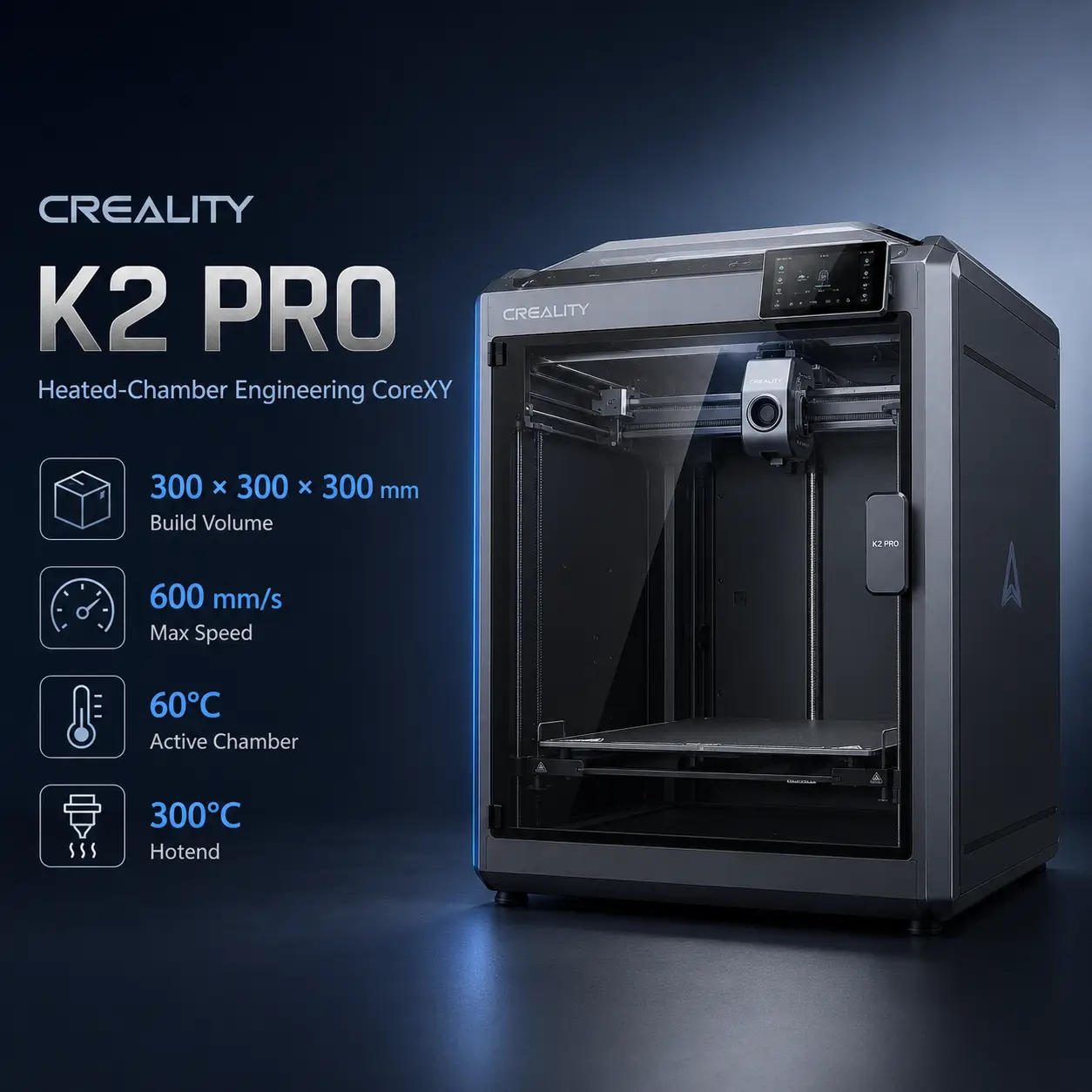
The Creality K2 Pro is a 300 mm-class enclosed CoreXY 3D printer for engineering prototypes, tooling, larger functional parts, and small-batch production. It combines a 300 × 300 × 300 mm build volume with a 300°C hotend, 110°C heated bed, and 60°C actively heated chamber.
Creality rates the printer for speeds up to 600 mm/s and acceleration up to 20,000 mm/s². Three FOC step-servo motors—on the X axis, Y axis, and extruder—are used to improve motion and extrusion control at higher speeds.
The K2 Pro also includes two AI-assisted camera systems: one for print monitoring and one for calibration. Full-auto leveling, Input Shaping, filament-tangle detection, power-loss recovery, a built-in air purifier, 32 GB eMMC storage, and Wi-Fi/Ethernet/USB file transfer are standard.
The base K2 Pro does not include a CFS. It is CFS-compatible, while the K2 Pro Combo includes one four-slot Creality Filament System. Up to four CFS units can be connected for workflows using as many as 16 filament channels.
For current specifications and pricing, see the official Creality K2 Pro product page. Setup, firmware, maintenance, and service documentation is available through the official Creality K2 Pro Wiki.
| Specification | Value |
|---|---|
| Printing technology | FDM / FFF |
| Motion system | CoreXY |
| Build volume | 300 × 300 × 300 mm |
| Layer height | 0.05–0.30 mm |
| Maximum printing speed | Up to 600 mm/s |
| Maximum acceleration | Up to 20,000 mm/s² |
| Extruder | Dual-gear direct drive |
| Standard nozzle | 0.4 mm steel-tipped tri-metal |
| Maximum nozzle temperature | 300°C |
| Maximum heatbed temperature | 110°C |
| Maximum chamber temperature | 60°C |
| Chamber heating | Active |
| Build surface | Flexible PEI build plate |
| Leveling | Full-auto leveling |
| X/Y/extruder motors | Step-servo |
| Monitoring camera | Standard AI camera |
| Calibration camera | Standard AI camera |
| Display | 4-inch color touchscreen |
| Internal storage | 32 GB eMMC |
| File transfer | USB drive, Ethernet, Wi-Fi |
| Printable file formats | G-code, 3MF |
| Slicer | Creality Print 6.0 or newer |
| Electrical input | 100–240 VAC, 50/60 Hz |
| Rated power | 1300 W |
| Printer dimensions | 445 × 505 × 850 mm |
| Net weight | 23.7 kg |
Speed note: Creality explicitly lists printing speed up to 600 mm/s, so the structured `maxPrintSpeedMmS` value can remain 600. Real speed depends on geometry, material, layer height, flow capability, acceleration, cooling, and quality targets.
Build-surface note: Creality publishes the 300 × 300 × 300 mm build volume and identifies a flexible PEI plate, but does not separately publish the physical X/Y dimensions of the removable plate.
The K2 Pro's 300 × 300 × 300 mm build envelope is large enough for many parts that exceed conventional 220–256 mm desktop platforms.
Typical uses include large housings, automotive prototypes, robot and drone components, jigs, fixtures, workshop tooling, production aids, and batches of smaller parts.
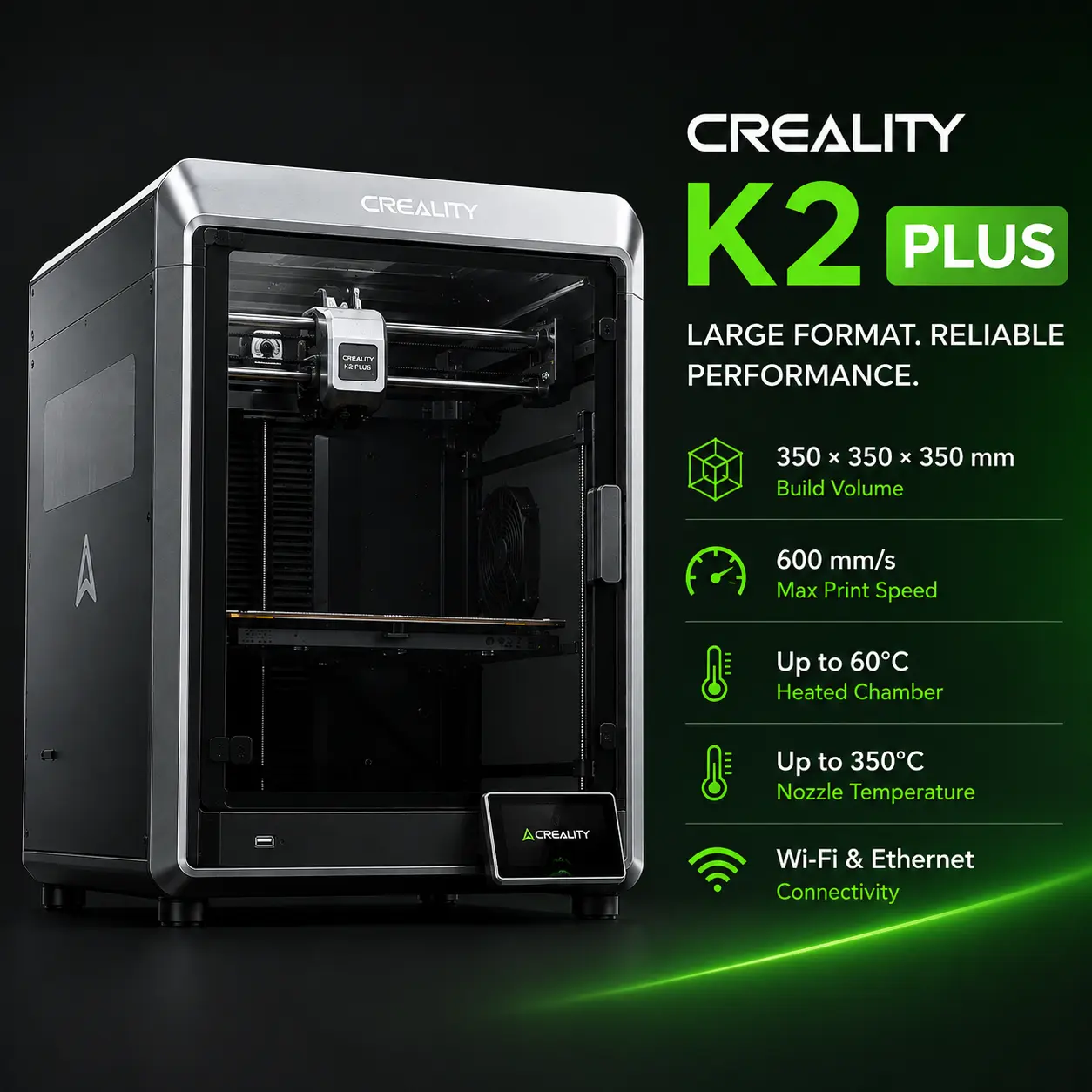
It remains smaller than the Creality K2 Plus, which offers a 350 mm-class build volume.
For buyers who do not need the K2 Plus footprint but want active chamber heating and more space than a 256 mm machine, K2 Pro occupies a useful middle ground.
The K2 Pro uses an actively heated chamber capable of reaching 60°C.
That is an important distinction from enclosed printers that rely only on passive heat from the bed and hotend.
A controlled chamber is useful for larger parts made from materials prone to shrinkage and warping, including ABS, ASA, PA-based composites, and PPA-CF.
Creality specifically highlights ASA and PPA-class materials when describing the active chamber.
For an indexed example, Prusament ASA illustrates the type of material that benefits from a stable, draft-controlled environment on larger parts.
Active chamber heating does not remove the need for suitable bed preparation, drying, orientation, or material-specific profiles.
The K2 Pro uses a 0.4 mm steel-tipped tri-metal nozzle and a dual-gear direct-drive extruder.
Creality's current supported-filament list includes:
The steel-tipped nozzle provides better abrasion resistance than a conventional brass nozzle, making it suitable for the carbon-fiber-filled materials Creality explicitly lists.
Fiber-filled materials still increase wear throughout the filament path, and nozzle size should be checked against the filament manufacturer's recommendation.
For related indexed composites, Prusament PA11 Carbon Fiber and Prusament PC Blend Carbon Fiber provide useful comparison points. Their individual processing requirements should be checked separately before use.
Creality equips the K2 Pro with three FOC step-servo motors:
The motion system is rated for up to 600 mm/s and 20,000 mm/s² acceleration. Input Shaping is also included.
The step-servo system gives the controller more feedback than a conventional open-loop stepper arrangement.
Headline speed should not be treated as the correct setting for every job. Large engineering prints often run below maximum speed because extrusion flow, surface quality, cooling, and material behavior become the practical limits.
Creality lists two AI camera functions as standard.
The chamber camera supports real-time observation and AI-assisted failure detection. Creality currently highlights detection or alerts for issues such as spaghetti failures, part detachment, and filament-related problems.
A second AI camera is used for calibration-related functions around the extrusion process.
These systems reduce manual oversight, but they should not be treated as a guarantee that every printing defect will be detected or corrected automatically.
The K2 Pro uses full-auto leveling and can focus leveling on the target print area.
Automatic leveling works alongside Input Shaping and camera-assisted calibration to reduce routine setup.
For production use, automated calibration remains only part of process control. Build-surface cleanliness, nozzle condition, filament quality, belt condition, and regular maintenance still matter.
The standard K2 Pro is CFS-compatible, but CFS hardware is not included with the base printer.
The K2 Pro Combo includes one CFS.
Each Creality Filament System has four slots. Creality supports up to four connected units, giving the platform access to as many as 16 filament channels.
CFS functions include:
The base K2 Pro should therefore be presented as 16-color capable with optional CFS expansion, not as a 16-color printer out of the box.
CFS compatibility is not identical to the printer's full material capability.
Creality's current CFS specification lists PLA, PETG, ABS, ASA, PET, PA-CF, and PLA-CF as compatible materials.
CFS is not intended for flexible TPU, damp BVOH/PVA, or unsuitable warped cardboard spools.
A material may therefore be printable on the K2 Pro from an external spool holder while not being appropriate for automatic CFS feeding.
The K2 Pro remains a single-nozzle printer.
When CFS changes colors or materials, the printer must transition the same nozzle from one filament to another. Depending on the job, this requires flushing and creates purge waste.
Up to 16 channels therefore means 16 available filament sources, not 16 independent nozzles.
For users who prioritize separate toolheads and lower purge waste, the Prusa XL+ uses an independent-toolchanger architecture.
Creality lists an integrated air purifier as standard.
The printer also uses chamber airflow and auxiliary part cooling to manage the different thermal needs of engineering and lower-temperature materials.
Filtration can reduce particles and odors, but it should not be treated as a substitute for appropriate room ventilation when printing styrene-containing or other higher-emission polymers.
The K2 Pro supports:
Creality explicitly lists USB Drive / Ethernet / Wi-Fi for file transfer.
Supported print-file formats are:
This gives users cloud-connected, local-network, and removable-media workflows.
Creality specifies:
The printer measures 445 × 505 × 850 mm and weighs approximately 23.7 kg.
Workspace planning should allow sufficient clearance around the machine for the door, top area, filament routing, ventilation, and maintenance access.
The Creality K2 Plus is the larger family member.
K2 Pro makes more sense when 300 mm is enough and the user wants active chamber heating without the size and cost of the K2 Plus.
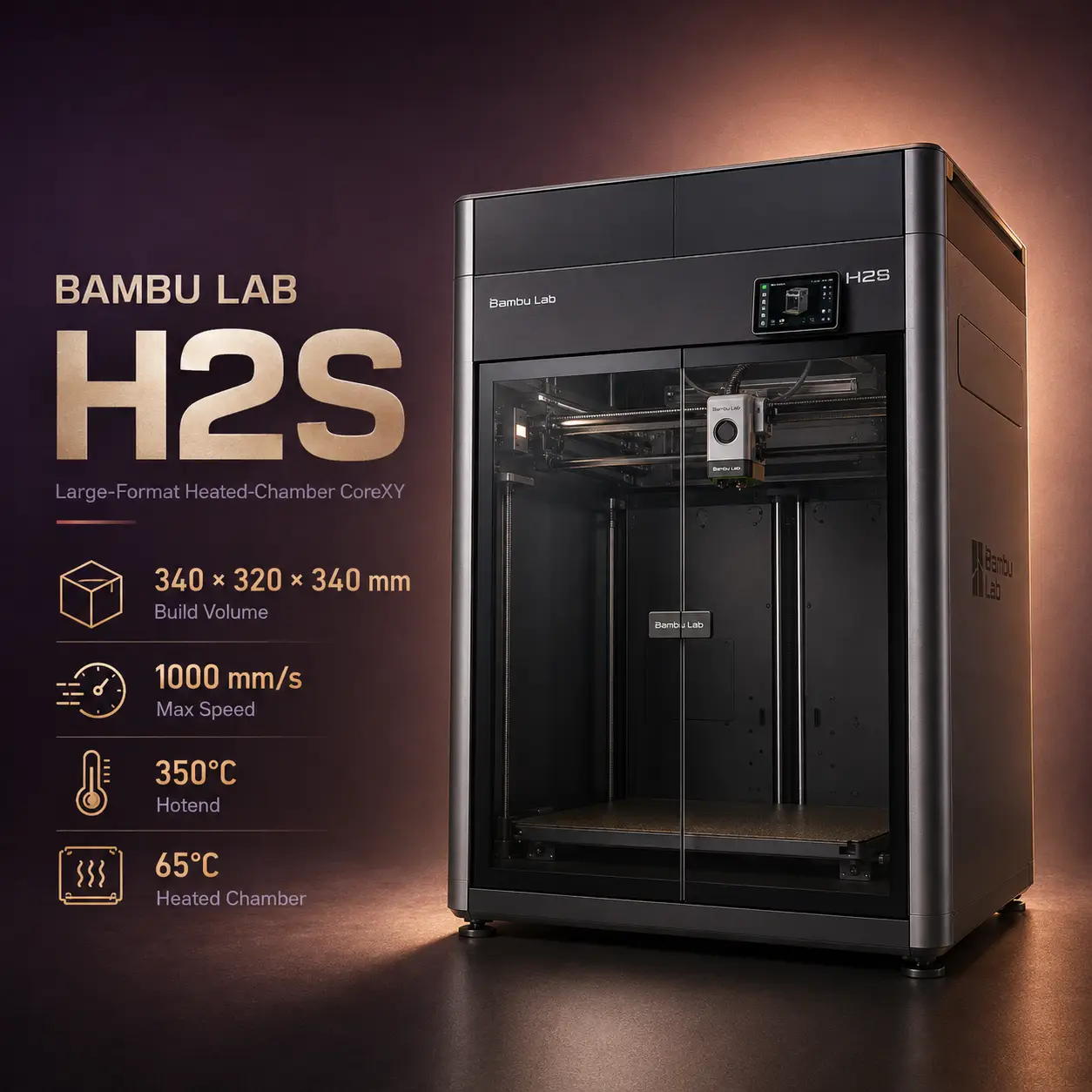
The Bambu Lab H2S is another enclosed single-nozzle CoreXY system with active chamber heating.
H2S offers a larger build envelope and higher hotend/chamber limits, while K2 Pro enters at a lower price and still provides a 300 mm build volume, 60°C chamber heating, dual AI cameras, Ethernet, and optional 16-channel CFS expansion.
The better fit depends on part size, material requirements, software preference, and budget.
For smaller parts, the Bambu Lab P2S occupies a more compact enclosed category.
K2 Pro becomes more compelling when:
Creality’s current US store lists the Creality K2 Pro from US$599. Estimated currency equivalents are approximately €518 in the Eurozone, £443 in the UK, C$831 in Canada, A$846 in Australia, AED 2,200 in the UAE, and ₹57,175 in India.
Recommended use: Choose Creality K2 Pro when you need a 300 mm enclosed CoreXY printer with a true 60°C active chamber, 300°C wear-resistant nozzle, high-speed motion, dual AI cameras, Ethernet, and an upgrade path to CFS multi-color printing without moving to the larger K2 Plus.
300 × 300 × 300 mm.
Creality specifies printing speeds up to 600 mm/s and acceleration up to 20,000 mm/s².
Yes. The chamber can reach up to 60°C.
300°C.
A 0.4 mm steel-tipped tri-metal nozzle.
Creality lists 0.05–0.30 mm.
PLA, PETG, PET, ABS, ASA, PLA-CF, PA-CF, and PPA-CF.
No. The base K2 Pro is CFS-compatible. The K2 Pro Combo includes one CFS.
Up to four CFS units can provide as many as 16 filament channels.
No. CFS has its own compatibility limits and is not intended for flexible TPU, damp BVOH/PVA, or unsuitable spools.
Yes. Creality lists an AI camera for monitoring and a separate AI camera for calibration as standard.
Yes. Creality lists USB drive, Ethernet, and Wi-Fi file transfer.
32 GB eMMC.
100–240 VAC, 50/60 Hz, with 1300 W rated power.
The current US store lists the base K2 Pro at US$599. Estimated currency equivalents are approximately €518 in the Eurozone, £443 in the UK, C$831 in Canada, A$846 in Australia, AED 2,200 in the UAE, and ₹57,175 in India.
The current US listing marks the base K2 Pro as back-order with shipping around August 20, 2026.