Large-Format Heated ChamberHigh-Speed PrintingActive Heating ChamberAdvanced Material PrintingHigh-Performance Polymer ReadyReinforced Filament Printing
BBambu Lab
Bambu Lab
# Bambu Lab H2S
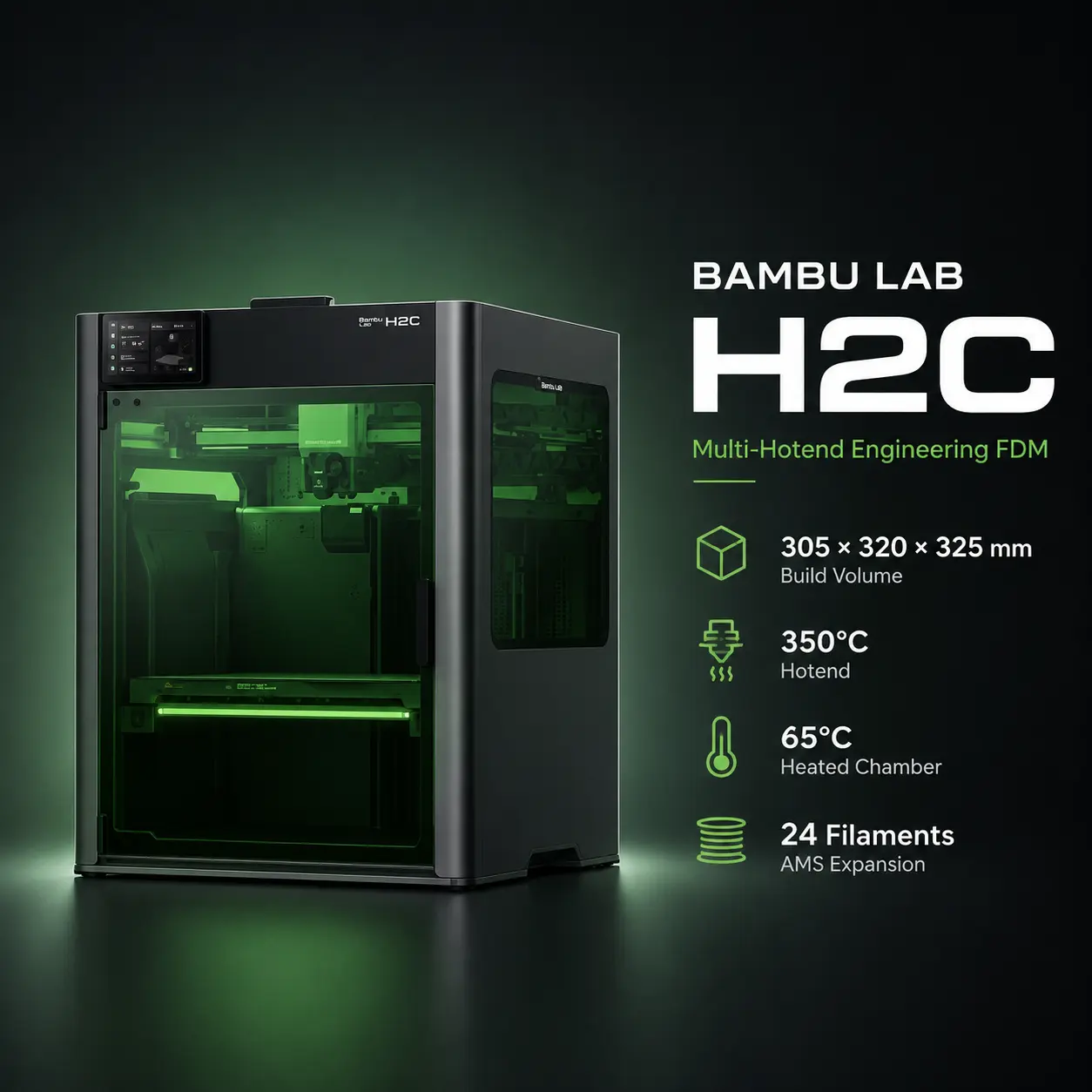
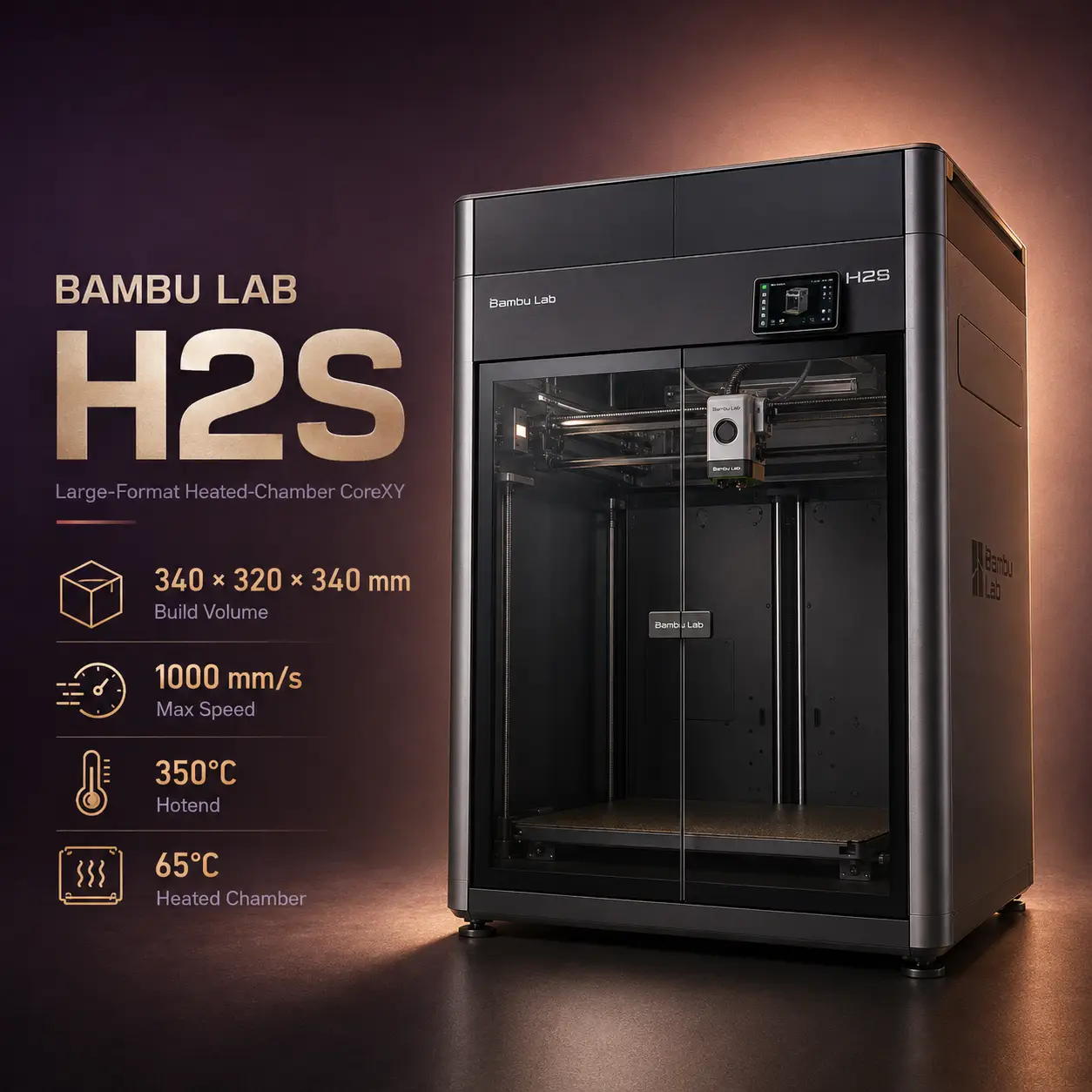
Bambu Lab H2S is a large-format enclosed CoreXY 3D printer for engineering, prototyping, tooling, education, and small-batch production. It combines a 340 × 320 × 340 mm build volume with a 350°C hotend, 120°C heatbed, and 65°C actively heated chamber, giving it strong capability for ABS, ASA, PC, PA, PPA, PPS, and selected carbon- and glass-fiber-reinforced polymers.
One specification needs careful interpretation: Bambu Lab publishes 1,000 mm/s as maximum toolhead speed, not a universal printing speed. Actual print speed depends on hotend flow, geometry, layer height, material, acceleration, cooling, and quality settings. This listing therefore leaves `maxPrintSpeedMmS` empty rather than treating 1,000 mm/s as a guaranteed print-speed figure.
H2S uses a single-nozzle architecture but supports Bambu Lab's AMS ecosystem. Up to 4 AMS 2 Pro units and 8 AMS HT units can be combined for 24 filament slots. The first-generation AMS is also compatible, while AMS lite is not supported.
The standard H2S is a 3D printer. Bambu also offers optional 10 W laser engraving/cutting, digital cutting, and pen plotting through H2S laser configurations and the official upgrade path.
For current specifications, see the official Bambu Lab H2S page and H2S technical specifications.
| Specification | Value |
|---|---|
| Printing technology | FDM / FFF |
| Motion system | CoreXY |
| Build volume | 340 × 320 × 340 mm |
| Filament diameter | 1.75 mm |
| Included nozzle | 0.4 mm hardened steel |
| Supported nozzle sizes | 0.2, 0.4, 0.6, 0.8 mm |
| Maximum nozzle temperature | 350°C |
| Maximum heatbed temperature | 120°C |
| Maximum chamber temperature | 65°C |
| Chamber heating | Active |
| Maximum toolhead speed | 1,000 mm/s |
| Maximum toolhead acceleration | 20,000 mm/s² |
| Standard-hotend max flow | 40 mm³/s in Bambu's stated ABS test |
| Optional high-flow max flow | 65 mm³/s in Bambu's stated ABS test |
| Extruder gear | Hardened steel |
| Nozzle | Hardened steel |
| Live-view camera | 1920 × 1080 |
| Toolhead camera | 1600 × 1200 |
| Build plates | Textured PEI and Smooth PEI supported |
| Air filtration | G3 pre-filter, H12 HEPA, activated carbon |
| Connectivity | Wi-Fi, USB storage |
| Internal storage | 8 GB eMMC |
| Electrical input | 100–120 VAC / 200–240 VAC, 50/60 Hz |
| Maximum power | 1170 W at 110 V / 2050 W at 220 V |
| Physical dimensions | 492 × 514 × 626 mm |
| Net weight | 30 kg |
| Slicer | Bambu Studio |
Speed note: 1,000 mm/s is maximum toolhead speed, not a universal maximum print speed.
Build-surface note: The 340 × 320 mm figure describes printable XY area. Bambu's current H2S specification does not separately publish the physical X/Y dimensions of the removable build plate.
The H2S provides a 340 × 320 × 340 mm build envelope, giving it substantially more room than a 250–260 mm-class desktop printer.
That extra volume is useful for:
Its CoreXY layout keeps the main XY motors fixed to the frame, helping limit moving mass during high-speed motion.
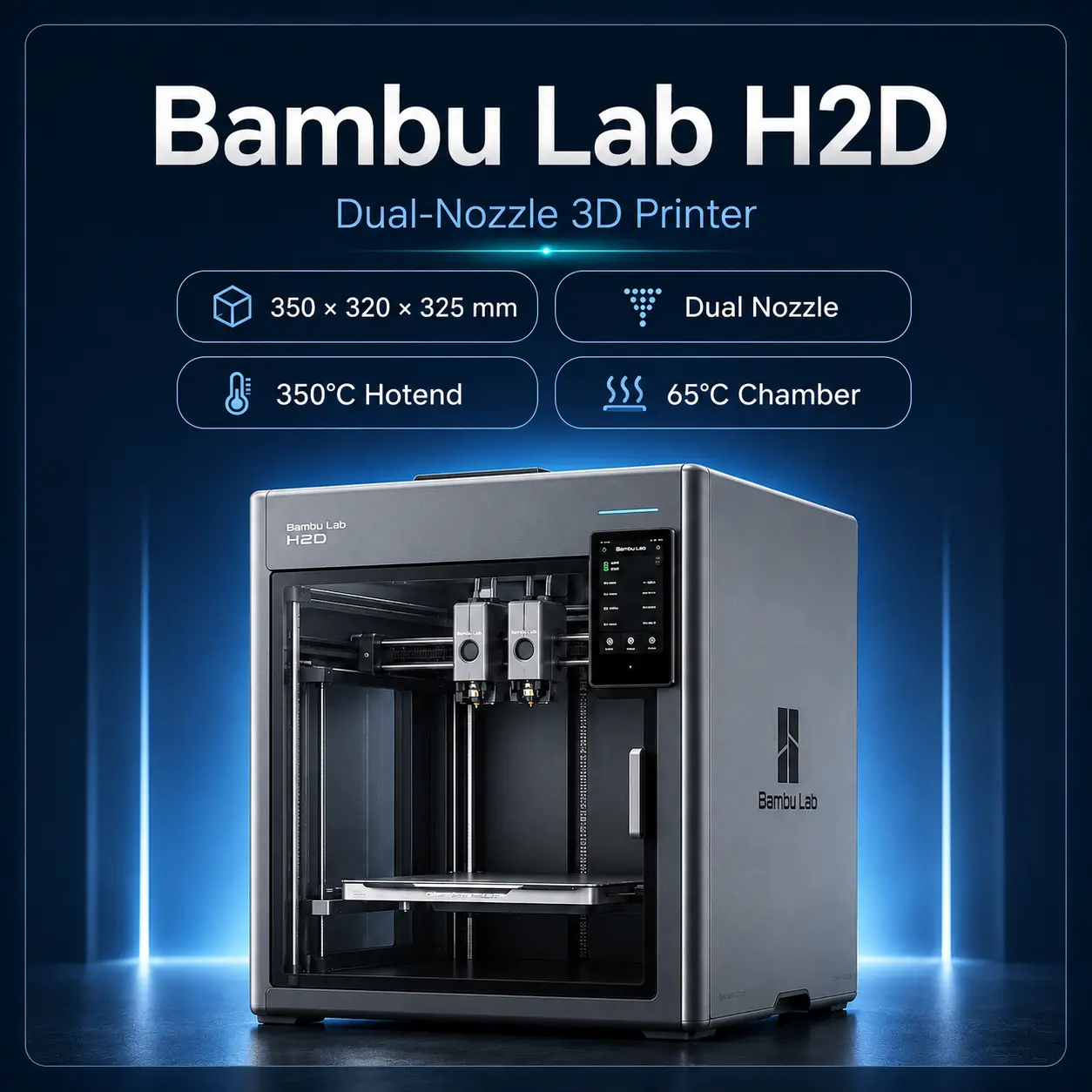
For other large enclosed platforms, compare the Creality K2 Plus and the dual-nozzle Bambu Lab H2D.
The H2S uses an actively heated chamber up to 65°C.
That matters most for large parts made from materials that are sensitive to drafts, shrinkage, and temperature gradients, including:
A heated chamber is only one part of the process. Wet filament, poor build-surface preparation, or incorrect profiles can still cause failures.
For an indexed material example, Prusament ASA benefits from a stable enclosed environment on larger parts.
H2S uses an all-metal hotend with a maximum temperature of 350°C.
The included 0.4 mm nozzle and extruder gear are hardened steel, making the stock toolhead suitable for more abrasive materials than an ordinary brass setup.
Supported nozzle sizes include:
For regular carbon- or glass-fiber use, nozzle diameter should also account for fiber loading and clogging risk. Bambu recommends larger hardened nozzles for many reinforced materials, while selected Bambu PLA-CF and PETG-CF profiles can use hardened 0.4 mm nozzles.
Relevant indexed composites include Prusament PC Blend Carbon Fiber and Prusament PA11 Carbon Fiber.
Bambu publishes 40 mm³/s maximum flow for the standard-flow hotend and 65 mm³/s for the optional high-flow hotend under its stated ABS test conditions.
These values are material- and test-specific.
Likewise, the 1,000 mm/s maximum toolhead speed is a motion-system limit rather than a promise that large engineering parts will print at that speed.
Real production speed depends on:
For large parts, sustained volumetric flow often limits print time before maximum toolhead speed becomes relevant.
Bambu Lab lists H2S support for:
Carbon- and glass-fiber-reinforced variants based on:
Compatibility depends on the exact formulation, nozzle size, drying conditions, AMS choice, and slicer profile.
For broader printer selection, see Best 3D Printers for Carbon-Fiber Materials in 2026.
H2S uses a single nozzle, so filament changes take place through the AMS feeding system rather than by switching complete toolheads.
Bambu's current FAQ states support for:
AMS 2 Pro provides four filament slots plus drying and sealed storage. It handles many common materials and selected Bambu composites.
AMS HT provides a single high-temperature-oriented filament path and is better suited to materials needing more aggressive drying.
The original AMS is plug-and-play compatible for multi-color printing, but it does not add the drying capability of newer AMS products.
Because H2S uses one nozzle, color and material changes can require purging between filaments.
That means 24-slot compatibility should not be confused with a 24-nozzle or zero-purge system.
Waste depends on color contrast, material combination, flush volume, purge-object strategy, and number of changes.
For users who prioritize independent nozzles and lower purge waste, the Prusa XL+ uses a different active-toolchanger architecture.
H2S combines automatic calibration with active motion and extrusion monitoring.
Bambu highlights:
The optional Vision Encoder is tied to Bambu's published sub-50 µm motion-accuracy calibration claim. That number should not be treated as a guaranteed finished-part dimensional tolerance.
The standard H2S includes:
The BirdsEye top camera belongs to Laser Edition configurations rather than the base H2S.
H2S includes:
For high-temperature printing, the system can recirculate heated chamber air. For PLA and PETG, the top vent can open to reduce chamber temperature while maintaining filtered exhaust.
Filtration can reduce particles and odors, but it does not replace the filament manufacturer's ventilation and workplace-safety guidance.
H2S supports cloud-connected control through Bambu's ecosystem, but internet access is not mandatory.
Bambu states that users can control the printer, send files, and upgrade firmware offline. Developer Mode also exposes MQTT access for integrations.
The current technical specification lists Wi-Fi and USB storage. Built-in Ethernet is not listed for the standard H2S, so this listing does not claim Ethernet support.
The H2S platform supports an optional 10 W 455 nm laser module.
Bambu's FAQ specifically states that H2S supports the 10 W laser but not the 40 W laser.
Laser-capable configurations can also support:
These functions require the relevant optional hardware and are not included with the base printer.
The Bambu Lab H2D is the closest indexed relative.
Choose H2S when:
Choose H2D when:
H2S offers a larger single-nozzle printable envelope, while H2D offers more flexible dual-nozzle production.
The Bambu Lab P2S is a smaller enclosed printer for general-purpose desktop work.
H2S is better suited when users need:
P2S remains easier to place and less expensive when a 256 mm-class build volume is sufficient.
Bambu Lab's current US H2-series pricing lists the H2S from US$1,249. Based on current exchange rates, the estimated equivalent starting prices are approximately €1,080 in the Eurozone, £923 in the UK, C$1,733 in Canada, A$1,764 in Australia, AED 4,587 in the UAE, and ₹119,218 in India. AMS and laser bundles may cost more.
Recommended use: Choose Bambu Lab H2S when you need a large enclosed single-nozzle CoreXY printer with a 65°C active chamber, 350°C hotend, hardened extrusion hardware, and broad engineering-material support. It is strongest for large functional parts and production workflows where AMS convenience is more important than independent multi-nozzle toolchanging.
340 × 320 × 340 mm.
No. Bambu specifies 1,000 mm/s as maximum toolhead speed.
350°C.
120°C.
Yes. The chamber can reach 65°C.
A 0.4 mm hardened-steel nozzle.
Yes. Bambu lists several carbon- and glass-fiber-reinforced material families, subject to the correct nozzle, drying, and profile.
Up to 24 filament slots using supported AMS 2 Pro and AMS HT expansion.
Yes.
No.
Built-in Ethernet is not listed in Bambu Lab's current H2S technical specification.
Yes. Bambu supports offline control and firmware updates.
Yes, through compatible H2S laser configurations or the official 10 W laser upgrade path. It does not support the 40 W laser module.
Bambu Lab lists H2S from US$1,249.