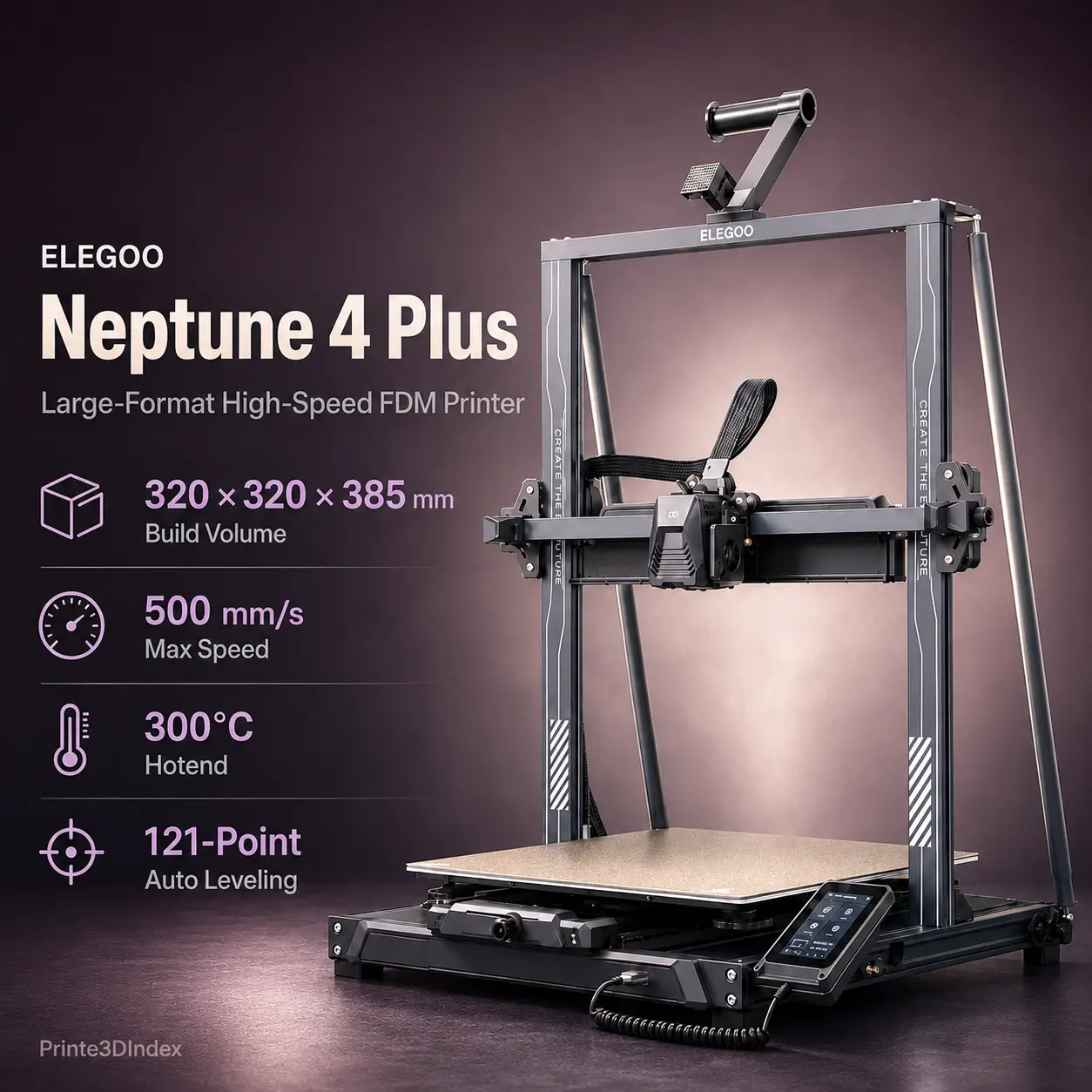
Large-Format Klipper Printing500 mm/s High-Speed Motion121-Point Auto LevelingX/Y Resonance CalibrationDual-Gear Direct DriveRear Auxiliary Cooling
EELEGOO
ELEGOO
# ELEGOO Neptune 4 Plus
The ELEGOO Neptune 4 Plus is a large-format open-frame FDM/FFF printer for users who want substantially more build space than a typical 250–260 mm desktop machine without giving up high-speed Klipper motion. Its 320 × 320 × 385 mm build volume suits helmets, props, tall functional parts, jigs, prototypes, and batch printing.
ELEGOO rates the printer for 30–500 mm/s, with 250 mm/s as the recommended/default speed and up to 12,000 mm/s² acceleration. It also combines a 300°C hotend, 100°C heated bed, 121-point bed mesh, direct-drive extrusion, dual Z motors, X/Y acceleration sensors, and Wi-Fi, wired LAN, and USB connectivity.
For current specifications and pricing, see the official ELEGOO Neptune 4 Plus page and ELEGOO Neptune-series support resources. For large wearable projects, see Best 3D Printers for Cosplay Props and Helmets in 2026.
| Specification | Value |
|---|---|
| Printing technology | FDM / FFF |
| Printer design | Open-frame Cartesian / bed-slinger |
| Build volume | 320 × 320 × 385 mm |
| PEI platform area | 330 × 330 mm |
| Layer height | 0.10–0.40 mm |
| Recommended layer height | 0.20 mm |
| Printing accuracy | ±0.1 mm manufacturer specification |
| Recommended/default speed | 250 mm/s |
| Maximum speed | 500 mm/s |
| Maximum acceleration | 12,000 mm/s² |
| Standard nozzle | 0.4 mm brass |
| Maximum nozzle temperature | 300°C |
| Hotend heater | 60 W ceramic |
| Maximum bed temperature | 100°C |
| Extruder | Dual-gear direct drive |
| Extruder ratio | 5.2:1 |
| Bed leveling | Manual setup + 121-point auto mesh |
| Z axis | Dual lead screws + dual motors + support rods |
| Resonance calibration | X/Y acceleration sensors |
| Firmware | Klipper |
| Processor | ARM 64-bit, 1.5 GHz quad-core |
| Internal storage | 8 GB |
| Connectivity | 2.4 GHz Wi-Fi / Ethernet / USB |
| Web control | Supported |
| Filament detection | Supported |
| Power-loss resume | Supported |
| Machine dimensions | 578 × 533 × 640 mm |
| Maximum activity space | 578 × 750 × 860 mm |
| Net weight | 14.4 kg |
| Input voltage | 100–120 / 220–240 V AC |
The 500 mm/s figure is a maximum motion specification, not a recommended speed for every model. Real throughput depends on filament flow, nozzle size, layer height, acceleration, cooling, and geometry.
The Neptune 4 Plus offers much more usable room than the Neptune 4 and Neptune 4 Pro. Its 320 × 320 mm XY area is useful for helmets, masks, housings, RC parts, architectural models, workshop jigs, tall prototypes, and multiple parts on one plate.
For cosplay, the larger platform can reduce the number of seams required when a helmet or prop would otherwise need to be split across a 250 mm-class bed.
The tradeoff is footprint. ELEGOO lists the printer itself at 578 × 533 × 640 mm, but the moving bed and spool arrangement need up to roughly 578 × 750 × 860 mm of operating space.
Neptune 4 Plus ships with Klipper pre-installed.
Its ARM-based controller, 8 GB storage, X/Y acceleration sensors, input shaping, and pressure advance provide a more complete high-speed setup than simply increasing maximum carriage speed.
Input shaping reduces ringing caused by resonance, while pressure advance compensates extrusion pressure through speed changes. A large moving bed still carries more inertia than a CoreXY motion system, so tall or heavy prints benefit from sensible acceleration and speed settings.
The printer uses a 5.2:1 dual-gear direct-drive extruder with a 60 W ceramic heater and all-titanium throat on current Plus/Max hotend hardware.
ELEGOO lists PLA, PETG, TPU, ABS, ASA, and Nylon. Direct drive is useful for flexible filament because the filament path is short.
For everyday functional parts, Prusament PETG is a relevant low-warp rigid material, while Prusament TPU 95A illustrates a flexible-material use case.
The Neptune 4 Plus reaches 300°C at the nozzle and 100°C at the bed, but it remains open-frame. ELEGOO specifically recommends using an enclosure for ABS and ASA.
That matters on a 320 mm bed because larger parts experience stronger thermal gradients and are more prone to lifting or warping. Prusament ASA, for example, benefits from an enclosure for larger parts and requires appropriate ventilation.
Nylon also benefits from dry filament and stable conditions. The Plus can process these materials, but it is not equivalent to a purpose-built enclosed engineering printer.
The core material list focuses on PLA, PETG, TPU, ABS, ASA, and Nylon. Although ELEGOO's upgraded build-plate copy mentions carbon-fiber use, the standard nozzle is brass.
Abrasive carbon- or glass-fiber-filled filaments can wear brass rapidly. Frequent composite printing calls for wear-resistant nozzle hardware and validated profiles.
For more demanding reinforced-material work, compare the indexed Creality K2 Plus or review Best 3D Printers for Carbon-Fiber Materials in 2026.
The Neptune 4 Plus probes an 11 × 11 / 121-point mesh across its large bed. That is useful on a 330 mm-class plate, where small height differences can become more noticeable across the full surface.
The mesh compensates for surface variation, but correct mechanical setup and Z offset still matter.
The Plus uses toolhead cooling plus two large 6025 rear auxiliary blower fans.
This helps high-speed PLA overhangs and bridges. For ABS, ASA, and some nylons, aggressive cooling can increase warping or weaken layer bonding, so fan settings should match the material.
Unlike the smaller Neptune 4 and Neptune 4 Pro, the Plus includes Wi-Fi as well as wired LAN and USB. ELEGOO's current network documentation specifies 2.4 GHz Wi-Fi.
Users can access the printer over the local network through its web interface for remote control and file transfer. The Plus also supports network-based multi-printer management.
The Neptune 4 Plus exists in two hardware revisions.
Core build volume, speed class, nozzle temperature, leveling, and networking are similar, but firmware and parts should not be assumed interchangeable.
| Printer | Build Volume | Max Speed | Nozzle / Bed | Enclosure | Main Advantage |
|---|---|---|---|---|---|
| ELEGOO Neptune 4 Plus | 320 × 320 × 385 mm | 500 mm/s | 300°C / 100°C | No | Affordable large-format Klipper |
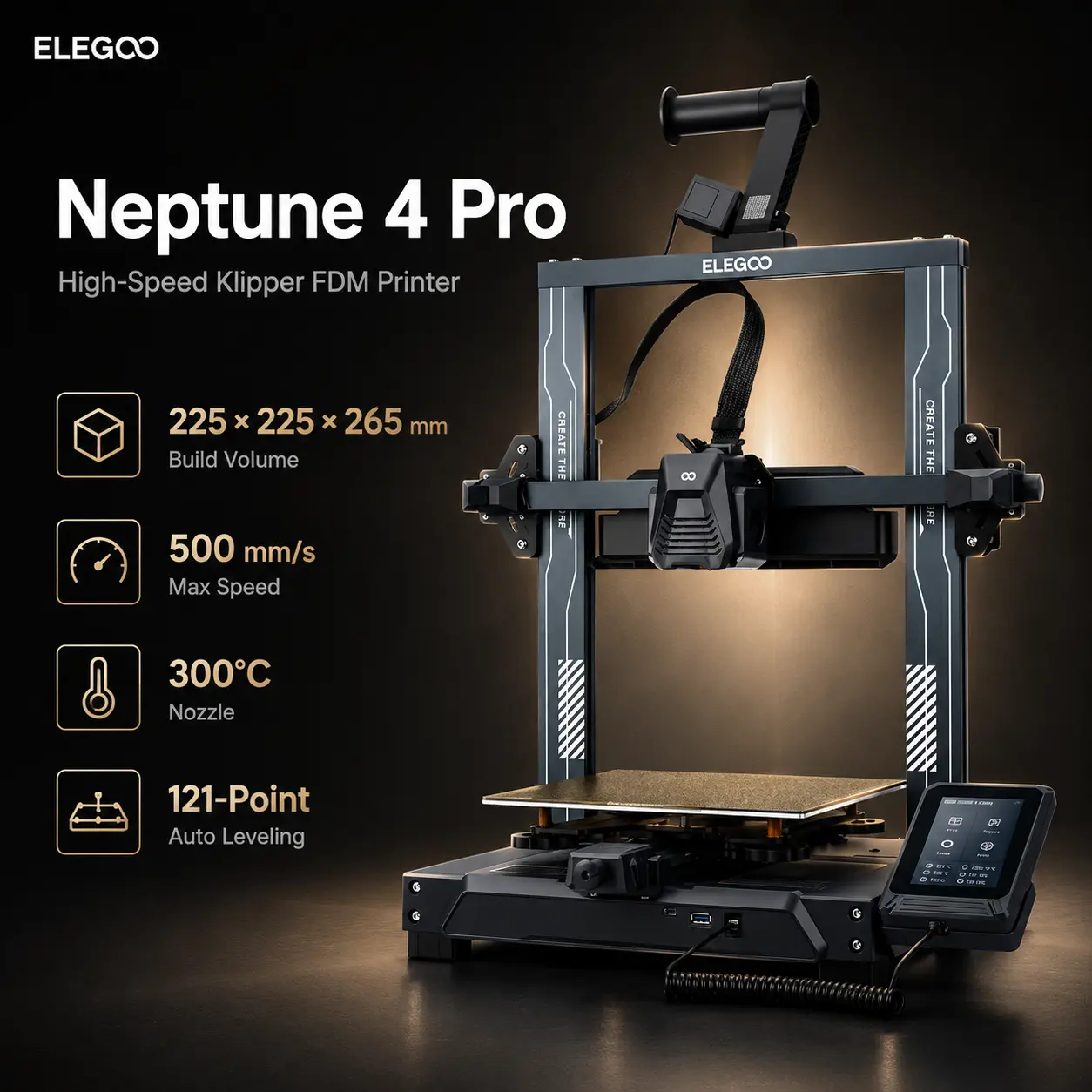
| ELEGOO Neptune 4 Pro | 225 × 225 × 265 mm | 500 mm/s | 300°C / 110°C | No | Smaller footprint + segmented bed |
| ELEGOO Neptune 4 Max | 420 × 420 × 480 mm | 500 mm/s | 300°C / 85°C | No | Much larger print volume |
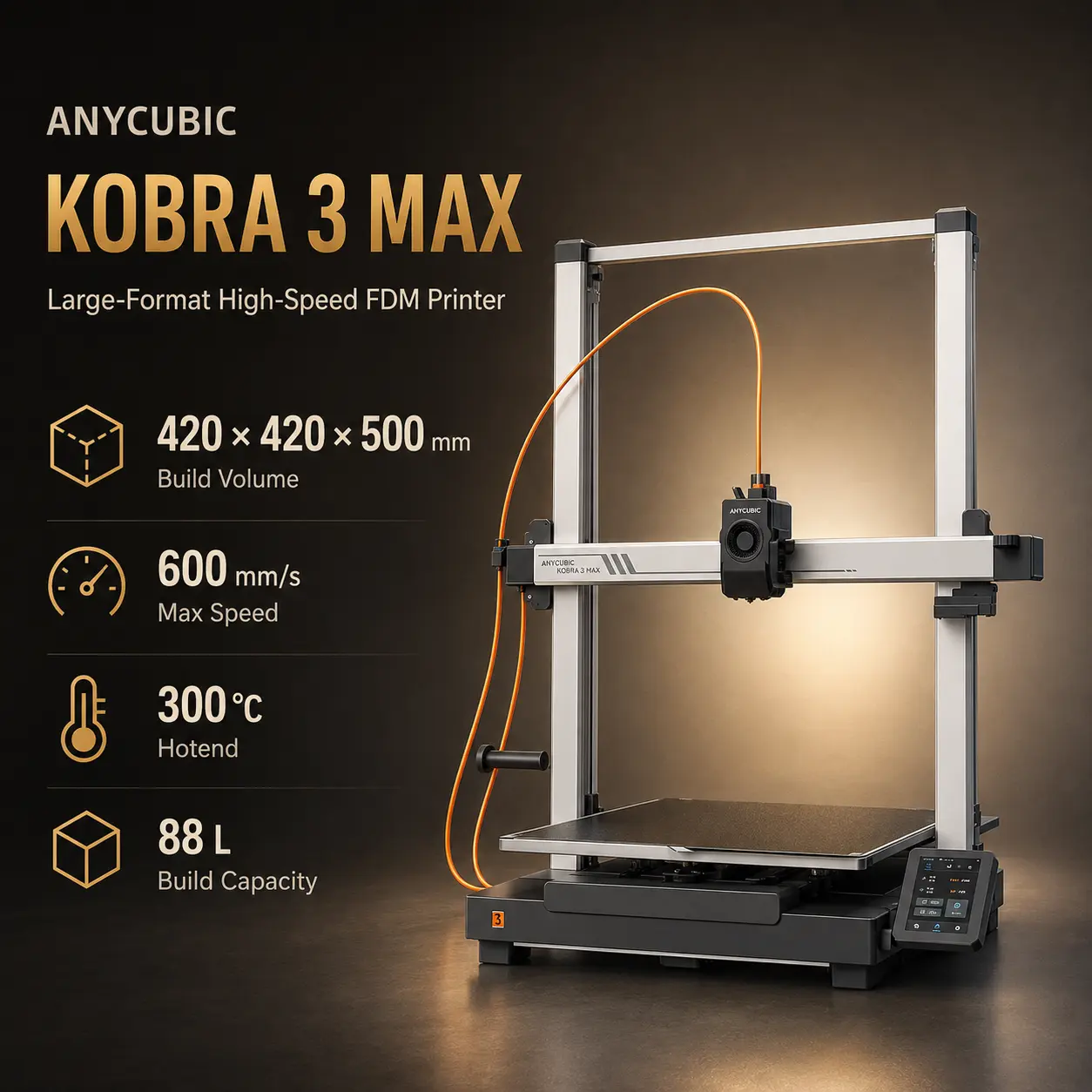
| Anycubic Kobra 3 Max | 420 × 420 × 500 mm | 600 mm/s | 300°C / 90°C | No | Huge volume + optional multi-color |
| Creality K2 Plus | 350 × 350 × 350 mm | 600 mm/s | 350°C / 120°C | 60°C active | Enclosed engineering workflow |
The Neptune 4 Plus sits in a useful middle ground: far larger than typical desktop printers, easier to place than a 420 mm-class bed-slinger, and much less expensive than large enclosed CoreXY systems.
The Neptune 4 Plus vs Neptune 4 Pro comparison is mainly build size and wireless networking versus compactness and a segmented bed.
The Neptune 4 Pro provides a 225 × 225 × 265 mm build volume, 500 mm/s maximum speed, 20,000 mm/s² maximum acceleration, 300°C hotend, 110°C bed, and segmented heatbed.
The Plus grows to 320 × 320 × 385 mm, adds Wi-Fi, and uses X/Y acceleration sensors, but its maximum acceleration is 12,000 mm/s² and its bed limit is 100°C.
Choose Neptune 4 Pro for a smaller footprint, higher maximum acceleration, and segmented heating. Choose Neptune 4 Plus when large parts, 385 mm Z height, and Wi-Fi matter more.
See the official Neptune 4 Pro page.
The Neptune 4 Plus vs Neptune 4 Max comparison is about how much build volume you actually need.
The Neptune 4 Max expands to 420 × 420 × 480 mm while retaining 500 mm/s maximum speed, Klipper, direct drive, Wi-Fi/LAN/USB, and 121-point leveling.
The Max's current specification lists an 85°C bed and 8,000 mm/s² maximum acceleration, lower than the Plus's 100°C bed and 12,000 mm/s² ceiling.
Choose Neptune 4 Max for the biggest helmets, props, and housings. Choose Neptune 4 Plus when 320 × 320 × 385 mm is already sufficient and a smaller footprint, hotter bed, lower price, and higher acceleration are more useful.
See the official Neptune 4 Max page.
The Neptune 4 Plus vs Anycubic Kobra 3 Max comparison is compact large-format value versus maximum consumer bed-slinger capacity.
The indexed Anycubic Kobra 3 Max provides a much larger 420 × 420 × 500 mm build volume, up to 600 mm/s, 300°C hotend, 90°C PEI bed, LeviQ 3.0 leveling, and optional four- or eight-color ACE Pro support.
Neptune 4 Plus is smaller but less expensive, uses Klipper, has a hotter 100°C bed, and occupies less workshop space.
Choose Kobra 3 Max when maximum helmet, prop, or large-part size is the priority. Choose Neptune 4 Plus when a 320 mm bed is enough and Klipper, compactness, and lower cost matter more.
See the official Anycubic Kobra 3 Max page.
The Neptune 4 Plus vs Creality K2 Plus comparison is open-frame value versus an enclosed engineering platform.
The indexed Creality K2 Plus provides a 350 × 350 × 350 mm build volume, up to 600 mm/s printing, 350°C nozzle, 120°C bed, and 60°C actively heated chamber.
K2 Plus is better suited to large ABS, ASA, PA, PC, and reinforced-material parts and can add CFS multi-color capability.
Choose Neptune 4 Plus for large PLA/PETG/TPU work, cosplay, and general prototyping. Choose K2 Plus for engineering materials, enclosure-controlled printing, and CFS expansion.
The ELEGOO Neptune 4 Plus current original price is US$425 in the USA, approximately €363 in Europe, £311 in the UK, C$585 in Canada, A$595 in Australia, ₹40,685 in India, and AED 1,561 in the UAE. But ELEGOO Neptune 4 Plus Ribbon-Cable version currently starts from US$269, approximately €230 in Europe, £197 in the UK, C$370 in Canada, A$377 in Australia, ₹25,749 in India, and AED 988 in the UAE. Actual pricing may vary by region depending on VAT or local taxes, shipping costs, exchange rates, stock availability, hardware revision, regional bundles, and promotional discounts. The Ribbon-Cable and Type-C versions may also be priced differently, so the exact configuration should be checked before purchase.
320 × 320 × 385 mm.
ELEGOO lists a 330 × 330 mm PEI platform.
0.10–0.40 mm, with 0.20 mm recommended.
500 mm/s. ELEGOO lists 250 mm/s as the recommended/default speed.
12,000 mm/s².
300°C.
100°C.
Yes. Klipper is pre-installed.
Yes. Neptune 4 Plus supports 2.4 GHz Wi-Fi, wired LAN, and USB.
PLA, PETG, TPU, ABS, ASA, and Nylon.
No.
They are different hardware revisions. The current US Ribbon-Cable version uses local firmware updates, while the Type-C version sold in some regions supports OTA updates.
The Plus has a much larger build volume and Wi-Fi. The Pro is smaller, has higher maximum acceleration, a hotter 110°C bed, and a segmented heatbed.
The Max grows to 420 × 420 × 480 mm. The Plus is smaller, cheaper, and has a hotter bed and higher maximum acceleration.
Kobra 3 Max is much larger and adds optional multi-color capability. Neptune 4 Plus is cheaper, more compact, and uses Klipper.
The ELEGOO Neptune 4 Plus current original price is US$425 in the USA, approximately €363 in Europe, £311 in the UK, C$585 in Canada, A$595 in Australia, ₹40,685 in India, and AED 1,561 in the UAE. Actual pricing may vary by region depending on VAT or local taxes, shipping costs, exchange rates, stock availability, hardware revision, regional bundles, and promotional discounts.