Extreme-Heat PPS-CFChemical-Resistant PPS CompositeHigh-Temperature Carbon FibreLow-Moisture Engineering FilamentIndustrial PPS-CF MaterialHigh-Creep-Resistance Composite
BBambu Lab
Bambu Lab
# Bambu Lab PPS-CF
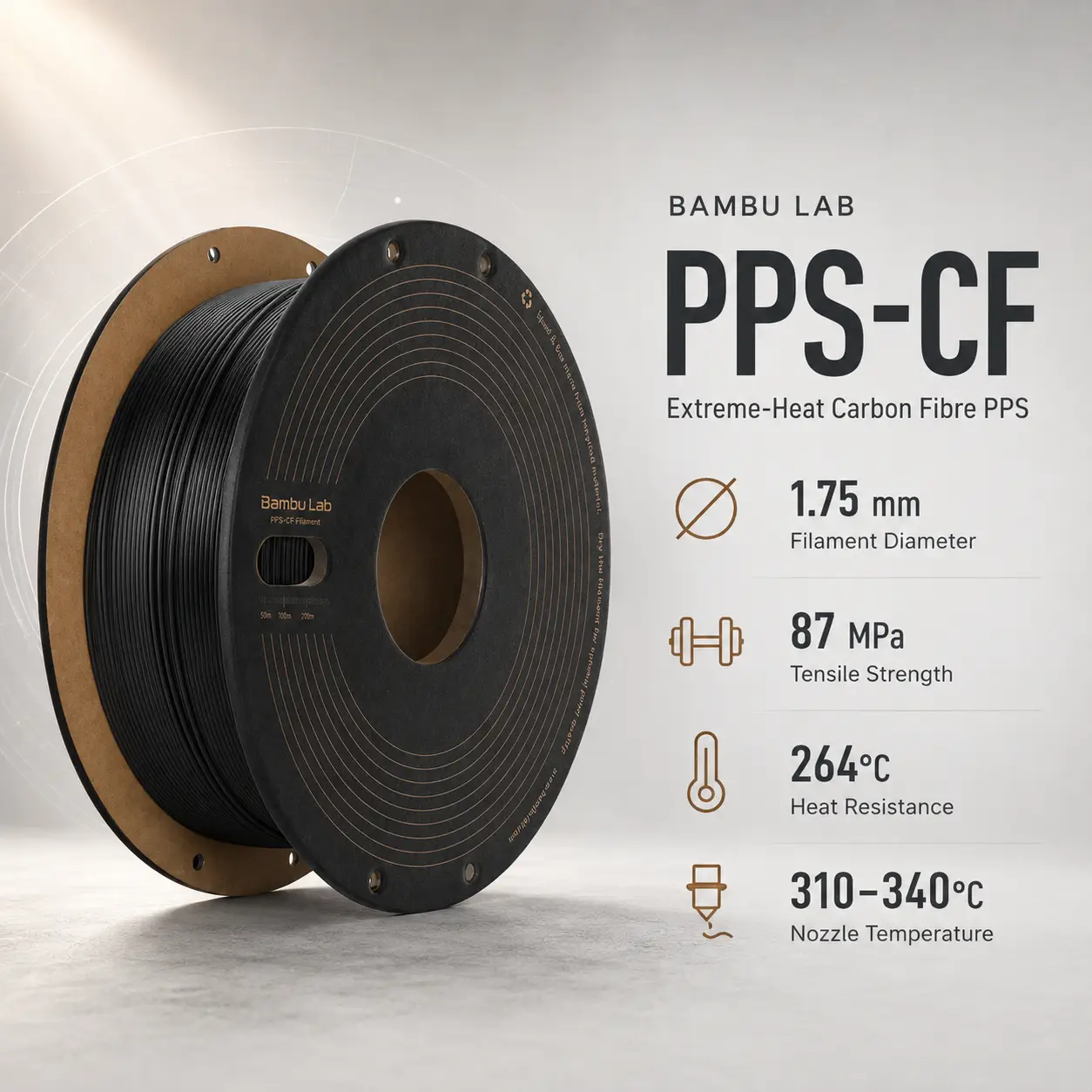
Bambu Lab PPS-CF is a 1.75 mm carbon-fiber-reinforced polyphenylene sulfide filament for high-temperature, chemically aggressive, and dimensionally demanding FDM applications.
PPS is already known for heat, solvent, corrosion, and moisture resistance. Bambu's chopped-carbon-fiber reinforcement further increases stiffness, bending strength, dimensional stability, and resistance to warping. The result is one of Bambu Lab's highest-temperature engineering filaments rather than an everyday Bambu PLA or general-purpose material.
Bambu publishes 87 ± 5 MPa tensile strength, 142 ± 5 MPa bending strength, 7160 ± 280 MPa bending modulus, and 264°C HDT at 0.45 MPa. The technical data also lists 235°C HDT at 1.8 MPa, 284°C melting temperature, 268°C Vicat softening temperature, and approximately 1.26 g/cm³ density.
PPS-CF also has exceptionally low moisture uptake for a reinforced engineering polymer. Bambu's comparison data lists about 0.05% saturated water absorption at 25°C / 55% RH, substantially below many nylon-based carbon-fiber filaments.
For current specifications and pricing, see the official Bambu Lab PPS-CF page and Bambu Lab filament compatibility guide.
| Specification | Value |
|---|---|
| Material | Carbon-fiber-reinforced PPS |
| Printing process | FDM / FFF |
| Diameter | 1.75 ± 0.05 mm |
| Net filament weight | 0.75 kg |
| Spool | Cardboard, approx. 200 mm diameter |
| Nozzle temperature | 310–340°C |
| Bed temperature | 100–120°C |
| Chamber temperature | 60–90°C |
| Recommended nozzle sizes | 0.4 / 0.6 / 0.8 mm |
| Preferred nozzle size | 0.6 mm hardened steel |
| 0.2 mm nozzle | Not compatible |
| Print speed | Below 100 mm/s |
| Cooling | 0–40% |
| Build surfaces | Smooth PEI / Textured PEI with glue |
| Density | 1.26 g/cm³ |
| Melting temperature | 284°C |
| Glass transition temperature | 100°C |
| Crystallization temperature | 214°C |
| Vicat softening temperature | 268°C |
| HDT at 0.45 MPa | 264°C |
| HDT at 1.8 MPa | 235°C |
| Tensile strength | 87 ± 5 MPa |
| Elongation at break | 1.2 ± 0.4% |
| Bending strength | 142 ± 5 MPa |
| Bending modulus | 7160 ± 280 MPa |
| Impact strength | 27.8 ± 2.3 kJ/m² |
| Water absorption | Approx. 0.05% at 25°C / 55% RH in Bambu comparison data |
| Flame rating | UL 94 V-0 |
| Color | Black |
| Abrasive | Yes |
| Enclosure | Required / strongly controlled environment |
Mechanical and thermal values are manufacturer test results from defined print conditions and should not be treated as universal finished-part design allowables.
Bambu's current PPS-CF guidance specifies:
The carbon-fiber fill is abrasive. Use a hardened nozzle; Bambu recommends 0.6 mm to reduce clogging and wear.
PPS-CF needs substantially more thermal capability than ordinary Bambu filament such as PLA, PETG, or ABS.
Bambu's current filament guide lists H2 Series and X1E for PPS-CF. Older store copy still names X1E/H2D, so use the latest profile for the exact printer.
The indexed Bambu Lab H2D is a direct match with a 350°C hotend and 120°C bed. By contrast, the Bambu Lab P2S and Bambu Lab A1 are not current PPS-CF platforms under Bambu's material guide.
PPS-CF must be thoroughly dried before printing.
Bambu's TDS recommends:
A controlled forced-air oven is the clearest drying method. Bambu warns against microwave or ordinary kitchen ovens because uneven heating can damage the spool or filament.
The keyword Bambu Lab AMS 2 Pro filament dryer is relevant here mainly because PPS-CF exceeds the dryer's temperature capability.
AMS 2 Pro reaches up to 65°C, while PPS-CF requires 100–140°C for 8–12 hours in Bambu's drying guidance. AMS 2 Pro therefore cannot perform the required high-temperature pre-drying cycle for wet PPS-CF.
Bambu also warns that rigid PPA-CF and PPS-CF can break in AMS gears or sharply bent PTFE tubes. The H2 guide shows direct feeding from an external airtight dry box.
Dry the spool correctly, move it to a sealed dry box, follow the printer-specific feed path, and keep humidity below 20% RH. AMS 2 Pro remains useful for many lower-temperature Bambu filaments, but not for the required PPS-CF pre-drying cycle.
PPS-CF sits far above conventional PLA, PETG, ABS, ASA, and most PC composites in Bambu's heat-resistance table.
Bambu publishes:
Bambu also states that PPS-CF can operate above 200°C in suitable applications, but actual service limits remain load-, geometry-, orientation-, and environment-dependent.
Bambu documents 180–220°C for 6–12 hours. Annealing can improve stability but may also cause warping or dimensional change, so validate the final process on production geometry.
PPS-CF is very stiff rather than ductile: Bambu publishes 87 MPa tensile strength, 142 MPa bending strength, 7160 MPa bending modulus, 1.2% elongation, and 27.8 kJ/m² impact strength. That profile suits fixtures, housings, tooling, frames, and heat-loaded brackets.
Bambu documents resistance to acids, alkalis, organic solvents, oils, grease, water, and humid environments, while its comparison data shows only about 0.05% water absorption. Validate the exact chemical concentration and service temperature for production use.
PPS-CF also carries a UL 94 V-0 flame rating. That is useful material data, but it does not automatically certify the final printed assembly.
For users comparing Bambu filament cost per gram, the current US price of US$129.99 for 750 g works out to approximately US$0.173/g, or about 17.3 cents per gram before tax and shipping.
That is far more expensive than everyday Bambu Lab PLA, so the premium only makes sense when extreme heat, chemicals, creep, or humidity stability are required.
Users searching for Bambu filament, Bambu Lab filament, Bambu filaments, Bambu PLA, or Bambu Lab PLA should not treat PPS-CF as a premium version of ordinary PLA.
PPS-CF needs a 310–340°C hotend, 100–120°C bed, 60–90°C chamber, hardened nozzle, high-temperature drying, and dry feeding. The phrase “Bambu Labs filament” is a common search variation; the manufacturer name is Bambu Lab.
For ordinary models, PLA or PETG is far easier and cheaper.
A common search question is “does Bambu come with filament?”
Some Bambu printer packages include small samples, but a full PPS-CF spool should be treated as a separate purchase. Confirm printer, nozzle, chamber, plate, and drying compatibility before use.
| Material | HDT | Processing | Moisture Behavior | Main Advantage |
|---|---|---|---|---|
| Bambu Lab PPS-CF | 264°C @ 0.45 MPa / 235°C @ 1.8 MPa | 310–340°C nozzle; 60–90°C chamber | Very low | Extreme heat, chemicals, creep |
| Bambu PPA-CF | 227°C @ 0.45 MPa | High-temp enclosed workflow | More moisture-sensitive than PPS | High heat with strong mechanical performance |
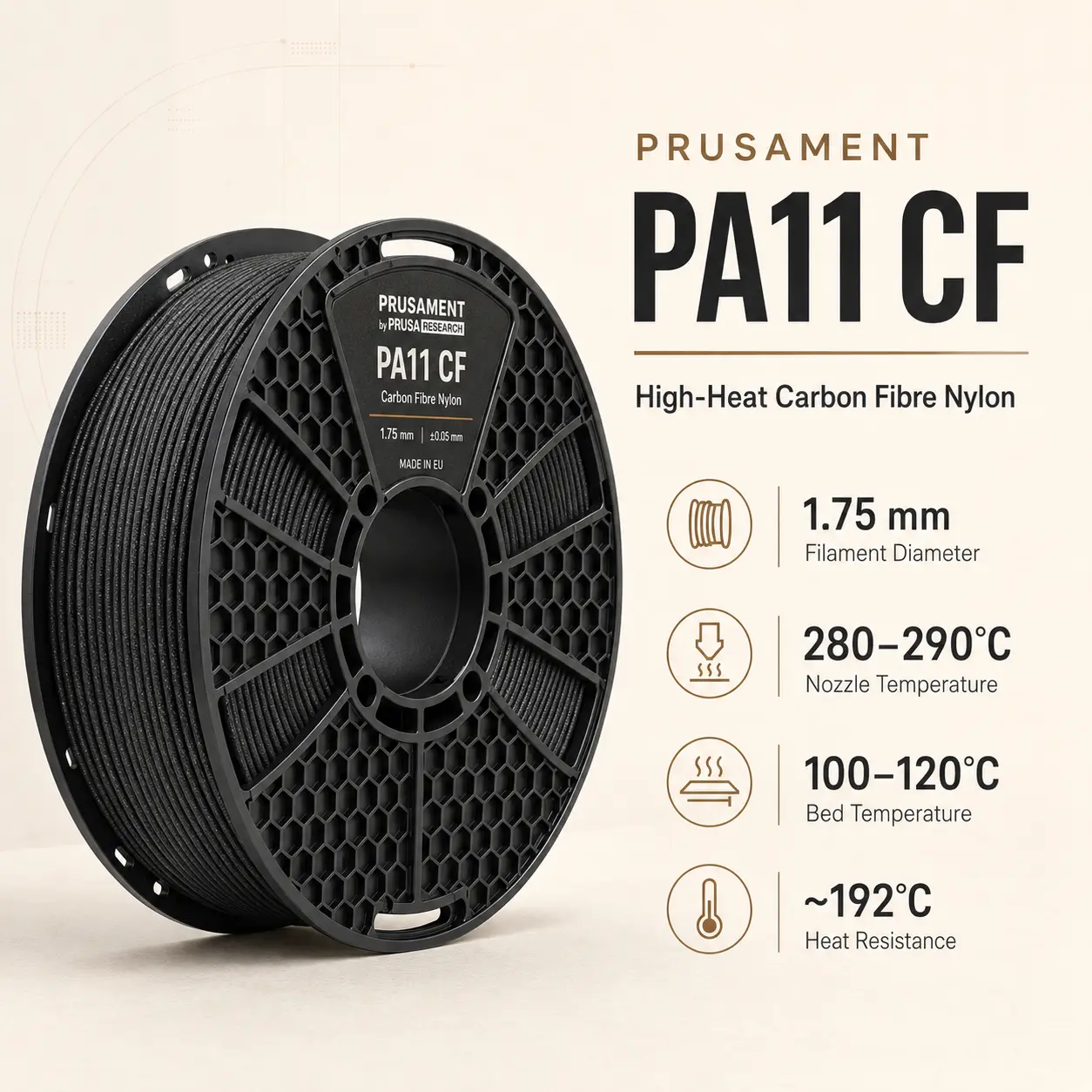
| Prusament PA11 Carbon Fiber | 192°C @ 0.45 MPa / 152°C @ 1.8 MPa | Around 285°C nozzle | Low for PA, but still hygroscopic | Wear, impact, chemical resistance |
| Prusament PC Blend Carbon Fiber | 114°C @ 0.45 MPa / 106°C @ 1.8 MPa | 275–295°C nozzle | Moderate | Easier rigid high-heat CF printing |
Figures come from different manufacturers and test conditions and should be used for material positioning rather than direct design substitution.
The Bambu PPS-CF vs PPA-CF comparison is the most relevant high-temperature decision inside Bambu's engineering range.
Bambu's own heat-resistance comparison lists approximately 264°C HDT at 0.45 MPa for PPS-CF and 227°C for PPA-CF.
PPA-CF remains more moisture-sensitive. Choose PPA-CF for very high mechanical/thermal performance without PPS-level chemical requirements; choose PPS-CF for the highest heat, humidity stability, and chemical resistance.
The indexed Prusament PA11 Carbon Fiber provides 192°C HDT at 0.45 MPa and 152°C at 1.8 MPa.
PA11-CF adds wear, low friction, impact performance, and easier processing. Choose PA11-CF for 190°C-class moving/mechanical parts; choose PPS-CF for a much higher thermal ceiling and lower moisture uptake.
The indexed Prusament PC Blend Carbon Fiber is a considerably easier high-stiffness carbon-fiber material.
Prusa publishes 114°C HDT at 0.45 MPa, with temperature resistance rising to about 130°C after its documented annealing process.
PC Blend CF needs only around 285°C and no enclosure according to Prusa. Choose it for 100–130°C-class rigid tooling; choose PPS-CF for substantially harsher thermal, chemical, humidity, or creep service.
Bambu's current US store lists PPS-CF at US$129.99 per 0.75 kg spool.
That equals roughly:
The spool is black PPS-CF on a cardboard spool with desiccant. Pricing, stock, tax, and shipping can change by region.
For regional reference, the approximate price is €111.45 in Europe, £95.61 in the United Kingdom, AED 477.45 in the UAE, C$179.67 in Canada, A$182.67 in Australia, and ₹12,426 in India. The actual Bambu Lab regional prices may differ because of local pricing, taxes, shipping, promotions, stock, and exchange-rate changes.
It is a carbon-fiber-reinforced PPS engineering filament designed for extreme heat, chemical exposure, low moisture uptake, stiffness, and dimensional stability.
310–340°C.
264°C at 0.45 MPa and 235°C at 1.8 MPa in Bambu's technical data.
Bambu's current filament guide lists H2 Series and X1E. The indexed H2D is a directly relevant platform.
Bambu's PPS-CF documentation does not recommend the conventional AMS/AMS lite path, and current H2 guidance warns that PPS-CF can break in AMS gears or bent PTFE tubes. Follow the printer-specific external dry-box feed workflow.
Not to the required pre-drying specification. AMS 2 Pro reaches 65°C, while Bambu specifies 100–140°C for 8–12 hours for PPS-CF.
At US$129.99 for 750 g, Bambu filament cost per gram is about US$0.173, or 17.3 cents per gram. For regional reference, the approximate price is €111.45 in Europe, £95.61 in the United Kingdom, AED 477.45 in the UAE, C$179.67 in Canada, A$182.67 in Australia, and ₹12,426 in India for 750 g. The actual Bambu Lab regional prices may differ because of local pricing, taxes, shipping, promotions, stock, and exchange-rate changes.
Package contents vary by printer, but buyers should not expect a printer to include a full 0.75 kg spool of PPS-CF. This specialized material is sold separately.
No. Bambu Lab PLA is a low-temperature general-purpose material; PPS-CF requires much higher processing temperatures, drying, chamber control, and wear-resistant hardware.
Yes. Bambu recommends forced-air drying at 100–140°C for 8–12 hours and keeping humidity below 20% RH.