Small Object PrecisionFine Detail ScanningJewelry Detail CaptureCompact Blue Light ScannerPrecision Miniature ScanningHigh Detail Structured LightDesktop Detail Scanning
RRevopoint
Revopoint
# Revopoint MINI 2
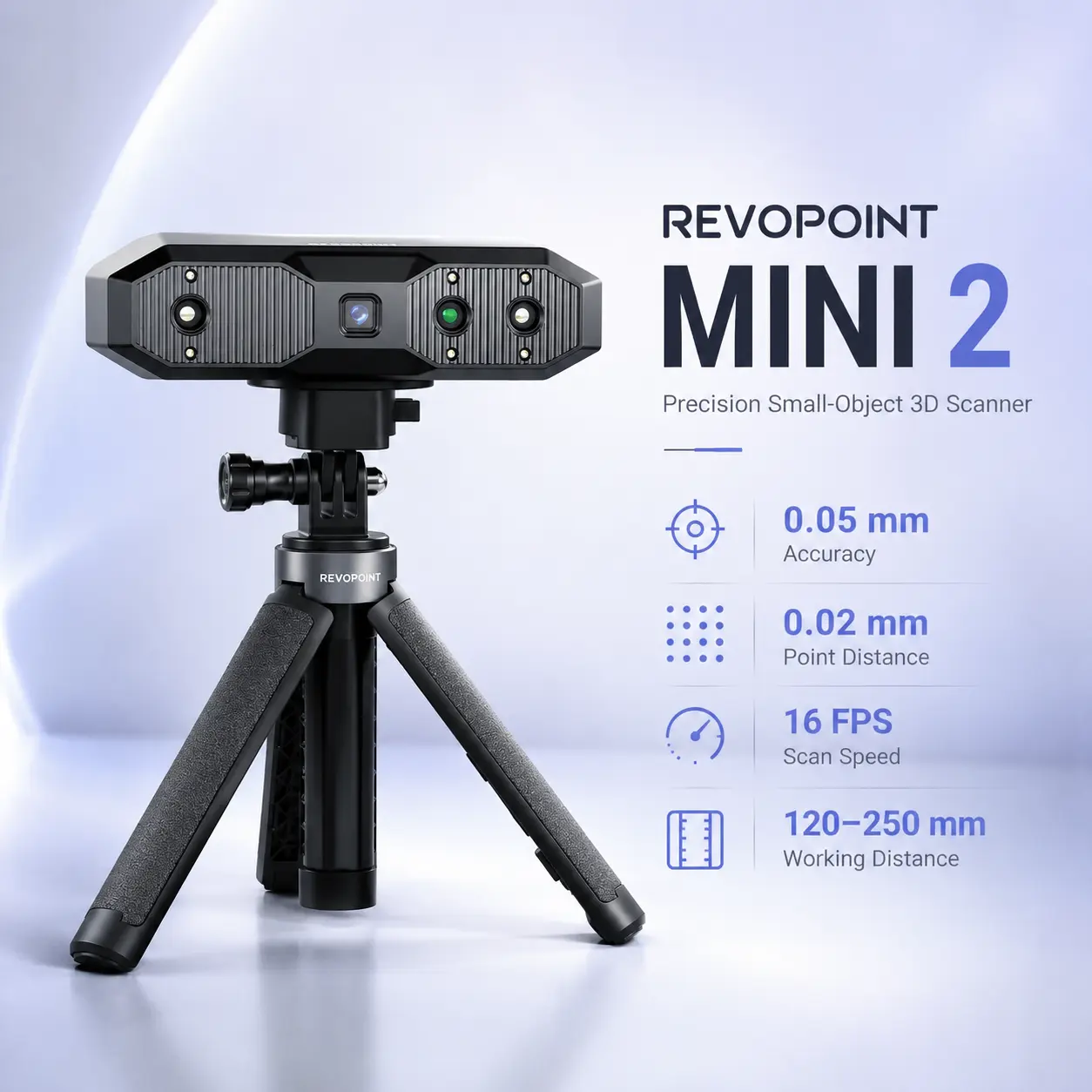
The Revopoint MINI 2 is a compact blue structured-light 3D scanner built for small objects where fine geometric detail matters more than wide-area coverage. Jewelry, miniatures, small mechanical parts, figurines, dental models, historical artifacts, and 3D-printing references are the kinds of subjects that best match its close working range and dense point capture.
Revopoint specifies up to 0.05 mm single-frame accuracy, up to 0.02 mm single-frame precision, and point distance down to 0.02 mm. These numbers describe different things: the 0.05 mm figure is the published accuracy specification, while 0.02 mm refers to repeatability/precision and fused point spacing rather than absolute accuracy.
MINI 2 uses dual-camera blue structured light, two 2 MP depth cameras, a 2 MP RGB camera, a 9-axis IMU, Wi-Fi 6, and USB Type-C connectivity. It weighs only 175 g, making it easy to use handheld, on a tripod, or with a turntable.
For current specifications and pricing, see the official Revopoint MINI 2 product page and the official MINI 2 support page.
| Specification | Value |
|---|---|
| Scanner type | Handheld / desktop |
| Technology | Dual-camera blue structured light |
| Light source | Class 1 blue light |
| Single-frame accuracy | Up to 0.05 mm |
| Single-frame precision | Up to 0.02 mm |
| Fused point distance | Up to 0.02 mm |
| Scan speed | Up to 16 FPS |
| Working distance | 120–250 mm |
| Nearest capture area | 52 × 64 mm at 120 mm |
| Furthest capture area | 168 × 132 mm at 250 mm |
| Minimum scan volume | 10 × 10 × 10 mm |
| Maximum scan volume | 0.5 × 0.5 × 0.5 m |
| Depth cameras | 2 MP |
| RGB camera | 2 MP |
| Color scanning | Yes |
| Position sensing | 9-axis IMU |
| Tracking | Feature, Marker, Global Marker |
| Wi-Fi | Wi-Fi 6 |
| Wired connection | USB Type-C |
| CPU | 2-core, 1.8 GHz |
| Scanner dimensions | 132 × 53 × 36 mm |
| Scanner weight | 175 g |
| Outdoor scanning | No |
| User recalibration | Supported |
| Software | Revo Scan |
| Output formats | PLY, OBJ, STL, ASC, 3MF, GLTF, FBX |
MINI 2's three headline detail specifications should not be treated as interchangeable.
Single-frame accuracy: up to 0.05 mm
This is Revopoint's published accuracy figure for an individual frame under controlled conditions.
Single-frame precision: up to 0.02 mm
Precision describes repeatability between measurements. A scanner can be highly repeatable without its absolute dimensional error being identical to that precision value.
Fused point distance: up to 0.02 mm
Point distance describes the spacing or density of the reconstructed point cloud. It is useful for understanding how densely small surface details can be represented.
For buyer comparisons, 0.05 mm is the appropriate headline accuracy figure, while the 0.02 mm values help explain why MINI 2 remains useful for intricate small-object work.
Revopoint notes that its precision and accuracy figures are obtained under controlled laboratory conditions, so real scans still depend on calibration, surface condition, tracking, distance, and operator technique.
MINI 2 is optimized around a close 120–250 mm working distance.
At the nearest specified distance, the capture area is approximately 52 × 64 mm. At 250 mm, it expands to 168 × 132 mm.
The manufacturer specifies a minimum scan volume of 10 × 10 × 10 mm, making the scanner a natural match for:
Skilled operators may sometimes capture useful data from geometry smaller than the nominal minimum, but the published 10 mm cube is the safer reference point for planning a workflow.
Revopoint's MINI 2 brochure specifies a maximum scan volume of approximately:
0.5 × 0.5 × 0.5 m
That does not make MINI 2 a large-object scanner in the same sense as wide-field infrared or LiDAR systems. Its relatively narrow field of view means larger subjects require many more frames and stronger tracking discipline.
For regular scanning of people, furniture, or vehicle-scale objects, a scanner with a wider field of view is generally more efficient.
MINI 2 uses a dual-camera blue structured-light system rather than blue laser lines.
Blue structured light is well suited to close-range fine-detail scanning because the projected pattern can generate a dense surface reconstruction across a relatively small field.
The tradeoff is environmental sensitivity. Revopoint explicitly lists outdoor scanning as unsupported, and strong sunlight can overwhelm the projected blue-light pattern.
Indoor scanning with controlled lighting gives the scanner the best chance of maintaining stable exposure and tracking.
Transparent, highly reflective, and very dark surfaces can be difficult for optical scanners.
Revopoint recommends scanning spray for these surfaces when necessary.
Typical problem materials include:
Matting spray reduces reflections and gives the depth cameras a more consistent surface pattern to measure.
For jewelry workflows, this is especially important because polished metals and gemstones can create difficult reflections even when the physical geometry is within the scanner's ideal size range.
MINI 2 supports three tracking approaches.
Feature tracking uses natural geometry and surface variation.
It works best on objects with enough unique shape information for consecutive frames to be matched reliably.
Reflective markers provide artificial reference points.
Markers are useful for smooth, repetitive, cylindrical, or low-feature objects where geometry alone does not provide enough tracking information.
Global Marker mode is designed for workflows using a wider marker layout around the scanning scene.
This can improve repeatability when combining multiple passes or scanning objects that are difficult to track naturally.
The built-in 9-axis IMU supplements optical tracking with motion information.
It does not replace geometric or marker tracking, but it helps Revo Scan identify sudden scanner movement and improve frame alignment during handheld operation.
The IMU is particularly useful when the operator changes angle quickly around small objects.
For maximum detail, a turntable or tripod-based setup can still be more repeatable than freehand scanning.
MINI 2 includes a 2 MP RGB camera for color texture capture.
White flash LEDs provide additional illumination so the camera can record more even surface color in controlled indoor environments.
Color capture is useful for:
For dimensional reverse engineering, geometry quality usually matters more than texture resolution, but having native color capture expands the scanner beyond purely mechanical work.
MINI 2 supports both wireless and wired workflows.
Wi-Fi 6 is useful for mobile scanning where cable movement would interfere with positioning.
USB Type-C provides a direct connection to compatible computers and supported Android devices.
The scanner itself is powered through its USB connection or a compatible power source such as Revopoint's mobile power accessories; it does not contain a large standalone battery or onboard display.
MINI 2 uses Revo Scan for capture and post-processing.
The software supports:
Revopoint lists compatibility with:
System requirements can change as Revo Scan evolves, so the current Revopoint support page is the best reference for workstation and mobile compatibility.
MINI 2 supports:
STL and 3MF are particularly useful for downstream 3D-printing workflows, while OBJ, GLTF, and FBX are useful when texture or digital-content workflows matter.
PLY and ASC are useful when point-cloud or geometry-processing workflows are required.
| Scanner | Technology | Accuracy | Detail / Precision | Max Speed | Best Fit |
|---|---|---|---|---|---|
| Revopoint MINI 2 | Blue structured light | 0.05 mm | 0.02 mm precision / point distance | 16 FPS | Jewelry and detailed small objects |
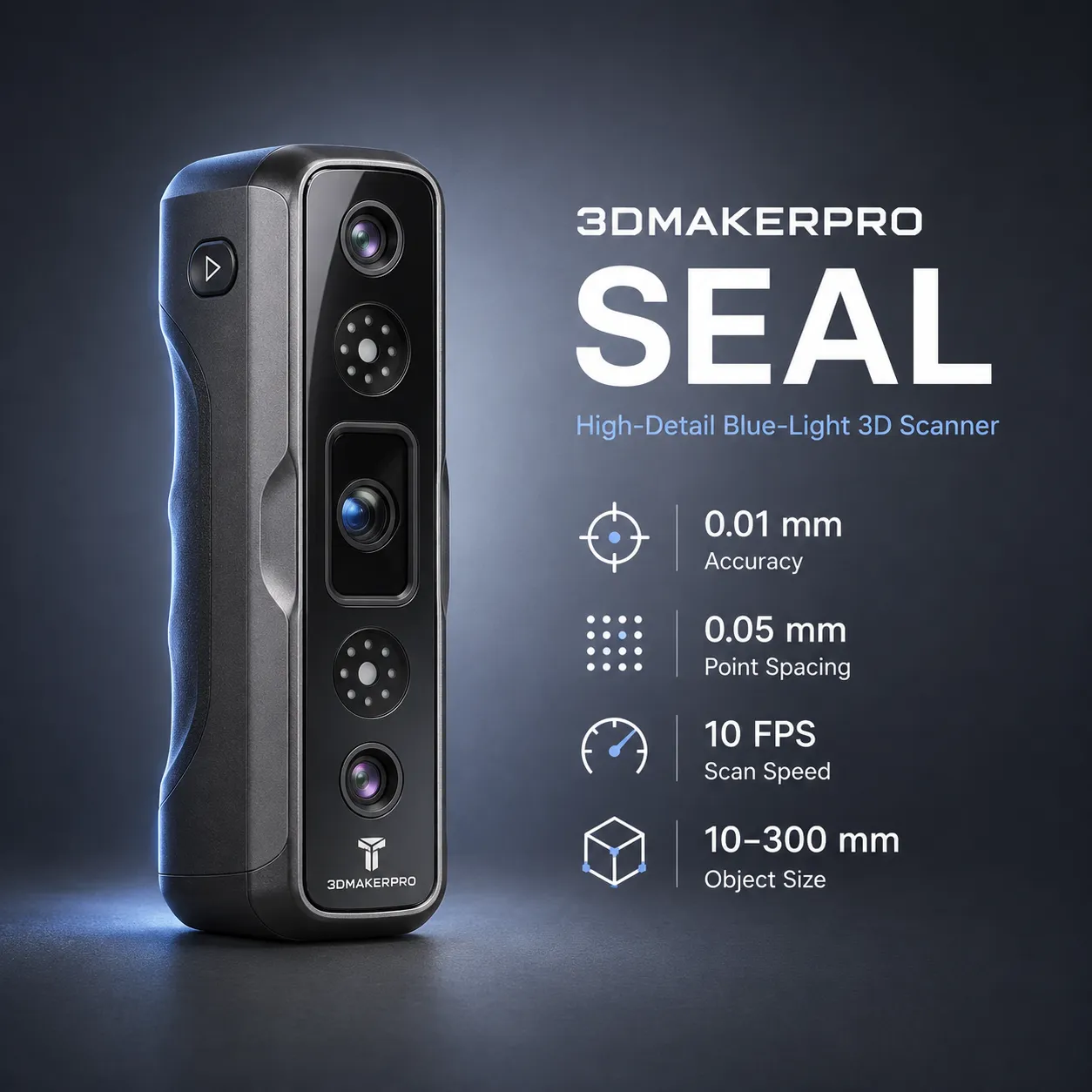
| 3DMakerpro Seal | Blue structured light | 0.01 mm | 0.05 mm resolution | 10 FPS | Jewelry, miniatures, very small details |
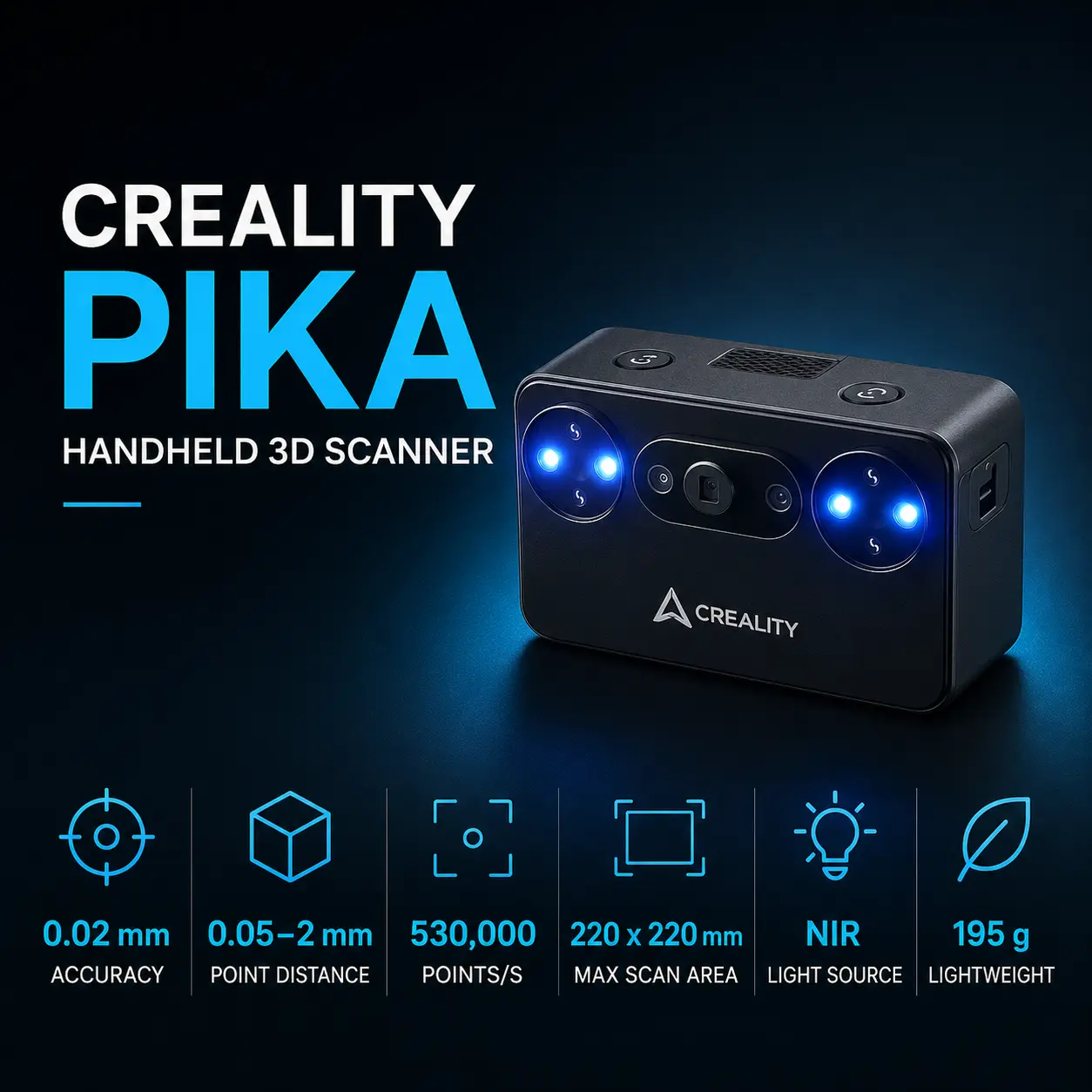
| Creality Pika | 7-line blue laser + NIR | 0.03 mm laser | 0.1 mm laser resolution | 110 FPS PC laser | Portable small-to-large hybrid scanning |
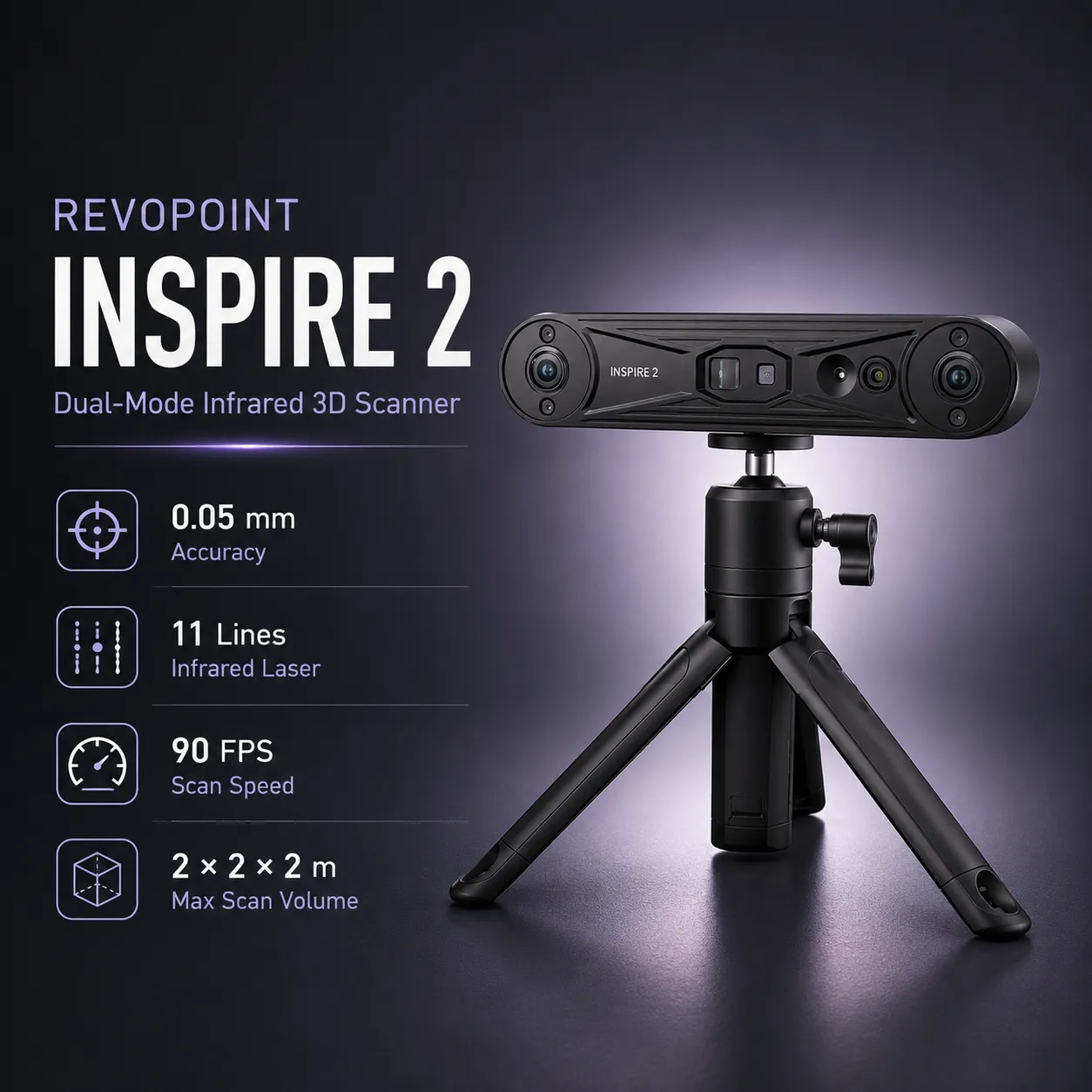
| Revopoint INSPIRE 2 | Infrared laser + structured light | 0.05 mm | 0.03 mm precision | 90 FPS laser | Small-to-medium objects and outdoor flexibility |
The comparison table shows why nominal accuracy is only part of the decision. MINI 2 emphasizes dense close-range structured-light capture, Seal prioritizes very small-object detail, Pika adds portable hybrid laser/NIR scanning, and INSPIRE 2 covers a wider range of small-to-medium subjects with infrared modes.
The Revopoint MINI 2 vs 3DMakerpro Seal comparison is particularly relevant for jewelry, miniature, and small-part scanning.
The 3DMakerpro Seal publishes a stronger nominal 0.01 mm accuracy figure and 0.05 mm resolution, with a 180–280 mm working distance and up to 10 FPS scanning.
MINI 2 instead offers:
Choose Seal when the smallest published accuracy number is the main priority and its workflow fits the object. Choose MINI 2 when wireless scanning, faster frame rate, flexible tracking, and the Revopoint software ecosystem matter more.
The Revopoint MINI 2 vs Creality Pika comparison separates a dedicated small-object structured-light scanner from a portable hybrid scanner.
The Creality Pika combines 7 parallel blue laser lines and NIR structured light, with up to 0.03 mm laser accuracy and blue-laser speeds reaching 110 FPS on a PC.
Pika is better suited when you want:
MINI 2 is more specialized around close-range small objects, 0.02 mm point spacing, turntable workflows, and compact indoor scanning.
For jewelry and miniatures, MINI 2 remains the more purpose-built option. For a wider range of object sizes, Pika is the more versatile scanner.
The MINI 2 vs INSPIRE 2 comparison is useful for buyers choosing between Revopoint's detail-first blue-light workflow and a broader infrared scanner.
The Revopoint INSPIRE 2 uses 11 parallel infrared laser lines plus infrared structured light.
Both publish up to 0.05 mm single-frame accuracy, but their priorities differ.
MINI 2 offers:
INSPIRE 2 offers:
Choose MINI 2 for compact, detail-heavy subjects. Choose INSPIRE 2 when speed, outdoor flexibility, and a wider object-size range are more important.
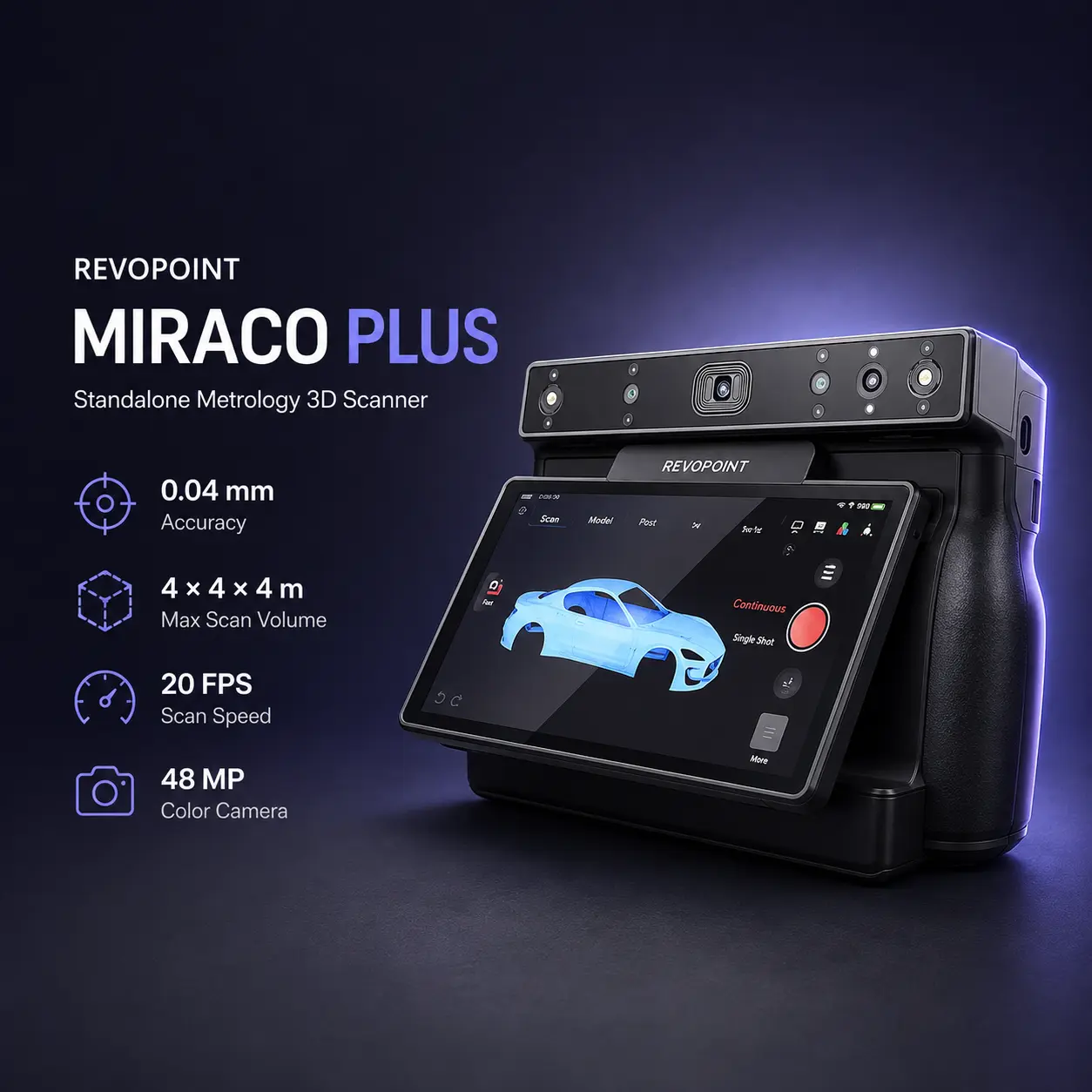
For engineering users considering a more advanced Revopoint scanner, the Revopoint MetroX Pro sits well above MINI 2 in laser versatility and reverse-engineering capability.
MINI 2 is the better fit when:
MetroX Pro is the stronger choice when blue-laser scanning, demanding engineering surfaces, higher-end reverse engineering, and broader professional workflows justify the extra cost.
The best Revopoint MINI 2 alternative depends on what limitation you are trying to solve.
For broader buying guidance, see Best 3D Scanners for Reverse Engineering in 2026 and 3D Scanner Accuracy vs Resolution.
Revopoint lists the MINI 2 Standard Edition from US$705.
Approximate regional equivalents: North America: US$705 / C$978 · Europe: €609 / £521 · Middle East: AED 2,589 · Australia: A$996 · India: ₹67,293.
The scanner is available through Revopoint and regional sales channels worldwide. Final pricing varies by region, taxes, import duties, shipping, accessories, and promotions. Currency conversions are approximate.
Recommended use: Choose Revopoint MINI 2 when your work centers on jewelry, miniatures, small mechanical parts, or other indoor objects where close-range detail and dense point spacing matter more than large-object coverage or outdoor scanning.
Dual-camera blue structured light.
Revopoint specifies up to 0.05 mm single-frame accuracy.
Revopoint uses 0.02 mm for single-frame precision and fused point distance, not the published absolute accuracy.
Up to 16 FPS.
120–250 mm.
About 52 × 64 mm at 120 mm and up to 168 × 132 mm at 250 mm.
10 × 10 × 10 mm.
Revopoint's brochure specifies up to 0.5 × 0.5 × 0.5 m.
Yes. Its close working range, dense point spacing, and small minimum scan volume make jewelry a strong use case.
Yes. It includes a 2 MP RGB camera and white flash LEDs for texture capture.
Yes. It supports Wi-Fi 6.
Not for every object. Feature, Marker, and Global Marker tracking are available.
No. Revopoint lists outdoor scanning as unsupported.
Revo Scan.
PLY, OBJ, STL, ASC, 3MF, GLTF, and FBX.