Filtered Enclosed CoreXYHEPA and Carbon FiltrationHigh Speed Desktop PrintingCamera-Monitored 3D PrintingAutomatic Leveling WorkflowQuick-Swap Nozzle System
FFlashforge
Flashforge
# Flashforge Adventurer 5M Pro
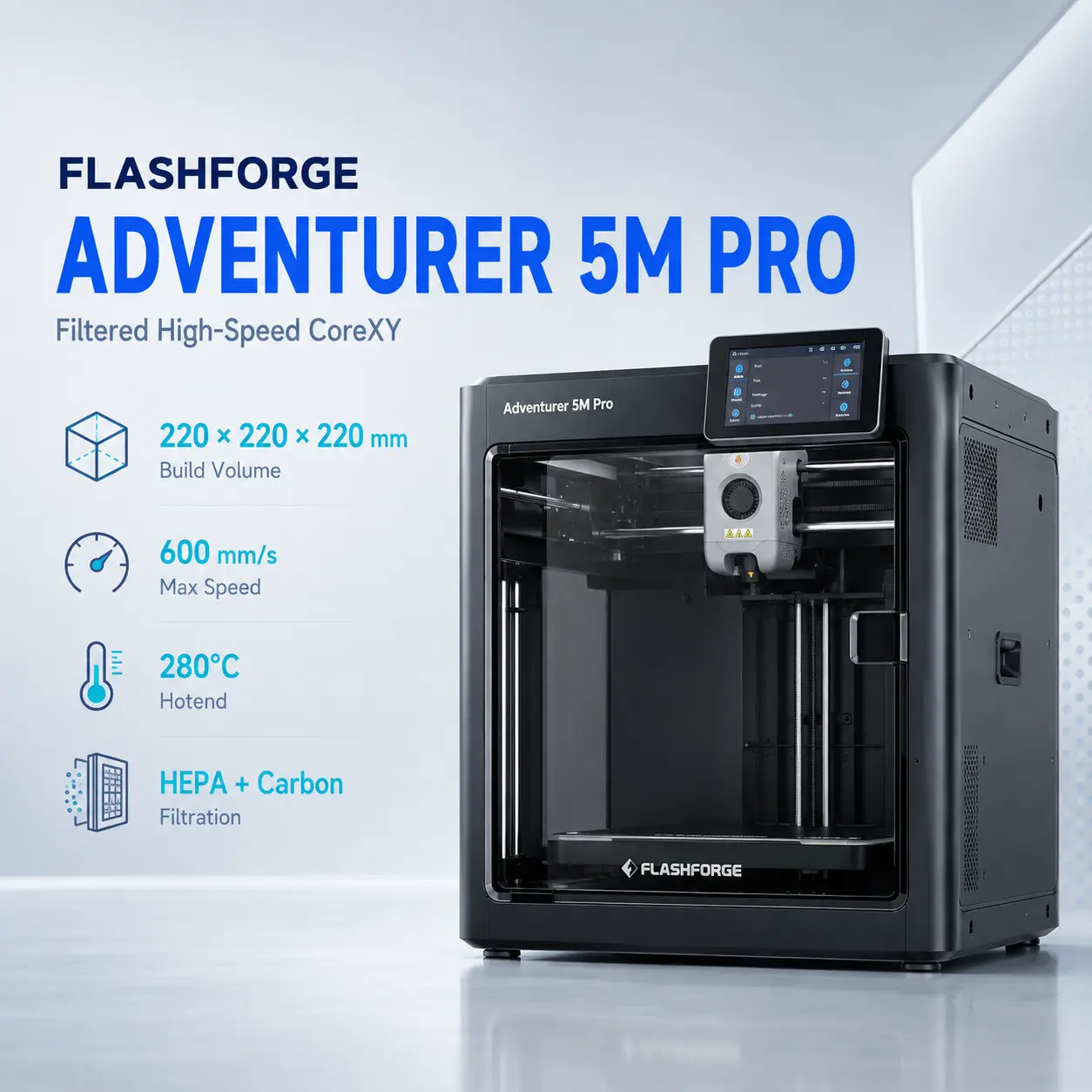
Flashforge Adventurer 5M Pro is an enclosed CoreXY FDM 3D printer for home users, classrooms, makerspaces, and desktop prototyping. It combines a 220 × 220 × 220 mm build volume with automatic leveling, a built-in camera, quick-swap nozzles, and HEPA plus activated-carbon filtration.
Flashforge's current user documentation distinguishes between printing speed of 10–300 mm/s and maximum travel speed of 600 mm/s. The product page still markets the machine with a 600 mm/s headline, but its specification table also labels 600 mm/s as travel speed. For the structured `maxPrintSpeedMmS` field, this listing therefore uses 300 mm/s rather than presenting travel speed as extrusion speed.
The hotend reaches 280°C and supports 0.25, 0.4, 0.6, and 0.8 mm quick-release nozzle assemblies. Flashforge lists PLA and PETG with the 0.4 mm nozzle, ABS and ASA as supported materials, and TPU, PLA-CF, and PETG-CF with 0.6 or 0.8 mm nozzles.
The Pro model's key advantages over the standard Adventurer 5M are its enclosed shell, internal/external air circulation, dual filtration, quieter operating modes, and built-in camera.
For current pricing and specifications, see the official Flashforge Adventurer 5M Pro page. For setup and the detailed parameter table, see the official Adventurer 5M Pro user guide.
| Specification | Value |
|---|---|
| Printing technology | FDM / FFF |
| Motion system | CoreXY |
| Build volume | 220 × 220 × 220 mm |
| Layer thickness | 0.10–0.40 mm |
| Documented printing speed | 10–300 mm/s |
| Maximum travel speed | 600 mm/s |
| Maximum acceleration | 20,000 mm/s² |
| Maximum published nozzle flow | 32 mm³/s |
| Standard nozzle | 0.4 mm |
| Optional nozzle sizes | 0.25, 0.6, 0.8 mm |
| Maximum nozzle temperature | 280°C |
| Maximum bed temperature | 100°C on current US product page |
| Chamber | Fully enclosed |
| Active chamber heating | No |
| Extruder | Direct drive |
| Build surface | Flexible removable PEI steel plate |
| Bed leveling | Automatic |
| Display | 4.3-inch touchscreen |
| Camera | Built in |
| Filtration | HEPA + activated carbon |
| Airflow modes | Internal and external circulation |
| Noise | 50 dB low-noise mode; 55 dB standard mode |
| Connectivity | Wi-Fi, Ethernet, USB |
| Power input | AC 100–120 / 200–240 V, 50/60 Hz |
| Rated power | 350 W |
| Dimensions | 380 × 400 × 453 mm excluding spool holder |
| Net weight | 14.6 kg in current user documentation |
| Slicers | Orca-Flashforge, OrcaSlicer, FlashPrint 5 |
The Adventurer 5M Pro uses a metal CoreXY motion platform designed to reduce moving mass and support faster travel.
Flashforge publishes:
Travel speed describes non-extruding moves, while printing speed applies when material is being deposited. Actual throughput also depends on nozzle size, layer height, filament, extrusion temperature, cooling, and surface-quality requirements.
For most real jobs, the 32 mm³/s flow figure and 10–300 mm/s print range are more useful than the 600 mm/s travel headline.
The Adventurer 5M Pro uses replaceable nozzle assemblies that can be removed without fully disassembling the hotend.
Flashforge offers:
Current AD5M-series nozzle assemblies are rated up to 280°C.
The 0.4 mm nozzle is the general-purpose default. Larger 0.6 and 0.8 mm nozzles are especially relevant for higher-flow, flexible, or filled-material printing.
Flashforge's current nozzle documentation specifically highlights the 0.6 and 0.8 mm assemblies for more abrasive materials such as carbon-fiber-filled filaments.
Flashforge currently lists the following materials for the Adventurer 5M Pro:
This nozzle-specific guidance is important. The printer's 280°C temperature ceiling does not mean every material should be run through every nozzle size.
For indexed filament comparisons:
The Adventurer 5M Pro is best viewed as a capable desktop materials platform rather than a high-temperature industrial polymer printer.
The Pro version's enclosed shell is one of its most useful practical upgrades.
It combines:
Internal circulation retains more heat inside the enclosure and is intended for materials such as ABS. External circulation brings in cooler air and exhausts filtered air, which is more appropriate for materials such as PLA and PETG.
The chamber is not actively heated, so `hasHeatedChamber` remains `false`.
For users who need controlled chamber heat for more demanding materials, the Bambu Lab H2D represents a higher-temperature engineering category.
Flashforge uses a combined HEPA and activated-carbon filtration system.
The manufacturer markets the system as reducing particulate and VOC exposure during indoor printing.
That makes the Adventurer 5M Pro more practical than an open-frame printer for classrooms, homes, and shared workspaces.
Filtration should still be treated as a risk-reduction feature rather than a substitute for suitable room ventilation, particularly when printing ABS, ASA, or other higher-emission materials.
The Adventurer 5M Pro uses one-click automatic leveling.
This reduces manual adjustment and helps make first-layer setup more repeatable.
Automatic leveling works best when paired with:
It simplifies setup, but does not remove the need for routine maintenance.
Flashforge supplies a flexible removable PEI steel plate.
The official product and user documentation identify the build surface, but they do not separately publish the physical X/Y dimensions of the removable plate. The catalog therefore leaves `buildPlateX` and `buildPlateY` empty rather than copying the 220 × 220 mm printable area.
The built-in camera supports:
FlashMaker can be used for remote printer management and monitoring, while Orca-Flashforge provides desktop slicing and network-print workflows.
The camera is useful for checking long jobs, but it is not presented as an AI failure-detection system.
The Adventurer 5M Pro includes a filament runout sensor.
If filament runs out, the printer can pause instead of continuing an empty toolpath.
Power-loss recovery is also supported, allowing interrupted jobs to resume after an outage when conditions permit.
Automatic shutdown is another standard feature.
Flashforge lists:
The printer works with:
FlashMaker adds mobile monitoring and management.
Ethernet is useful in schools, labs, and workshops where wired local-network connectivity is preferred.
Flashforge currently lists:
Noise varies with print speed, fan behavior, model geometry, surface, and room acoustics.
The enclosed structure can reduce perceived mechanical noise, but the machine is not silent.
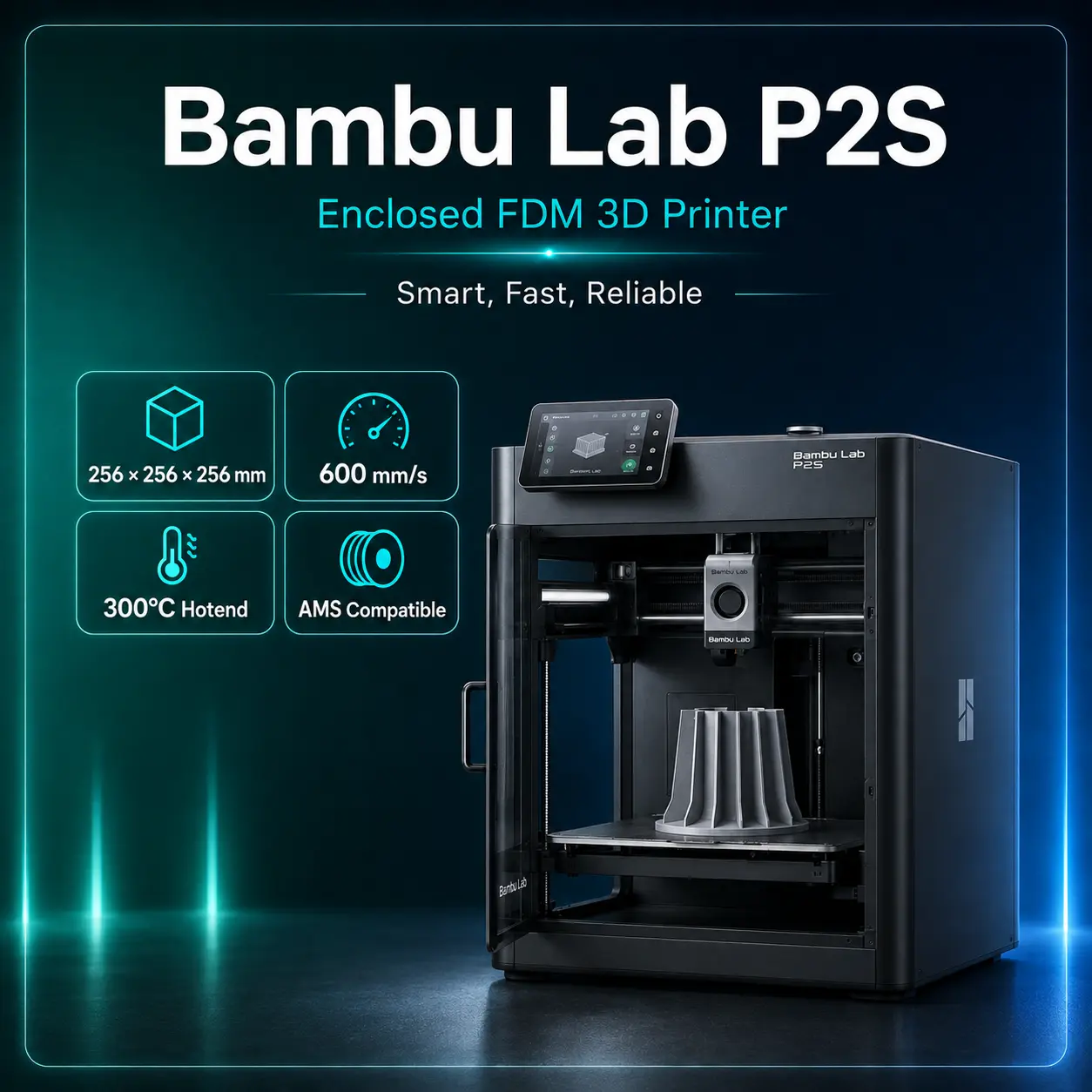
The Bambu Lab P2S is a relevant indexed alternative for users comparing compact enclosed desktop printers.
The Adventurer 5M Pro emphasizes:
The P2S offers a different automation and multi-material ecosystem.
For broader home-printer comparisons, see Best 3D Printers for Home Use.
Price and Availability
Flashforge’s current US product page lists the Adventurer 5M Pro for US$599. The estimated equivalent prices are approximately €518 in the Eurozone, £443 in the UK, C$831 in Canada, A$848 in Australia, AED 2,200 in the UAE, and ₹57,175 in India.
Recommended use: Choose the Flashforge Adventurer 5M Pro when you want an enclosed, filtered desktop printer with straightforward automatic leveling, Ethernet/Wi-Fi connectivity, quick-swap nozzles, and support for common engineering materials without moving to a larger actively heated-chamber machine.
220 × 220 × 220 mm.
Flashforge marketing uses a 600 mm/s headline, but its user guide lists 10–300 mm/s printing speed and 600 mm/s maximum travel speed.
280°C.
A 0.4 mm quick-release nozzle.
0.25, 0.6, and 0.8 mm.
PLA, PETG, ABS, ASA, TPU, PLA-CF, and PETG-CF, with nozzle-size guidance depending on the material.
No. It is fully enclosed and uses internal/external air circulation but does not have a dedicated chamber heater.
Yes. It uses HEPA and activated-carbon filtration.
Yes. The built-in camera supports remote monitoring and time-lapse recording.
Yes. Flashforge lists Wi-Fi, Ethernet, and USB connectivity.
Flashforge's user guide lists 0.10–0.40 mm.
The current price is from US$599, and the estimated equivalent prices are approximately €518 in the Eurozone, £443 in the UK, C$831 in Canada, A$848 in Australia, AED 2,200 in the UAE, and ₹57,175 in India.
Yes. Flashforge's website lists the printer for purchase.